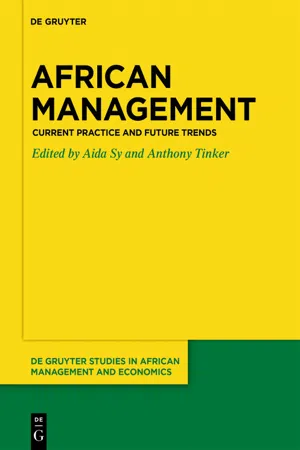
The De Gruyter Studies in African Management and Economics series is intended to encourage research in these fields and to begin to offer workable solutions to the problems that Africa faces. It aims to inspire Africa's scholars, thinkers, writers, academicians and practitioners who want their research to be published and used in a way that will benefit the continent's development.
This book series will cover a range of topics relevant to management, economics and organizational research in Africa. What types of management practices would best boost the efficiency of both foreign and domestic organizations in Africa? For example, in the development and management of infrastructure, what should be the role of private-public partnerships?
As a region, Africa cannot succeed without building robust systems of political institutions and environmental networks. The environmental impacts of increased economic growth are clear through the experiences of other economic regions.
1 Introduction: Understanding African Management and Economics through History
AidaSy
Farmingdale State College, State University of New York, Business Management Department, School of Business, USA
Anthony MaxwellTinker
Baruch College City, University of New York, USA
De Gruyter Studies in African Management and Economics has been launched to bring together researchers, writers, thinkers, academicians to contribute to finding solutions to the issues that concern Africa. De Gruyter, thus, is publishing this inaugural volume with a various list of contributors and high-quality texts. But before the editors give an introduction of these papers, it is very important to go back to African history, for it is hard for anyone to understand African issues and challenges without understanding its history.
The economic situation in Africa has changed over the centuries. During and after the colonial period, the continent did show steady economic progress until recent decades. This has led to a reduced evolution toward economic development. Before the colonial period, Africa saw the development and making of huge kingdoms and empires.
The continent witnessed the slave trade. As Cheikh Anta Diop put it, the making of many states was stopped by the institution of the slave trade. Therefore, Africa could have formed more empires and kingdoms (see Cheikh Anta Diop’s writings, “Precolonial Black Africa”, 1960; “The African Origin of Civilization: Myth or Reality”, 1974; “Black Africa: The Economic and Cultural Basis for a Federated State”, 1978; “Civilization or Barbarism”, 1981). Aida Sy, in her PhD thesis at the Sorbonne, counted that for each slave who arrived at a given destination (e.g., Europe or America), six slaves perished during their journeys. This is important, as researchers before Sy only calculated the number of slaves who reached the two continents.
The great African empires and kingdoms were, but are not limited to, the Nubian, Ethiopian, Egyptian, Libyan, Zimbabwean; as well as the kingdoms of Mossi, Ghana and Zimbabwe; and the empires of Mali, Songhay, Kanem-Bornu, Hausa, Mutapa, Kongo and Benin.
Africa built big economies based on trade and constructions (Figures 1.2–1.4). The Nubians and the Egyptians made economies based on huge constructions; the Empire of Ghana traded in gold and other goods. The following goods were traded in Africa: gold, salt, copper, millet, sorghum, cotton, rice, kola nuts, sesame seeds, cow peas, okra, pumpkins, watermelon, mangos, Shea nuts, cloths, diamonds, silvers, spices, fruits, vegetables, potatoes, drinks, cows, lambs, goats, camels, donkeys, horses, poultry, birds, pots, meat, baskets, made tools, jewelry, make-up, ornaments, shoes, drugs, stone, wood, sun-dried fruits, vegetables, fish, salves, weapons and iron. The Empire of Mali mined gold from its mines which, by the end of the 1200s, was the source of more than 50% of the Old World’s gold supply. Mansa Musa ruled the Empire of Mali and was the richest man in the world by today’s standards.
The system of management used can be described as follows: first, accounting and auditing were very important; second, the system of management was based on key elements, such as knowledge of mathematics, good memory, possession of ethical values, knowledge of the laws, etc. Each empire had several cities and those cities were involved in trade as well. The management was organized around a very hierarchical system: in the Empire of Ghana, for instance, the Minister of Finances worked with a cabinet that assisted him in his task to ensure that the system of accounting and management worked perfectly. His cabinet included private accountants and senior managers. Accountants would commit suicide in the event of accounting failure (do not tell ENRON!)
The general accountant or top manager worked directly with the emperor. Each city had a governor; however, in order to ensure that law and order were respected in the empire, the emperor ruled his court. The African system was a mix of a centralized and decentralized system. The governor ruled the court only in case of disease of the emperor. Judges’ rules consisted of gathering information and introducing the belligerents. The language of Mandinka was one of the few African languages with its own alphabet. Note that there are 4,000 languages in ancient Africa. The general accountant collected taxes for the emperor. His was also the executioner.
During the colonial period, taxation was a huge source of conflict between African leaders and the European colonial administrators.
During the 1800s, the continent was divided following a new political map that showed huge fights over taxation. The year 1885 is known as the year of the Berlin Conference, where the new map depicted a lot of ill-defined borders throughout the continent because the “Scramble for Africa, the partitioning of Africa by the European powers has not yet really begun. Depicted on the map [see Figure 1.1] is the African continent at the end of the 19th century, in the then prevailing opinion that the last white spots of terra incognita have almost vanished from the maps of the Black Continent” (nationsonline, 2019):
Source: John Bartholomew provided by nationsonline.org
Figure 1.1: Political Map, Huge Fights Over Taxation.
(1855) Victoria Falls discovered by David Livingstone
(1858) Lake Victoria discovered by John Speke
(1859–1869) The Suez Canal is built in Egypt
(1860s) End of Atlantic slave trade
(1867) Diamonds discovered at Hope Creek
(1870s) Zulu Wars fought against Great Britain
(1882) Egypt and Sudan occupied by Britain
(1884) Namibia, Tanzania, Togo and Cameroon taken over by Germany; Mahdi leads an uprising in Sudan against British
(1885) First railroad and telegraph line opened from Kimberley to Cape Town
(1886) Gold discovered in Transvaal; Kenya established as British colony
This inaugural volume is publishing texts that deal with finance, financial management, theories, management and control, accounting, accountability and organizations.
Effects of Financial Innovations on Volume Traded at the Nairobi Securities Exchange by James Agwata and Liza Wainaina is a chapter that deals with the examination of the effect of the introduction of financial innovations on volumes trades on the Nairobi Securities Exchange.
Financial Inclusion and Financial System Stability in Nigeria by Barine Michael Nwidobie, investigates the connections between financial inclusion and financial stability in Nigeria. The author argues that the system is stable in Nigeria, but cautions that platforms exist to improve matters of financial inclusion.
Financial Management: A General Theory for Africa – the Finance Director’s Role in the Formulation and Implementation of Strategy by Aida Sy and Anthony Maxwell Tinker, is another chapter whose general thesis is that the finance manager should construct some conceptual framework in order to provide suggestions for effective financial decision-making, policies and actions. The chapter discusses the previous theories in financial management.
The Role of Transparency, Internal Control and Risk Management in Corporate Governance: The Case of Nigeria is written by Olatunde Julius Otusanya. Otusanya examines the contribution that audit function makes to corporate governance. The chapter further deals with the role of disclosure in corporate governance and considers the importance of a company’s system of internal control, risk management and the audit function in relation to corporate governance.
Management Control and Performance Management in Public Hospitals: a Case Study of Cameroon by Donatien Avelé, is concerned with costs, management and control in public hospitals. The author uses a case study approach. It shows the importance of cost analysis and performance management where budgeting is crucial.
Charities’ Accountability – Financial and Non-financial Reporting Disclosures by Mary Low, Daniel Farrell, Umesh Sharma, investigates charitable organizations and the role of accounting and accountability. These authors use charities that are publicly available through annual reports, and the framework for reviewing financial reporting compliance in New Zealand, to conduct their research.
Accounting for Humanity in Business Organizations by Bruce Committe, is a chapter that aims to go beyond the numbers by linking accounting and organizations to a more humanitarian aspect. Bruce Committe argues that companies should publish a humanities accounting report along with their financial statement reports.
National Monitoring and Evaluation Systems as a Hybrid Order and Economic Growth by Solomon Samanhyia and Dadson Awunyo-Vitor, investigates the importance of monitoring and evaluating the systems of economic growth in the context of Ghana. This chapter examines the correlation between the quality of the M&E system in Ghana and growth.
Evaluation of the Impact of Crop Rotation on Maize Yields in Burkina Faso by Tiatité Noufe, Adama Nikiema, Hamidou Konkobo, treats the decline of soil fertility and attempts to find a solution to this environmental problem by examining crop rotation in Burkina Faso. The authors use matched group methodology to conduct their research.
Figure 1.2: Nubian Empire.
Figure 1.3: Egyptian Sphinx.
Figure 1.4: Emperor of Mali – Mansa Musa.
Table of contents
Title Page
Copyright
Contents
1 Introduction: Understanding African Management and Economics through History
Part I: Finance, Financial Management and Theories
Part II: Management and Control
Part III: Accounting, Accountability and Case Studies
Abbreviations
Trusted by 375,005 students
Access to over 1.5 million titles for a fair monthly price.
Study more efficiently using our study tools.
Frequently asked questions
Yes, you can cancel anytime from the Subscription tab in your account settings on the Perlego website. Your subscription will stay active until the end of your current billing period. Learn how to cancel your subscription
No, books cannot be downloaded as external files, such as PDFs, for use outside of Perlego. However, you can download books within the Perlego app for offline reading on mobile or tablet. Learn how to download books offline
Perlego offers two plans: Essential and Complete
Essential is ideal for learners and professionals who enjoy exploring a wide range of subjects. Access the Essential Library with 800,000+ trusted titles and best-sellers across business, personal growth, and the humanities. Includes unlimited reading time and Standard Read Aloud voice.
Complete: Perfect for advanced learners and researchers needing full, unrestricted access. Unlock 1.5M+ books across hundreds of subjects, including academic and specialized titles. The Complete Plan also includes advanced features like Premium Read Aloud and Research Assistant.
Both plans are available with monthly, semester, or annual billing cycles.
We are an online textbook subscription service, where you can get access to an entire online library for less than the price of a single book per month. With over 1.5 million books across 990+ topics, we’ve got you covered! Learn about our mission
Look out for the read-aloud symbol on your next book to see if you can listen to it. The read-aloud tool reads text aloud for you, highlighting the text as it is being read. You can pause it, speed it up and slow it down. Learn more about Read Aloud
Yes! You can use the Perlego app on both iOS and Android devices to read anytime, anywhere — even offline. Perfect for commutes or when you’re on the go. Please note we cannot support devices running on iOS 13 and Android 7 or earlier. Learn more about using the app
Yes, you can access African Management by Aida Sy, Anthony Tinker, Aida Sy,Anthony Tinker in PDF and/or ePUB format, as well as other popular books in Business & Business General. We have over 1.5 million books available in our catalogue for you to explore.