Blockchain and artificial intelligence are perhaps the two most significant disruptive technologies this century and both will significantly rewire the world of global financial markets and the world in which we live. While blockchain offers a number of significant advantages over traditional forms of finance including lower cost and massive increases in operational efficiencies of traded markets, property records and a whole host of transaction processes, artificial intelligence is moving fast from basic structured machine learning doing menial yet important big data tasks like credit card fraud detection to predictive analysis and real-time real-world risk management and investment decision making.
There is still a lot of confusion in the market about cryptocurrencies, bitcoin and the underlying blockchain technology. Blockchain and Artificial Intelligence highlights the underlying technologies of blockchain and the differences between cryptocurrencies and blockchain financial applications. It explores the current AI offerings and gives a vision of the fast-moving developments in this area including the many solutions that are expected to revolutionize the way financial and commodity markets will operate in the future.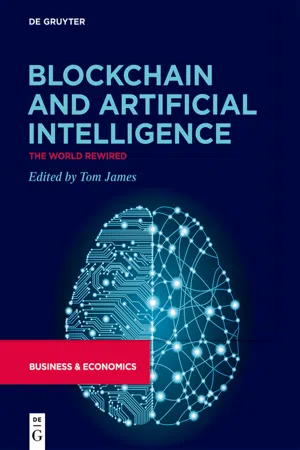
- 264 pages
- English
- ePUB (mobile friendly)
- Available on iOS & Android
eBook - ePub
About this book
Information
Topic
Negocios y empresaSubtopic
Comercio electrónicoChapter 1 Marketing
Tom James
Artificial Intelligence
Artificial intelligence (AI) frameworks continually take a shot at the foundations of famous items and services like Netflix, Amazon, and Google. As great as these disruptions have been, recent years have seen in a brief time AI clearing an even more profound path into promoting and helping brands improve each progression of the client’s venture. As business and technological innovations in AI have gained wider adoption, instruments accessible only once to big business organizations have now opened the door to small- and medium-sized organizations.
Imaginative ideas of an engineered cognizance created by people – a wild development along the lines of science fiction motion pictures – are probably not going to be realized soon. Current AI, though simpler than a sci-fi sapience, are no less disruptive to the world. Today’s AI are frameworks capable of performing assignments that would otherwise regularly require human intelligence and oversight. Capable of incorporating aspects of critical thinking, perceiving feelings, playing complex strategy games, and even diagnosing diseases, AI are increasingly matching or surpassing their human counterparts. One only needs to participate in an AI showcasing arrangement to illustrate how much the gap between information science and execution is vanishing.
What is AI in Marketing?
Artificial intelligence marketing (AIM) is a technique for utilizing client information and AI innovations like machine learning to predict your best course of action.
Computer-based intelligence in promoting is the utilization of client information, AI, and other computational ideas to anticipate an individual’s activity or inaction. It can take on colossal quantities of information and help advertisers effectively portion them into processable categories. After all relevant information is considered, advertisers can further organize information groupings to make modified content for their crowds. With AI, organizations can make incredibly well-informed promotion strategies to focus on the correct potential clients. This will enable computerized advertisers to take care of clients with the correct content on the correct channel at the correct time.
Why is AIM Important?
AI is leaving an enormous impression in advanced marketing. An investigation by Smart Insights shows that out of 100 senior advertisers from various enterprises, 55% of organizations are executing or previously considering utilizing AI in their marketing.
AIM is a practice that allows advertisers to crunch tremendous quantities of marketing information during investigations of internet-based life, messages, and the wider web. Additionally, shorter time periods spent on data collection and processing assists advertisers with boosting effort execution and return on investment (ROI). This gives advertisers and organizations more opportunity to concentrate on other significant assignments.
This is practiced by utilizing big data analytics, machine learning, and different procedures to pick up knowledge and insight into intended interest groups. With these parcels of knowledge, you can make increasingly powerful client contact focuses. Regardless of whether you are participating in email marketing or providing client service, AI takes out a significant part of the mystery associated with client interactions.
AIM will help content advertisers comprehend who precisely their intended interest group is, and accordingly make an individual encounter personalized for clients. On a grander scale, it very well may be utilized to automate forms that were once subject to people. Content generation, PPC promotions, and even website design are all potential applications for AI marketing. It is easy to see why AI will continue to grow in significance beyond 2021.
How to Use AI for Marketing
AI has increasingly been integrated into every industry with benefits not just limited to decreasing human intercession in complex and simple tasks. Usage of AI has concurrently led to an increase in the quality of productive output, by helping people carry out their responsibilities better, with less effort. As such, fields like social media, consumer electronics, robotics, travel and transportation, finance, healthcare, security, surveillance, e-trade, etc., today are already profiting by means of AI.
A good example of where we might see the dynamic benefits of AI is in the creation of a website. Ordinarily, building up a site without at least some expertise in HTML, CSS, and JavaScript is inconceivable for a business. Be that as it may, AI has made it conceivable. Well-known web designers like Wix utilize AI to construct sites. The only human interaction required is in providing the substance, pictures, and page format. Then your expertly crafted site is good to go. Such benefits in skill and efficiency form the new normal in digital marketing.
Digital Marketing
Digital marketing and AI are intrinsically linked. In computerized marketing, there is an imperative to process huge quantities of information. AI encourages computerized advertisers to process information faster, which provides them with the free time and attention to make advanced methodologies more effectively.
Online advertising is one of the most significant components of computerized marketing. It encourages organizations to contact their intended interest group as quickly as possible. A larger part of online promotions we see today are controlled by a muddled conveyance framework fueled by AI, which is classified as “programmatic advertising.” The program encourages the purchasing and selling of advertisement spaces. It conducts barters where these advertisement spaces are sold and purchased in timespans measured in fractions of milliseconds.
“Personalization is the new cool.” According to Evergage, 96% of advertisers concur that personalization is the way to convey an awesome client experience. AI has made it conceivable to make sense of the preferences, standards of conduct, interests, and exercises of a huge number of individuals consistently. It does so by gathering and breaking down client information while considering factors including (but not limited to) physiography, socioeconomics, gadgets, and geography. The greater the personalization, the greater the odds of change.
AI helps achieve this personalization by doing the math and examining information, two tasks in which AI frameworks are exceptionally proficient. Computer-based intelligence utilizes measurable models and programming to foresee a client’s future activities by considering their past conduct and attributes. Along these lines, AI encourages advertisers to find out about their clients, for example, finding out what cost do they expect for a specific item. In view of the information, likewise, AI can anticipate what sort of highlights clients expect in the item update. Advertisers can use this information to make slogans and run battles with the end goal of pulling in more clients and expanding the odds of transformation.
Right now, in the era of auto-created messages, individuals are anticipating customized/personalized messages that are pertinent and personally appealing to them. Computer-based intelligence can assist you with sending a modified email for your email marketing efforts by examining client conduct and inclinations. Simulated intelligence dissects many gigabytes of information to identify the correct title and headline that will catch a client’s eye. Likewise, it can locate the correct time, day, and recurrence to send the email, which further raises the odds of transformation.
Sales Forecasting
Sales forecasting is enormous business. If you can reliably foresee the demand of a specific item or administration service you will sell in a given day, you can more readily stock inventory, staff your offices better, and learn more from your business’ records, which in doing so you will gain a competitive advantage in the market.
To further assist in forecasting, you can utilize AIM for processing social affairs information about past arrangements. AIM will contemplate the information from messages, gatherings, and certain event calls. AIM can relate the information to the result of the potential deals of your present and future campaigns.
Customer Experience
Through the information assembled by AIM arrangements, it tends to be simpler for advertisers to comprehend what their client’s needs are, and when they need it. Advertisers can also make client profiles to make it simpler for them to categorize individuals who are keen on their item from the individuals who are yet considering or unlikely to ever buy (see Figure 1.1).
By 2025, as many as 95 percent of all customer interactions will be through channels supported by artificial intelligence (AI) technology – Microsoft

Source: www.pointillist.com; https://www.pointillist.com/blog/role-of-ai-in-customer-experience/
Figure 1.1: The Big Data Map of customer data necessary to discover impactful insights for business.
AI can be effectively utilized to provide savvy, advantageous and educated client involvement at all points along the client venture. This will bring about reconsidered client encounters and start-to-finish client experiences that are incorporated into an experience, which feels progressively natural to clients.
AI’s greatest effect without a doubt will be to change client assistance by making it mechanized, quick, and hassle free. Salesmen, call center specialists, and workers in other client assistance jobs can’t be relied upon to ingest and comprehend a client’s whole history before every discussion, as this would be an unreasonably time-consuming task for any person. AI, however, is presently making this task a conceivable reality.
AI is helping organizations make encounters that regularly incorporate information of consumer patterns with shoppers’ day-to-day routines. Customers will no longer change their example of correspondence while collaborating with brands to fulfill their requirements. Wise expectation and customization will cause clients to feel as though every item or brand experience was custom-made only for them.
Organizations will have the option to evaluate individual customer inventories and purchaser practices to anticipate and order merchandise to homes before they’re ev...
Table of contents
- Title Page
- Copyright
- Contents
- Chapter 1 Marketing
- Chapter 2 Sales
- Chapter 3 IT Operations
- Chapter 4 Human Resources
- Chapter 5 Contact Centers
- Chapter 6 Building Maintenance
- Chapter 7 Manufacturing
- Chapter 8 Finance and Accounting
- Chapter 9 Customer Experience
- Chapter 10 Maritime Innovation
- Chapter 11 The Coming Revolution
- Index
Trusted by 375,005 students
Access to over 1.5 million titles for a fair monthly price.
Study more efficiently using our study tools.
Frequently asked questions
Yes, you can cancel anytime from the Subscription tab in your account settings on the Perlego website. Your subscription will stay active until the end of your current billing period. Learn how to cancel your subscription
No, books cannot be downloaded as external files, such as PDFs, for use outside of Perlego. However, you can download books within the Perlego app for offline reading on mobile or tablet. Learn how to download books offline
Perlego offers two plans: Essential and Complete
- Essential is ideal for learners and professionals who enjoy exploring a wide range of subjects. Access the Essential Library with 800,000+ trusted titles and best-sellers across business, personal growth, and the humanities. Includes unlimited reading time and Standard Read Aloud voice.
- Complete: Perfect for advanced learners and researchers needing full, unrestricted access. Unlock 1.5M+ books across hundreds of subjects, including academic and specialized titles. The Complete Plan also includes advanced features like Premium Read Aloud and Research Assistant.
We are an online textbook subscription service, where you can get access to an entire online library for less than the price of a single book per month. With over 1.5 million books across 990+ topics, we’ve got you covered! Learn about our mission
Look out for the read-aloud symbol on your next book to see if you can listen to it. The read-aloud tool reads text aloud for you, highlighting the text as it is being read. You can pause it, speed it up and slow it down. Learn more about Read Aloud
Yes! You can use the Perlego app on both iOS and Android devices to read anytime, anywhere — even offline. Perfect for commutes or when you’re on the go.
Please note we cannot support devices running on iOS 13 and Android 7 or earlier. Learn more about using the app
Please note we cannot support devices running on iOS 13 and Android 7 or earlier. Learn more about using the app
Yes, you can access Blockchain and Artificial Intelligence by Tom James in PDF and/or ePUB format, as well as other popular books in Negocios y empresa & Comercio electrónico. We have over 1.5 million books available in our catalogue for you to explore.