In grammar design, a basic distinction is made between derivational and modular architectures. This raises the question of which organization of grammar can deal with linguistic phenomena more appropriately. The studies contained in the present volume explore the interface relations between different levels of linguistic representation in Functional Discourse Grammar as presented in Hengeveld and Mackenzie (2008) and Keizer (2015). This theory analyses linguistic expressions at four linguistic levels: interpersonal, representational, morphosyntactic and phonological. The articles address issues such as the possible correspondences and mismatches between those levels as well as the conditions which constrain the combinations of levels in well-formed expressions. Additionally, the theory is tested by examining various grammatical phenomena with a focus both on the English language and on typological adequacy: anaphora, raising, phonological reduction, noun incorporation, reflexives and reciprocals, serial verbs, the passive voice, time measurement constructions, coordination, nominal modification, and connectives. Overall, the volume provides both theoretical and descriptive insights which are of relevance to linguistics in general.
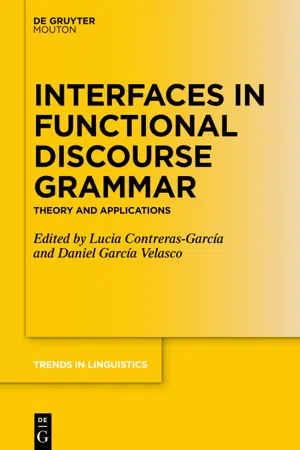
eBook - ePub
Interfaces in Functional Discourse Grammar
Theory and Applications
- 457 pages
- English
- ePUB (mobile friendly)
- Available on iOS & Android
eBook - ePub
Interfaces in Functional Discourse Grammar
Theory and Applications
About this book
Information
Subtopic
LanguagesA Functional Discourse Grammar typology of reflexives, with some notes on reciprocals
Riccardo Giomi
University of Coimbra, CELGA-ILTEC, Largo da Porta Férrea, 3004-530, Coimbra, Portugal
Acknowledgements: I am greatly indebted to Lachlan Mackenzie for his insightful comments on an earlier draft. I also wish to thank the editors of this volume, an anonymous reviewer and all the participants in the seventh International Workshop on Functional Discourse Grammar for allowing me to improve the final version of the paper.
Abstract
This chapter presents the first-ever Functional Discourse Grammar typology of reflexives and opens the way to a comparable typology of reciprocals. The main finding of the paper is that the striking morphosyntactic diversity of reflexive markers can be reduced to only three basic classes, which differ as regards the structure of the predication frame on which the construction is built. In Type I reflexives the lexical predicate takes two coindexed arguments; Type II reflexives are based on a one-place frame in which the predicate bears a reflexive (or reflexive/reciprocal) operator; finally, Type III reflexives are characterized by the presence of a configurational predicate which takes both an external and an internal argument. All further differences are explained with reference to different ways of aligning the underlying pragmatic and semantic structures of each construction-type – more specifically, the number and information-structural status of referents at the Interpersonal Level and the number and structural position of verb arguments at the Representational Level. A further advantage of the proposed typology is that of accounting for possible differences in the lexical distribution of reflexive markers on the basis of the notion of partially instantiated predication frames, i.e. partially lexicalized constructional templates of the Representational Level.
Keywords: Reflexives, Reciprocals, Linguistic typology, Functional Discourse Grammar, Pragmatics-semantics-syntax interfaces, Grammar-lexicon interface,
1 Introduction
This paper presents a general typology of reflexives cast in terms of Functional Discourse Grammar (FDG), which will hopefully also serve as a basis for an analogous typology of reciprocal constructions. Since it would not be possible to offer an encompassing analysis of both types of constructions within the space of a single paper, I have chosen to focus primarily on reflexives, which are usually regarded as a more fundamental grammatical category. As a matter of fact, all of the basic types into which reflexive constructions can be classified are also attested among reciprocal constructions, while the opposite is not the case. Correspondingly, reflexives constitute a prime diachronic source for reciprocal markers, whereas the opposite development is cross-linguistically exceptional (although not unattested: see Bahrt 2020: 226–233 for evidence from at least five different language families).
There are two main reasons why reflexive markers are particularly interesting from the perspective of FDG, both of which also concern the synchronically and diachronically related functional cluster of reciprocity. First, reflexives display a remarkable degree of cross-linguistic variation and therefore represent an appealing topic for a model with a strong typological orientation like FDG. In this regard, the aim of the paper is to show that the perspective afforded by FDG allows for a radical reduction in the variation that stems from any attempt to classify reflexive constructions on morphosyntactic grounds, also eliminating all of the fuzziness that is inherent to such classifications. Second, many reflexives are characterized by a mix of properties typical of transitive and intransitive clauses, which has often been explained with the fact that, conceptually, such constructions are characterized by the assignment of two distinct participant roles to the same referent(s). My working hypothesis as regards this particular point is that FDG, with its strict separation between different levels of grammatical analysis and its emphasis on the mapping relations between hierarchically higher and lower levels...
Table of contents
- Title Page
- Copyright
- Contents
- Abbreviations
- Functional Discourse Grammar: Blueprint and interfaces
- Interfaces, mismatches, and the architecture of Functional Discourse Grammar
- Grammar in 5D: The interface design of a mismatching grammar
- Phonology and phonetics in Functional Discourse Grammar: Interfaces, mismatches, and the direction of processing
- Noun incorporation in Functional Discourse Grammar
- A Functional Discourse Grammar typology of reflexives, with some notes on reciprocals
- Serial verb constructions, interface mismatches and Functional Discourse Grammar
- A Functional Discourse Grammar account of voice in Plains Algonquian Languages
- The English ‘Time-measurement construction’ as a case of gradience: A Functional Discourse Grammar approach
- Inter-level mismatches in English coordinated partitives
- A Functional Discourse Grammar account of postnominal modification in English
- Meaning-to-form mismatches in Functional Discourse Grammar and Systemic Functional Grammar: A case study of the English discourse connective however
- Subject Index
- Name Index
- Language Index
Trusted by 375,005 students
Access to over 1.5 million titles for a fair monthly price.
Study more efficiently using our study tools.
Frequently asked questions
Yes, you can cancel anytime from the Subscription tab in your account settings on the Perlego website. Your subscription will stay active until the end of your current billing period. Learn how to cancel your subscription
No, books cannot be downloaded as external files, such as PDFs, for use outside of Perlego. However, you can download books within the Perlego app for offline reading on mobile or tablet. Learn how to download books offline
Perlego offers two plans: Essential and Complete
- Essential is ideal for learners and professionals who enjoy exploring a wide range of subjects. Access the Essential Library with 800,000+ trusted titles and best-sellers across business, personal growth, and the humanities. Includes unlimited reading time and Standard Read Aloud voice.
- Complete: Perfect for advanced learners and researchers needing full, unrestricted access. Unlock 1.5M+ books across hundreds of subjects, including academic and specialized titles. The Complete Plan also includes advanced features like Premium Read Aloud and Research Assistant.
We are an online textbook subscription service, where you can get access to an entire online library for less than the price of a single book per month. With over 1.5 million books across 990+ topics, we’ve got you covered! Learn about our mission
Look out for the read-aloud symbol on your next book to see if you can listen to it. The read-aloud tool reads text aloud for you, highlighting the text as it is being read. You can pause it, speed it up and slow it down. Learn more about Read Aloud
Yes! You can use the Perlego app on both iOS and Android devices to read anytime, anywhere — even offline. Perfect for commutes or when you’re on the go.
Please note we cannot support devices running on iOS 13 and Android 7 or earlier. Learn more about using the app
Please note we cannot support devices running on iOS 13 and Android 7 or earlier. Learn more about using the app
Yes, you can access Interfaces in Functional Discourse Grammar by Lucía Contreras-García, Daniel García Velasco, Lucía Contreras-García,Daniel García Velasco,Lucia Contreras-García, Lucia Contreras-García, Daniel García Velasco in PDF and/or ePUB format, as well as other popular books in Languages & Linguistics & Languages. We have over 1.5 million books available in our catalogue for you to explore.