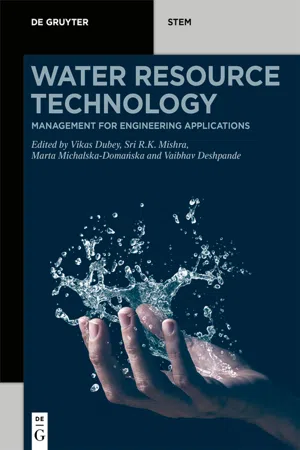
Water resource systems and technologies are important fields in engineering today. This book will discuss various areas on water resource management. Topics discussed include water harvesting techniques, waste water purification, and urban water systems as well as concrete, pavement, and mortar stabilizers, and earthquake resistance technologies and how they relate to water management systems.
eBook - ePub
Water Resource Technology
Management for Engineering Applications
- 115 pages
- English
- ePUB (mobile friendly)
- Available on iOS & Android
eBook - ePub
Water Resource Technology
Management for Engineering Applications
About this book
Trusted by 375,005 students
Access to over 1.5 million titles for a fair monthly price.
Study more efficiently using our study tools.
Information
Subtopic
Hydrology1 Analysis of rainfall and runoff of a catchment area using HYMOS
Ashay Shende
Department of Civil Engineering, KDK College of Engineering, Nagpur 440009, Maharashtra, India
Mahendra Umare
Department of Civil Engineering, KDK College of Engineering, Nagpur, Maharashtra, India
Acknowledgement: We are grateful to the Hydrology Division, Water Resource Department, Nagpur, Government of Maharashtra, India, for providing data and necessary facilitation of analysis on HYMOS.
Abstract
The primary source of water in India is rainfall which is experienced over most part of the country. The rainfall varies from place to place and is measured using more than 3,000 rain gauge stations, which are set up by Indian Meteorological Department (IMD) and Water Resource Department of State Government. The average annual rainfall of India is about 119.4 cm. According to Irrigation Commission of India, the total annual average precipitation in India is about 4,000 km3, which contributes towards a total annual surface water flow of about 1,869 km3 and the remaining is lost as evaporation, transpiration and infiltration. If the intensity of rainfall is more, it can cause hazardous flood leading to high casualties and property damages. To mitigate the floods, structural and non-structural measures are inevitable along with strong flood forecasting or early warning systems. This is possible when effective and scientific analysis of rainfall and runoff is carried out for a vulnerable catchment area. This chapter emphasizes the application of rainfall–runoff relationship and Unit Hydrograph in Flood Forecasting using a software tool HYMOS. The results obtained show good amount of accuracy and corroborate with site parameters. For calculation purpose, the data of catchment area serving Multipurpose (Irrigation and Hydroelectric) Project Pench in Maharashtra–Madhya Pradesh is used, and rainfall is calculated for full climatic station, Kamthikhairy (latitude 21°22′01″N and 79°11′37″E) with altitude 295.00 m using various climatologically factors and HYMOS tool. This will provide data for the planning, scheduling of different irrigation and non-irrigational projects, flood routing and so on of the region.
1.1 Introduction
Long-term planning of water resource project depends upon the correlation of rainfall and surface hydrology of respective catchment areas. The analysis helps the concerned department to understand the availability of water for the use in various sectors (Kebila, 2008).
Precipitation is measured using various pluviometers (types of rain gauges). The characteristic features need to be considered are catchment area and topography, intensity and type of storm, and season. For studying the characteristic features of rainfall and runoff, all the meteorological parameters should be considered. All the components of hydrological cycle (such as runoff, surface runoff, sub-surface runoff, precipitation, evaporation, condensation, transpiration, infiltration) need to be evaluated for analysing discharge of particular catchment (Kim and Kim, 2020). The meteorological parameters are recorded using different instruments, which provide information on local weather and climatic conditions.
All the recorded qualitative and quantitative data pertaining to meteorological and hydrological parameters are fed into Surface Water Data Entry System (SWDES) software. HYMOS is used to analyse the data fed to SWDES thereby helping the officials to achieve effective reservoir operation.
Hence, the user-friendly features of HYMOS make it a versatile tool for carrying out research and consultancy in the field of water management. At present, HYMOS 4.03 version is in use. Using statistical data from the water resource department, various analyses such as Unit Hydrograph Ordinate (UHO), flood forecasting, coefficient of rainfall and run-off and its relationship, identification of characteristic features of catchment, surface water analysis are performed.
1.1.1 Background
Many researchers have studied rainfall–runoff relation for different catchment, watershed for effective computation of flood discharge, planning and management of water resource projects and so on. However, a few notable research have been reviewed and summarized in Table 1.1 as given below:
Table 1.1:Review of literature.
| SN | Name of paper | Review |
|---|---|---|
| 01 | Kebila (2008) | This article focused on developing a rainfall–runoff model using limited data and characteristics of catchment. |
| 02 | Verma (2005) | The authors have carried out work on rainfall, runoff and sediment losses from watersheds of the central Himalayas over different land cover. Precipitation was recorded for five rain gauge stations spread into different regions. |
| 03 | Nur-Sharifah (2015) | The research was conduct... |
Table of contents
- Title Page
- Copyright
- Contents
- 1 Analysis of rainfall and runoff of a catchment area using HYMOS
- 2 An investigation on hydrodynamic cavitation as pre-treatment or post-treatment technology for treating CETP wastewater
- 3 The physico-chemical interaction of fluorine with the environment
- 4 The effect of chemical waste produced by industrial area near Raipur (Chhattisgarh) on the quality of drinking water
- 5 Seasonal variation of PM10 in the ambient air over an urban industrial area
- 6 Groundwater sustainability assessment using multi-criteria analysis
- 7 Impact of sodium absorption ratio on Kharun river basin, Raipur, Chhattisgarh
- 8 Experimental approach to study the fall velocity of different sized particle in quiescent liquid column
- 9 Comparative analysis of NDVI and LST to identify Urban Heat Island effect using remote sensing and GIS
- Index
Frequently asked questions
Yes, you can cancel anytime from the Subscription tab in your account settings on the Perlego website. Your subscription will stay active until the end of your current billing period. Learn how to cancel your subscription
No, books cannot be downloaded as external files, such as PDFs, for use outside of Perlego. However, you can download books within the Perlego app for offline reading on mobile or tablet. Learn how to download books offline
Perlego offers two plans: Essential and Complete
- Essential is ideal for learners and professionals who enjoy exploring a wide range of subjects. Access the Essential Library with 800,000+ trusted titles and best-sellers across business, personal growth, and the humanities. Includes unlimited reading time and Standard Read Aloud voice.
- Complete: Perfect for advanced learners and researchers needing full, unrestricted access. Unlock 1.5M+ books across hundreds of subjects, including academic and specialized titles. The Complete Plan also includes advanced features like Premium Read Aloud and Research Assistant.
We are an online textbook subscription service, where you can get access to an entire online library for less than the price of a single book per month. With over 1.5 million books across 990+ topics, we’ve got you covered! Learn about our mission
Look out for the read-aloud symbol on your next book to see if you can listen to it. The read-aloud tool reads text aloud for you, highlighting the text as it is being read. You can pause it, speed it up and slow it down. Learn more about Read Aloud
Yes! You can use the Perlego app on both iOS and Android devices to read anytime, anywhere — even offline. Perfect for commutes or when you’re on the go.
Please note we cannot support devices running on iOS 13 and Android 7 or earlier. Learn more about using the app
Please note we cannot support devices running on iOS 13 and Android 7 or earlier. Learn more about using the app
Yes, you can access Water Resource Technology by Vikas Dubey, Sri R.K. Mishra, Marta Michalska-Domańska, Vaibhav Deshpande, Vikas Dubey,Sri R.K. Mishra,Vaibhav Deshpande,Marta Michalska-Domańska in PDF and/or ePUB format, as well as other popular books in Technology & Engineering & Hydrology. We have over 1.5 million books available in our catalogue for you to explore.