Quantum Chemistry
eBook - ePub

Quantum Chemistry

An Introduction

  1. 352 pages
  2. English
  3. ePUB (mobile friendly)
  4. Available on iOS & Android
eBook - ePub

Quantum Chemistry

An Introduction

About this book

This textbook introduces the reader to quantum theory and quantum chemistry. The textbook is meant for 2 nd – 3 rd year bachelor students of chemistry or physics, but also for students of related disciplines like materials science, pharmacy, and bioinformatics.

At first, quantum theory is introduced, starting with experimental results that made it inevitable to go beyond classical physics. Subsequently, the Schrödinger equation is discussed in some detail. Some few examples for which the Schrödinger equation can be solved exactly are treated with special emphasis on relating the results to real systems and interpreting the mathematical results in terms of experimental observations.

Ultimately, approximate methods are presented that are used when applying quantum theory in the field of quantum chemistry for the study of real systems like atoms, molecules, and crystals. Both the foundations for the different methods and a broader range of examples of their applications are presented.

The textbook assumes no prior knowledge in quantum theory. Moreover, special emphasis is put on interpreting the mathematical results and less on an exact mathematical derivations of those. Finally, each chapter closes with a number of questions and exercises that help in focusing on the main results of the chapter. Many of the exercises include answers.
Frequently asked questions

Yes, you can cancel anytime from the Subscription tab in your account settings on the Perlego website. Your subscription will stay active until the end of your current billing period. Learn how to cancel your subscription.
No, books cannot be downloaded as external files, such as PDFs, for use outside of Perlego. However, you can download books within the Perlego app for offline reading on mobile or tablet. Learn more here.
Perlego offers two plans: Essential and Complete
  • Essential is ideal for learners and professionals who enjoy exploring a wide range of subjects. Access the Essential Library with 800,000+ trusted titles and best-sellers across business, personal growth, and the humanities. Includes unlimited reading time and Standard Read Aloud voice.
  • Complete: Perfect for advanced learners and researchers needing full, unrestricted access. Unlock 1.4M+ books across hundreds of subjects, including academic and specialized titles. The Complete Plan also includes advanced features like Premium Read Aloud and Research Assistant.
Both plans are available with monthly, semester, or annual billing cycles.
We are an online textbook subscription service, where you can get access to an entire online library for less than the price of a single book per month. With over 1 million books across 1000+ topics, we’ve got you covered! Learn more here.
Look out for the read-aloud symbol on your next book to see if you can listen to it. The read-aloud tool reads text aloud for you, highlighting the text as it is being read. You can pause it, speed it up and slow it down. Learn more here.
Yes! You can use the Perlego app on both iOS or Android devices to read anytime, anywhere — even offline. Perfect for commutes or when you’re on the go.
Please note we cannot support devices running on iOS 13 and Android 7 or earlier. Learn more about using the app.
Yes, you can access Quantum Chemistry by Michael Springborg,Meijuan Zhou in PDF and/or ePUB format, as well as other popular books in Physical Sciences & Chemistry. We have over one million books available in our catalogue for you to explore.

Information

Publisher
De Gruyter
Year
2021
Print ISBN
9783110742190
eBook ISBN
9783110742237
Edition
1
Subtopic
Chemistry

1 What is quantum theory?

1.1 Classical physics

The quantum theory, together with the theory of relativity, is one of the two most important developments in physics during the 20th century. The quantum theory is important when considering objects that are very small (e. g., electrons and atoms), while the relativity theory becomes important when the objects move very fast. In both cases, phenomena occur that are different from what we are experiencing in our everyday life. The book of George Gamow, Mr. Tompkins in Wonderland can be recommended for the interested readers. This book describes what the world would look if either quantum effects or relativistic effects were noticeable in our everyday life. The book is written as an entertainment, and the author who also was a very capable scientist, has been able to present science to the educated layman.
Before these two theories were developed, the situation in the second half-part of the 19th century has often been compared with our present situation. One was largely convinced that all important physical laws were understood, and one needed “only” to apply these on all sorts of issues. That everything would change within few years was not considered possible. Whether we will soon experience another, similar revolution in the natural sciences is an open question.
Here, we shall briefly discuss some concepts of classical physics, which are not always valid with the introduction of quantum theory. “Not always” means that classical physics must be regarded as sufficiently accurate when it comes to macroscopic objects, e. g., when sending a rocket to the moon.
According to classical physics:
  • Position and momentum coordinates are independent of each other and can have arbitrary values.
  • If one knows the position and momentum of an object at a certain point in time, as well as all forces acting on the object, the position and momentum coordinates at any later time, in principle, can be computed with any precision.
  • The energy of an object can take any value.
  • A part of physics deals with bodies, while another part deals with waves. The two parts have little to do with each other.
We shall now see how experimental and theoretical results led to questioning these statements.

1.2 Black-body radiation

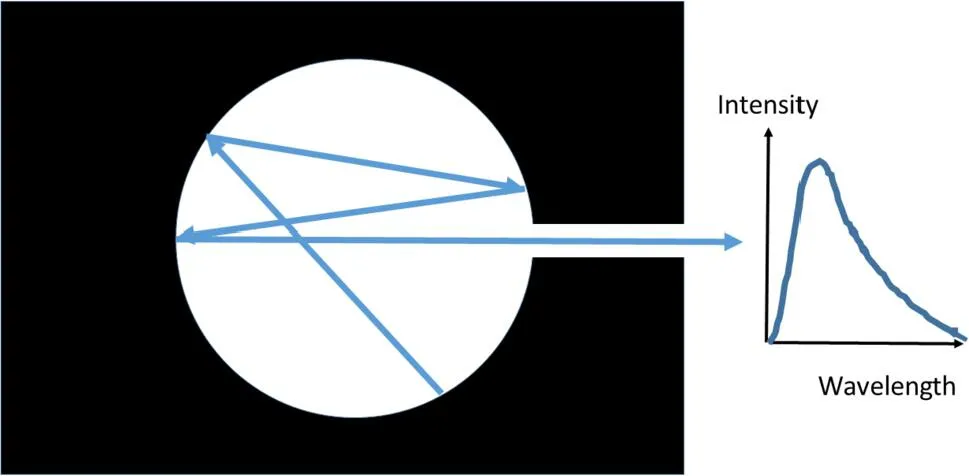
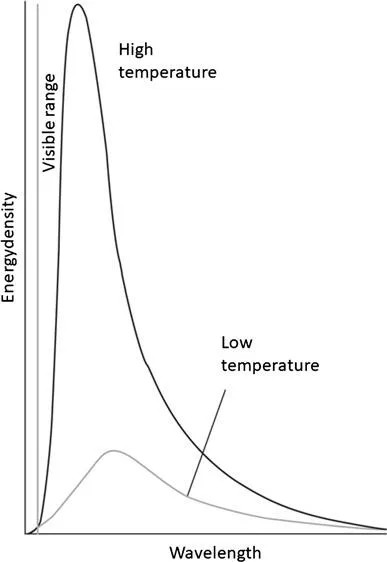
A black body with a certain temperature emits electromagnetic radiation (see Figure 1.1). This radiation is composed of radiation with all possible wavelengths λ and the whole spectrum depends on the temperature of the body, as shown in Figure 1.2. This effect is already known from everyday life. When you turn on a hearth, it becomes increasingly hot, and thereby its color changes from black to red, and even later to orange and yellow.
Figure 1.1 Schematic representation of the radiation of a black body. From the surface of the internal cavity of the body, radiation (photons) is emitted, which is brought into thermal equilibrium with the black body through multiple reflections at the surface before it emerges through a small opening. Ultimately, the intensity of the emitted radiation can be measured as a function of the wavelength.
Figure 1.2 The radiation of a black body as measured experimentally at two different temperatures. Adapted from the book of Peter W. Atkins, Kurzlehrbuch Physikalische Chemie, Wiley-VCH, 2001.
According to Wilhelm Wien, the wavelength λmax, at which the spectrum h...

Table of contents

  1. Title Page
  2. Copyright
  3. Contents
  4. 1 What is quantum theory?
  5. 2 Basics of quantum theory
  6. 3 Operators and quantum theory
  7. 4 Particle in a box
  8. 5 More or less free particles
  9. 6 Vibrations
  10. 7 Rotations
  11. 8 The hydrogen atom
  12. 9 Foundations of the approximate methods
  13. 10 The orbital model
  14. 11 Atoms
  15. 12 The smallest molecules
  16. 13 Other diatomic molecules
  17. 14 Larger systems: methods
  18. 15 Larger systems: applications
  19. 16 Supporting information
  20. 17 Mathematical formulas
  21. Subject Index