eBook - ePub
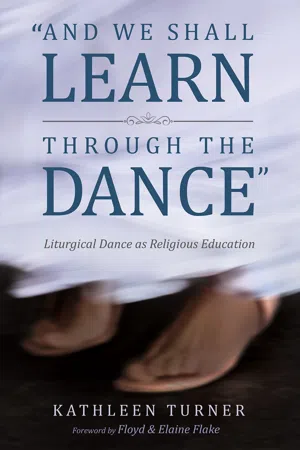
And We Shall Learn through the Dance
Liturgical Dance as Religious Education
- 256 pages
- English
- ePUB (mobile friendly)
- Available on iOS & Android
eBook - ePub
About this book
Liturgical dance is a way to present, reflect, instruct, learn, study, and share religious beliefs with one's self, within one's worship community, and with one's God. Such a belief is confirmed and witnessed within a variety of religious settings throughout the world from the beginning of time to this present age. However, there is a vacuum of resources that connect liturgical dance within the Christian context as a tool for religious learning within the field of religious education. With the continual rise of liturgical dance as an artistic form of expression, this book proposes that liturgical dance offers unique attributes conducive to the teaching and learning of faith and to faith formation. Kathleen S. Turner shows how liturgical dance is religious education in two very important ways: first, by addressing the power and potential liturgical dance has in nourishing the faith life of Christian congregants through means that are both educative and reflective; and second, by giving examples of how liturgical dance can be implemented as a religious-education tool within the teaching life of the church.
Information
Topic
Theology & ReligionSubtopic
Christian Rituals & PracticeChapter 1
My Steps Have Held to Your Paths and Have Not Slipped
A History of Two Communities
Introduction
The history of religious education shows that various tools were utilized in teaching about faith and religion. The arts were one such tool. History records that the arts have been effective in the teaching of Christianity and religious education. Their usage reveals much about the faith communities who found their inclusion helpful in fostering the life of faith. The artistic forms of song, word, and dance are expressions utilized by many faith communities whose religious walk appears to neither falter nor slip. For reasons that will be explored in the chapter below, these artistic tools remain helpful in recalling memories and historical events while fostering Christian and religious identity. The aim of this chapter is to describe and analyze the way two historical faith communities have used the arts in the life of faith.
Marianne Sawicki describes religious education as a “traditioning,” a handing on of what has been handed down.1 It contains stories of rituals, belief systems, and the interplay of activities that give expression to one’s religious beliefs. For Sawicki, the historical is where one finds the correlation between what the religious traditions are and how they are taught. She identifies the religious tradition found within the biblical narrative and then names the teaching and policy methods that were utilized in teaching the religious tradition. She creates a comprehensive historical method through which religious educators can teach by not just retelling the story but also finding and expressing the religious experience behind it. According to Sawicki, the religious experience and its comprehension should be a primary focus of religious educators.
It is within such a methodology that the use of the arts as a teaching tool is at its best. This chapter explores the power of recalling memory and historical events as well as how a community of faith is formulated in order to teach and shape Christian identity. Sawicki observes the overall creation of a religious community through the successive sharing of the gospel message from one person to another and how such an act transforms the faith identity of that community.2 This analysis provides background to Sawicki’s notion of traditioning, the handing on of what has been handed down in religious education. It is followed by an examination of the historical use of the arts—more specifically, song, word, and dance—in religious education and faith formation in two specific faith communities: the African slaves and the teaching of Christianity through the “invisible church” during the Antebellum South and the United Society of Believers in Christ’s Second Appearing, also known as the Shakers. The theological underpinnings of the Shaker belief system will not be presented, however, since their controversial views of Christianity (particularly the acceptance of the male and female duality of Christ as witnessed through Jesus and Mother Ann) are not germane to this study. The tensions and conflicts between their theological beliefs and those of other Christian denominations will not be addressed. Similarly, considering that the period of slavery in the Antebellum South was more readily exposed to Protestantism than Catholicism, here, only the use of song, word, and dance in the birth of the Black church under Protestantism will be examined. Hence, references to the influence of Catholicism upon slaves in Louisiana (where African pantheons and rituals were mixed inside their comprehension of Catholicism) will not be addressed.3
The Steps that Form a Community of Faith
This section describes how the church and Christian communities were formed. Marianne Sawicki submits that the telling of the Christian gospel message began with the simple telling of the story—the sharing of the gospel from one person to another. Sawicki’s thesis, however, is based on the questions, “How did the gospel get itself told and retold in successive generations,” and, “How did that telling transform the quality of human living for the ordinary people?”4 Her text seeks: “To follow the ‘low road’ of the gospel’s travel from mouth to mouth, heart to heart, among ordinary Christians. The writings of learned scholars and the achievements of ecclesiastical administrators are regarded as secondary to this grass-roots communications process.”5 Sawicki hopes that her inquiry will touch the ordinary, present-day Christian so that they will benefit from the recovery of such a heritage.
Sawicki locates her investigational tactic under the field of phenomenology, which focuses on the impact particular realities have upon human consciousness. This method is subjective, taking the human subject as its starting point, since subjectivity is the quality which distinguishes human beings from things. Subjectivity, Sawicki contends, promotes not only the knowing of human beings but also, and more importantly, that human beings know that they know. Within that knowing, all humans come into possession of who they are as informed knowers. For Sawicki, this subjectivity takes place among people as well as between individual persons and things. She writes: “Intersubjectivity is the quality of being human together in some sort of group, and knowing that the group itself also has being—a being different from the being of things, and also different from the individual subjectivities who enact the group.”6 Communication—and, in particular, the telling of stories—is what sustains both subjectivity and intersubjectivity. It is what creates and maintains both the personal being of persons and the social being of groups. Sawicki points out that the phenomena in which this creation and maintenance occur are the events which make up the field that phenomenology studies.
According to Sawicki, the Christian regards the gospel as God’s wo...
Table of contents
- Title Page
- Foreword
- Preface
- Introduction
- Chapter 1
- Chapter 2
- Chapter 3
- Chapter 4
- Chapter 5
- Bibliography
- Appendix A
- Appendix B
- Appendix C
- Appendix D
- Appendix E
- Appendix F
- Appendix G
- Appendix H
- Appendix I
- Appendix J
Trusted by 375,005 students
Access to over 1.5 million titles for a fair monthly price.
Study more efficiently using our study tools.
Frequently asked questions
Yes, you can cancel anytime from the Subscription tab in your account settings on the Perlego website. Your subscription will stay active until the end of your current billing period. Learn how to cancel your subscription
No, books cannot be downloaded as external files, such as PDFs, for use outside of Perlego. However, you can download books within the Perlego app for offline reading on mobile or tablet. Learn how to download books offline
Perlego offers two plans: Essential and Complete
- Essential is ideal for learners and professionals who enjoy exploring a wide range of subjects. Access the Essential Library with 800,000+ trusted titles and best-sellers across business, personal growth, and the humanities. Includes unlimited reading time and Standard Read Aloud voice.
- Complete: Perfect for advanced learners and researchers needing full, unrestricted access. Unlock 1.5M+ books across hundreds of subjects, including academic and specialized titles. The Complete Plan also includes advanced features like Premium Read Aloud and Research Assistant.
We are an online textbook subscription service, where you can get access to an entire online library for less than the price of a single book per month. With over 1.5 million books across 990+ topics, we’ve got you covered! Learn about our mission
Look out for the read-aloud symbol on your next book to see if you can listen to it. The read-aloud tool reads text aloud for you, highlighting the text as it is being read. You can pause it, speed it up and slow it down. Learn more about Read Aloud
Yes! You can use the Perlego app on both iOS and Android devices to read anytime, anywhere — even offline. Perfect for commutes or when you’re on the go.
Please note we cannot support devices running on iOS 13 and Android 7 or earlier. Learn more about using the app
Please note we cannot support devices running on iOS 13 and Android 7 or earlier. Learn more about using the app
Yes, you can access And We Shall Learn through the Dance by Kathleen S. Turner in PDF and/or ePUB format, as well as other popular books in Theology & Religion & Christian Rituals & Practice. We have over 1.5 million books available in our catalogue for you to explore.