This book examines the intersection between national and international counter-terrorism policies and civil society in numerous national and regional contexts. The 9/11 terrorist attacks against the United States in 2001 led to new waves of scholarship on the proliferation of terrorism and efforts to combat international terrorist groups, organizations, and networks. Civil society organisations have been accused of serving as ideological grounds for the recruitment of potential terrorists and a channel for terrorist financing. Consequently, states around the world have established new ranges of counter-terrorism measures that target the operations of civil society organisations exclusively.
Security practices by states have become a common trend and have assisted in the establishment of 'best practices' among non-liberal democratic or authoritarian states, and are deeply entrenched in their security infrastructures. In developing or newly democratized states - those deemed democratically weak or fragile - these exceptional securities measures are used as a cover for repressing opposition groups, considered by these states as threats to their national security and political power apparatuses.
This timely volume provides a detailed examination of the interplay of counter-terrorism and civil society, offering a critical discussion of the enforcement of global security measures by governments around the world.
eBook - ePub
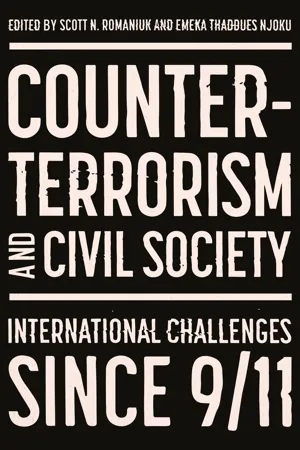
Counter-terrorism and civil society
Post-9/11 progress and challenges
- 330 pages
- English
- ePUB (mobile friendly)
- Available on iOS & Android
eBook - ePub
Counter-terrorism and civil society
Post-9/11 progress and challenges
About this book
Information
Part I
Conceptual platform
1
Counter-terrorism knows no borders: the post-9/11 global security regime and the securitization of civil society
Richard McNeil-Willson and Scott N. Romaniuk
Introduction
This chapter maps the development of global security architecture in the context of the “new terrorism” security paradigm, and the impact this is having on civil society – creating challenges for community integration, securitizing political dissent, and potentially advancing fundamental social and economic inequalities. It argues that the inequalities of counter-terrorism represent an internalization of racism associated with colonialism into the heart of the Westernized (but not Western) state model through the language of security. This has blurred the line between what have been traditionally defined as “democratic,” “authoritarian,” and “hybrid” states to such an extent that they are rendered problematic in their usage in a counter-terror context. As such, more radical approaches to theorizing the relationship between terrorism and counter-terrorism need to be considered.
First, this chapter will offer a broad overview of the foundation of cross-national counter-terror security structures – the overt security responses of 2001–2006, which have since given way to a greater focus on preventative countermeasures – and the supporting discourses which have sprung up. It will also outline how physical and economic manifestations of counter-terrorism have developed, spreading existing and sprouting new counter-terror structures into areas of civil society, in line with the securitization paradigm.
It will also explore how the development of counter-terrorism models – of military detention, secretive courts, pre-crime arrests, and extrajudicial killings – represent the active internalization of a certain type of racialized violence in the current state system. Authoritarian and democratic governments alike have recognized and utilized opportunities offered by counter-terrorism powers to centralize, consolidate, and expand security powers, as well as engaging in the mutually beneficial trading and co-optation of counter-terror and counter-extremism practices.
Finally, this chapter will argue that this is having a destabilizing effect on the traditional theoretical models tending to define regimes, which bifurcate states between the supposedly oppositional “democratic” and “autocratic” regime. Counter-terrorism has become a core component in the armament of contemporary statecraft, intertwined with democratic governments to such an extent that, in many cases, treating democratic and autocratic states differently when engaging in counter-terrorism obfuscates the many overlapping elements of repression. Counter-terrorism not only replicates structural racism and violence – echoing many colonial processes – it is often sustained by counter-terror techniques drawn directly from modern articulations of settler-colonialism in Palestine, Northern Ireland, South Africa, the United States, and Russia.
Racism and colonialism are therefore not only being internalized and reinforced within Western states, but modern articulations of colonialist-style racism and counter-terrorism have become inherently reliant on each other. As such, the theoretical tools needed to understand the international architecture of counter-terrorism must be expanded to account for their racial and settler-colonial scaffolding.
Counter-terror structures
This first section will explore counter-terrorism as a set of (harmonized) military, discursive, physical, and economic structures, and will examine the directional change for each of these structures.
Military structures
The events of September 2001 in the United States opened the stage on the development of a new paradigm of conflict, as Western states pivoted concerns away from hostile states and toward an often-internal enemy operating across and despite national borders. As such, while military structures and spending has ballooned since the start of the “War on Terror” (WoT), focus has shifted away from operational engagement with the “far enemy” and toward the internalized, “near enemy.”
The initial acts of the WoT saw largely “conventional” military engagements in the Middle East, marked by the invasion of Afghanistan in 2001 and, soon after, Iraq in 2003. Immediately, there was a growth of Western national military capabilities and various engagements in international warfare operations. The start of the WoT led to Western states spending vast funds on international operations against terrorism – as of May 2018, for instance, the United States is estimated to have spent $5.6 trillion on the WoT. This has largely occurred against the background music of fiscal cuts to state services and austerity politics implemented at home.
The revelation that key members of the September 2001 attacks operated from Germany (the so-called “Hamburg Cell”), and that the 2004 Madrid and 2005 London bombings were conducted by cells comprising home nationals, began a shift in security focus away from an external enemy, toward one embedded within, and internal to, the state and its communities. This led to a swing away from the “hard” military articulations characterizing the post-2001 landscape (bleeding into the post-post-9/11 era landscape), toward “softer,” preventative “pre-crime” approaches, to combat internal threats – the growth of international intelligence units, counter-terrorism policing units and counter-extremism programs, such as Prevent and Channel in the UK, which took a closer, more scrutinizing look at society at home and its manifold constituent parts, whether they have always been friendly or not.
Significant elements of the model adopted by the EU in dealing with terrorism is drawn from the UK’s CONTEST strategy – the skeleton of which was established with Britain’s Terrorism Act of 2000. The act indicated a shift toward a broader contemporary working definition of terrorism encompassing more diverse perceived threats, enabling subsequent establishment of a wide range of new police and investigatory powers into traditionally civic spheres.1 With the development of CONTEST came four central pillars or “workstreams” for responding to terrorism: Pursue (“to stop terrorist attacks”); Prevent (“to stop people becoming terrorists or supporting terrorism”); Protect (“to strengthen our protection against a terrorist attack”); and Prepare (“to mitigate the impact of a terrorist attack”) (UK Government, 2015). Since CONTEST was made publicly available in 2006, it has shifted toward a preventative approach to counter-terrorism, with the “Prevent” workstream coming to dwarf others in terms of power, resources, and reach:
It’s fair to say that first of the ten years ago, the principle areas of the contest strategy were on Pursue and Protect. Prevent, which is now such a key part of our work was very much seen as the misunderstood and the little brother in the relation between the four “P”s. (McNeil-Willson, 2019)
The growth of Prevent has seen a shift in policing toward a more intelligence-focused approach, with authorities looking to move away from traditional arrest and prosecute styles to account for preventative approaches to attacks. This was deemed particularly prescient following the 2005 London bombings (also referred to as 7/7), the 2006 transatlantic aeroplane plot, the Tiger Tiger plot and Glasgow city airport bombing of 2007, creating the framework for close police and intelligence collaboration and coordination.
With bombings in the UK and the resultant public launch of CONTEST in 2006, Prevent came to be seen within policy circles as key to unlocking the problem of home-grown terrorism – an approach becoming increasingly embedded as the Home Office has gained control over the Foreign and Commonwealth Office on issues around terrorism, and further accelerated under the prime ministership of former Home Secretary, Theresa May. This has led to a reliance on “upstreaming” the problem of terrorism – the introduction of approaches to tackle violence long before it is articulated:
I think what we’ll start to see is the Foreign Office starting to engage in more upstream programming in terms of looking at capacity building in the country around Prevent legislation, deradicalisation programmes/the CHANNEL programme, I think we’ll start to see that emphasis. Certainly, I think the Americans are engaged in delivering deradicalisation programmes upstream. There’s no doubt that under Home Office guidance, the FCO will increasingly become involved in that too. (Jones, 2016)
Much of these developments have been echoed in European Commission approaches, who have adopted wholescale elements of British counter-terrorism structures and programmes.
Securitization theories illustrate how counter-terror structures have developed around the assumption that Western states face a different kind of violent terrorist threat, framed as unique, unpredictable, irrational, and existential – a “new” terrorism, “particularly savage and relentless” in its aims (Enders & Sandler, 1999; Ilardi, 2004: 223; Juergensmeyer, 2000). Such Manichaean underpinnings create the conditions for another key feature: “terrorism” (Brachman, 2009: 11), as constituting existential harm to “every free society” (Trent, 1980: 12).2 The state itself – and not just the individual – becomes a potential victim of those poised to destroy what are framed as “our” freedoms, democracy, and value for life, write Jackson et al. (2011: 68), who further reason:
Whatever the terrorists are, we are the opposite: the terrorists hate freedom, we love freedom; they are anti-democratic; we are pro-democratic; they destroy life; we value life. Labelling something as “terrorism,” in other words, not only condemns the actions of the “other,” it also importantly, helps to construct the identity of the “self.”
From this discursive justification, massive centralization of powers has coalesced (see Buzan, 2006), resulting in the implementation of sweeping counter-terror legislation throughout Western states ensuring, according to David Blunkett, “the norms of prosecution and punishment no longer apply” (Wintour, 2004). This process of securitization has enabled the expansion of security structures and capabilities into traditionally civil spheres of democratic states.
The securitization processes of the ever-widening WoT have also seen the blurring of state-military power and private business, with governments outsourcing state concerns about terrorism to a plethora of germinating non-governmental military, security, and intelligence firms. This has increased the scope of security, with several actors now implicated in the advancement of counter-terror interests – a categorization Earl determines as constituting: state agents with tight ties to national elites; state agents with loose ties to national elites; and non-state, or private agents (Earl, 2011) – all with overlapping security interests. Such partnerships are framed as necessities for safeguarding societies and have created a dense body of reinforcing security structures which enable multilevel access throughout civil society.
Discursive structures
Alongside these military developments, discourse has grown to support this shift from the “far enemy” to the “near enemy.” These have focused on understanding and responding to “radicalization” and, more recently, “extremism,” which has greatly broadened the scope of internal securitization.
During the early stages of the WoT, relatively simplistic neo-Orientalist rhetoric dominated discussion, building support for international warfare operations based largely on the democratic deficit of (almost exclusively) majority Muslim states and the threat they posed to Western and international stability. However, as focus grew on identifying and responding to internal threats, more complex security discourses have develop...
Table of contents
- Cover
- Half Title
- Title Page
- Copyright Page
- Contents
- List of figures
- List of contributors
- List of abbreviations
- Introduction: global security architectures and civil society since 9/11
- Part I Conceptual platform
- Part II The cases: civil society and security governance in the Americas
- Part III Repressive security and civil society in Europe
- Part IV Civil society and security in Africa
- Part V States of emergency and civil society in North Africa, the Middle East, and Central and South Asia
- Part VI Closed or closing: security policy and civil society in the Asia-Pacific region
- Conclusion: counter-terrorism as insecurity
- Index
Trusted by 375,005 students
Access to over 1.5 million titles for a fair monthly price.
Study more efficiently using our study tools.
Frequently asked questions
Yes, you can cancel anytime from the Subscription tab in your account settings on the Perlego website. Your subscription will stay active until the end of your current billing period. Learn how to cancel your subscription
No, books cannot be downloaded as external files, such as PDFs, for use outside of Perlego. However, you can download books within the Perlego app for offline reading on mobile or tablet. Learn how to download books offline
Perlego offers two plans: Essential and Complete
- Essential is ideal for learners and professionals who enjoy exploring a wide range of subjects. Access the Essential Library with 800,000+ trusted titles and best-sellers across business, personal growth, and the humanities. Includes unlimited reading time and Standard Read Aloud voice.
- Complete: Perfect for advanced learners and researchers needing full, unrestricted access. Unlock 1.5M+ books across hundreds of subjects, including academic and specialized titles. The Complete Plan also includes advanced features like Premium Read Aloud and Research Assistant.
We are an online textbook subscription service, where you can get access to an entire online library for less than the price of a single book per month. With over 1.5 million books across 990+ topics, we’ve got you covered! Learn about our mission
Look out for the read-aloud symbol on your next book to see if you can listen to it. The read-aloud tool reads text aloud for you, highlighting the text as it is being read. You can pause it, speed it up and slow it down. Learn more about Read Aloud
Yes! You can use the Perlego app on both iOS and Android devices to read anytime, anywhere — even offline. Perfect for commutes or when you’re on the go.
Please note we cannot support devices running on iOS 13 and Android 7 or earlier. Learn more about using the app
Please note we cannot support devices running on iOS 13 and Android 7 or earlier. Learn more about using the app
Yes, you can access Counter-terrorism and civil society by Scott N. Romaniuk, Emeka Thaddues Njoku, Scott N. Romaniuk,Emeka Thaddues Njoku in PDF and/or ePUB format, as well as other popular books in Politics & International Relations & Civil Rights in Politics. We have over 1.5 million books available in our catalogue for you to explore.