![]()
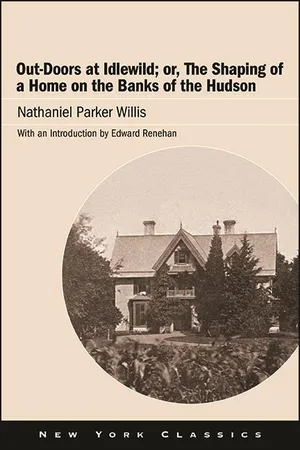
OUT-DOORS
AT
IDLEWILD;
OR, THE
Shaping of a Home on the Banks of the Hudson
BY
N. P. WILLIS
“AT King Kemserai’s caravanserai I dismounted from my camel ; and here travelers were entertained, on condition of telling their adventures.”
EASTERN STORY-BOOK.
ENTERED, according to Act of Congress, in the year 1854, by
CHARLES SCRIBNER,
In the Clerk’s Office for the District Court of the Southern District of New York.
| W. H. TINSON, | TAWS, RUSSELL & CO., |
| STEREOTYPER, | BOOK AND JOB PRINTERS BY STEAM |
| 23 Beekman St., N. Y. | 26 Beekman and 18 Spruce st |
TO
HON. JOSEPH GRINNELL
THESE OUT-DOOR SKETCHES OF THE HOME
TO WHOSE IN-DOOR HAPPINESS HIS KIND AFFECTION IS ONE OF THE
CONSTANT BLESSINGS,
Are Gratefully and Cordially Dedicated,
by his son-in-law,
N. P. WILLIS.
Idlewild, October, 1854.
![]()
Preface.
THE following volume is a simple weaving into language of the every-day circumstances of an invalid retirement in the Highlands of the Hudson. It was written in Letters to the Home Journal, and it was expected by the author, that they would owe their interest to being plainly truthful, and to picturing exactly the life that formed itself around the new-comer to one particular portion of our country—its climate, its conveniences, its accessibilities, and its moral and social atmosphere. As it is a neighborhood to which the sick are often sent by the physicians of New York, for the nearest mountain air, which is completely separated from the sea-board, the author has thought it might add a utility to his book to give his invalid experience with the rest. In this feature of it he has aimed to serve his fellow sufferers rather than to please the general reader.
In contributing these sketches to a periodical, and contenting himself with no other formation of thoughts and events into a work, than the mere putting of the loose sketches together, the author has committed another of the offences for which he has been called to account by every genial and kind critic, as well as abused by every malicious and carping one. As this may be his last work, and it is time, perhaps, to say, what he has always felt, but neglected to say, deprecatorily, upon this point, he will venture to quote the most recent of these fault-finding passages of criticism, with a word of reply to it. Thus says the New York Quarterly Review (of July, 1854), in a most liberal and friendly criticism, written, the author understands, by a clergyman who is a stranger to him :—
“Mr. Willis is perhaps most distinguished as a writer of light, brilliant and dashing sketches, contributed to the magazines. His collected papers of this kind amount to three thick volumes. Notwithstanding their apparent absence of hard work, they have no doubt been carefully eliminated. In style they are original, artistic, and follow no previous model. * * He has that one merit—that his style is his own. There are elements in all his sketches, which, if combined in one well-compacted design, might make a sparkling novel, and Mr. Willis would better have consulted his own fame had he seized upon the retirement of five years afforded him at Glenmary, to have wrought out some works of more enduring character, where that which seems light and flippant, when we have too much of it, and liable, like loose leaves, to be blown away, might have been securely bound up in some design much safer than board covers. The mere collection and collocution of papers which have served the purposes of ephemeral magazines, into books and volumes, may enhance their chance for time—but not for eternity. There is an opportunity for Mr. Willis to do at Idlewild what he has neglected to accomplish at Glenmary. He has seen enough of the world to afford him ample material ; let him combine the qualities which sparkle along his works so that they may flash in one setting. This is good advice but it is to be observed that those who bind themselves down to the craving demands of the periodical press, soon jog along like patient horses in the traces, and forego the ambition and aspiration of authors. * * It would be better to run some of the Home Journal metal into bullet-moulds, clip over an aspiring gray eagle as it is trespassing upon his air-territory over the bounds of Idlewild, pluck a feather, nib it to a sharp point, and go to work at that novel in two volumes,” &c., &c.
Kind as this is, the author feels that it implies, as do other criticisms, a misconception of both the aim and the impulse with which he has labored in his profession. It is a refusal to him of what he has never sought nor claimed in his prose writings—what, if he knows himself, he has never sufficiently wished, to give turn or color to a sentence. He could not but value “fame,” if it should be thus won, inasmuch as it might give pleasure to his children ; but, TO LIVE, as variedly, as amply, and as worthily, as is possible to his human faculties, while upon this planet, has been his aim ; and not to be remembered after he shall have left it. Literature—periodical literature—offered him the readiest means for this—the least confining mode of subsistence, the freest access to contemporary mind and society, the most influence and power, the best habits of mental exercise and enlargement. He chose, it, therefore, as a profession. In it, as an editor, he found a power—over and above all power of serving himself—and upon this alone, aside from the objects just named, he has endeavored to keep a fixed purpose, suitable to the trust with which, in that power, he was charged. The reviewer above quoted, has, in one chance remark, borne testimony to his discharge of this trust—therein giving him, he must freely own, a certain “fame” which he hopes will belong to his writings while they live. He says :—
“Mr. Willis has usually minded his own business, and gone straight ahead in his literary career, without any apparent regard either of praise or blame, of appreciation, or neglect, or dislike ; * * and he has already, by words in season, built up the reputation of a score of people as securely, at least, as his own.”
That the author has had no eye to “immortality,” but has labored honestly and industriously for the wants of himself and those dear to him, and has served others whenever it was in his power, with what means and opportunities chance threw into his hands—if this, which he finds thus incidentally testified to by a stranger, be true, he has certainly achieved all his purpose in literature, and would be abundantly content with that, for all his fame.
Idlewild, October, 1854.
![]()
Contents.
LETTER I.
The Highland Terrace.
LETTER II.
Highland Terrace, Continued.
LETTER III.
Lessening the Brook—Pig-Prophecy—Nearing of the City with Spring—the City Eye, as felt in the Country—Telegraph Wires, Æolian.
LETTER IV.
Slight of Small Streams in the Landscape—Character of Idlewild Brook—Legend and Name of our Nearest Village.
LETTER V.
Reasons for Neighbors moving Off—Morals of Steamboat Landings—Class that is gradually taking Possession of the Hudson—Thought-property in a Residence—Horizon-clock of Idlewild—Society for the Eye, in a View.
LETTER VI.
Evergreen Independence of Seasons—Nature’s Landscape Gardening—Weakness as to Reluctance in Planting Trees.
LETTER VII.
Earlier City Migration to the Country than usual—Peculiar Dignity-plant—Object of Country Farmers in taking City Boarders for the Summer—Suggestion as to City and Country Exchange of Hospitality.
LETTER VIII.
Ownership in Nature worth Realizing—Thumb-and-finger Nationality of Yankees—United Experience of Many, as expressed in a Common-minded Man’s Better Knowledge—Lack of Expression and Variety in Gates—Pigtight Gates.
LETTER IX.
Private Performance of Thunder-storms—Nature’s Sundays—Marriage of Two Brooks—Funnychild’s Deserted Bed.
LETTER X.
Making a Shelf-road—Character shown in Wall-laying—By-the-Day and By-the-Job—English Literalness and Yankee “Gumption.”
LETTER XI.
Plank Foot-bridge over the Ravine—Its Hidden Location—Value of Oldman Friendships—Friend S.—His Visit to the Bridge—His Remembrance of Washington—Tobacco Juice on Trees to Prevent Horse-biting, &c., &c.
LETTER XII.
Foliage and its Wonders—Caprice of Tree-living—Auto-verdure of Posts—Hemlock, the Homestead Emblem, &c., &c.
LETTER XIII.
Noon Visitors to Scenery—The Bull-Frog at the Gate—Inconvenient Opening of a Spring—Frog Curiosity and Intelligence—Process of Animal Progression, &c., &c.
LETTER XIV.
Canterbury Rowdies—Pianos and Porkers—Unwelcome Visitors—Penalty of Pounding—A Public Benefactor.
LETTER XV.
Trouble in Gate Designing—Letter from an Unknown Correspondent, on Gates—Invisible Society at Idlewild—Correction of Error as to Hemlocks—Handsome Irishman’s Mistake in Felling Trees, &c.
LETTER XVI.
Laurel-blossoming—The Imbedded Stone, and Jem’s Neglect of his Countryman’s honors—Sabbath stop to our Running Water, &c., &c.
LETTER XVII.
Effect of clearing out Underbrush from a Wood—Praise Disclaimed—Horror of Bloomeriized Evergreens—Neglect of departed Great Men—Carrion Nuisance, &c., &c.
LETTER XVIII.
Summer of Even Weather—Lightning-rods falling into Disuse—Filling of Country Boarding-houses—Luxury of Rural Remoteness—Viewless Peopling of a Spot—Wallace the Composer, and his Tribute to Alexander Smith, &c., &c.
LETTER XIX.
Neglect of Personal Appearance in Country Seclusion—Unexploring Habits of City People—Dignity of Un-damage-able Dress—Thoughts on Cooper’s Mansion being turned into a Boarding-house—Suggestion to Authors, as to turning their Influence to better Account—Letter from Cooperstown, &c., &c.
LETTER XX.
Timely Seasons and Untimely Age in America—Wild Glen so near the Hudson—Finding of Water Lilies—Anchoring a Lily in a Brook—Name of Moodna, &c., &c.
LETTER XXI.
Avalanche or Storm-King—Idlewild Ravaged by the Flood—Accidents to Persons and Destruction to Property—House Laid Open—Rareness of such Phenomena, &c., &c.
LETTER XXII.
Gentleman towing a Cow—Daughter taken out in the Storm to see the Freshet—The Power of a Flood—Lofty Bridge Swept Away—Extent of Desolation, &c., &c.
LETTER XXIII.
Young Lady killed by Lightning at our Neighbor’s House—Another Paralyzed—Careless General Attention to such Fearful Events, &c., &c.
LETTER XXIV.
Dilemma as to Placing Settees—Double Service of out-of-door Seats—Difference Between Appreciation of Landscape by Men and by Women—Right of all Strangers to enter Beautiful Grounds—Favor of being Figures on the Land-scape—&c., &c.
LETTER XXV.
A Wet September—Effect on Trees—Freshets—Dam-building—Nature’s Lesson in Water-power, &c., &c.
LETTER XXVI.
Wet Seasons Unfavorable to Hemlocks—The First Inland Mile on the Hudson—The American Malvern and Cheltenham—The Steamboat Landing a Fashionable Resort—The Highland Gap at Sunset, &c.
LETTER XXVII.
Highway Pigs—Giving the Old Woman a Ride—Her Favorite Jemmy—Pork and Poets—Common Folks’ Knowledge of Neighbors—Letter from a Correspondent, &c., &c.
LETTER XXVIII.
Autumnal Privileges—Extent of Personal Orbit—Dignity of a Daily Diameter—Difference between Saddle and Carriage-Riding—Health in a Nobody-bath, &c., &c.
LETTER XXIX.
October’s First Sunday—Silverbrook, and the Blacksmith’s Story of its History—Storm-King and Black Peter—Effects of the Avalanche—Tribute to Children’s Love, &c., &c.
LETTER XXX.
Working for Neighbors—Answers of Inquiries as to the price of Land, Farms, &c.—“Harriet’s” Letter—Apples Promiscuous on Barn-floor—Account of Society around us, &c., &c.
LETTER XXXI.
Autumn Splendors—Road Tax and amateur Road Making—Society for Volunteer Raking—Difference of Roads and Neighborhoods—North and South of Idle-wild, &c., &c.
LETTER XXXII.
Discovery of an Iron Mine in the Neighborhood—Lack of National Quickness at Beautifying Scenery—Poem on the Flood-ravages at Idlewild—Drawing and Landscape-Gardening, &c., &c.
LETTER XXXIII.
Sudden Fall of Leaves—November Haze—Fame of Newspaper-wrappers—Naming of a Village—Legend of MOODNA, the Indian Chief—Importance of Immortalizing Men and Events by the Naming of Towns, &c., &c.
LETTER XXXIV.
Mellow Middle in a November day—Ascent to Storm-King—Road from Newburg to West Point—Chances for Human Eyries—Difference of Climate between the two Mountain-sides—Home-like familiarity of a Brook, &c., &c.
LETTER XXXV.
Instance of Stick-a-pin-there—Survey of Premises after a Freshet—History of a Dam—Specimen of Yankee Coax-ocracy, &c., &c.
LETTER XXXVI.
Fine Specimen of a Boy—Young America—Mr. Roe’s Boys’ School—Surveying Class in the Paths of the Ravine, &c., &c.
LETTER XXXVII.
Interesting to Invalids only—Letter from an Invalid Clergyman—Reply—Keeping Disease in the Minority—Climate of the Tropics—Importance of Attention to Trifles, in Convalescence, &c., &c.
LETTER XXXVIII.
Summer in December—Flippertigibbet—Idleness—Annual Quarrelsomeness of Dogs—Pig-influence—Home without a Hog, &c., &c.
LETTER XXXIX.
Visit to Seven Lakes and Natural Bridge—Torrey the Blacksmith—Sunday in Nature—My Companion’s Hobby—Hollett the Quaker—Morning Sensations—Jonny Kronk’s and its Cemetery—Mammoth Snapping-Turtle—Iron Mine, &c., &c.
LETTER XL.
Many-Lake Alps and their Woodsmen—Highland Life—Contrast between it and New York, only three Hours’ Distance—The Difficulty—Natural Bridge—Driven on the Rocks—Hollett’s House, and our Ascent to the Peak—Seven Lakes—Quaker and Panther Meeting in the Woods, &c., &c.
LETTER XLI.
Degrees of Horseback Acquaintance with a Road—Slaughter-House “Round by Headley’s”—Geese and their Envy—Goose-Descent upon Unexpected Ice, &c., &c.
LETTER XLII.
Pool of Bethesda above the Highlands—Climate of Highland Terrace—Late Snows—Christmas, and Dressing of Church—Poem on Farmers’ Christmas Preparations—Black Peter—Snake Love of Solitude, &c., &c.
LETTER XLIII.
Trip of the Family Wagon to Newburgh—The Fashionable Resort—Chapman’s Bakery—Aristocracy “setled down”—Newburgh as a Neighbor.
LETTER XLIV.
Personal Experience interesting to Invalids—Difficulty as to Horseback Exercise—Advice as to Winter-riding—Economies in Horse-owning—New Idea as to Exposure—Philosophy of Exercise to Scholars, &c., &c.
LETTER XLV.
Snow and its Uses—Winter View of Grounds, as to Improvements—Old Women’s Weather-Prophecy—Finding of an Indian God in the Glen—Idlewild a Sanctuary of Deities of the Weather—Name of Moodna, &c., &c.
LETTER XLVI.
Hudson Frozen Solid—Boats on Runners—Water-lilies—Indian Legend, and Poem on it by a Friend—Philosophy of naming Streams hereabouts—Angola and its Epidemic—Story of Smart Boy, &c., &c.
LETTER XLVII.
Boy-Teamster—Our Republic’s worst-treated Citizen—Boy Condition in the Country—Our Neighborhood suited to Boy-Education in Farming—Vicinity of New York Market—Boy-Labor and Boy-Slavery—City Parents and their Disposal of Boys—Gardening Profits, &c., &c.
LETTER XLVIII.
Living in the Country all the Year round—Trips to the City—Hindrances by Snow on the Track—Chat in the hindered Cars—Mr. Irving—Bad Ventilation—Late Arrival, &c., &c.
LETTER XLIX.
First Signs of Spring—A Public of Invalids—An Invalid Chronicle—Letter from a Lady—Our Friend S.—Beauty of Old Age, &c., &c.
LETTER L.
Breaking up of the River-ice—Dates of previous Resumings of Navigation—Companionship in the distant Views of Travel—Nature’s Illnesses—Hillsides, &c., &c.
LETTER LI.
Weather-wise Squirrels—Effect of Spring Winds on Roads—Dodge of Turnpike Companies—Anecdote of a Teamster’s Revenge—The Kings in Republics—Road from Newburgh to West Point, &c., &c.
LETTER LII.
Deceptive Grass-Patch—Why Northerners love Home—Tragedy and Turkey-cock—Suspicion of Neighborhood and Vindication—Don Quixote, the Newfoundland Dog—Flippertigibbet, the Terrier—My Mare and her Illness, &c.
LETTER LIII.
Cedar-Trees and their Secrets—Bird-Presence about Home—Our Night-Owl—A Bird’s Claim on Hospitality—Difference between City and Country Influences—Death in a Neighbor’s House, &c., &c.
LETTER LIV.
A Newfoundland Dog and his Nature—The Beauty of a Brook as a Playfellow for Children—Country Life’s Opportunity to cultivate Intimacy with Children—Local Protection against East Winds—Mechanical Alleviation for Night-Coughs, &c., &c.
LETTER LV.
Snow-Storm in April—Newburgh to become a Seaport—Railroad from Hoboken, opposite Chamber Street, to West Point and Newburgh—Dutch Aristocracy—American difference from England as to Living near the Old Families, &c.
LETTER LVI.
Birds suffering from Snow—Answer to a Fault-finder—Preparing for Old Age by learning to live with Nature—Another Estimate of the Value of Farming—Common and strangely unvaried Idea of “a Vill...