- 390 pages
- English
- ePUB (mobile friendly)
- Available on iOS & Android
eBook - ePub
About this book
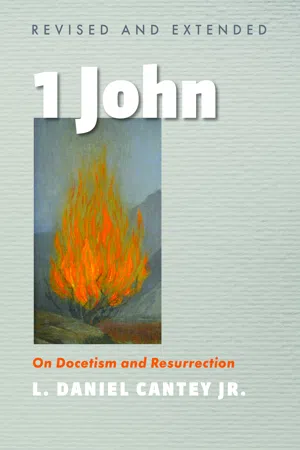
In 1 John: On Docetism and Resurrection (2016), the author elucidated the fundamental principles driving the modern order. The latter works according to a novel form of salvation, an ontology unto dissolution that the author recognizes as a new manifestation of the ancient heresy of docetism. The modern heresy turns on faith in the Christ-Idol, an idolatry hidden for centuries beneath the cover of Western Christianity. Its theological solution requires renewed engagement with the Trinitarian love, understanding that love as a function of mutual life-giving between the divine persons. The revised and extended version of 1 John assumes the undoing of Western society under the docetic ethos, seeking theological foundations for the society that might follow. It details the meaning of various aspects of docetic (modern) society through a Johannine lens, explaining these aspects as forms of oppression. The author counters these through the Eastern Orthodox focus on the inner life over the external one, the spiritual world over the physical, and the proper appreciation of hierarchy as opposed to docetic equality.
Information
Topic
Theology & ReligionSubtopic
Christian TheologyBook I
Lay Introduction
To the Devout Christians in the West
To Western Christians who have sought the Lord to the best of their ability, who have yearned to know and to be known by God, who have labored to live in a manner pleasing to him, who have sought him in suffering, prayed to him and beseeched him in trials, and who have trusted him in adversity and temptation: greetings in the name of the Lord Jesus Christ. My heart goes out to you devoted ones, who include friends whom I respect as well as the family that I cherish. To those who are not my acquaintances I offer my hope and concern that God will look upon you with compassion here and at the judgment.
Do not be fooled, for many deceivers have gone out into the world. Men now proclaim that there is no God and no judgment, they accuse and impugn God as unjust and a tyrant, they declare that they are without sin and they announce that God has left the world. They decry the notion that nature has a meaning other than what men deign to give it while they burst the bonds that hold men together, so that all that makes a claim to truth they brand as propaganda, agendas, and falsehood. Men today wander in a sea of lies and do not know which way to turn, with believers often overlooking their participation in the deception. For there is another falsehood, one not as obvious, one to which Christians turn a blind eye as they sing their songs, as they—we, you and I—pray our prayers and perform our worship. This falsehood ensnares and spoils us, driving us away from Christ while speaking in his name.
The ancient church faced a heresy called Docetism. As a premise, the Docetists believed that the spirit is good and that matter is evil, and that the two cannot mix. They then affirmed that God sent his Son, Jesus Christ, but with the attendant claim that Christ had no physical body. Shall God, who is all goodness, light, and truth, combine with depraved matter? According to Docetism, certainly not! Christ therefore comes as the Son of God but without a body, and all that he did, the walking on water, the teachings and healings, the feedings of thousands, the Last Supper, he did without a body. He appeared as if he had a body to those around him, but in fact he did not have one. He even climbed the cross not in the flesh but as a seeming. This Christ without a body did not die in the body nor did he raise the body from the dead. Thus in Docetism there is no resurrection, no life, and no salvation, and those who believe in Christ in the docetic way are deceived.
In like manner we also are deceived, for Western Christians also believe that Christ has no body. I speak not of the body of the man Jesus, but of the body of Christ, the church. “But,” you say, “I go to church every week and have for years! How could I not believe in the body of Christ?” Listen: when a man’s body dies it does not vanish into air, but over time it decomposes, disintegrating and scattering into dust. This has happened to Christ’s body in the West. Over many centuries it has decomposed, breaking through schism upon schism until today it is all but lifeless. To say “I accept these multiplied and multiplying Western denominations,” to regard their collective existence as a matter of indifference or personal choice, to consider each sect as justified according to its own rationale, and to participate in one or another of them—or worse, to say “It does not matter how or whether one worships, it only matters what one believes in the heart”—to say any one of these things is effectively to accept the disintegration and scattering of the body of Christ. To accept the scattering of the body of Christ, however, is to accept its death, and to worship a Christ with a dead body is to worship a Christ without a body. That one says “I believe in Jesus Christ” makes little difference here, as even demons acknowledge that Jesus is the Christ. What matters is that one worships the Christ correctly, according to the way he has given,1 as a Lord not only of spirit but also of the flesh, who came to redeem both the body and the soul. How can Christ redeem the bodies of men when his own body, the church, is torn into pieces? Western Christians, inasmuch as we worship a Christ without a body, are Docetists, all; we have been deceived, despite our devotion, to the last one of us.
“Every kingdom divided against itself becomes a desert, and house falls on house . . . whoever is not with me is against me, and whoever does not gather with me scatters” (Luke 11:17, 23). These are the words of our Lord and they are true. He is the great gatherer, who aims to bring all things together in his body the church. But Western Christendom is the great scattering, the intensifying division of the body of Christ. Juxtapose Christ’s assertion that “he who does not gather with me scatters” beside his admonition that “you will know them by their fruits” (Matt 7:15–20), so that the fruit that witnesses to the Holy Spirit is gathering and its opposite is scattering.2 Then examine the history of Western Christendom, which amounts to scattering after scattering. You will see that throughout Western history the Bible, and the Christ whose name we hope to exalt, indicts that history’s witness.
Can one find a page in the Scripture where God does not affirm the unity of the church? “I am the good shepherd,” says the Christ. “The good shepherd lays down his life for the sheep. The hired hand, who is not the shepherd and does not own the sheep, sees the wolf coming and leaves the sheep and flees—and the wolf snatches them and scatters them” (John 10:11–12). The false leader cannot stand against forces that threaten and divide Christ’s body, while Christ, seeing the wolf coming, lays down his life for the sheep. “I have other sheep,” he continues, “that do not belong to this fold [referring to the Gentiles who are added, in the church, to the flock of the Jews]. I must bring them also, and they will hear my voice.” Of these two peoples Christ makes “one flock” under one shepherd, joined in the witness to resurrection and life in Jesus (10:15–16).
Hear also the prayer of Christ before his passion, when in the Garden awaiting his betrayer (John 17). Concerning his disciples he asks, “Holy Father, protect them in your name that you have given me, so that they may become one, as we are one . . . I ask not only on behalf of these, but also on behalf of those who believe in me through their word, that they may all be one. As you, Father, are in me and I am in you, may they also be in us, so that the world may believe that you have sent me. The glory that you have given me I have given them, so that they may be one, as we are one, I in them and you in me, that they may be completely one.” These are the words of Christ to his Father, his last testament and the prelude to his death, and in them he petitions for the unity of the faithful. Above all they must be one, united in Spirit and in truth, lest they do not accomplish the earthly purpose for which he calls them. The Christ seeks their unity so that “the world may know that you have sent me and have loved them even as you have loved me.” The unity of the body of Christ witnesses to its truth, and to the truth of God who enlivens and maintains it through his Spirit. When the body divides unto incoherence, what is left of its witness except that Christianity, rather than engendering peace, is a seed of faction and conflict?
The unity of men in the church stands at the center of God’s cosmic plan. “With all wisdom and insight God has made known to us the mystery of his will,” writes St. Paul, “according to his good pleasure that he set forth in Christ, as a plan for the fullness of time” (Eph 1:9–10). Westerners might be astonished that this plan is not for individuals per se, not for the lonely man before God. The divine plan gathers up “all things in Christ, things in heaven and on earth.” Recall that Christ is the great gatherer, and see here that the eternal purpose of God gathers all things in him! God has “raised Christ from the dead and seated him at his right hand in the heavenly places, far above all rule and authority and power and dominion, and above every name that is named, not only in this age but also in the age to come. And he has put all things under his feet and has made him the head over all things”—for what reason? What manifests and embodies the rulership of Christ, exemplifying his lordship over all? Where is this headship located and for what is it established?—“for the church, which is his body, the fullness of him who fills all in all” (1:20–23, emphasis added). We must affirm that Christ is the head of his body, the church; that Christ is put over all things for this body as his fullness; and that in it he gathers all things in heaven and earth under himself. For “through the church the wisdom of God in its rich variety . . . [is] made known to the rulers and authorities in the heavenly places. This was in accordance with the eternal purpose that he has carried out in Christ Jesus our Lord” (3:10–11). Should we deny the centrality of the church for God’s purposes, we deny also the words of Christ and his foremost apostle.
I urge you to pray for those who divide the body of Christ, who attempt to reconcile God’s plan of gathering all things in Christ with the scattering of his body! I further urge you to pray for those who say that they can believe in Christ without submitting to the church. Beware those who say “I am loved by God and will be gathered to him in eternity” but who spurn Christ’s body now. Those who reject the body of Christ in this world may well be shut out from it in the next, for God is not mocked.
God saves men by grace through faith, “and this is not your own doing; it is the gift of God—not the result of works, so that no one may boast” (Eph 2:8–9). Paul directed this statement to Jews who used their inheritance, including the law, the prophets, and the covenant of the Old Testament, to raise themselves up above Gentiles. Paul declares that the Jews do not find justification in this inheritance but in the faith of Jesus Christ, a message that applies equally well to believers today. The upshot of this justification in the first century was that Christ “is our peace; in his flesh he has made both groups [Jews and Gentiles] into one and has broken down the dividing wall, that is, the hostility between us. He has abolished the law with its commandments and ordinances,3 that he might create in himself one new humanity in place of the two, thus making peace, and might reconcile both groups to God in one body through the cross, thus putting to death that hostility through it” (2:14–16). Justification in Christ does not occur without man’s assimilation into his body, which reconciles him to those against whom he formerly raised himself up. Christ means to create one humanity out of believers at peace with one another and devoid of hostility, men who manifest the divine wisdom in which Christ gathers all to himself.
Faction in the church contradicts both the cosmic plan of God in Christ and the reconciliation brought about for those justified in him. For this reason Paul berates the Corinthians who would segregate themselves from one another. “Each of you says, ‘I belong to Paul,’ or ‘I belong to Apollos,’ or ‘I belong to Cephas,’ or ‘I belong to Christ.’ Has Christ been divided? Was Paul crucified for you? Or were you baptized in the name of Paul?” (1 Cor 1:12–13) Those who divide according to their apostolic teachers misunderstand what it means to follow Christ. They raise up leaders against one another when they should bear in mind that Christ, the Lord of all, led by humbling himself. When Paul came to the Corinthians, he knew “nothing among [them] except Jesus Christ, and him crucified” (1 Cor 2:2). He knew nothing of leaders puffed up in pride, nothing of men in competition for human honor or recognition, but he knew the Lord who lowered himself to become a servant of sinners. Faction according to leaders undermines this example because it sets men up as antagonists, tending toward the division of Christ’s body as though the servants and stewards of God’s mysteries surpassed their master.
“Do you not know that you are God’s temple and that God’s Spirit dwells in you?” Paul asks in the midst of this discussion. “If anyone destroys God’s temple, God will destroy that person. For God’s temple is holy, and you are that temple” (1 Cor 3:16). These words should send chills down the modern spine. Faction is the destruction of the church, according to Paul, and men who destroy the church through faction shall be destroyed by God. But what are Christians of the West if not totally at home in and approving of faction? Do we not see that the body of Christ has fallen, that it has become a desert and been destroyed, overwhelmed by schism, secularity, and disregard for the church? If we turn our back toward the dissolution of Christ, will he not also turn his back upon us?
As Paul exhorts, let us “lead a life worthy of the calling to which we have been called, with all humility and gentleness, with patience, bearing with one another in love, making every effort to maintain the unity of the Spirit in the bond of peace. There is one body and one Spirit, just as you were called to the one hope of your calling, one Lord, one faith, one baptism, one God and Father of all, who is above all and through all and in all” (Eph 4:1–5). Where there is “one body” there is “one Spirit,” as the Holy Spirit holds all things together for the glory of Christ, but where there are many bodies, separated by indifference if not by disdain and violence, there are many spirits that goad men to conflict with one another. The Christian cannot affirm one Spirit, one faith, one baptism, and one God and Father of all, and at once affirm a multitude of bodies born out of antagonism and mutual condemnation.4
One discovers the New Testament’s emphasis on the unity of God’s people in the Old Testament also. When God promises Abraham that he will make him a great nation, bestowing upon him land and blessing, and giving him a great name (Gen 12:1–3), one does not need to add that this nation will be unified. When God announces of Israel through the prophets that “I will be their God, and they shall be my people,” it goes without saying that this people is one, strengthened in their singularity by their worship of God and their obedience to his law. We learn more of the necessity of Israel’s unity not through direct assertions of national solidarity, which the Old Testament often presumes, but through the forms of punishment leveled on the people: division and exile, both of which are kinds of scattering.5
When Solomon sinned by idolatry, following the gods of his foreign wives, God announced that “Since this has been your mind and you have not kept my covenant and my statutes that I have commanded you, I will surely tear the kingdom from you and give it to your servant . . . I will not, however, tear away the entire kingdom; I will give one tribe to your son, for the sake of my servant David and for the sake of Jerusalem” (1 Kgs 11:11–13, 29–36). God fulfilled this sentence by dividing the kingdom from Solomon’s son, Rehoboam, who enforced harsh labor on the people and so drove them to rebellion under Jeroboam. The line of David lost 10 tribes but retained the kingdom of Judah and Jerusalem.
Later and more prominently God punished the people through exile, uprooting them from the land. This happened in two events, each a turning point in the history of Israel, and each the result of the people’s turning from God. In each case, the prophets brought accusations against Israel for the two sins of idolatry and disobedience. The conjoining of these two infractions signaled the impending judgment of God. In the first manifestation of that judgment, the Assyrian Empire defeated the Northern Kingdom around 721 BC, deporting the people. By this action the Northern Kingdom died, being wiped out completely. As the prophet Amos proclaimed, “The end has come upon my people Israel,” for “Israel must go into exile away from his land” (8:2, 7:11). The second instance, with the Exodus perhaps the most important pair of events in the Old Testament, is the Babylonian exile (ca. 586–538 BC). Here God removed the remainder of his people, the Judeans who had survived the Assyrian threat roughly a century earlier, and subjected them to life in a foreign kingdom under foreign gods. One cannot overstate the impact of this event on the Jewish consciousness. The prophets predicted it and God carried it out, and the Israelites mourned until restored to their homeland. The scatterings of the Jews in the Old Testament are twofold: the division of the kingdom, a national schism that separates man from man; and the division of the people from the land, which forcibly removes men from their ancestral home.
Consider closely the biblical witness, how the words of Jesus and Paul exhort believers toward the unity of the faith, how the Old Testament presumes the unity of the people of Israel, and how God punishes and all but destroys his people for their sins through division. The Bible nowhere justifies schism; it nowhere says that the body of Christ ought to be rent for one or another reason; it nowhere says that the people of Israel ought to seek division rather than regard one another in friendship and brotherhood. It says that followers of God must love one another and give to one another, humbling themselves before God and serving the neighbor. The Bible’s teaching on these points is unqualified.
Consider now the history of the church in the West. As we move briefly through this history, we shall see that at juncture after juncture the body of Christ has divided, that men who claim the name “Christian” have turned against one another, sometimes killing one another because of their faith. Can this scattering and eventual demise of the body of Christ be directly harmonized with the gathering that is his purpose?
For approximately a millennium the church was one, spanning roughly from Spain to the Middle East, fighting heresies and enduring contrary religions with an ostensibly unified front. About 1054, wit...
Table of contents
- Title Page
- Book I
- Book II
- Epilogue
- Appendix to the Academics
- Select Consulted Works
Trusted by 375,005 students
Access to over 1.5 million titles for a fair monthly price.
Study more efficiently using our study tools.
Frequently asked questions
Yes, you can cancel anytime from the Subscription tab in your account settings on the Perlego website. Your subscription will stay active until the end of your current billing period. Learn how to cancel your subscription
No, books cannot be downloaded as external files, such as PDFs, for use outside of Perlego. However, you can download books within the Perlego app for offline reading on mobile or tablet. Learn how to download books offline
Perlego offers two plans: Essential and Complete
- Essential is ideal for learners and professionals who enjoy exploring a wide range of subjects. Access the Essential Library with 800,000+ trusted titles and best-sellers across business, personal growth, and the humanities. Includes unlimited reading time and Standard Read Aloud voice.
- Complete: Perfect for advanced learners and researchers needing full, unrestricted access. Unlock 1.5M+ books across hundreds of subjects, including academic and specialized titles. The Complete Plan also includes advanced features like Premium Read Aloud and Research Assistant.
We are an online textbook subscription service, where you can get access to an entire online library for less than the price of a single book per month. With over 1.5 million books across 990+ topics, we’ve got you covered! Learn about our mission
Look out for the read-aloud symbol on your next book to see if you can listen to it. The read-aloud tool reads text aloud for you, highlighting the text as it is being read. You can pause it, speed it up and slow it down. Learn more about Read Aloud
Yes! You can use the Perlego app on both iOS and Android devices to read anytime, anywhere — even offline. Perfect for commutes or when you’re on the go.
Please note we cannot support devices running on iOS 13 and Android 7 or earlier. Learn more about using the app
Please note we cannot support devices running on iOS 13 and Android 7 or earlier. Learn more about using the app
Yes, you can access 1 John, Revised and Extended by L. Daniel Cantey Jr. in PDF and/or ePUB format, as well as other popular books in Theology & Religion & Christian Theology. We have over 1.5 million books available in our catalogue for you to explore.