- English
- ePUB (mobile friendly)
- Available on iOS & Android
eBook - ePub
About this book
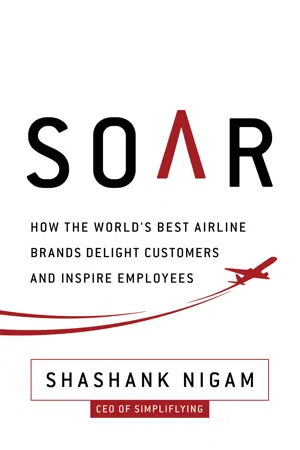
An airline has over 50 different brand touchpoints at which it can choose to operate exactly as it has in the past or to exceed expectations at each step and become truly exceptional. This book aims to highlight 10 exceptional airline brands which are thinking differently about branding, and executing brilliantly. There is an exceptional breed of airlines that continue to win in their markets because they dare to think differently. They dare to challenge the conventional wisdom and industry norms.Some proactively borrow concepts from consumer industries; some choose to put customers at the heart of their business; some choose to empower their staff to lead the brand. Yet, they all aim to create an experience that the customers will appreciate, pay for and share about - in their own different ways. This book sets a new direction on and a new attitude towards airline marketing.
Trusted by 375,005 students
Access to over 1.5 million titles for a fair monthly price.
Study more efficiently using our study tools.
Information
Subtopic
Marketing internazionale
1:Southwest:
A LUV STORY
Introduction
In 1983, about a decade after Southwest Airlines started flying, a children’s book called Gumwrappers and Goggles, written and illustrated by Winifred Barnum, was published. To most readers, the book was largely indistinguishable from the multitude of children’s books published each year. But the premise of its story had an uncanny resemblance to a famous court case that anyone following Southwest Airlines would have identified.
In the story, TJ Luv, a small jet, is taken to court by two larger jets to keep him from their hangar and stop him from flying. In 1967, soon after Herb Kelleher and Rollin King incorporated the airline in Texas, three other airlines—Braniff, Trans-Texas, and Continental Airlines—started legal action against Southwest (then called Air Southwest Co.) to prevent it from flying. In the book, TJ Luv’s right to fly is upheld after impassioned arguments from a character called The Lawyer. In 1970, Air Southwest prevailed over its antagonists as the courts upheld its right to fly.
While no company names were mentioned in the book (which continues to be in print), TJ Luv’s colors were those of Southwest Airlines, and the two other jets were in Braniff and Continental colors. The Lawyer, quite obviously, resembled Herb Kelleher.
Having overcome legal struggles, Air Southwest Co. changed its name to Southwest Airlines Co. in 1971, and established its headquarters in Dallas, Texas. Southwest Airlines began scheduled flights on June 18, 1971, from Dallas’ Love Field to Houston, and Dallas to San Antonio, with their fleet of three 737-200s.
One of the greatest airline stories of the modern era was finally underway.
Say it with LUV
The children’s book, which turns out to have been commissioned by the airline, is only one of the myriad ways in which Southwest Airlines has affected and shaped its public perception and, in the process, stood out from its competitors. That process, of course, started right at the beginning when Lamar Muse, the airline’s first president, ordained that hostesses (all female at the beginning) would be dressed in tangerine hot pants and go-go boots. As Southwest Airlines claims on its website, “With the prettiest Flight Attendants serving ‘Love Bites’ on our planes, and determined Employees issuing tickets from our ‘Love Machines,’ we changed the face of the airline industry throughout the 1970s.”
The hot pants and go-go boots eventually gave way to less gimmicky, more respectful attire for its female flight attendants. In 1982, Southwest finally decreed that customer-facing agents could be both male and female. The airline, initially a close copy of Pacific Southwest Airlines, developed its own distinct culture and practices, including a unique boarding process. Recently, Southwest has embraced social media wholeheartedly, not only in order to reach out to its many advocates—and to offer a glimpse into the brand—but also to serve its customers better.
Most importantly, the word “Love”—or, in Southwest’s orthography, “LUV”—has been important to Southwest’s brand from the beginning. TJ Luv is but one small repitition of the LUV theme. The airline claims that “Southwest has been in LUV with our Customers from the very beginning. Therefore, it’s fitting that we began service to San Antonio and Houston from Love Field in Dallas on June 18, 1971. As our Company and Customers grew, our LUV grew too! Then in 1977, our stock was listed on the New York Stock Exchange under the ticker symbol ‘LUV.’ Over the ensuing years, our LUV has spread from coast to coast and border to border thanks to our hardworking Employees and their LUV for Customer Service.”
In 2016, Southwest Airlines is at a delicate stage. As the largest domestic carrier in the US, it is in a unique position. It flies to about a 100 destinations, employs over 50,000 people, and has a massive fleet of more than 700 planes all Boeing 737s. It is also the second-largest carrier in the world, transporting almost 144 million passengers in 2015. While other airlines have suffered bankruptcies and layoffs, Southwest has remained profitable for 43 consecutive years.
LUV has brought Southwest Airlines this far. But now that the airline is poised for international growth and further expansion, can LUV thrive globally?
The Brand with a Heart
The Southwest story has become famous in the airline industry and beyond. Yet it grows better with each passing year, as Southwest Airlines itself grows. It starts like this: More than 49 years ago, Rollin King and Herb Kelleher decided to start a different kind of airline. They began with one simple notion: if you get your passengers to their destinations when they want to get there, on time, at the lowest possible fares, and make darn sure they have a good time doing it, people will fly your airline.
Herb was later joined by Colleen Barrett, who had been his executive assistant at the law firm he ran before starting Southwest. Working closely with her mentor and former boss, Colleen pioneered Southwest’s unusual and now legendary approach to customer service, which aims to treat the company’s employees like family, to make the workplace fun, and then to carry that upbeat attitude to consumers.
Everything that Southwest has done since its inception has aimed to prove that it’s possible to succeed through a dedication to the highest quality of customer service delivered with a “sense of warmth, friendliness, individual pride, and company spirit.”
Employees Embody the Brand
Though she stepped down from active duty in 2008, speak to employees now and you get a sense that Colleen’s spirit is still at the center of the airline’s ethos. “Everyone cares, everyone is cared for” is a motto that resonates with the airline’s staff. Almost everyone we spoke to had a reverential attitude toward their former boss.
Mike Hafner, Vice President of Cabin Services, says that little has changed in the last 35 years. Mike has been in the airline business since age 15, when he began working out of the back of his mother’s station wagon as a baggage delivery agent for several airlines. He began working at Southwest in 1981, when he was just 23 years old. His first job was ramp agent, cleaning the planes when they stayed overnight in Austin, Texas. In 1982, after it was decreed that flight crew and ticket agents could be both male and female, Mike became the second male ticket agent in Southwest history. For 26 years, he held multiple positions in ground operations before becoming the Vice President of Inflight Services in 2007. In 2009, wanting to enhance customer experience, Mike led the effort to combine Inflight and Provisioning into the single Cabin Services department, adding another 14,000 people to his responsibilities almost overnight. Since 2015, he has been Vice President of Customer Services. He describes Southwest employees’ trajectory at the airline not as a ladder, but as a lattice, since the airline encourages employees not simply to move up the ranks within a single department, but to move their talents from one department to another, resulting in people with a greater-than-usual breadth of knowledge of the industry.
Southwest is still an organization that believes in creating strong leaders who care about their teams. In fact, the reason Southwest has succeeded, according to Mike, is that “both its leaders and its frontline employees have outworked and outcared the competition.”
Brand Refresh
One of the people who most exemplify outworking and outcaring is Anne Murry, who led the brand refresh and rollout for Southwest Airlines in 2014. After extensive research and concept evaluations that stressed the need to appear fresh while retaining the spirit of Southwest, Anne and her team put love right at the center of the brand.
Research started in 2013 with both customers and non-customers. The focus was on remaining a colorful brand. Also a consistent brand: before then there had been no brand guide. Everything was completely dependent on trust. Internally there was no brand consistency, with different departments carrying out different executions of internal campaigns. So the custom logo used for a community day effort, for instance, was different from the custom logo for a birthday party.
The previous update to the brand had happened in 2001, and was minor compared with the thoroughgoing 2013 effort. This time everything was re-examined, and every element of the brand that was retained or created anew had to have a good reason to exist. In a logo redesign, the word “Airlines” was dropped entirely. Anne cites Apple and Starbucks as inspirations: Apple removed the word “Computers” from its logo and Starbucks went so far as to remove the word “Starbucks.” The “Southwest” is now followed by a small heart, almost like a punctuation mark, signifying humility. The desire was, ultimately, to position Southwest as a lifestyle brand, with heart at its core.
The Southwest ride has been exhilarating for Anne, with many high points, but the night of the brand rollout, September 8, 2014, was particularly special for her. She still gets emotional when recalling it. After Dallas Love Field had ended its day at around 2:30 a.m., a team moved into place and flipped the images at 4:00 a.m. Anne describes it as a magical night, reminiscent of Christmas, in which gifts were unwrapped one by one. The team was in tears, hugging and kissing each other, savoring the moment they’d awaited for months.
She also remembers sighing with relief after it was all over. So much could have gone wrong, but everything went right. She says, “It’s the people I get to work with, it blows my mind, that’s why I’ve stayed in a marketing role for 25 years.”
Responses to the new brand from customers were mostly very positive. Respondents singled out the heart in the logo: no other airline has it, and it probably would not feel right as a brand statement about any airline but Southwest.
Even when introducing the world to something so obviously customer-targeted as a new brand identity, Southwest ensured that its core values would still drive the change. This is how Gary Kelly, current CEO of Southwest, introduced the re-branding: “Our collective heartbeat is stronger and healthier than ever, and that’s because of the warmth, the compassion, and the smiles of our People. The Heart emblazoned on our aircraft, and within our new look, symbolizes our commitment that we’ll remain true to our core values as we set our sights on the future.”
People Power
Southwest Airlines has consistently won accolades for being one of the best companies to work at. Not only that, but it is usually the only airline on such lists. A positive culture has been a crucial part of the company’s DNA all along. As Herb Kelleher put it, “The business of business is people, people, and people.” For Southwest, that was true in the beginning, it is true today, and it will hopefully be true in the coming years. You will hear statements from Herb like this repeated often at Southwest: “Our people make us what and who we are, and our people can deliver what our customers want and need.”
To achieve and maintain its people-centered approach, Southwest begins with a set of attributes that percolate through the organization. Enter Southwest’s offices and you’ll invariably find a poster reminding employees of three desirable traits that encapsulate the Southwest way: “Warrior Spirits, Servant’s Hearts, Fun-LUVing Attitudes.”
Each of these three traits has helpful sub-traits to ensure the message of the bold headlines is backed up with specifics. According to Julie Weber, VP of People at Southwest (at other organizations she would be known as VP of Human Resources), a Warrior Spirit means “a desire to excel, act with courage, persevere, and innovate.” A Servant’s Heart entails “the ability to put others first, treat everyone with respect, and proactively serve customers.” And a fun-loving attitude includes “passion, joy, and an aversion to taking oneself too seriously.”
“Hire for Attitude, Train for Skill”
These are not mere commandments that sit desolately on walls. Employees at Southwest have been nursed and nurtured into living by them. In fact, if they do not already embody them, they are unlikely to be hired. To ensure that they get the sort of people who embody Southwest traits, Southwest uses a behavior-based interviewing process. Potential recruits are asked questions that determine whether their past job performance indicates a dedication to service, creativity, and problem-solving skills.
Says Shari Conaway, who has been at the airline for 22 years in the People department, “At Southwest, we hire for attitude and train for skill.” In other words, it does not matter if the new hire’s previous profession was not airline-related. If candidates score high marks in the Warrior, Servant, and Fun categories, they are likely to fit the Southwest mold. Shari says it is easier to train someone from another field how an airline works than it is to train someone from aviation how to be a nice person. In fact, the organization likes having a staff with diverse employment backgrounds, since a diversity of ideas will help improve the business.
Southwest spends an unusual amount of time on the recruiting and hiring process, and the numbers show how tough it is to land a job there. In 2015, the airline reviewed more than 351,000 resumes, interviewed close to 130,000 potential candidates, and hired just over 6,300 new employees. It is typical for the airline to interview more than 100 people to fill a single position. A fact often repeated with pride is that statistically it’s harder to get into Southwest than it is to get into Harvard.
One of the most unusual ideas that float around with an air of normalcy at Southwest is something that would sound outrageous elsewhere: “At Southwest we are family. Hence nepotism makes sense,” said Gary Kelly, the CEO. Many Southwest employees are spouses or children of other Southwest employees. The airline actively encourages family members to apply for vacancies. While there are safeguards, such as not allowing one family member to supervise another, Southwest seeks to harness the potential of kin who are already familiar with and invested in the brand—those who have grown up hearing about it, and know the benefits of being employed there. For example, VP of Cabin Services Mike Hafner’s brother works at Southwest, and so does his wife—in fact, he met his wife on the job. Connor Hughey, who works in Customer Relations at Southwest, completed two years with the company in June 2016. Not coincidentally, his mother, Cheryl Hughey, has been with Southwest for 36 years, and is now Managing Director of Culture. Connor says he “grew up with the company” and was already familiar with the Southwest ethos when he joined. Seeing his mom work so dedicatedly with the airline encouraged him to seek a position there.
Building a Sense of Community
In 1999, Mike Hafner was diagnosed with a brain tumor, and underwent an operation the following year. He remembers receiving handwritten notes and cards from people in the organization, many of whom had probably never even met him. While he was in the hospital, his wife was compelled to stay home and tend to her pregnancy. Mike’s sister-in-law, who worked at United, came to help. One day while she was attending to Mike at the hospital, she read all the notes. Overwhelmed, she started weeping. At that moment she understood how different Southwest was from United, where she’d always felt like just another number.
Mike says Southwest understands that every employee has a story. The job of leaders is to learn those stories and through them, connect on a human level with their teams.
The sense of community at Southwest was put to a test when in 2014 the company acquired AirTran Airways, another low-cost airline based in Atlanta, Georgia. This was Southwest’s first acquisition of another airline. It was an anxious time for many at Southwest, who were concerned about dilution of the culture, quality of incoming staff (remember Southwest’s two-percent hiring rate) and pay disparities with AirTran employees who would suddenly start earning more at Southwest compared to their original pay.
The leadership at Southwest took the situation by the horns, and did what they do best—they harnessed the power of people. They initiated community programs to integrate AirTran employees and show them the Southwest Way. For the induction, a Wingmate program was established. Every AirTran employee brought in was paired with a Southwest buddy who would act as a coach-mentor-friend and show the new employee the ropes of the organization. Second, a Read Before Lead program ensured that the same information about the acquisition was shared across all Southwest leaders. The purpose of Read Before Lead was to ensure transparency, so that no corrosive rumors were floated about the acquisition. Third, under the Sponsor a New Hire initiative, Southwest would get its employees to pay five dollars to sponsor the lanyard of a new person for the induction training. In addition, photos of all new hires were displayed on a wall on the walls of the training center, and every new hire received a handwritten note from a current Southwest employee. The Wingmate program was later extended for a year, and, in keeping with the Southwest spirit, was re-named the Co-Heart Program. Today, 8,000 of the 50,000+ Southwest employees previously worked for AirTran.
Training for Success
Establishing the right environment is crucial to Southwest’s success at creating a culture in which employees are treated well, feel cared for, and therefore produce stellar results.
One example of a culture initiative geared toward generating a fun-LUVing attitude is Deck Parties on Monday nights. The reason—uniquely Southwest—is that on Monday evening you should celebrate the fact that the worst day of the week is over. Of course, there’s a more serious reason behind it too: every Monday, about 300 new hires visit the Southwest headquarters for their induction, so the Deck Party brings them right into the heart of the culture on their first day of work. The gathering takes place on a roof deck with stunning views of the runways at Dallas Love Field, a place to dream about the possibilities of the future, and to breathe in the culture that ...
Table of contents
- Introduction
- 1: Southwest: A LUV STORY
- 2: Finnair: Designed for You
- 3: AirAsia: Never say never
- 4: Turkish Airlines: Delightfully Different
- Photos
- 5: kulula.com: The world’s funniest airline
- 6: Singapore Airlines: No Detail Too Small
- 7: Vueling – Act like a startup
- 8: Air New Zealand: A little airline from the corner of the world, no more
- Appendix
- Acknowledgments
- Bibliography
- About the Author
Frequently asked questions
Yes, you can cancel anytime from the Subscription tab in your account settings on the Perlego website. Your subscription will stay active until the end of your current billing period. Learn how to cancel your subscription
No, books cannot be downloaded as external files, such as PDFs, for use outside of Perlego. However, you can download books within the Perlego app for offline reading on mobile or tablet. Learn how to download books offline
Perlego offers two plans: Essential and Complete
- Essential is ideal for learners and professionals who enjoy exploring a wide range of subjects. Access the Essential Library with 800,000+ trusted titles and best-sellers across business, personal growth, and the humanities. Includes unlimited reading time and Standard Read Aloud voice.
- Complete: Perfect for advanced learners and researchers needing full, unrestricted access. Unlock 1.5M+ books across hundreds of subjects, including academic and specialized titles. The Complete Plan also includes advanced features like Premium Read Aloud and Research Assistant.
We are an online textbook subscription service, where you can get access to an entire online library for less than the price of a single book per month. With over 1.5 million books across 990+ topics, we’ve got you covered! Learn about our mission
Look out for the read-aloud symbol on your next book to see if you can listen to it. The read-aloud tool reads text aloud for you, highlighting the text as it is being read. You can pause it, speed it up and slow it down. Learn more about Read Aloud
Yes! You can use the Perlego app on both iOS and Android devices to read anytime, anywhere — even offline. Perfect for commutes or when you’re on the go.
Please note we cannot support devices running on iOS 13 and Android 7 or earlier. Learn more about using the app
Please note we cannot support devices running on iOS 13 and Android 7 or earlier. Learn more about using the app
Yes, you can access Soar by Shashank Nigam in PDF and/or ePUB format, as well as other popular books in Tecnologia e ingegneria & Marketing internazionale. We have over 1.5 million books available in our catalogue for you to explore.