The Sa'dan Toraja are an ethnic group who live primarily on the Indonesian island of Sulawesi. This rigorous academic study by noted expert Michaela Budiman examines the deep cultural shifts among the Toraja during the last century through the lens of their most important ritual— funerals. This book specifically addresses the conversion of the Toraja from their indigenous religion, Aluk Todolo, to Christianity and how this shift is reflected in their contemporary funeral practices and understanding of both death and grief.
eBook - ePub
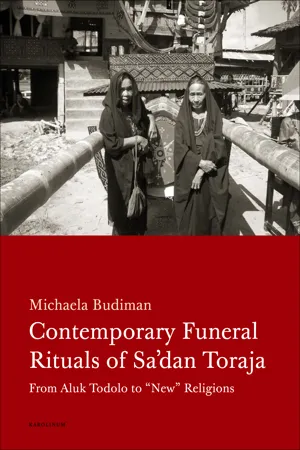
Contemporary Funeral Rituals of Sa'dan Toraja
From Aluk Todolo to "New" Religions
- English
- ePUB (mobile friendly)
- Available on iOS & Android
eBook - ePub
About this book
Information
1
Introduction
1.1 Themes and Objective of the Present Work
The present work discusses the Toraja ethnic group, who inhabit the Indonesian island of Sulawesi, and who, until the arrival of the first Dutch missionaries at the beginning of the 20th century, had essentially been cut off from the rest of the world. It can thus be said that until that point, the Toraja represented an isolated socio-cultural system. The present work draws on the field research of the author, which focused on the study of the most important contemporary Toraja ritual – the funeral – and furthermore on identifying and documenting the changes that have affected Toraja society as a result of their embrace of Christianity during the past century. The Toraja region, which is at present populated by the adherents of various Christian denominations, Islam, and the autochthonous religion Aluk Todolo (lit. the religion of the ancestors), offered an exceptionally rich and varied source material for study. The result of this field research is the present work, which aims to analyse the material gathered and to present a description of the formal and principal shifts expressed in the traditional rituals, which reflect seminal changes in terms of the role of religion. The book points out how Christianity, which has been adopted relatively recently, is incorporated into the indigenous religion and the customary law adat, which is derived from it. The present work ventures to explain why in less than a hundred years, almost 90 % of the population converted from Aluk Todolo, mainly to Christianity, also describing the process of conversion, and the extent to which (and in which localities) the new religion most visibly affected the form of modern-day rituals. The opinions of both Christians and minority adherents of Aluk Todolo are noted, especially with regard to the current situation, where funeral rites in particular represent a curious syncretic phenomenon, reflecting the societal changes that have taken place.
The body of textual, oral and audio-visual documentation collected by the author is unique, chiefly in that it includes interviews with one of the last living experts on the traditional Toraja religion. The present work offers the first processing of the material thus gathered, which is now ready for further expert review. It can be used for instance for linguistic analysis, or as a study from the perspective of the ethnography of communication, or in comparison with other ethnicities undergoing similar changes.
1.2 Structure of the Present Work
The present work is divided into two parts, logically interconnected, and sub-divided into chapters. The results of the research are summarized in the Conclusion.
The first part, The Foundations of Toraja Culture, is subdivided into three chapters surveying various aspects of Toraja culture. Chapter One, entitled Tana Toraja and Its Inhabitants, outlines the origin of the Toraja, as well as the etymology of the term Toraja itself. Given the cultural differences as well as the geographical remoteness of the country, it also presents brief essential information on the geography, climate and economic situation of the region. This is followed by an introduction into the Toraja language and available literature on the Toraja language and cultural traditions; the chapter closes by citing the historical milestones of the Toraja ethnic group. Chapter Two, Autochthonous Religion Aluk Todolo and Adoption of Christianity, presents the two main theories regarding the status of God, Puang Matua, in the indigenous religion. Another section is dedicated to the arrival of Protestant missionaries to the territory of present-day Toraja region, the foundation of the first schools, the arrival of Catholics in the area and the disputes of the two denominations which were sparked by their efforts to gain as many converts as possible. The final chapter of this part, Important Aspects of Toraja Culture, discusses the social stratification which – though officially abolished – is still evident in practice, and which even today to some extent determines the form of rituals. This is followed by a general classification of Toraja rituals and the classification of funeral rites based on the social status of the deceased. The chapter closes with the description of traditional Toraja houses, which play a crucial role during the rituals, and also of the burial chambers which form an integral pairing with the house, as well as the role of buffaloes, an essential fixture in most Toraja funerals.
The core of the work is presented in the second part of the book, entitled Forms of Funeral Rituals in the Past and Today, which is based almost exclusively on my own field research. The first chapter General Information on Funeral Rites outlines what happens to the soul of the deceased according to the indigenous Toraja belief, the ways in which the family of the deceased administers to the body, and the extent to which the social status and financial situation of the family influence the form and duration of this most important Toraja ritual in the present day. Next is a general outline of the funeral site and the accompanying rituals. The following chapter The Actual Catholic Funeral and the Shift in Meaning in Some Rites Practised by Christians describes the funeral of Yohana Maria Sumbung. The second part of this chapter is dedicated to the differences between funerals held in keeping with the rules of the indigenous religion, Aluk Todolo, and the contemporary Toraja rituals of Catholics and Protestants. The last two chapters, Toraja Pentecostalists and Their Funerals and Toraja Muslims, present interviews with adherents of both Pentecostalism and Islam, discussing the manner in which other religions have come to terms with Toraja traditions.
The Conclusion presents all the facts gleaned, particularly those gathered on the basis of field research. Appendices include the transcription of the interviews in the original Indonesian language, a list of the most important informants with brief biographical data, a timetable of the funeral of Yohana Maria Sumbung, the genealogy of the Gods nos. 1-3, an index and a glossary of Toraja and Indonesian terms used in the work, and a selection of photographs.
1.3 Research Thus Far
Given the fact that up until the beginning of the 20th century the Toraja ethnic group lacked a written tradition, researchers struggle with the absence of literature on Toraja history before this period. Therefore it is necessary to glean information about Toraja life only from myths, a far cry from modern-day historiography, or from the chronicles of the neighbouring ethnic group of the Bugis, most of which have been published and studied only in part. The first European to mention the modern Toraja was the Jesuit Father Gervaise, at the end of the 17th century.1 The information he offers, however, does not originate in personal experience, as it is merely drawn from his conversations with two Makassar princes who were students at the Jesuit College in Paris.2
From the 1920s onwards, various myths, folk tales, genealogies, songs, rhymes and proverbs were recorded and published, and there also emerged numerous works on linguistics. The first authors in the latter field were the Dutch, and in later years their place was taken by Toraja researchers. Available literature on Toraja history is relatively limited. The more ancient history is presented in a book by the Toraja author L. T. Tangdilintin Toraja dan Kebudayaannya [The Toraja and Their Culture]. Modern history dealing with events from 1860 until almost the end of the 20th century is laid out brilliantly in Terance Bigalke’s (US) work Tana Toraja: A Social History of an Indonesian People.3 The Dutch scholar Hetty Nooy-Palm in her two books The Sa’dan-Toraja: A Study of Their Social Life and Religion I. Organization, Symbols and Beliefs (1979) and The Sa’dan-Toraja: A Study of Their Social Life and Religion II: Rituals of the East and West (1986) provides a detailed description of traditional Toraja culture and its rituals in their original form, before the arrival of Christianity. Another influential book on Toraja culture and, in particular, funerals is Feasts of Honor: Ritual and Change in the Toraja Highlands (1985) by Toby Alice Volkman. Apart from the above-cited works, there are a number of other publications concerned chiefly with the traditional form of Toraja rituals. A book dealing with the changes that Toraja society underwent in the last decades – Paths and Rivers: Sa’dan Toraja Society in Transformation – was published in 2009 by Roxana Waterson, who has studied the Toraja since 1978. The present work, however, does not draw on Waterson’s findings, as my dissertation in Czech, on which the present English translation is based, had been defended one year previously, in 2008. Although the present work is based above all on my field research, the information cited in the part The Foundations of Toraja Culture is drawn from the above-mentioned specialized literature.
1.4 Field Research and Methods of Work
The material on which the present work draws is the result of two field research expeditions I undertook in the Toraja region, on the island of Sulawesi. The first of those took place between mid-February and mid-March of 2002,4 and its chief benefit was becoming acquainted with the socio-cultural environment of the region. The second six-month-long field research undertaken in 2005–2006 was more systematic in nature, underpinned both by deeper personal knowledge and significantly better technical support.
Like many others, I struggled with a variety of problems during my field research. In spite of my fairly good knowledge of the environment, it was far from easy to constantly keep in mind all the rules and codes of social life which determine the everyday affairs of the Toraja in a fundamental way. Another delicate task was making the video recordings of the rituals – often, this constituted balancing on the verge between public space and the intimate sphere of the people involved. My primary aim was to gather as much material, video recordings and information as possible without committing a faux pas which would block my access to the community I was observing. On the other hand, my sojourn in the Toraja region was facilitated by the fact that Indonesians in general are highly friendly to foreigners. Most felt honoured by the presence of a European woman at their rituals, and as a result, I generally met with a positive reception.5 Working with people who have recently lost someone dear to them, however, was rather demanding psychologically, presenting frequent dilemmas regarding how to articulate my queries as sensitively as possible so as not to hurt or offend the bereaved, and at the same time, to gather the necessary information.
Throughout my field research, I lived at the invitation of my informant, Priest Lucas Paliling, whom I had met already during my first sojourn there, in the city of Rantepao at a building belonging to the STIKPAR school,6 which he had founded and where he served as director.7 From Rantepao I made regular excursions to the nearby surroundings, where I participated in funerals. Among the field research methods I applied were participant observation and interview. Wherever possible, I would prepare at least a general field of questions, which I would then utilise freely. I deliberately avoided structured question and answer sessions, since given the nature of the environment, they would be very artificial and the replies of my respondents would lose their immediacy.
After the conclusion of the rites at which I was present, I would review the recordings I took as well as the photo-documentation, preparing questions to then put to a selected informant from the family hosting the given ritual. Several days after the ceremony itself, I would meet the person I had selected as my informant and record the ensuing interview, which as a rule would be semi-structured. I would then analyse these materials after my return from my field research. The present work offers an intersection of ethnological and psychological perspectives. It describes the impact of the conversion to new religions on Toraja people.
1.5 Informants
I list all of my major informants and t...
Table of contents
- Cover Page
- Title Page
- Copyright Page
- Dedication
- Contents
- Acknowledgements
- 1 - Introduction
- 2 - The Foundations of Toraja Culture
- 3 - Forms of Funeral Rituals in the Past and Today
- 4 - Conclusion
- Summary
- Bibliography
- Appendices
- Glossary and Index
- Plates
Trusted by 375,005 students
Access to over 1.5 million titles for a fair monthly price.
Study more efficiently using our study tools.
Frequently asked questions
Yes, you can cancel anytime from the Subscription tab in your account settings on the Perlego website. Your subscription will stay active until the end of your current billing period. Learn how to cancel your subscription
No, books cannot be downloaded as external files, such as PDFs, for use outside of Perlego. However, you can download books within the Perlego app for offline reading on mobile or tablet. Learn how to download books offline
Perlego offers two plans: Essential and Complete
- Essential is ideal for learners and professionals who enjoy exploring a wide range of subjects. Access the Essential Library with 800,000+ trusted titles and best-sellers across business, personal growth, and the humanities. Includes unlimited reading time and Standard Read Aloud voice.
- Complete: Perfect for advanced learners and researchers needing full, unrestricted access. Unlock 1.5M+ books across hundreds of subjects, including academic and specialized titles. The Complete Plan also includes advanced features like Premium Read Aloud and Research Assistant.
We are an online textbook subscription service, where you can get access to an entire online library for less than the price of a single book per month. With over 1.5 million books across 990+ topics, we’ve got you covered! Learn about our mission
Look out for the read-aloud symbol on your next book to see if you can listen to it. The read-aloud tool reads text aloud for you, highlighting the text as it is being read. You can pause it, speed it up and slow it down. Learn more about Read Aloud
Yes! You can use the Perlego app on both iOS and Android devices to read anytime, anywhere — even offline. Perfect for commutes or when you’re on the go.
Please note we cannot support devices running on iOS 13 and Android 7 or earlier. Learn more about using the app
Please note we cannot support devices running on iOS 13 and Android 7 or earlier. Learn more about using the app
Yes, you can access Contemporary Funeral Rituals of Sa'dan Toraja by Michaela Budiman in PDF and/or ePUB format, as well as other popular books in Social Sciences & Comparative Religion. We have over 1.5 million books available in our catalogue for you to explore.