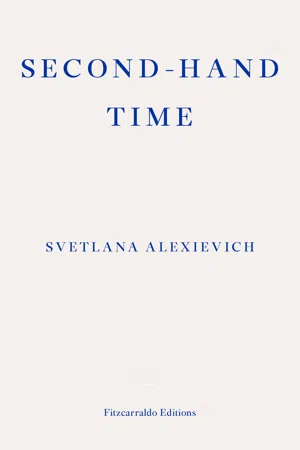
In Second-hand Time, her masterpiece, 2015 Nobel Prize in Literature laureate Svetlana Alexievich brings together the voices of dozens of witnesses to the collapse of the USSR in a formidable attempt to chart the disappearance of a culture and to surmise what new kind of man may emerge from the rubble. Fashioning a singular, polyphonic literary form by combining extended individual monologues with a collage of voices, Alexievich creates a magnificent requiem to a civilization in ruins, a brilliant, poignant and unique portrait of post-Soviet society out of the stories of ordinary women and men.
- 704 pages
- English
- ePUB (mobile friendly)
- Available on iOS & Android
eBook - ePub
Second-hand Time
About this book
Information
TEN STORIES
IN A RED INTERIOR
ON THE BEAUTY OF DICTATORSHIP AND THE MYSTERY OF BUTTERFLIES CRUSHED AGAINST THE PAVEMENT
Elena Yurievna S., third secretary of the district Party committee, 49 years old
There were two of them waiting for me: Elena Yurievna, with whom I’d arranged to meet, and her friend Anna Ilyinichna M., who was visiting from Moscow. She immediately joined the conversation. ‘I’ve been waiting for someone to explain what’s going on to me for a long time.’ Their stories had nothing in common except for the significant proper nouns: Gorbachev, Yeltsin. But each of them had her own Gorbachev and her own Yeltsin. And her own version of the nineties.
Elena Yurievna
Is it really already time to tell the story of socialism? To whom? Everyone around is still a witness. To be perfectly honest, I’m surprised that you’ve come all this way just to see me. I’m a communist, part of the nomenklatura… No one wants to listen to us any more… Everyone wants to shut us up. Lenin was a gangster and don’t even mention Stalin… We’re all criminals, even though there isn’t a single drop of blood on my hands. Still, we’ve been branded, every last one of us…
Perhaps fifty or a hundred years from now they’ll be able to write objectively about the way of life we called socialism. Without all the tears and obscenities. They’ll unearth it like ancient Troy. Until recently, you weren’t allowed to say anything good about socialism. In the West, after the fall of the Soviet Union, they realized that Marxism wasn’t really over, it still needed to be developed. Without being worshipped. Over there, he wasn’t an idol like he’d been for us. A saint! First we worshipped him, then we anathematized him. Crossed it all out. But science has also caused immeasurable suffering – should we eliminate scientists? Curse the fathers of the atom bomb, or better yet, start with the ones who invented gunpowder? Yes, start with them… Am I wrong? [She doesn’t give me a chance to answer her question.] You’re on the right track, leaving Moscow. You could say that you’ve come to the real Russia. When you walk around Moscow, you might get the impression that we’re a European country: the luxury cars, the restaurants… those golden cupolas gleaming! But listen to what the people talk about in the provinces… Russia isn’t Moscow, Russia is Samara, Tolyatti, Chelyabinsk… Some Bumblepinsk… How much can you really learn about Russia from sitting around in a Moscow kitchen? Going to parties. Blah, blah, blah… Moscow is the capital of some other nation, not the country beyond the ring road*. A tourist paradise. Don’t believe Moscow…
You come here and right away, it’s perfectly clear, ‘Now, this is the sovok.’ People live very poorly, even by Russian standards. They blame the rich and resent everyone. Blame the government. They feel that they’ve been lied to, that no one had told them that there was going to be capitalism; they thought that socialism was just going to get fixed. The life that we’d all been used to, which is to say the Soviet way of life. While they were out at demonstrations, tearing their vocal chords chanting ‘Yeltsin! Yeltsin!’ they were robbed. The plants and factories were divvied up without them. Along with the oil and the natural gas – everything that came to us, as they say, from God. But they’ve only just understood. Back in 1991, everyone was joining the revolution. Going off to the barricades. They wanted freedom, and what did they get? Yeltsin’s gangster revolution… My friend’s son was almost killed for his socialist views. ‘Communist’ has become an insult. The boys who hang out in the courtyard nearly murdered one of their own. Their friend. They had been sitting around on the benches with their guitars and talking, saying that pretty soon, they’d be marching on the Communists, hanging them from the lamp-posts. Mishka Slutzer is a well-read boy, his father worked on the district Party committee. He quoted G. K. Chesterton, ‘A man without some kind of dream of perfection is quite as much of a monstrosity as a noseless man…’ And for that they beat him… kicked him with their heavy boots… ‘You little kike! Who brought about the Revolution in 1917!’ I remember the way people’s eyes gleamed at the beginning of perestroika, I’ll never forget it. They were prepared to lynch the Communists, to send us all to prison camps… Volumes of Gorky and Mayakovsky piled up in the dumpsters… People would drop the complete works of Lenin off at the paper recycling centre. And I would take them home… Yes! I’ll admit it! I recant nothing! I’m not ashamed of anything! I never changed my colours, repainting myself from red to grey. You’ll meet people like that – if the Reds come to power, they welcome the Reds; if it’s the Whites, they’ll greet the Whites with open arms. People performed incredible transformations: yesterday they were communists, today they’re ultra-democrats. Before my very eyes, ‘honest’ communists turned into religious liberals. But I love the word ‘comrade’ and I’ll never stop loving it. It’s a good word. Sovok? Bite your tongue! The Soviet was a very good person, capable of travelling beyond the Urals, into the furthest deserts, all for the sake of ideals, not dollars. We weren’t after somebody else’s green bills. The Dnieper Hydroelectric Station, the Siege of Stalingrad, the first man in space – that was all us. The mighty sovok! I still take pleasure in writing ‘USSR’. That was my country; the country I live in today is not. I feel like I’m living on foreign soil.
I was born Soviet… My grandmother didn’t believe in God, but she did believe in communism. Until his dying day, my father waited for socialism to return. The Berlin Wall had fallen, the Soviet Union was crumbling, but he clung to his hope. He stopped talking to his best friend because he had called the flag a red rag. Our red flag! Red calico! My father fought in the Russo-Finnish War, he never understood what he’d been fighting for, but they told him to go, so he went. They never talked about that war, they called it the ‘Finnish campaign’, not a war. But my father would tell us about it… in hushed tones. At home. On rare occasions, he would look back on it. When he was drinking… The setting of his war was winter: the forests and metre-deep snows. The Finns fought on skis, in white camouflage uniforms; they’d always appear out of nowhere, like angels. ‘Like angels’ — those are my father’s words… They could take down a detachment, an entire squadron, overnight. The dead… My father recalled how the dead always lay in pools of blood; a lot of blood seeps out of people killed in their sleep. So much blood, it would eat through the metre-deep snow. After the war, my father couldn’t even bear to butcher a chicken. Or a rabbit. He couldn’t stand the sight of a dead animal or the warm smell of blood. He had a fear of large trees with full crowns because they were the kinds of trees that the Finnish snipers would hide in – they called them ‘cuckoos’. [She is silent.] I want to add… This is my opinion… After the Victory, our little town was flooded with flowers, people went flower crazy. The most important flowers were dahlias, you had to keep the bulbs alive through the winter and not let them freeze. God forbid! People would swaddle them, tucking them in like they were little babies. Flowers grew in front of people’s houses, behind their houses, around the wells, along the fences. People were hungry for life. After living in fear for so long, they needed to celebrate. But eventually, the flowers disappeared; there’s nothing left of that now. But I remember… I just remembered them… [Silence.] My father… My father only saw six months of combat before being taken prisoner. How did they capture him? They were advancing over a frozen lake while the enemy’s artillery shot at the ice. Few made it across, and those who did had just spent their last strength swimming through freezing water; all of them lost their weapons along the way. They came to the shore half-naked. The Finns would stretch out their arms to rescue them and some people would take their hands, while others… Many of them wouldn’t accept any help from the enemy. That was how they had been trained. My father grabbed one of their hands, and he was dragged out of the water. I remember his amazement: ‘They gave me schnapps to warm me up. Put me in dry clothes. They laughed and clapped me on the shoulder, “You made it, Ivan!”’ My father had never been face to face with the enemy before. He didn’t understand why they were so cheerful…
The Finnish campaign ended in 1940… Soviet war prisoners were exchanged for Finns. They were marched toward each other in columns. On their side, the Finns were greeted with hugs and handshakes… Our men, on the other hand, were immediately treated like enemies. ‘Brothers! Friends!’ they threw themselves on their comrades. ‘Halt! Another step and we’ll shoot!’ The column was surrounded by soldiers with German Shepherds. They were led to specially prepared barracks surrounded by barbed wire. The interrogations began… ‘How were you taken prisoner?’ the interrogator asked my father. ‘The Finns pulled me out of a lake.’ ‘You traitor! You were saving your own skin instead of the Motherland.’ My father also considered himself guilty. That’s how they’d been trained… There was no trial. They marched everyone out on the quad and read the entire division their sentence: six years in the camps for betraying the Motherland. Then they shipped them off to Vorkuta to build a railway over the permafrost. My God! It was 1941… The Germans were moving in on Moscow… No one even told them that war had broken out – after all, they were enemies, it would only make them happy. Belarus was occupied by the Nazis. They took Smolensk. When they finally heard about it, all of them wanted to go to the front, they all wrote letters to the head of the camp… to Stalin… And in response, they were told, ‘Work for the victory on the home front, you bastards. We don’t need traitors like you at the front.’ They all… Papa… he told me… All of them wept… [Silence.] Really, that’s who you should be talking to… Alas, my father is gone. The camp cut his life short, and so did perestroika. He suffered so much. He couldn’t understand what had happened. To the country, to the Party. Our father… After six years in the penal colony, he forgot what an apple was or a head of cabbage… sheets and pillows… Three times a day, they would give them thin gruel and a single loaf of bread split among twenty-five men. They slept with a log under their heads and a wooden plank on the ground for a mattress. Papa… He was a strange man, not like the others… incapable of striking a horse or a cow or kicking a dog. I always felt bad for him. The other men would make fun of him: ‘What kind of man are you? You’re a girl!’ My mother would cry over the fact that he… well, that he wasn’t like other people. He would pick up a head of cabbage and stare at it… Or a tomato… When he first came back, he was totally silent, he wouldn’t tell us anything. It wasn’t until about ten years later that he finally started talking. Never before… Yes… At a certain point, while he was in the camp, his job had been transporting dead bodies. There would be ten to fifteen fresh corpses a day. The living returned to the barracks on foot, the dead were pulled back on sleds. They were ordered to remove their clothing, so the dead men lay naked on the sleds, ‘like jerboas’. My father’s words… It’s coming out all muddled… because of my feelings… It’s all so upsetting… For the first two years in the camp, none of them thought that they would survive. Those who’d been sentenced to five or six years would talk about home, but those who got ten to fifteen never mentioned it. They never brought up anyone, not their wives or their kids. Their parents. ‘If you started thinking about your loved ones, you wouldn’t survive,’ my father explained. We waited for him… ‘Papa will come back, and he won’t even recognize me…’ ‘Daddy…’ I would look for any excuse to say the word ‘Papa’. Then, one day, he returned. Grandma saw a man in a soldier’s cloak standing by our gate: ‘Who are you looking for, soldier?’ ‘You don’t recognize me, Mama?’ Grandma fainted on the spot. That was Papa’s homecoming… He came back frozen to the bone, he could never get his hands or his feet warm. My mother? Mama would say that my father came back from the camps gentle, although she had been worried… She’d heard scary stories… about people coming back mean. Papa wanted to enjoy life. His motto was, ‘Man up – the worst is yet to come.’
I forgot… I forgot where this happened… Where was it? The transit camp? They were crawling around a large yard on their hands and knees eating the grass. Men with dystrophy and pellagra. You couldn’t complain about anything with my father around. He knew that in order to survive, you only needed three things: bread, onions, and soap. Just those three things… that’s all… They’re no longer with us, our parents, their generation… but if any of them are still around, they should be put in museums, kept under glass so that no one can touch them. They went through so much! After my father was rehabilitated†, they paid him two months’ wages for all of his suffering. For a long time, a large portrait of Stalin continued to hang in our home. A very long time… I remember it well… My father didn’t hold a grudge, he considered it all to be a product of his era. Those were cruel times. A powerful nation was being built. And they really did build it, plus they defeated Hitler! That’s what my father would say…
I grew up a serious girl, a real Young Pioneer. Today, everyone thinks that they used to force people into the Pioneers. I’m telling you: no one was forced to do anything. All of the kids dreamed of becoming Young Pioneers. Of marching together. To drums and horns. Singing Young Pioneer songs: ‘My Motherland, I’ll love forever / Where else will I find one like her?’ ‘The eagle nation has millions of chicks, and we are our nation’s pride…’ There was a stain on our family name because my father had been in the camps. My mother was scared that I wouldn’t be accepted into the Pioneers right away or even at all. I really wanted to be with everyone else. I had to be… ‘Who are you for, the sun or the moon?’ the little boys would interrogate me in class. You had to be on your toes! ‘For the moon!’ – ‘Correct! For the Soviet Union.’ Because if you said, ‘For the sun,’ you would get, ‘For that damn Japan!’ They’d laugh and tease you. The way we swore was ‘Pioneer’s honour,’ or we gave ‘Lenin’s word.’ The most sacred oath was ‘Stalin’s word.’ My parents knew that if I gave them Stalin’s word, I couldn’t possibly be lying. My God! It’s not Stalin I remember, it’s our life… I joined a club and learned how to play the accordion. Mama got a medal for being a shock worker‡. It wasn’t all misery… barracks life… In the camp, my father met a lot of educated people. He never met people that interesting anywhere else. Some of them wrote poems; the ones who did were more likely to survive. Like the priests who would pray. My father wanted all of his kids to go to university. That was his dream. And all of us – there are four of us – ended up with degrees. But he also taught us how to plough, to mow the grass. I know how to load a cart with hay and how to make a haystack. ‘Anything can come in handy,’ Papa believed. And he was right.
Now I want to remember it all… I want to understand what I’ve lived through. And not just my own life, all of our lives… our Soviet life… Overall, I’m not impressed with my people. And I’m not impressed with the Communists either, our Communist leaders. Especially nowadays. All of them have grown petty and bourgeois, all of them chase after the good life, the sweet life. They want to consume and consume. Grab hold of whatever they can! The Communists aren’t what they used to be. Now we have Communists who make hundreds of thousands of dollars a year. Millio...
Table of contents
- Cover
- Praise
- Title Page
- Epigraph
- CONTENTS
- CHRONOLOGY
- REMARKS FROM AN ACCOMPLICE
- I. THE CONSOLATION OF APOCALYPSE
- TEN STORIES IN A RED INTERIOR
- II. THE CHARMS OF EMPTINESS
- TEN STORIES IN THE ABSENCE OF AN INTERIOR
- NOTES FROM AN EVERYWOMAN
- Translator’s Acknowledgements
- About the Authors
- Also published by Fitzcarraldo Editions
- Copyright
Trusted by 375,005 students
Access to over 1.5 million titles for a fair monthly price.
Study more efficiently using our study tools.
Frequently asked questions
Yes, you can cancel anytime from the Subscription tab in your account settings on the Perlego website. Your subscription will stay active until the end of your current billing period. Learn how to cancel your subscription
No, books cannot be downloaded as external files, such as PDFs, for use outside of Perlego. However, you can download books within the Perlego app for offline reading on mobile or tablet. Learn how to download books offline
Perlego offers two plans: Essential and Complete
- Essential is ideal for learners and professionals who enjoy exploring a wide range of subjects. Access the Essential Library with 800,000+ trusted titles and best-sellers across business, personal growth, and the humanities. Includes unlimited reading time and Standard Read Aloud voice.
- Complete: Perfect for advanced learners and researchers needing full, unrestricted access. Unlock 1.5M+ books across hundreds of subjects, including academic and specialized titles. The Complete Plan also includes advanced features like Premium Read Aloud and Research Assistant.
We are an online textbook subscription service, where you can get access to an entire online library for less than the price of a single book per month. With over 1.5 million books across 990+ topics, we’ve got you covered! Learn about our mission
Look out for the read-aloud symbol on your next book to see if you can listen to it. The read-aloud tool reads text aloud for you, highlighting the text as it is being read. You can pause it, speed it up and slow it down. Learn more about Read Aloud
Yes! You can use the Perlego app on both iOS and Android devices to read anytime, anywhere — even offline. Perfect for commutes or when you’re on the go.
Please note we cannot support devices running on iOS 13 and Android 7 or earlier. Learn more about using the app
Please note we cannot support devices running on iOS 13 and Android 7 or earlier. Learn more about using the app
Yes, you can access Second-hand Time by Svetlana Alexievich, Bela Shayevich in PDF and/or ePUB format, as well as other popular books in Literature & Journalism. We have over 1.5 million books available in our catalogue for you to explore.