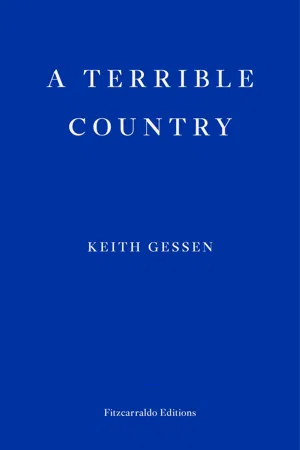
In the summer of 2008, Andrei Kaplan moves from New York to Moscow to look after his ageing grandmother, a woman who survived the dark days of communism and witnessed Russia's violent capitalist transformation. She welcomes Andrei into her home, even if she can't always remember who he is. Andrei learns to navigate Putin's Moscow, still the city of his birth, but with more expensive coffee. He looks after his elderly – but surprisingly sharp! – grandmother, finds a place to play hockey, a café to send emails, and eventually some friends, including a beautiful young activist named Yulia. Capturing with a miniaturist's brush the unfolding demands of family, fortune, personal ambition, ideology, and desire,
A Terrible Country is a compelling novel about ageing, radical politics, Russia at a crossroads, and the difficulty – or impossibility – of actually changing one's life.
- 424 pages
- English
- ePUB (mobile friendly)
- Available on iOS & Android
eBook - ePub
A Terrible Country
About this book
Information
PART I
I.
I MOVE TO MOSCOW
In the late summer of 2008, I moved to Moscow to take care of my grandmother. She was about to turn ninety and I hadn’t seen her for nearly a decade. My brother Dima and I were her only family; her lone daughter, our mother, had died years earlier. Baba Seva lived alone now in her old Moscow apartment. When I called to tell her I was coming, she sounded very happy to hear it, and also a little confused.
My parents and my brother and I left the Soviet Union in 1981. I was six and Dima was sixteen, and that made all the difference. I became an American, whereas Dima remained essentially Russian. As soon as the Soviet Union collapsed, he returned to Moscow to make his fortune. Since then he had made and lost several fortunes; where things stood now I wasn’t sure. But one day he Gchatted me to ask if I could come to Moscow and stay with Baba Seva while he went to London for an unspecified period of time.
“Why do you need to go to London?”
“I’ll explain when I see you.”
“You want me to drop everything and travel halfway across the world and you can’t even tell me why?”
There was something petulant that came out of me when dealing with my older brother. I hated it, and couldn’t help myself.
Dima said, “If you don’t want to come, say so. But I’m not discussing this on Gchat.”
“You know,” I said, “there’s a way to take it off the record. No one will be able to see it.”
“Don’t be an idiot.”
He meant to say that he was involved with some very serious people, who would not so easily be deterred from reading his Gchats. Maybe that was true, maybe it wasn’t. With Dima the line between those concepts was always shifting.
As for me, I wasn’t really an idiot. But neither was I not an idiot. I had spent four long years of college and then eight much longer years of grad school studying Russian literature and history, drinking beer, and winning the Grad Student Cup hockey tournament (five times!); then I had gone out onto the job market for three straight years, with zero results. By the time Dima wrote me I had exhausted all the available post-graduate fellowships and had signed up to teach online sections in the university’s new PMOOC initiative, short for “paid massive online open course,” although the “paid” part mostly referred to the students, who really did need to pay, and less to the instructors, who were paid very little. It was definitely not enough to continue living, even very frugally, in New York. In short, on the question of whether I was an idiot, there was evidence on both sides.
Dima writing me when he did was, on the one hand, providential. On the other hand, Dima had a way of getting people involved in undertakings that were not in their best interests. He had once convinced his now former best friend Tom to move to Moscow to open a bakery. Unfortunately, Tom opened his bakery too close to another bakery, and was lucky to leave Moscow with just a dislocated shoulder. Anyway, I proceeded cautiously. I said, “Can I stay at your place?” Back in 1999, after the Russian economic collapse, Dima bought the apartment directly across the landing from my grandmother’s, so helping her out from there would be easy.
“I’m subletting it,” said Dima. “But you can stay in our bedroom in Grandma’s place. It’s pretty clean.
“I’m thirty-three years old,” I said, meaning too old to live with my grandmother.
“You want to rent your own place, be my guest. But it’ll have to be pretty close to Grandma’s.”
Our grandmother lived in the center of Moscow. The rents there were almost as high as Manhattan’s. On my PMOOC salary I would be able to rent approximately an armchair.
“Can I use your car?”
“I sold it.”
“Dude. How long are you leaving for?”
“I don’t know,” said Dima. “And I already left.”
“Oh,” I said. He was already in London. He must have left in a hurry.
But I in turn was desperate to leave New York. The last of my old classmates from the Slavic department had recently left for a new job, in California, and my girlfriend of six months, Sarah, had recently dumped me at a Starbucks. “I just don’t see where this is going,” she had said, meaning I suppose our relationship, but suggesting in fact my entire life. And she was right: even the thing that I had once most enjoyed doing—reading and writing about and teaching Russian literature and history—was no longer any fun. I was heading into a future of halfheartedly grading the half-written papers of half-interested students, with no end in sight.
Whereas Moscow was a special place for me. It was the city where my parents had grown up, where they had met; it was the city where I was born. It was a big, ugly, dangerous city, but also the cradle of Russian civilization. Even when Peter the Great abandoned it for St. Petersburg in 1713, even when Napoleon sacked it in 1812, Moscow remained, as Alexander Herzen put it, the capital of the Russian people. “They recognized their ties of blood to Moscow by the pain they felt at losing it.” Yes. And I hadn’t been there in years. Over the course of a few grad-school summers I’d grown tired of its poverty and hopelessness. The aggressive drunks on the subway; the thugs in tracksuits and leather jackets walking around eyeing everyone; the guy eating from the dumpster next to my grandmother’s place every night during the summer I spent there in 2000, periodically yelling “Fuckers! Bloodsuckers!” then going back to eating. I hadn’t been back since.
Still, I kept my hands off the keyboard. I needed some kind of concession from Dima, if only for my pride.
I said, “Is there someplace for me to play hockey?” As my academic career had declined, my hockey playing had ramped up. Even during the summer, I was on the ice three days a week.
“Are you kidding?” said Dima. “Moscow is a hockey mecca. They’re building new rinks all the time. I’ll get you into a game as soon as you get here.”
I took that in.
“Oh, and the wireless signal from my place reaches across the landing,” Dima said. “Free wi-fi.”
“OK!” I wrote.
“OK?”
“Yeah,” I said. “Why not.”
A few days later I went to the Russian consulate on the Upper East Side, stood in line for an hour with my application, and got a one-year visa. Then I wrapped things up in New York: I sublet my room to a rock drummer from Minnesota, returned my books to the library, and fetched my hockey stuff from a locker at the rink. It was all a big hassle, and not cheap, but I spent the whole time imagining the different life I would soon be living and the different person I’d become. I pictured myself carrying groceries for my grandmother; taking her on excursions around the city, including to the movies (she’d always loved the movies); walking with her arm in arm around the old neighborhood and listening to her tales of life under socialism. There was so much about her life that I didn’t know, about which I’d never asked. I had been incurious and oblivious; I had believed more in books than I had in people. I pictured myself protesting the Putin regime in the morning, playing hockey in the afternoon, and keeping my grandmother company in the evening. Perhaps there was even some way I might use my grandmother’s life as the basis for a journal article. I pictured myself sitting monastically in my room and with my grandmother’s stories in hand adding a whole new dimension to my work. Maybe I could put her testimony in italics and intersperse it throughout my article, like in In Our Time.
On my last night in town my roommates threw me a small party. “To Moscow,” they said, raising their cans of beer.
“To Moscow!” I repeated.
“And don’t get killed,” one of them added.
“I won’t get killed,” I promised. I was excited. And drunk. It occurred to me that there was a certain glamor that might attend spending time in an increasingly violent and dictatorial Russia, whose armed forces had just pummeled the small country of Georgia into a humiliating defeat. At three in the morning I sent a text message to Sarah. “I’m leaving tomorrow,” it said, as if I were heading for a very dangerous place. Sarah did not respond. Three hours later I woke up, still drunk, threw the last of my stuff into my huge red suitcase, grabbed my hockey stick, and headed for JFK. I got on my flight and promptly fell asleep.
Next thing I knew I was standing in the passport control line in the grim basement of Sheremetevo-2 International Airport. It never seemed to change. As long as I’d been flying in here, they made you come down to this basement and wait in line before you got your bags. It was like a purgatory from which you suspected you might be entering someplace other than heaven.
But the Russians looked different than I remembered them. They were well dressed, with good haircuts, and talking on sleek new cell phones. Even the guards in their light-blue short-sleeve uniforms looked cheerful. Though the line was long, several stood off together to the side, laughing. Oil was selling at $114 a barrel, and they had clobbered the Georgians—is that what they were laughing about?
Modernization theory said the following: Wealth and technology are more powerful than culture. Give people nice cars, color televisions, and the ability to travel to Europe, and they’ll stop being so aggressive. No two countries with McDonald’s franchises will ever go to war with each other. People with cell phones are nicer than people without cell phones.
I wasn’t so sure. The Georgians had McDonald’s, and the Russians bombed them anyway. As I neared the passport booth, a tall, bespectacled, nicely dressed European, Dutch or German, asked in English if he could cut the line: he had to catch a connecting flight. I nodded yes—we’d have to wait for our luggage anyway—but the man behind me, about the same height as the Dutch guy but much sturdier, in a boxy but not to my eyes inexpensive suit, piped up in Russian-accented English.
“Go back to end of line.”
“I’m about to miss my flight,” said the Dutchman.
“Go back to end of line.”
I said to him in Russian, “What’s the difference?”
“There’s a big difference,” he answered.
“Please?” the Dutchman asked again, in English.
“I said go back. Now.” The Russian turned slightly so that he was square with the Dutchman. The latter man kicked his bag in frustration. Then he picked it up and walked to the back of the line.
“He made the correct decision,” said the Russian guy to me, in Russian, indicating that as a man of principle he was ready to pummel the Dutch guy for cutting the line.
I didn’t answer. A few minutes later, I approached the passport control booth. The young, blond, unsmiling border guard sat in his uniform bathed in light, like a god. I had no rights here, I suddenly remembered; there was no such thing here as rights. I wondered as I handed over my passport whether I had finally pressed my luck, returning to the country my parents had fled, too many times. Would they finally take me into custody for all the unkind things I had thought about Russia over the years?
But the guard merely took my battered blue American passport—the passport of a person who lived in a country where you didn’t have to carry your passport everywhere you went, where in fact you might not even know where your passport was for months and years at a time—with mild disgust. If he had a passport like mine he’d take better care of it. He checked my name against the terrorist database and buzzed me through the gate to the other side.
That was it. I was in Russia again. My grandmother Seva lived in the very center of the city, in an apartment she’d been awarded, in the late 1940s, by Joseph Stalin. My brother, Dima, brought this up sometimes, when he was trying to make a point, and so did my grandmother, when she was in a self-deprecating mood. “My Stalin apartment,” she called it, as if to remind everyone, and herself, of the moral compromise she had made. Still, in general in our family it was understood that if someone was offering you an apartment, and you lived at the time in a drafty room in a communal apartment with your small daughter, your two brothers, and your mom, then you should take the apartment, no matter who it was from. And it’s not like Stalin himself was handing her the keys or asking for anything in return. She was at the time a young professor of history at Moscow State University, and had consulted on a film about Ivan the Great, the fifteenth-century “gatherer of the lands of Rus” and grandfather to Ivan the Terrible, which Stalin so enjoyed that he declared everyone involved should get an apartment. So in addition to “my Stalin apartment,” my grandmother also called it “my Ivan the Great apartment,” and then, if she was speaking honestly, “my Yolka apartment,” after her daughter, my mother, for whom she had been willing to do anything at all.
To get to this apartment I exchanged some dollars at the booth outside baggage claim—it was about twenty-four rubles per dollar at the time—and took the brand-new express train to Savelovsky Railway Station, passing miles of crumbling Soviet apartment blocks, and the old (also crumbling) turn-of-the-century industrial belt just outside the center. Along the way the massive guy sitting next to me—about my age, in jeans and a short-sleeve button-down—struck up a conversation.
“What model is that?” he asked, about my phone. I had bought a SIM card at the airport and was now putting it in the phone and seeing if it worked.
Here we go, I thought. My phone was a regular T-Mobile flip phone. But I figured this was just a prelude to the guy trying to rob me. I grew tense. My hockey stick was in the luggage rack above us, and anyway it would have been hard to swing it at this guy on this train.
“Just a regular phone,” I said. “Samsung.” I grew up speaking Russian and still speak it with my father and my brother but I have a slight, difficult-to-place accent. I occasionally make small grammatical mistakes or put the stress on the wrong syllable. And I was rusty.
The guy picked up on this, as well as the fact that my olive skin set me apart from most of the Slavs on this fancy train. “Where you from?” he said. He used the familiar ty rather than vy—which could mean he was being friendly, because we were the same age and on the same train, or it could mean he was asserting his right to call me anything he wanted. I couldn’t tell. He began to guess where I might be from. “Spain?” he said. “Or Turkey?”
And what should I answe...
Table of contents
- Cover
- PRAISE
- TITLE PAGE
- DEDICATION
- CONTENTS
- PART I
- PART II
- PART III
- EPILOGUE
- ACKNOWLEDGMENTS
- ABOUT THE AUTHOR
- COPYRIGHT
Trusted by 375,005 students
Access to over 1.5 million titles for a fair monthly price.
Study more efficiently using our study tools.
Frequently asked questions
Yes, you can cancel anytime from the Subscription tab in your account settings on the Perlego website. Your subscription will stay active until the end of your current billing period. Learn how to cancel your subscription
No, books cannot be downloaded as external files, such as PDFs, for use outside of Perlego. However, you can download books within the Perlego app for offline reading on mobile or tablet. Learn how to download books offline
Perlego offers two plans: Essential and Complete
- Essential is ideal for learners and professionals who enjoy exploring a wide range of subjects. Access the Essential Library with 800,000+ trusted titles and best-sellers across business, personal growth, and the humanities. Includes unlimited reading time and Standard Read Aloud voice.
- Complete: Perfect for advanced learners and researchers needing full, unrestricted access. Unlock 1.5M+ books across hundreds of subjects, including academic and specialized titles. The Complete Plan also includes advanced features like Premium Read Aloud and Research Assistant.
We are an online textbook subscription service, where you can get access to an entire online library for less than the price of a single book per month. With over 1.5 million books across 990+ topics, we’ve got you covered! Learn about our mission
Look out for the read-aloud symbol on your next book to see if you can listen to it. The read-aloud tool reads text aloud for you, highlighting the text as it is being read. You can pause it, speed it up and slow it down. Learn more about Read Aloud
Yes! You can use the Perlego app on both iOS and Android devices to read anytime, anywhere — even offline. Perfect for commutes or when you’re on the go.
Please note we cannot support devices running on iOS 13 and Android 7 or earlier. Learn more about using the app
Please note we cannot support devices running on iOS 13 and Android 7 or earlier. Learn more about using the app
Yes, you can access A Terrible Country by Keith Gessen in PDF and/or ePUB format, as well as other popular books in Literature & Literature General. We have over 1.5 million books available in our catalogue for you to explore.