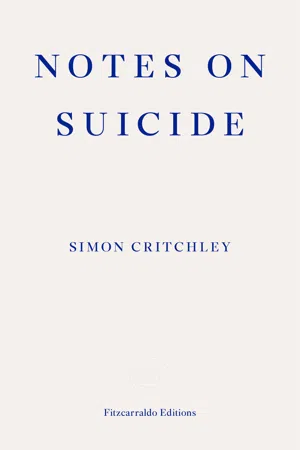
Suicide is everywhere. It haunts history and current events. It haunts our own networks of friends and family. The spectre of suicide looms large, but the topic is taboo because any meaningful discussion must at the very least consider that the answer to the question – 'is life worth living?' – might not be an emphatic yes; it might even be a stern no. Through a sweeping historical overview of suicide, a moving literary survey of famous suicide notes, and a psychological analysis of himself, Simon Critchley offers us an insight into what it means to possess the all too human gift and curse of being of being able to choose life or death.
Five years after its initial publication, this revised edition of
Notes on Suicide includes a new preface by the author addressing shifts in the discourse surrounding suicide, particularly in relation to social media.
- 120 pages
- English
- ePUB (mobile friendly)
- Available on iOS & Android
eBook - ePub
Notes on Suicide
About this book
Information
II.
Why is suicide seen as illegal, immoral or irreligious? The contrast between modern and ancient views of suicide is striking. Although Plato considered suicide a disgrace, he permitted notable exceptions, one of which allowed for self-killing by judicial order, as was the case with his teacher, Socrates. The practice of philosophy, then, begins with a suicide. To philosophize is to learn how to die, Socrates argues in the Phaedo, while at the same time telling his disciples stories of the immortality of the soul. Socrates was given the alternative of ostracism, which for him would have been even worse – the prospect of leaving Athens was worse than leaving life.
Faced with a more global and contingent imperial world, Stoics like Seneca took a more radical view of suicide, arguing that the brevity of human life was no source of woe. When a human life no longer flourishes because of bad fortune, one is permitted to end it. Seneca counsels that a wise person, a philosopher, ‘lives as long as he ought, not as long as he can’. Famously, Seneca was ordered to kill himself by Nero, although his suicide was somewhat botched and it seems to have taken him an inordinate amount of time to expire. Tacitus reports that, being unable to die by bleeding because of advanced age and a frugal diet, Seneca asked for poison, like Socrates, but that also didn’t work. Eventually, he was placed in a bath of hot water and suffocated to death by his servants.
Given this Greco-Roman background, what’s the problem with suicide? How did our perception of suicide shift from its partial acceptance in antiquity to the prohibition on suicide that one can find in later centuries? The key to answering these questions is Christian theology. But I would like to approach the latter by way of a fascinating story about a little-known, indeed obscure, Italian philosopher called Count Alberto Radicati di Passerano e Cocconato (1698-1737). This will allow me to move through a series of arguments, positions and prejudices about suicide, almost in the manner of sweeping up debris, dead leaves and twigs, that might permit us to view the muddy ground beneath more clearly.
Born into an aristocratic family in Piedmont, Radicati converted to Protestantism and took up voluntary exile in London. In 1732, he published a 94-page pamphlet, A Philosophical Dissertation upon Death, where he sought to legitimize suicide against the moral and legal strictures of Christianity and the state. The pamphlet caused a huge stir in London and was declared by the Attorney General, at the repeated promptings of the Bishop of London, ‘the most impious and immoral book’. Radicati was taken into custody, given a substantial fine and made his escape to the more tolerant United Provinces, the erstwhile name for the Netherlands. It is reported that, sadly, he died in complete destitution in Rotterdam some years later. He was attended by a Huguenot preacher who declared that, prior to his death, Radicati was filled with dread, renounced all he had written and was reconfirmed in the Protestant faith.
Radicati’s simple thesis in his Dissertation is that individuals are free to choose their own death. This right to suicide was inspired by ancient arguments, notably from the Stoics, that suicide is a legitimate act and an honorable gesture of farewell from a state of unbearablepain, whether physical or psychical. Despite drawing on ancient thought, Radicati’s views were so radical because they conflicted with Christian doctrine. Following a concept first formulated by Augustine and then refined by Thomas Aquinas, life, for the Christian, is something given – a datum – over which we have the right of use, usus, but not governance, dominion, which can only be the prerogative of God. To kill oneself is to exercise dominion over one’s life and to assume the power that is only possessed by the deity. This is why suicide is a sin. A true Christian must battle with pain and fight on like a soldier.
The Christian view begins to break down in the seventeenth century with the rise of science and a materialist conception of nature. This builds from Thomas Hobbes’s idea of reality as matter and motion and the atheistic interpretation of Spinoza, namely that when the latter begins the Ethics with the axiom ‘God or Nature’, what he really intends is material nature and nothing besides. According to this view, death is simply the dissolution of clusters of atoms, the transformation of one lump of matter into another. Radicati writes, ‘We cease to exist in one sort, in order to exist in another.’ Or, as Spinoza puts it, ‘A free man thinks of nothing less than death, and his wisdom is a meditation on life, not on death.’ In the demonstration of this proposition, Spinoza argues that a free human being is one who lives according to reason alone and is not governed by fear. To be free is to desire the good directly and to act and live in such a way as to persist in this desire without flinching or failing. This is why the free human being thinks of nothing less than death. Human life is simply an aspect of the vast, living vibrancy of a universe of matter. As Flaubert proposed a couple of centuries later, Spinoza’s vision is extremely seductive, and it constitutes Saint Anthony’s final and irresistible temptation: matter is God.
But if Radicati and Spinoza are right, then why do people fear death? This is where things start to get interesting. By definition, the fear of death cannot be based in experience as no one experiences death twice, as it were. Nor can the fear of death be ascribed to our natural, material constitution. Therefore, Radicati goes on, the fear of death has been imposed on humankind by, ‘Ambitious Men, who, not contenting themselves with the State of Equality which Nature had given them, took it into their heads to thirst for Dominion over others.’
Who are these ‘ambitious men’? Radicati is alluding to a book called the Traité des trois imposteurs (Treatise of the Three Imposters), also known as L’Esprit de Spinosa (The Spirit of Spinoza). Written in French and published an-onymously in the Netherlands probably in the 1690s, the Traité is perhaps the most dangerous heretical text of the eighteenth century. It embodies the radical inheritance of the Enlightenment, evident in Spinoza and Hobbes – the tradition that came to be known as ‘free-thinking’. (The great Irish philosopher John Toland, for example, was labelled a free-thinker by his idealist compatriot and relentless religious opponent, Bishop George Berkeley.) The Traité argues that Moses, Jesus and Mohammed are three imposters who have deceived humankind by imposing their ‘silly ideas of God’ and teaching ‘the people to receive them without examination’. Central to this imposition is the cultivation of the fear of death, a belief that the three imposters propagate through the offices of their priestly castes.
Although Jesus nowhere condemns suicide and there is no explicit prohibition against suicide within the Mosaic Law of Judaism (although a Sura in the Qu’ran expressly forbids suicide), one gets the general picture. The fear of death is not natural to human beings, but instilled into them by the spurious authority of the Rabbi, the Priest or the Imam. What is fascinating in Radicati’s text and the radical philosophical context that surrounds it is the connection between scientific materialism, anti-religious freethinking and the right to suicide.
But this was (and remains) no mere theoretical debate. In April 1732, shortly after the publication of Radicati’s pamphlet, the shocking suicide of the Smith family was widely reported in England. Richard Smith and his wife, living in dreadful poverty in London, shot their daughter before hanging themselves. In his extended and carefully reasoned farewell letter, Smith, a bookbinder by trade, makes allusion to Radicati’s pamphlet. He writes that he and his family had decided to take leave of this friendless world rather than live in misery. They made this decision in complete cognizance of the laws prohibiting suicide, adding that it is ‘indifferent to us where our bodies are laid’. The Smiths’ (and one ineluctably thinks of Morrissey – heaven knows I’m miserable now) only wish was for an epitaph, which reads,
Without a name, for ever silent, dumb;
Dust, Ashes, Nought else is within this Tomb;
Where we were born or bred it matters not,
Who were our parents, or hath us begot;
We were, but now are not; think no more of us,
For as we are, so you be turned to Dust.
¶ Radicati’s argument for the right to suicide was prefigured in an important treatise from 1644 by the great cleric and greater poet, John Donne. It was called Biathanatos, meaning literally ‘death-force’, or even the violence or strength of death. Donne’s book bears a long and revealing subtitle: A Declaration of that Paradox, or Thesis, that Self-Homicide is not so Naturally Sin, that it may never be Otherwise. Beginning from the fact that there is no condemnation of suicide in Scripture, Donne argues against the Christian doctrine that suicide is a natural sin and defends the right to ‘self-homicide’. Fascinatingly, Donne confesses that ‘a sickly inclination’ compelled him to ponder the question of suicide, and when this sickness befell him, ‘methinks I have the Keys of the Prison in mine own hand and no Remedy presents itself so soon to my Heart, as my sword’. The historian Silvia Berti notes that, by the time Donne’s book was reissued in a second edition in 1700, it ‘had become the manifesto of the free-thinker’s right to die’.
The task of exposing the fallaciousness of Christian arguments against suicide begun by Donne and Radicati was completed with characteristic economy, aplomb and good humour by David Hume. He almost satirically unpicks Aquinas’s position, which is based on the appeal to natural law enshrined in the alleged divine order of the cosmos. For example, Hume says, if the divine order means the causal laws created by God, then it must always be wrong to contravene such laws. But if that is the case, then any form of sickness, wounding or malady must not be treated since it is at odds with the laws of nature and divine will. Thus, the entire medical profession itself, insofar as it seeks to ameliorate the condition of the sick, should be outlawed. But that would be ridiculous, particularly as Christ was apparently rather fond of healing the sick and even, in the case of Lazarus, raising the dead. Just as God permits us to divert water from rivers for the purpose of irrigation so too he ought to permit us to divert the blood from our veins. ‘It would be no crime in me to divert the Nile or Danube from its course, were I able to effect such purposes. Where then is the crime of turning a few ounces of blood from their natural channel?’
If suicide is a criminal act, Hume writes, then it must be a transgression of our duties either to God, our neighbour or our selves. It cannot be a transgression of any duty to God because of the spuriousness of the appeal to natural law. It would be a malevolent and wicked God that wished me to suffer unbearable, unceasing pain. As for my duties to myself, let’s imagine that I am in a condition of great suffering from an incurable disease and my existence has become an intolerable burden to me. What possible duty could I have to myself to continue in such a state if the alternative is something I wish for? With regard to my neighbour and society, Hume writes that someone ‘who retires from life, does no harm to society. He only ceases to do good; which, if it be an injury, is of the lowest kind.’ On the contrary, Hume adds, we do no harm to ourselves or to others when existence has become a weight that is too heavy to carry. Suicide, he concludes, is ‘the only way, that we can then be useful to society, by setting an example, which, if imitated, would preserve to every one his chance for happiness in life, and would effectively free him from all danger of misery’. The legitimacy of the recourse to suicide, namely the foreknowledge that I do not have to experience endless pain with either legal blame or moral shame, is the key to any chance for happiness. This is still a strong and highly relevant argument in relation to the debates on assisted or accompanied suicide. The wish of a terminally ill person is very often not so much happiness as death with dignity, without feeling they have acted illegally or immorally. Hume argues that suicide ‘may be free from imputation of guilt and blame’.
What is most shocking about Hume’s arguments is that they still have the capacity to shock, some 240 years after they were written. This is because the moral and legal framework in which suicide is viewed and judged is still tributary to the Christian doctrine that Hume so elegantly demolishes. Consider the definition of suicide in Sir William Blackstone’s canonical Commentaries on the Laws of England (1765-69), which is a compiled record and interpretation of common law. Within the tradition of English common law, suicide was considered a felony and the equivalent of murder. Blackstone explains it in the following way, ‘Felonious homicide is … the killing of a human creature, of any age or sex, without justification or excuse … this may be done by killing one’s self, or another man.’ Warming to its theme, the text continues,
(T)he law of England wisely and religiously considers that no man hath a power to destroy life, but by commission from God, the author of it: and, as the suicide is guilty of a double offense; one spiritual, in invading the prerogative of the Almighty, and rushing into his immediate presence uncalled for; the other temporal, against the king, who hath an interest in the preservation of all his subjects; the law has therefore ranked this among the highest crimes, making it a peculiar species of felony, a felony committed on one’s self… a felo de se.
With those words in mind, it might be recalled that Hamlet’s first soliloquy expresses the vigorous wish to die, ‘O, that this too too solid flesh would melt’. But he immediately restrains himself from the thought for it is criminal, ‘that the Everlasting had not fix’d/ His canon ‘gainst self-slaughter!’ Canon law prohibits suicide.
In truth, suicide is a double crime: against God and against King (in Hamlet’s case, this would be the imposter Claudius). Whoever takes their life is sinning against the eternal power of God and the temporal power of the King. To kill oneself is to usurp the sovereignty of God and King by assuming it for oneself. If one replaces the words ‘God’ or ‘King’ by ‘state’, ‘society’, ‘country’ or ‘community’, then it is clear that the situation hasn’t really changed: rather than being seen as a free, sovereign act, suicide is seen as a usurpation of sovereignty, a morally embarrassing and reprehensible act of insubordination.
Of course, a rather obvious question arises: if suicide is a crime, then how can the perpetrator be punished? How does one discipline the dead? Once again, Blackstone provides the neat answer,
[W]hat punishment can human laws inflict on one who has withdrawn himself from their reach? They can only act upon what he has left behind him, his reputation and fortune: on the former, by an ignominious burial in the highway, with a stake driven through his body; on the latter, by a forfeiture of all his goods and chattels to the king: hoping that his care for either his reputation, or the welfare of his family, would be some motive to restrain him from so desperate and wicked an act.
The French had even more stringent posthumous punishments for suicide. In 1670, Louis XIV declared a criminal ordinance for suicide, where it was decreed that the corpse must be drawn through the streets face down and then hanged or thrown on a garbage dump. Their property was also confiscated. The Sun King tolerated poorly the suicide of France’s sons. In an English commentary on Chinese law from 1899, particular attention is paid to suicide pacts created for the profit of the surviving party. If it was proven that the parents entered into a suicide pact in order to aid the surviving child, then that child was to be decapitated.
Such punishments for the dead might seem either grisly or perhaps risible to us now, but it must be remembered that suicide is still a criminal offence in most Muslim countries. And, closer to home, although physician-assisted suicide became legal in Oregon in 1997, the great state of Missouri still classifies suicide as manslaughter (of course, the traditional, legal reasoning is perfectly logical: if someone else administers the fatal dose or lethal injection to the person who wants to die, then how can this qualify as self-killing?) Indeed, in New York State, although suicide is not considered a crime, it is still recognized by statute as a ‘grave public wrong’. By implication, the deceased would be categorized as a grave public offender, even from their grave. Of course, the obvious and longstanding defence against suicide as a form of legal offense is to claim insanity, some form of diminished responsibility or to not be, in t...
Table of contents
- Praise
- Title Page
- Contents
- Preface
- I.
- II.
- III.
- IV.
- Afterword
- Sources & Acknowledgments
- Also published by Fitzcarraldo Editions
- About the Author
- Copyright
Trusted by 375,005 students
Access to over 1.5 million titles for a fair monthly price.
Study more efficiently using our study tools.
Frequently asked questions
Yes, you can cancel anytime from the Subscription tab in your account settings on the Perlego website. Your subscription will stay active until the end of your current billing period. Learn how to cancel your subscription
No, books cannot be downloaded as external files, such as PDFs, for use outside of Perlego. However, you can download books within the Perlego app for offline reading on mobile or tablet. Learn how to download books offline
Perlego offers two plans: Essential and Complete
- Essential is ideal for learners and professionals who enjoy exploring a wide range of subjects. Access the Essential Library with 800,000+ trusted titles and best-sellers across business, personal growth, and the humanities. Includes unlimited reading time and Standard Read Aloud voice.
- Complete: Perfect for advanced learners and researchers needing full, unrestricted access. Unlock 1.5M+ books across hundreds of subjects, including academic and specialized titles. The Complete Plan also includes advanced features like Premium Read Aloud and Research Assistant.
We are an online textbook subscription service, where you can get access to an entire online library for less than the price of a single book per month. With over 1.5 million books across 990+ topics, we’ve got you covered! Learn about our mission
Look out for the read-aloud symbol on your next book to see if you can listen to it. The read-aloud tool reads text aloud for you, highlighting the text as it is being read. You can pause it, speed it up and slow it down. Learn more about Read Aloud
Yes! You can use the Perlego app on both iOS and Android devices to read anytime, anywhere — even offline. Perfect for commutes or when you’re on the go.
Please note we cannot support devices running on iOS 13 and Android 7 or earlier. Learn more about using the app
Please note we cannot support devices running on iOS 13 and Android 7 or earlier. Learn more about using the app
Yes, you can access Notes on Suicide by Simon Critchley in PDF and/or ePUB format, as well as other popular books in Literature & Literary Essays. We have over 1.5 million books available in our catalogue for you to explore.