- 200 pages
- English
- ePUB (mobile friendly)
- Available on iOS & Android
eBook - ePub
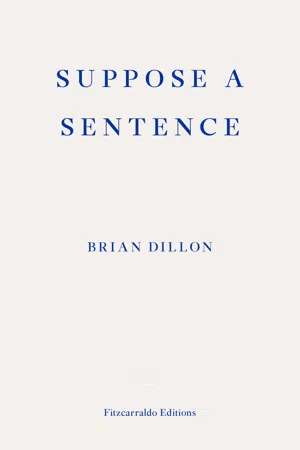
Suppose a Sentence
About this book
In
Suppose a Sentence, Brian Dillon turns his attention to the oblique and complex pleasures of the sentence. A series of essays prompted by a single sentence – from Shakespeare to Gertrude Stein, John Ruskin to Joan Didion – the book explores style, voice, and language, along with the subjectivity of reading. Both an exercise in practical criticism and a set of experiments or challenges,
Suppose a Sentence is a polemical and personal reflection on the art of the sentence in literature. Whether the sentence in question is a rigorous expression of a state of vulnerability, extremity, even madness, or a carefully calibrated arrangement, Dillon examines not only how it works and why but also, in the course of the book, what the sentence once was, what it is today, and what it might become tomorrow.
Information
THE GRAND ILLUSION
‘Opposite, above: All through the house, colour, verve, improvised treasures in happy but anomalous coexistence.’
— Joan Didion
I am one of those readers of magazines and journals who turn to the list of contributors before the table of contents; I want to know who before I know what. Often, the writers will have been asked to supply little biographical notices of themselves—these may tend to whimsy, or self-regard—so that even if I don’t know their work already, I can guess what sort of voice they will have on the page. Reading online, a comparable thing may happen, the social-media reputation preceding the text you might otherwise have missed. I wrote about X … Here’s a piece by Y. It is easy to forget how much periodical writing of the past was originally anonymous. Many of Virginia Woolf’s best critical essays, for example, were published anonymously in the Times Literary Supplement. But at the Times Lit (as people called it then) nobody had a byline; the case is different for writers whose early or occasional work appeared uncredited alongside stories, essays and articles by prominently named authors. It is no surprise that in this category there are many women: the likes of Maeve Brennan, Jamaica Kincaid and Janet Malcolm, just to mention writers who quickened their art in the (then) mostly anonymizing front section of the New Yorker.
In the early 1960s, while on the staff of Vogue, Joan Didion was only half known to the magazine’s readers. Her name appeared intermittently; her first signed piece, in June 1961, was a short essay on jealousy, which already showed certain features of her mature writing: an earnest consideration of the brittle contours of her own character, and a fine attention to language, including her own. ‘A passion for the documentation of irrelevant detail is characteristic of the afflicted’—of course, we are meant to understand, the detail is never irrelevant. The jealousy essay did not appear in her first collection, Slouching Towards Bethlehem; but just as in the celebrated writings in that book—on self-respect, on John Wayne, on keeping a notebook, on New York and its discontents—you can see, or hear, her becoming Joan Didion in ‘Jealousy: Is It a Curable Disease?’ It takes more than the odd essay, however, to train yourself to the particular pitch that Didion did in those years. More too than sitting at her sturdy Royal and typing out hunks of Hemingway, by way of practice, as Didion insists she did.
What more, what else? She wrote short, unattributed paragraphs—they could not be called essays, articles or pieces—for Vogue’s regular ‘People Are Talking About’ column. She wrote about Dr. No and The Manchurian Candidate; about the atom bomb, Telstar and the construction of the Guggenheim; on the budding careers of Willem de Kooning, Woody Allen and Barbara Streisand; and about the death of Marilyn Monroe, ‘a profoundly moving young woman’. She also composed photo captions: those ‘signposts’, as Walter Benjamin put it, that had become essential to the printed magazine page in the twentieth century. In Vogue, by the 1960s, captions were surprisingly substantial pieces of writing, and were accorded what might seem a remarkable amount of editorial care. The captions Didion wrote make up a minor, telling aspect of the mythology around her work. Perhaps ‘mythology’ is the wrong word. It is a matter of style, where style is verifiable presence on the page, a question of materiality. Didion is frequently described as an exact and exacting writer, building her prose like a shiny carapace, easy to admire and hard to crack if you’re hoping to emulate it. At the same time, she has a reputation for being, on the page and in person, brittle and neurasthenic, spectral and barely there. None of this adequately describes her prose. It is usually direct and declarative, it is filled with parallelisms and rhythmic repetitions, there is a wealth of concrete detail. Irony in her work consists largely of the plain statement of such detail, inflected by the innocent, mad or bad-faith language of the people or institutions she is writing about. Sometimes she leaves this plane for another, more abstracted or metaphorical, gothic even. As for instance this famous passage from ‘The White Album’, in which she is describing the feeling of dread and coming disaster that prevailed in Los Angeles at the end of the 1960s: ‘A demented and seductive vortical tension was building in the community. The jitters were setting in. I recall a time when the dogs barked every night and the moon was always full.’ These sentences are followed by an extremely precise recollection of where she was, and with whom, at the moment she heard about the Manson murders. In a lecture at UCLA in 1971, Didion said: ‘I’m not much interested in spontaneity; I’m not an inspirational writer. What concerns me is total control.’
Producing captions, Didion has said, was part of mounting ‘the monthly grand illusion’ of a glossy magazine. The editor-in-chief then was Diana Vreeland, but the more detailed work was done by Allene Talmey, who had been with Vogue since the mid-1930s, and became associate editor in 1963. By the accounts of Didion and her contemporaries, Talmey was an unsparing editor and boss. After she had wielded her pencil on another writer’s copy—tapping on the table all the while a large aquamarine and silver ring—the young woman was wrung out: ‘Well, my dear, I used to go home, sit in the tub and weep.’ Interviewed by the Paris Review in 1978, Didion said: ‘Every day I would go into [Talmey’s] office with eight lines of copy or a caption or something. She would sit there and mark it up with a pencil and get very angry about extra words, about verbs not working.’ Didion was profiled by the New York Times in 1979, and in that piece Talmey herself told how she would ask Didion to write a caption of three or four hundred words, and together they would cut it down to fifty. ‘We wrote long and published short and by doing that Joan learned to write.’
The New York Times article coincided with the publication of Telling Stories, Didion’s only collection of short fiction—if you could call three stories a collection. In this book’s preface, she enlarges on her time at Vogue and the rigours of working under Talmey. ‘We were connoisseurs of synonyms. We were collectors of verbs.’ Certain words went in and out of fashion: ‘to ravish’ was for some months an editorially approved verb. ‘I also recall it, for a number of issues more, as the source of a highly favoured noun: “ravishments”, as in tables cluttered with porcelain tulips, Fabergé egs, other ravishments.’ Didion and her young colleagues learned—‘or one did not stay’—to use active verbs instead of passive, to make sure ‘it’ always had a nearby reference, to reach for the OED to ensure surprise as much as precision. And most of all they learned to rewrite, time and again, in search of the correct balance of elegance and excitement. ‘Run it through again, sweetie,’ Talmey told them, ‘it’s not quite there.’
‘Opposite, above: All through the house, colour, verve, improvised treasures in happy but anomalous co-existence.’ I came across the sentence first online, in the 1979 profile, where it is offered as an example of Didion’s caption-writing for Vogue at the start of her career. So much to admire: not least, the verbless economy of the sentence, as if the caption’s deictic function—its act of pointing, or its open-handed gesture—quite does away with the need for verbs. (What would the verbed alternatives be? ‘All through the house are colour, verve…’ Or there are. Or one finds. The possible additions all seem to weaken the sentence.) There is some tension, isn’t there, between ‘Opposite above’ and ‘All through the house’? Or perhaps not: the caption directs us to a single picture, but it stands for the whole. ‘All through the house’: with its slumberous familiarity—‘It was the night before Christmas…’—it conjures time as well as space. We’re drifting or processing through this house (and we’ll soon be able to say which house). In her preface to Telling Stories, Didion recalls that Talmey, following rhetorical fashion, likes things, especially qualifiers, to come in threes. And so it is here with the somewhat abstracted features of house and household—‘colour, verve, improvised treasures’. What is an improvised treasure? A found object, or Duchampian readymade, whose meaning or value derives from the artist-collector’s choosing and acquiring it? Or maybe ‘improvised’ refers to a casual or intuitive arrangement or mode of display, to a style of living with things rather than the things themselves?
‘Happy but anomalous coexistence’—‘happy’ here means apt, fortunate and pleasing, rather than pleased, or (nearly vanished sense) happenstance. I like the way this third term in the sentence’s brief inventory—the most concrete term, but not so very concrete—has been elongated, allowed to spread itself around. The absence of stricturing commas around ‘but anomalous’ is in line with Didion’s later style: she knows better than most when to leave out the commas for which other writers (or their editors) instinctively reach, to let grammar and a certain sonic ease do their work. The sentence sounds like Didion: in its rhythm, care and thrift, then also in the swerve towards something more troubling or mysterious, the suggestion in the final phrase of an impish curating personality at work in the house.
Was I right to think about the sentence in this way? Here is what I found when I turned from the New York Times to Telling Stories and Didion’s more detailed account of her time at Vogue—an apprenticeship, she says, that is too easy to mock. At first she composed merchandising copy, and then promotional copy (‘the distinction between the two was definite but recondite’), and eventually editorial copy, which included captions. ‘A sample of the latter’, Didion writes:
Opposite, above: All through the house, colour, verve, improvised treasures in happy but anomalous coexistence. Here, a Frank Stella, an art nouveau stained-glass panel, a Roy Lichtenstein. Not shown: a table covered with frankly brilliant oilcloth, a Mexican find at fifteen cents a yard.
And the sentence, at least in this telling, is followed by another that opens out, shows us the incongruent treasures, includes again some nice economies—‘a Mexican find’, not ‘a find in Mexico’—and bright phrasing: the ‘frankly brilliant oilcloth’.
But run it through again, because we’re not quite there. On the desk in front of me—an eBay find at fifty dollars—I have the 1 August 1965 issue of American Vogue. In the way of popular magazines of that period, it reads now as a surprisingly highbrow artefact. There is a substantial feature on Giacometti, a movie review by Elizabeth Hardwick—Ship of Fools, from Katherine Anne Porter’s novel—and (opposite) a report by Didion on the new National Museum of Anthropology in Mexico City: ‘one comes away remembering certain small things, haunted by oddities.’ Verbal novelty seems to exercise the editors of Vogue to an impressive degree. As the cover declares, the issue is devoted to the style, tastes and attitudes of a figure it calls ‘the young chicerino’: an awkward coinage, obsolete precursor to ‘fashionista’, that seems not to have existed much outside these pages. (Vogue had introduced the type exactly a year before: ‘Her presentation is perfect: she comes in a blaze of certainty, engages all interest, sustains it, provokes. Unhesitatingly she chooses what’s good for her—the gesture, the look that conveys her mood, her quality, her special dash.’) A few pages after Didion and Hardwick, the magazine announces its twenty-fifth Prix de Paris: ‘a career competition for college seniors’, with the first prize of a year on the magazine as a Junior Editor, and a trip to Paris to see the shows. Didion herself had won the prize in 1956, with an essay on the California architect William Wilson Wurster. It was what brought her to New York; she turned down the Paris trip in favour of real work at the magazine. In 1965, competition entrants are asked to identify teenage fashion trends, suggest a person to cover for the ‘People Are Talking About’ section and, in an exercise that sounds thoroughly Talmey-esque, to propose alternative words or phrases for ‘Bargains in Chic’, ‘The Young Chicerino’, ‘Accessories’, ‘Shop Hound’ and ‘Fashions in Living’.
Didion’s caption appears in the ‘Fashions in Living’ department, alongside a culinary conversation with Paul Newman and Joanne Woodward, and a short drinks feature titled ‘Through Deepest Summer with Zest and Cube’. The piece to which Didion contributed is called ‘The Loved House of the Dennis Hoppers’—the now dated plural denoting both Hopper and his actor wife Brooke Hayward—and was written by the novelist and screenwriter Terry Southern, with photographs of house and family by Hopper himself. Southern’s tone is insiderish, hipster-New-Journalist, a touch embarrassing even for its time. His opening paragraph: ‘The Den Hoppers are tops in their field. Precisely what their field is, is by no means certain—except that she is a Great Beauty, and he is a kind of Mad Person.’ Southern essays a zany tour of Hopper’s acting career, his politics (a ‘jaunt’ to photograph the Selma marches earlier that year), counter-cultural affiliations (Ginsberg, et al.) and his art collection, on which subject Southern solicits an approving comment from Frank O’Hara. It’s an entertaining, imprecise and exhausting sort of writing, rather like its author’s description of his subject: ‘To walk down a city street with him is like being attached to a moving adrenaline pump.’
There is energy of a kind in the captions too, but it is coolly and rigorously contained. ‘Left, Mrs. Hopper, who is the actress Brooke Hayward, poses in a red leather chair for Robert Walker junior. The pillow reads “Long May It Wave.”’ Or this: ‘To visit the Hopper house is to be, at every turn, surprised, freshly beguiled by a kaleidoscopically shifting assemblage of found objects, loved objects, objets d’art.’ And some of those objects: ‘Opposite page, below, on the dining room walls, a 1907 Budweiser girl and a Chéret poster. In the hall, one of several streetlights in the house. On the living room wall: a Marcel Duchamp found object; above it, the Mona Lisa in duplicate by Andy Warhol.’
At the bottom of the first page of the piece, one finds the passage Didion quotes in Telling Stories—the passage then cited by the New York Times and, as ‘an early example’ of her Vogue editorial copy, by Didion’s biographer Tracy Daugherty. Or rather, you find this: ‘Opposite, above, through the house, colour, verve, things in happy, anomalous coexistence. Here, a Frank Stella painting, an art nouveau stained glass panel, a Roy Lichtenstein painting.’ What has happened, exactly? Let us stick with the first sentence for now. Never mind the italics, a convention of these captions which Didion might be expected to leave out later, when she quotes herself. Never mind the comma instead of a colon. Though I have always liked the habit—now mostly American—of a capital letter after a colon, as if a whole new sentence were starting up, and I would quite like to linger on what it does and what it means. Onwards, to the most obvious difference. It is of course this: ‘things in happy, anomalous coexistence’. Things. In the caption as printed on page 138 of Vogue, the word comes three lines from the bottom, at the right-hand limit of a run of short nouns: ‘house, colour, verve, things.’ (I feel justified in treating the sentence in this line-by-line fashion, because Didion tells us that she was working within not only strict word limits, but character counts too: the shape of available space on the page mattered.) Things—it subtracts from the rhythm of the sentence heard aloud, and seems in all respects a feeble word choice, inexact and thin.
Except, except: recall that line of Didion’s in her piece about the Mexican museum. Here is the whole sentence: ‘Inside, the collection is too overwhelming to see all at once; one comes away remembering certain small things, haunted by oddities.’ Sometimes, in the face of profusion, when tempted by treasures, you need instead a word as unshowy as ‘things’, which is anyway given a certain (how she loves this phrasing!) Didion flavour, which rescues it from banality. The caption is seventeen lines long, printed in small sans-serif type, with (unlike the main feature) a ragged right-hand edge. And it starts like this: ‘Up in the Hollywood Hills, above the Sunset Strip, Mr. and Mrs. Dennis Hopper (portraits, above left) have a house of such gaiety and wit that it seems the result of some marvellous scavenger hunt, full of improvised treasures, the bizarre and the beautiful and the banal in wild juxtaposition, everything the most of its kind.’ There they are, the ‘improvised treasures’, as if some careless admiring guest has picked them up and put them down again in the wrong place. It’s not the only phrase in Didion’s remembered version of her caption that looks like it’s been moved from where we first found it. Here again is the second sentence, from 1965: ‘Here, a Frank Stella painting, an art nouveau stained glass panel, a Roy Lich...
Table of contents
- PRAISE
- TITLE PAGE
- DEDICATION
- CONTENTS
- EPIGRAPH
- SENSIBILITY AS STRUCTURE
- WHAT, GONE WITHOUT A WORD? (WILLIAM SHAKESPEARE)
- FAIR HOPES OF ENDING ALL (JOHN DONNE)
- O ALTITUDO (SIR THOMAS BROWNE)
- DAGUERREOTYPE, &C. (THOMAS DE QUINCEY)
- THE EXALTATION OF LUCY SNOWE (CHARLOTTE BRONTË)
- A HISTORY OF THE LIGHTS AND SHADOWS (GEORGE ELIOT)
- TRADITIONS OF AIR (JOHN RUSKIN)
- SUPPOSE A SENTENCE (GERTRUDE STEIN)
- HOW HOW HOW WHAT WHAT WHAT HOW—WHEN (VIRGINIA WOOLF)
- ALL KINDS OF OBSCURE TENSIONS (SAMUEL BECKETT)
- (SMALL PICTURES 1915-1940) (FRANK O’HARA)
- SPLINTERS OF ACTUALITY (ELIZABETH BOWEN)
- OBEYING THE FORM OF THE CURVE (JAMES BALDWIN)
- THE GRAND ILLUSION (JOAN DIDION)
- A TOUR OF THE MONUMENTS (ROBERT SMITHSON)
- IT IS ONLY A PAPER DAGGER (MAEVE BRENNAN)
- TO EAT IS NOT TO RESPECT A MENU (ROLAND BARTHES)
- ALBEIT SUCCOURED BY A CULT (WHITNEY BALLIETT)
- THE CUNNING OF DESTRUCTION (ELIZABETH HARDWICK)
- SUITE VÉNITIENNE (SUSAN SONTAG)
- A RITUAL FEAT (ANNIE DILLARD)
- BROKEN TONGUE (THERESA HAK KYUNG CHA)
- SAVING IMPRECISION (JANET MALCOLM)
- SURPRISED HIS SHOES (FLEUR JAEGGY)
- BEFORE SHE SOLIDIFIED (HILARY MANTEL)
- GUSTO NOTWITHSTANDING (CLAIRE-LOUISE BENNETT)
- OR SOME NOT-STUPID SENTENCES (ANNE CARSON)
- LIKE HOW IF (ANNE BOYER)
- READINGS
- ACKNOWLEDGEMENTS
- ABOUT THE AUTHOR
- COPYRIGHT
Trusted by 375,005 students
Access to over 1.5 million titles for a fair monthly price.
Study more efficiently using our study tools.
Frequently asked questions
Yes, you can cancel anytime from the Subscription tab in your account settings on the Perlego website. Your subscription will stay active until the end of your current billing period. Learn how to cancel your subscription
No, books cannot be downloaded as external files, such as PDFs, for use outside of Perlego. However, you can download books within the Perlego app for offline reading on mobile or tablet. Learn how to download books offline
Perlego offers two plans: Essential and Complete
- Essential is ideal for learners and professionals who enjoy exploring a wide range of subjects. Access the Essential Library with 800,000+ trusted titles and best-sellers across business, personal growth, and the humanities. Includes unlimited reading time and Standard Read Aloud voice.
- Complete: Perfect for advanced learners and researchers needing full, unrestricted access. Unlock 1.5M+ books across hundreds of subjects, including academic and specialized titles. The Complete Plan also includes advanced features like Premium Read Aloud and Research Assistant.
We are an online textbook subscription service, where you can get access to an entire online library for less than the price of a single book per month. With over 1.5 million books across 990+ topics, we’ve got you covered! Learn about our mission
Look out for the read-aloud symbol on your next book to see if you can listen to it. The read-aloud tool reads text aloud for you, highlighting the text as it is being read. You can pause it, speed it up and slow it down. Learn more about Read Aloud
Yes! You can use the Perlego app on both iOS and Android devices to read anytime, anywhere — even offline. Perfect for commutes or when you’re on the go.
Please note we cannot support devices running on iOS 13 and Android 7 or earlier. Learn more about using the app
Please note we cannot support devices running on iOS 13 and Android 7 or earlier. Learn more about using the app
Yes, you can access Suppose a Sentence by Brian Dillon in PDF and/or ePUB format, as well as other popular books in Literature & Literary Essays. We have over 1.5 million books available in our catalogue for you to explore.