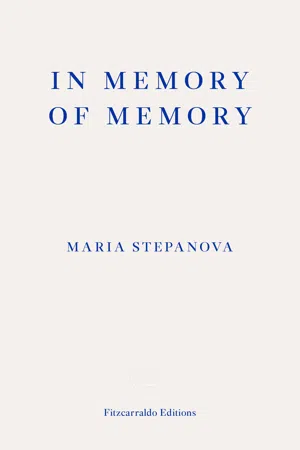
With the death of her aunt, Maria Stepanova is left to sift through an apartment full of faded photographs, old postcards, letters, diaries, and heaps of souvenirs: a withered repository of a century of life in Russia. Carefully reassembled with calm, steady hands, these shards tell the story of how a seemingly ordinary Jewish family somehow managed to survive the myriad persecutions and repressions of the last century. In dialogue with writers like Roland Barthes, W. G. Sebald, Susan Sontag and Osip Mandelstam,
In Memory of Memory is imbued with rare intellectual curiosity and a wonderfully soft-spoken, poetic voice. Dipping into various forms - essay, fiction, memoir, travelogue and historical documents - Stepanova assembles a vast panorama of ideas and personalities and offers an entirely new and bold exploration of cultural and personal memory.
- 448 pages
- English
- ePUB (mobile friendly)
- Available on iOS & Android
eBook - ePub
In Memory of Memory
About this book
Information
PART I
I. SOMEONE ELSE’S DIARY
Aunt Galya, my father’s sister, died. She was just over eighty. We hadn’t been close – there was an uneasiness between the families and a history of perceived snubs. My parents had what you might call troubled dealings with Aunt Galya, and we almost never saw her. As a result, I had little chance to form my own relationship with her. We met infrequently, we had the odd phone call, but towards the end she unplugged her phone, saying ‘I don’t want to talk to anyone.’ Then she disappeared entirely into the world she had built for herself: layered strata of possessions, objects and trinkets in the cave of her tiny apartment.
Galya lived her life in the pursuit of beauty: the dream of rearranging her possessions into a definitive order, of painting the walls and hanging the curtains. At some point, years ago, she began the process of decluttering her apartment, and this gradually consumed her. She was permanently shaking things out, checking anew what objects were essential. The contents of the apartment constantly needed sorting and systematizing, each and every cup required careful consideration, books and papers stopped existing for themselves and became mere usurpers of space, forming barricades that crossed the apartment in little heaps. The apartment consisted of two rooms and as one room was overcome by more objects, Galya would move to the other, taking only the absolute essentials with her – but then the tidying and re-evaluating would begin again. The home wore its own viscera on the outside, unable to draw it all back into itself again. There was no longer any deciding whether a particular thing was important or not, because everything had significance in some way, especially the yellowing newspapers collected over decades, tottering piles of clippings that propped up the walls and the bed. At a later point the only spare living space was a divan, worn concave, and I remember we were sitting there on one occasion, the two of us, in the middle of a raging sea of postcards and TV guides. She was attempting to feed me the chocolates she kept reserved for special occasions, and I was attempting to turn down these precious offerings with anxious politeness. A newspaper clipping at the top of a pile bore the headline: ‘Which saint rules your sign of the Zodiac?’ and the name of the paper and the publication date were written carefully at the top in her beautifully neat handwriting, blue ink across the dead paper.
♦
We got there about an hour after her caretaker rang. The stairwell was in half-darkness and there was a hum in the air. People we didn’t know stood around on the landing and sat on the stairs, they had heard about her death somehow and had rushed round to offer their undertaker services, to help with registering the death, dealing with the paperwork. How on earth did they know? Had the doctor told them? The police? One of them came into the apartment with us, and stood there without taking off his coat.
Aunt Galya died in the early evening on 8 March, Women’s Day, that Soviet festival of mimosa and greetings cards festooned with chicks. Women’s Day had been one of those celebration days in our family, when everyone gathered around a single enormous table and the minerals splashed liberally into ruby-coloured wine glasses. On Women’s Day there were always at least four different types of salad on the table: carrot and walnut; cheese; beetroot and garlic; and, of course, the common denominator of all Russian salads, olivye. But all that had ceased thirty years ago, long before my parents had emigrated to Germany. Galya was left behind, fuming, and in the new post-Soviet world her newspapers began publishing unprecedented and titillating things: horoscopes, recipes, homemade herbal remedies.
She desperately didn’t want to end her life in a hospital and she had her reasons. She’d seen her own parents, my grandparents, die in one, and she’d already had some sobering experiences of state medical care. But still the moment came for summoning an ambulance, and we might well have done so if it hadn’t been a holiday weekend. It was decided to wait for Monday and the working week, and in this way Galya was given her chance to turn onto her side and die in her sleep.
In the other room, where her caretaker slept, photographs and sketches by my father Misha hung like squares on a chessboard, covering the whole wall. By the door was a black-and-white photograph taken in the 1960s, one from my favourite series of ‘pictures taken at the vets’, a beautiful picture: a boy and his dog waiting their turn, sitting against a wall, the boy a sullen fourteen-year-old, and the dog, a boxer, leaning into him with its shoulder.
♦
Her apartment now stood silent, stunned and cowering, filled with suddenly devalued objects. In the bigger room television stands squatted grimly in each corner. A huge new fridge was stuffed to the gills with icy cauliflower and frozen loaves of bread (‘Misha loves his bread, get me a couple of loaves in case he comes round’). The same books stood in lines, the ones I used to greet like family members whenever I went round. To Kill a Mockingbird, the black Salinger with the boy on the cover, the blue binding of the Library of Poets series, a grey-bound Chekhov set, the green Complete Works of Dickens. My old acquaintances on the shelves: a wooden dog, a yellow plastic dog, and a carved bear with a flag on a thread. All of them crouched, as if preparing themselves for a journey, their own stolid usefulness in sudden doubt.
A few days later when I sat down to sort through papers I noticed that in the piles of photographs and postcards there was hardly anything written. There were hoards of thermal vests and leggings; new and beautiful jackets and skirts, set aside for some great sallying-forth and so never worn and still smelling of Soviet emporia; an embroidered men’s shirt from before the war; and tiny ivory brooches, delicate and girlish: a rose, another rose, a crane with wings outstretched. These had belonged to Galya’s mother, my grandmother, and no one had worn them for at least forty years. All these objects were inextricably bound together, everything had its meaning only in the whole, in the accumulation, within the frame of a continuing life, and now it was all turning to dust before me.
In a book about the working of the mind, I once read that the important factor in discerning the human face was not the combination of features, but the oval shape. Life itself, whilst it continues, can be that same oval; or, after death, the thread of life running through the tale of what has been. The meek contents of her apartment, feeling themselves to be redundant, immediately began to lose their human qualities and, in doing so, ceased to remember or to mean anything.
I stood before the remnants of her home, doing the necessary tasks. Bemused at how little had been written down in this house of readers, I began to tease out a melody from the few words and scrappy phrases I could remember her saying: a story she had told me; endless questions about how the boy, my growing son, was doing, and anecdotes from the far-off past – country rambles in the 1930s. The woven fabric of language decomposes instantly, never again to be felt between the fingers: ‘I would never say “lovely”, it sounds so terribly common,’ Galya admonished me once. And there were other prohibited words I can’t recall, her talk of one’s people, gossip about old friends, the neighbours, little reports from a lonely and self-consuming life.
I soon found that there was in fact much evidence of the written word in the apartment. Amongst the possessions she kept till her dying day, the possessions she often asked for, sometimes just to touch with her hand, were countless used notebooks and diaries. She’d kept a diary for years, not a day passed without her scribbling a note, as much a part of her routine as getting out of bed or washing. These diaries were stored in a wooden box by her headboard and there were a lot of them, two full bag-loads, which I carried home to Banny Pereulok. There I sat down at once to read them, in search of stories, explanations: the oval shape of her life.
♦
For the interested reader, diaries and notebooks can be placed in two categories: in the first the text is intended to be official, manifest, aimed at a readership. The notebook becomes a training ground for the outward self, and, as in the case of the nineteenth-century artist and diarist Marie Bashkirtseff, an open declaration, an unending monologue, addressed to an invisible but sympathetic ear.
Still I’m fascinated by the other sort of diary, the working tool, the sort the writer-as-craftsperson keeps close at hand, of little apparent use to the outsider. Susan Sontag, who practised this art form for decades, said of her diary that it was ‘an instrument, a tool’ – I’m not sure this is entirely apt. Sontag’s notebooks (and the notebooks of other writers) are not just for the storage of ideas, like nuts in squirrels’ cheeks, to be consumed later. Nor are they filled with quick outlines of events, to be recollected when needed. Notebooks are an essential daily activity for a certain type of person, loose-woven mesh on which they hang their clinging faith in reality and its continuing nature. Such texts have only one reader in mind, but this reader is utterly implicated. Break open a notebook at any point and be reminded of your own reality, because a notebook is a series of proofs that life has continuity and history, and (this is most important) that any point in your own past is still within your reach.
Sontag’s notebooks are filled with such proofs: lists of films she has seen, books she has read, words that have charmed her, the dried husks of completed endeavours – and these are largely limited to the notebooks; they almost never feed into her books or films or articles, they are neither the starting point, nor the underpinning for her public work. They are not intended as explanations for another reader (perhaps for the self, although they are scribbled down at such a lick that sometimes it’s hard to make out what is meant). Like a fridge, or as it was once called, an ice house, a place where the fast-corrupting memory-product can be stored, a space for witness accounts and affirmations, or the material and outward signs of immaterial and elusive relations, to paraphrase Goncharov.
There is something faintly displeasing, if only in the excess of material, and I say this precisely because I am of the same disposition, and far too often my working notes seem to me to be heaped deadweight: ballast I would dearly love to be rid of, but what would be left of me then? In The Silent Woman, Janet Malcolm describes an interior that is, in some ways, the image of my own notebook (and this was a horrible realization). It is littered with newspapers, books, overflowing ashtrays, dusty Peruvian tat, unwashed dishes, empty pizza boxes, cans, flyers, books along the lines of Who’s Who, attempting to pass as real knowledge and other objects passing as nothing at all, because they lost all resemblance to anything years ago. For Malcolm this living space is Borges’s Aleph, a ‘monstrous allegory of truth’, a gristly mass of crude fact and versions that never attained the clean order of history.
♦
My Aunt Galya’s diaries were completely peculiar, and their strangely woven texture, which reminded me above all of chain-link fencing, intrigued me more and more as I read them.
At any of the big art exhibitions I visited as a child, there were always a few viewers who stood out to me, and they were usually, and inexplicably, women. These women went from one picture to another, bending over the captions and making notes on pieces of paper or in exercise books. It dawned on me at some point that they were simply copying down the names of all the pictures, making for themselves a sort of homemade catalogue – a shadow copy of what they’d seen. And I wondered why they were doing it, and hadn’t yet realized that a list creates the illusion of possession: the exhibition would pass and dissolve in the air, but the piece of paper held the order of sculptures and pictures, as freshly as when they first saw them, long after the actual images had faded.
Galya’s diaries were just such lists, but of daily occurrences, recorded with astonishing exactness, and with astonishing opacity. The diaries documented the time she got up and when she went to sleep, the television programmes she’d watched, the number of phone conversations she’d had, who they’d been with, what she’d eaten, whatever else she’d done. There was a minute and virtuosic avoidance of content – how she’d actually filled her hours. It might say ‘read’, for example, but with no mention of what the reading material had been or what it had meant to her – in fact everything in her long and exhaustively documented life was the same. Nothing indicated what this life had been for, there was nothing about herself, nothing about other people, only the fastidious details, the fixing of the passing of time with the exactitude of a medieval chronicler.
I kept thinking that surely life would rear its head, if only once, and reveal itself in all its colour. Hadn’t she spent her life reading – wouldn’t that alone have provoked intense reflection? There were also the constant slights and grievances that my aunt clung to, and only reluctantly relinquished. Surely something of this would be preserved and laid out in a final furious paragraph, in which Galya would tell the world, and us, its representatives, what she thought of us – the unexpurgated truth.
But there was nothing of the sort in the diaries. There were hints and semitones of meaning, folds in the weave that denoted emotion, ‘hurray’ written in the margin against the note of a phone call with my father or with me, a few opaquely bitter comments on her parents’ anniversaries. And that was it. It was as if the main task of each and every note, each completed year’s diary, was a faithful witnessing of the exterior, and a concealment of the authentic and interior. Show everything. Hide everything. Preserve it for ever.
What was it she held to be of such value in these diaries? Why did she keep them by her bedside until her dying day, frightened they would be lost, often asking for them to be moved closer to her? Perhaps the written text as it stood – and it was the tale of a life of loneliness and the imperceptible slide towards non-existence – still had the force of an indictment. The world needed to read all this, to realize just how shoddily we had dealt with her.
Or, strange as it seems, for her these pinched records might have contained the substance of joy, which she needed to immortalize, to add to the pile of manuscripts that, as Bulgakov wrote, don’t burn, and which speak without any intention towards the future. If that’s the case then she succeeded.
11 October 2002
Working backwards again. It’s 1.45pm. Just put the towels, nightgown etc except dark colours in to soak. Will do the bedlinen later. Before that I brought everything in from balcony. 3 degrees, the vegetables might have frozen. Peeled and chopped pumpkin an...
Table of contents
- PRAISE
- TITLE PAGE
- CONTENTS
- EPIGRAPH
- PART I
- PART II
- PART III
- ACKNOWLEDGEMENTS
- TRANSLATOR’S NOTE
- ABOUT THE AUTHOR
- COPYRIGHT
Trusted by 375,005 students
Access to over 1.5 million titles for a fair monthly price.
Study more efficiently using our study tools.
Frequently asked questions
Yes, you can cancel anytime from the Subscription tab in your account settings on the Perlego website. Your subscription will stay active until the end of your current billing period. Learn how to cancel your subscription
No, books cannot be downloaded as external files, such as PDFs, for use outside of Perlego. However, you can download books within the Perlego app for offline reading on mobile or tablet. Learn how to download books offline
Perlego offers two plans: Essential and Complete
- Essential is ideal for learners and professionals who enjoy exploring a wide range of subjects. Access the Essential Library with 800,000+ trusted titles and best-sellers across business, personal growth, and the humanities. Includes unlimited reading time and Standard Read Aloud voice.
- Complete: Perfect for advanced learners and researchers needing full, unrestricted access. Unlock 1.5M+ books across hundreds of subjects, including academic and specialized titles. The Complete Plan also includes advanced features like Premium Read Aloud and Research Assistant.
We are an online textbook subscription service, where you can get access to an entire online library for less than the price of a single book per month. With over 1.5 million books across 990+ topics, we’ve got you covered! Learn about our mission
Look out for the read-aloud symbol on your next book to see if you can listen to it. The read-aloud tool reads text aloud for you, highlighting the text as it is being read. You can pause it, speed it up and slow it down. Learn more about Read Aloud
Yes! You can use the Perlego app on both iOS and Android devices to read anytime, anywhere — even offline. Perfect for commutes or when you’re on the go.
Please note we cannot support devices running on iOS 13 and Android 7 or earlier. Learn more about using the app
Please note we cannot support devices running on iOS 13 and Android 7 or earlier. Learn more about using the app
Yes, you can access In Memory of Memory by Maria Stepanova, Sasha Dugdale in PDF and/or ePUB format, as well as other popular books in Literature & Social Science Biographies. We have over 1.5 million books available in our catalogue for you to explore.