Rembrandt van Rijn and the Netherlands shared a profound connection. Born in Leiden in 1606, the artist witnessed the birth of the independent Dutch Republic. Settling in Amsterdam, Rembrandt gained renown as the city's leading portraitist. However, his later years were marred by financial hardship and personal tragedy.
Now available in paperback, Rembrandt's Holland offers a fresh perspective on this celebrated painter. The book explores his life alongside the visual culture of the emerging Dutch Republic, and reassesses his artistic journey from grand religious works to intimate drawings, etchings, self-portraits and emotive depictions of saintly figures. Featuring up-to-date research, profound analysis of Rembrandt's major works and captivating imagery, this book is essential for art students and enthusiasts of the Dutch Masters.
eBook - ePub
Rembrandt’s Holland
About this book
Information
Topic
ArtSubtopic
Art GeneralONE
Representing Amsterdam’s Citizens

At the centre of this weblike expansion the central organization emerged from the Town Hall (illus. 4) on the main Dam Square, whose construction on the River Amstel gave the town its name. Right after the formal confirmation of national independence for the Dutch Republic with the Peace of Westphalia in 1648, Amsterdam began to build a neoclassical palace for the people on the Dam Square to replace an ageing structure, which suffered a terminal fire in mid-1652. Designed by Jacob van Campen, begun in 1648 and continued beyond van Campen’s departure in 1654, the massive new City Hall featured a large central citizens’ atrium (Burgerzaal), whose floor featured an inlaid world map, based on the great atlas publications of Amsterdam by the Blaeu firm.
For the most part, in his relatively infrequent landscape drawings and etchings (26 of them, dated between 1641 and 1652), most of them during the 1640s, Rembrandt chose to record favourite strolls in the nearby countryside and along canals rather than the urban fabric of Amsterdam. The buildings he represented were vestiges of an earlier era, often thatched rural cottages in disrepair in areas of marshland where water and solid ground mix. He exploited the spontaneity of black chalk when he worked from life outdoors, but also produced wide-format panoramas in ink with light wash.
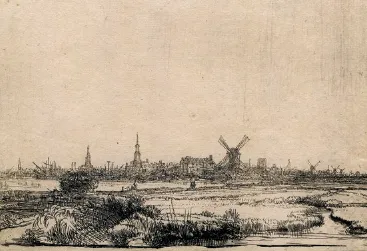
5 Rembrandt, View of Amsterdam, c. 1640, etching.
Around 1640 Rembrandt produced his only view of the city of Amsterdam (illus. 5), made from atop a dyke near the large home that he bought in 1639 on Sint Anthoniesbreestraat (St Anthony’s Broad Street). Though manipulated for compositional purposes against a high, blank sky, the artist features skyline silhouettes of principal features of Amsterdam: needle-like church towers (most prominently the Oude Kerk, or Old Church); X-shaped windmills on wall fortifications; and masts of sailing ships. In the print’s centre warehouses and shipyards of the VOC stand out. The foreground marsh expanse is punctuated by waterways and reeds.
While some painters, notably Gerrit Berckheyde (1638– 1698), painted urban scenes of the Dam Square and its imposing new City Hall, Rembrandt made no attempt to represent the heart of his adopted city. Instead, he made images only of the Old Town Hall, a chalk drawing of its demolition and a pen drawing of its ruined condition after the 1652 fire.
As soon as he relocated to Amsterdam, Rembrandt set to work in the most lucrative and promising of painting assignments – portraiture. Already in 1631 he monogrammed (‘R[H?] L’) and dated one of his largest, most magnificent portraits, painted on the expensive support of mahogany (a West Indies import). This half-length figure, Nicholas Ruts (illus. 6), was the first commissioned likeness for Rembrandt, inaugurating one of his most important contributions to art history, chiefly representing his fellow citizens in Amsterdam. In the period from 1631 to 1635 alone, he produced more than forty portraits, which firmly established his career.
Nicholas Ruts ( né Rutgeerts) exemplifies the life story of many prominent Dutch citizens in Amsterdam. He was a fairly recent immigrant whose Mennonite father, a silk trader, had fled Antwerp to Cologne because of his Protestant beliefs. But by 1617 Nicholas Ruts had arrived in Amsterdam, adopted the Reformed Church and involved himself with Russian trade, a lucrative Dutch exchange of fur imports for finished goods, such as woollens, silks and even church bells.
In Rembrandt’s portrait Ruts proclaims not only his personal wealth but its source in the form of his fur hat and the prominent sable trim on his elegant mantle. In a strong side light the sitter stands confidently, turning slightly to direct his steady gaze at the observer. Reserve is suggested by a slightly distancing corner chair, on which his right hand rests; his other hand clasps a sheet of paper, illegible except for another 1631 date, but suggesting a business document. Rembrandt uses delicate brushwork, especially for the textured fur and white lace collar, but he emphasizes Ruts’s whiskers through additional scratches on the pigment surface. Face and hands, built of varying colours in layers, animate the warm flesh, while the neutral background around the body is subtly modified to reinforce its dynamic, asymmetrical silhouette. Nor does Rembrandt airbrush the features of Ruts’s face; instead, he frankly renders both the wrinkles of his brow and the bags under his eyes. Ruts thus appears to be a figure who is vital, prosperous and serious, but also physically present.
This commission sparked Rembrandt’s immediate domination in Amsterdam of the competitive portraiture market, over such earlier rivals as Thomas de Keyser (1596/7–1667; see illus. 36; 1627). The commission from Nicholas Ruts probably came from Rembrandt’s new Amsterdam affiliation. He was already living with Hendrick Uylenburgh, a prominent art dealer who provided lodging but also studio space for a stable of young painters who fulfilled commissions for him. Uylenburgh, also a Mennonite, provides another telling example of how religious immigration to the commercial centre of Amsterdam could take advantage of a personal network, in this case to match portrait sitters with portraitists, though the dealer might not have had a workshop of his own until he became associated with Rembrandt in 1631. Their close association also had personal implications for Rembrandt, who married Saskia Uylenburgh, the dealer’s niece, in 1634 and continued to live with Uylenburgh until 1635. That period marks the most intense output of portraits in Rembrandt’s career by far (he made no portraits at all in Leiden); fully half of his hundred portraits were produced while he resided and worked with Uylenburgh.
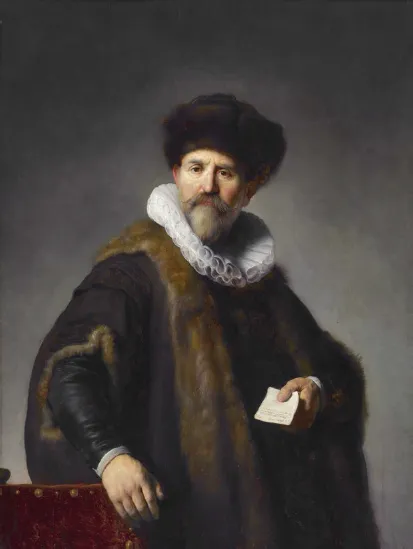
6 Rembrandt, Nicholas Ruts, 1631, oil on wood
Like Ruts, one other initial Rembrandt sitter also stems from a Mennonite émigré family of textile merchants from the southern Netherlands: Marten Looten (dated January 1632), who came in 1615 to Amsterdam from Leiden. His commission also probably came to the painter through Uylenburgh, although it is possible that Rembrandt already knew the family in Leiden. The artist ensured identification of his sitter by positioning a legible paper with his name on it in large script along with his RHL monogram.
Throughout his career, most Rembrandt portraits of couples depict husbands and wives as pendant likenesses in separate frames on a modest scale, necessitated by both cost and the scale of rooms in Dutch houses. In those cases, heraldic rules of putting the principal figure on the viewer’s left (but also the favourable right-hand side from within the picture) mean that husbands consistently appear in that position, often gesturing towards their wives. Rembrandt seldom got the opportunity to paint larger-scale double portraits (see illus. 8), but when he did he always gave the husband prominence, often in the centre of the composition. In 1633 he painted his first double portrait, a large canvas (but considerably smaller than life-sized) of an unknown, elegantly dressed Gentleman and Lady in Black (illus. 7; stolen). This portrait adopts the current Amsterdam fashion of full-length figures in elegant dress, located within enveloping spatial interiors, already popular from Thomas de Keyser. In this work, Rembrandt continues the exquisite detail of many of his Leiden works (a practice long characteristic of his Leiden student Gerard Dou). The husband stands, assertively occupying central space with extended arms, while his wife before him, seated and seemingly distracted in thought, occupies the right front corner, counterbalanced by a chair opposite her. Behind the man a large map – one of Amsterdam’s cartographic prizes – decorates the back wall, suggesting the husband’s active role in the outside world. An X-ray reveals that a boy once appeared between the couple, surely the object of his mother’s gaze; why he was omitted must remain moot. These sitters are not securely identified, but they do match an inventory item for Jan Pietersz Bruyningh, a cloth merchant, and his wife Hillegont Pieterdr. Moutmaker. Certainly their more luxurious dress suggests that they definitely do not belong to the more austere Mennonite sect.
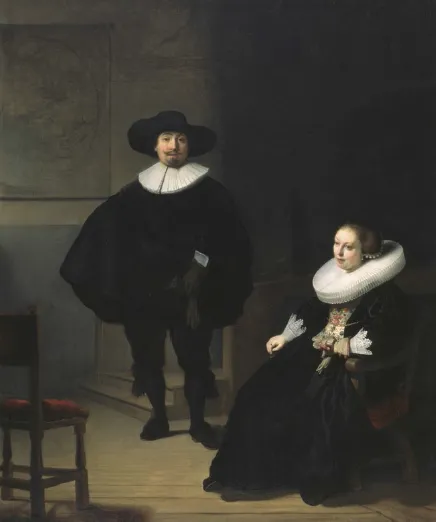
7 Rembrandt, Gentleman and Lady in Black, 1633, oil on canvas.
Rembrandt also adopted the same Gardner poses for male and female sitters in other individual early portraits (each paired with a partner in a different pose). He produced another dated (1633) set of pendants, three-quarter lengths, now separated, where the unidentified man has his arms extended and is gesturing towards his wife during the process of rising from his chair, while his wife remains seated with a fan; both sitters face the viewer in dark costumes (with the ever-present lace collars and ruffs) against a dark background. While their white ruffs and collars also light the two Gardner figures as objects of attention, the net result of this double portrait of two individuals evokes a social distance between the couple, albeit still observing gender conventions, including feminine demureness. Rembrandt, however, would utilize the same averted gaze across his career to suggest thoughtfulness or introspection in many figures, especially biblical actors.
A similar-sized pair of early pendant portraits of a couple (c. 1633) shows another richly dressed husband and wife, both seated (she rests her shoe on a foot-warmer, a common domestic accessory in cold Dutch interiors). Each is accompanied by a standing child of the same sex who receives coins (the son gets the lion’s share), showing continuity of family fortunes. The sitters can be identified: Jan Pellicorne and Son Casper; Susanna van Collen and Daughter Eva Susanna. Pellicorne, born in Leiden but resident in Amsterdam, enjoyed a wide commercial network through his wife’s family.
Finally, Rembrandt’s only extant full-length pair of standing portraits (signed and dated 1634; illus. 8) adopts a showy presentation of court portraits, normally reserved for kings and nobles. It shows instead a wealthy couple, Marten Soolmans and Oopjen Coppit, married the previous year. In this case, the wife’s family was an old, established Amsterdam clan; Soolmans stemmed from a prosperous Antwerp family. As usual, the male appears on the favourable viewer left, wearing a broad-brimmed black hat but richly adorned with flamboyant shoes, belt and a fine lace collar, while also casually carrying a kid-leather glove that conveyed aristocratic pretence, even in sober Holland. Her black-on-black satin dress is also complemented with lace at cuffs and neck, plus a pearl choker, and her right hand holds a fan attached to her belt with a gold chain. His left hand with the glove stretches out towards his bride (a marital convention, also used by Frans Hals), even as Soolmans faces forward. Meanwhile, Coppit turns her entire body to him but still eyes the viewer. A background curtain continues across both portraits. Such a commission from this well-dressed, prominent couple, not to mention their request for full-length pendants, points clearly to Rembrandt’s meteoric rise to prominence among Amsterdam’s leading portraitists shortly after he arrived in the port city.
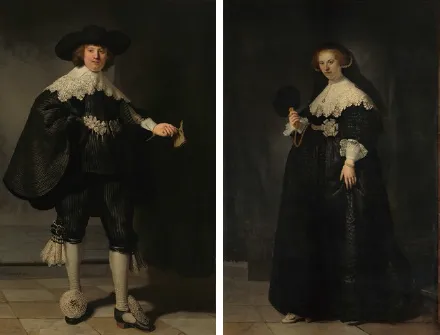
8 Rembrandt, Marten Soolmans and Oopjen Coppit, 1634, oil on canvas.
AMSTERDAM GROUP PORTRAITS
Young Rembrandt’s most ambitious early group portrait in Amsterdam followed soon after his Nicholas Ruts. It was commissioned by a physician, Dr Nicholas Pietersz, who adopted the surname Tulp, after the Dutch word for tulip, his favourite flower (also the object of intense desire, ‘tulipmania’, and commodity speculation in Holland until the bulb investment bubble burst in 1637). Dr Tulp was a surgeon and chief lecturer of the surgeons’ guild but also a devout Calvinist; already a member of the Amsterdam town council, he served five times afterwards as city burgomaster. When a new Amsterdam university opened in January 1632, in part as a reaction against the religious orthodoxy of Leiden, it attempted to rival Leiden’s famed anatomy theatre (where Tulp had trained), so shortly afterwards Tulp performed a public dissection on a cadaver, obtained from a recently executed criminal, as authorized by city officials. This medical instruction was performed in the upper storey of the repurposed old St Anthony’s gatehouse of the city, the Waag, near the Breestraat area where Uylenburgh – and eventually Rembrandt himself – would live.
Rembrandt’s commemorative painting ...
Table of contents
- Front Cover
- Half Title
- Title Page
- Copyright
- CONTENTS
- Preface
- Introduction: Stirrings in a New Dutch Nation
- 1. Representing Amsterdam’s Citizens
- 2. Amsterdam’s Religious Stew
- 3. Rembrandt and the Orange Court
- 4. Rembrandt’s World
- CHRONOLOGY
- BIBLIOGRAPHY
- ACKNOWLEDGEMENTS
- PHOTO ACKNOWLEDGEMENTS
- INDEX
Trusted by 375,005 students
Access to over 1.5 million titles for a fair monthly price.
Study more efficiently using our study tools.
Frequently asked questions
Yes, you can cancel anytime from the Subscription tab in your account settings on the Perlego website. Your subscription will stay active until the end of your current billing period. Learn how to cancel your subscription
No, books cannot be downloaded as external files, such as PDFs, for use outside of Perlego. However, you can download books within the Perlego app for offline reading on mobile or tablet. Learn how to download books offline
Perlego offers two plans: Essential and Complete
- Essential is ideal for learners and professionals who enjoy exploring a wide range of subjects. Access the Essential Library with 800,000+ trusted titles and best-sellers across business, personal growth, and the humanities. Includes unlimited reading time and Standard Read Aloud voice.
- Complete: Perfect for advanced learners and researchers needing full, unrestricted access. Unlock 1.5M+ books across hundreds of subjects, including academic and specialized titles. The Complete Plan also includes advanced features like Premium Read Aloud and Research Assistant.
We are an online textbook subscription service, where you can get access to an entire online library for less than the price of a single book per month. With over 1.5 million books across 990+ topics, we’ve got you covered! Learn about our mission
Look out for the read-aloud symbol on your next book to see if you can listen to it. The read-aloud tool reads text aloud for you, highlighting the text as it is being read. You can pause it, speed it up and slow it down. Learn more about Read Aloud
Yes! You can use the Perlego app on both iOS and Android devices to read anytime, anywhere — even offline. Perfect for commutes or when you’re on the go.
Please note we cannot support devices running on iOS 13 and Android 7 or earlier. Learn more about using the app
Please note we cannot support devices running on iOS 13 and Android 7 or earlier. Learn more about using the app
Yes, you can access Rembrandt’s Holland by Larry Silver in PDF and/or ePUB format, as well as other popular books in Art & Art General. We have over 1.5 million books available in our catalogue for you to explore.