![]()
Chapter 1
‘Everyone is entitled to his own opinion, but not to his own facts.’
Former United States Senator Daniel Patrick Moynihan Empowerment Demands Excellence: The Evidence is Clear
Erin Pinney can’t help it. She tears up when she talks about sending her son to kindergarten.
A precocious, gifted child, Jackson was reading in preschool. He played better with kids a couple of years older. When Jackson was five years old, Erin’s husband wanted to enroll him in first grade. But Erin, a teacher, and other educators said no, that Jackson needed to be with kids his own age in kindergarten, that he had too many behavior issues to be in first grade.
“We were wrong, devastatingly wrong,” Erin says. “He was absolutely miserable and in trouble every day. His teacher was expecting him to sit and learn the sounds of letters and many other skills that he already knew.”
Erin Pinney reads to her son, Jackson. (Photo: Jerry Mennenga)
Jackson began experiencing terrible anxiety and night terrors.
Desperate, Erin finally talked to the talented and gifted coordinator in the district, who gave her a copy of A Nation Deceived: How Schools Hold Back America’s Brightest Students.
“I devoured it,” she says, along with several other texts on gifted children and gifted education. Jackson was tested, and his high abilities confirmed.
At mid-year, the Pinneys moved their son to first grade. Three days later, the boy’s night terrors stopped. The Pinneys had their happy, bright child back. He was reading and learning and interacting with the teachers and students. He had friends. He wasn’t in trouble every day.
“It is good to accelerate kids,” Erin says now, two years later. “It’s just so ingrained in our culture that it’s good to go to school with people your own age, that it’s not good for high-ability kids to be moved ahead. But those attitudes are based on bias and a lack of education. When you see the research, when you’re given the tools, you see that acceleration makes complete sense.”
Erin’s discovery was not only transformative for her son, it energized her. She is now a teacher for gifted and potentially gifted students in a western Iowa school district, where she also works with classroom teachers.
“Teachers, with minimal knowledge about giftedness, can make a huge impact on gifted child learning. It starts with understanding that gifted children have different needs and knowing a few things about meeting those needs. Then the children will take off on their own.”
Erin’s story, as well as any, sums up the state of gifted education ten years after the groundbreaking policy report, A Nation Deceived: How Schools Hold Back America’s Brightest Students, caught the nation’s attention.
In short: Access to programs and support for gifted students has grown as parents, educators, and policymakers have learned about research and the tools that identify giftedness and support acceleration. But far too many parents, educators, and policymakers don’t know about the research and the tools. And that means far too many high-ability children languish in our classrooms, bored and unchallenged, their potential unrecognized and unnourished, their futures imperiled, and their country’s future diminished.
We still haven’t figured out excellence.
Ten years ago, the point of A Nation Deceived was to change the conversation about educating gifted students. It did that in a powerful, enduring way.
“We eliminated many of the excuses people were using to hold back gifted students,” says Dr. Nicholas Colangelo, Director Emeritus of the Belin-Blank Center and Dean of the University of Iowa’s College of Education. “The paradox is that even though we know that acceleration worked, we did not put it into practice. We no longer have the luxury to pretend.”
But, still, ten years later, myths too often trump facts. Disconnects continue.
“A powerful argument can be made, based on research, about the importance of acceleration for gifted students,” says Dr. Joyce VanTassel-Baska, Professor Emerita and Founding Director of The Center for Gifted Education at the College of William and Mary. “Yet false ideas about the supposed dangers of moving students through school faster still get air time in teachers’ lounges and at neighborhood kitchen tables.”
The goal of this follow-up report, A Nation Empowered: Evidence Trumps the Excuses Holding Back America’s Brightest Students, is to re-energize the discussion around academic interventions for gifted students and once again forcefully present the facts about acceleration as an educational intervention. We now have ten more years of research and practice, hence the evidence.
“We intend to provide the facts about gifted education to busy parents, educators, and policymakers,” says Dr. Susan Assouline, Director of the Belin-Blank Center and Professor of Psychological and Quantitative Foundations at the University of Iowa. “We aim to dispel the perceived conflicts about how we spend our public education dollars. We intend to challenge Colleges of Education to better prepare teachers to recognize and serve gifted students.
“We can’t take shortcuts,” she adds. “We really have to understand what’s involved, the breadth and depth of the options available.”
This volume of A Nation Empowered presents vignettes of individual gifted students, their families, and educators who recognize the power of acceleration. Each story captures a universal message about the successful application of various types of acceleration to the academic and social-emotional development of students at different stages in their lives. The message is positive and affirming, while also challenging us to do more. To achieve excellence, America’s gifted students need the help of informed adults.
“I’ve heard it said that the first several strokes of any portrait determine the essence of that portrait,” Dr. Colangelo says. “We are now creating the first strokes of this century. If we want to determine what the portrait of gifted education will be in the twenty-first century, what we do now counts. We need to get away from irrational ideas and confront and call them for what they are, and to realize that the heart and soul of gifted education is recognizing individual differences, appreciating them, and then responding to them.”
The table on page 3 summarizes the research evidence from Volume 2.
20 Important Points about Educational Acceleration
1. Acceleration is the most effective academic intervention for gifted children.
2. For bright students, acceleration results in both long-term and short-term beneficial effects, academically, psychologically, and socially.
3. Acceleration is a very low-cost intervention for addressing the needs of gifted students.
4. Gifted children tend to be socially and emotionally more mature than their age-mates; therefore, for many bright students, acceleration provides a better personal maturity match.
5. When bright students are presented with curriculum developed for age-peers, they can become frustrated and disengaged from learning. Advanced curriculum in core subject matter is essential to challenge them.
6. Testing, especially above-level testing (using tests developed for older students), is highly effective in identifying students who would benefit from acceleration.
7. The K-12 Common Core State Standards, which correspond to math and reading, and the Next Generation Science Standards, which focus on K-12 science, raise academic expectations for most students; however, for highly capable students, these standards do not eliminate the need for accelerative options.
8. The twenty types of acceleration available to bright students fall into two broad categories: grade-based acceleration, which shortens the number of years a student spends in the K–12 system, and subject-based acceleration, which allows for advanced content earlier than customary.
9. Entering school early is an excellent option for some gifted students, both academically and socially.
10. Early entrance to college is effective, both academically and socially, especially when students are part of a cohort of early entrants. This option results in both short-term and long-term academic success, leading to long-term occupational and personal satisfaction.
11. Advanced Placement (AP) is the most available large-scale option for bright students who want to take college-level courses in high school.
12. State residential STEM schools use accelerated approaches that include early admission, AP, International Baccalaureate (IB), and various forms of personalized learning.
13. High-ability students who are economically vulnerable achieve considerably less without support for their abilities than economically secure students.
14. Educators need to ensure that options for acceleration are available for students at all stages of the learning process.
15. Policy on acceleration at state and local levels can facilitate the effective use of the process and promote change. To encourage a major change in America’s perceptions of educational acceleration, we need to use legislation, the courts, administrative rules, and professional initiatives.
16. Effective implementation of accelerative options for gifted students with disabilities is necessary for their academic advancement and social and emotional well-being.
17. It is important for educators, parents, and students to be fully involved in the decision-making process about an individual student’s acceleration. The Iowa Acceleration Scale is an effective instrument for helping schools through the process.
18. The few problems that have been experienced with acceleration have stemmed from inadequate planning and insufficient preparation on the part of educators or parents.
19. Educational equity does not mean educational sameness; rather, equity respects individual differences in readiness to learn and recognizes the value of each student.
20. The key questions for educators are: what type(s) of acceleration does the gifted learner need and when is it optimal to implement the intervention?
For more information on the research that informs these points, see Volume 2 of A Nation Empowered (www.nationempowered.org), or Volumes I and II of A Nation Deceived (www.nationdeceived.org).
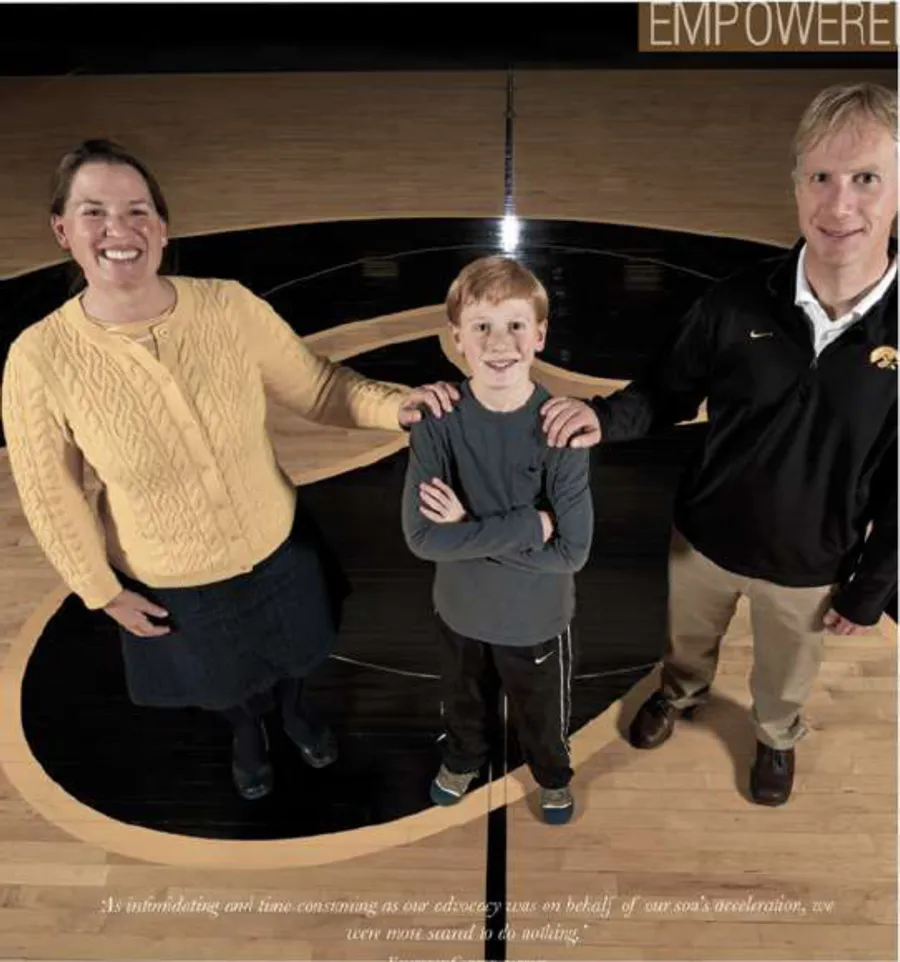
Mason Carter with his parents, Andrew and Kimberly. (Photo: Mark Tade)
The Carters: Finding the right fit meant skipping a grade
Mason Carter was so disengaged when he started fifth grade that he made up songs about it. He also came home so frustrated, he says, he felt like a dam that was going to burst.
Before moving to Iowa, Mason had been in a full-time, streamlined program for gifted children in Miami. His father, Andrew Carter, accepted a coaching position at a university, and the family moved to a new city, one without a full-time, self-contained gifted program. Mason languished in the regular classroom, asking for more work, which he quickly completed. It was not a happy time.
“Flags went up for us,” Andrew says. “Until that year, school was where Mason wanted to be. Where I work (in athletics), people want to promote, or sometimes even hitch their wagon to, a star. But that wasn’t happening in Mason’s classroom.”
Andrew, with Mason’s mom, Kimberly, decided they had to begin advocating for their son, or “pressing buttons,” as his father calls it. Mason began an enrichment program, but the 90-minutes-a-week “escape” it offered—Mason’s word—was not enough.
As intimidating and time-consuming as their advocacy on behalf of Mason was, Kimberly says, “we were more scared to do nothing.”
The Carters read the research and talked to gifted education researchers at the University of Iowa. At the end of fifth grade, Mason attained a perfect score on the ACT Explore test, a test for eighth graders. On the Iowa Assessments (formerly the Iowa Tests of Basic Skills), Mason tested in the 99th percentile in all subjects; in some subjects, his performance was similar to advanced high school students.
The Carters began pushing for whole-grade acceleration for Mason and, afte...