This essay anthology offers enlightening perspectives on how East-Central Europe was transformed into the "other" Europe during the Cold War era.
When the Second World War ended, a new conflict arose between world powers jockeying for supremacy. The Soviet Union pursued a policy of exporting its system of government in a process known as sovietization. But there were also governments that sought to adopt a Soviet way of life on their own accord. Dictated by ideological imperatives, both styles of sovietization employed socialist strategies of state and nation building.
This volume not only examines the imposition of new forms of government, but also the socialist response to modernity as reflected in approaches to new technology and management, consumption and leisure patterns, religious and educational policy, political rituals and attitudes to the past. The essays explore the diversity and the tensions within the sovietization process in the countries of the region.
"This collection is a bold and timely attempt at shedding light on a rather insufficiently researched topic . . . the diverse approaches-ranging from socio-cultural and economic history to psycho-history." —Dr. Dragos Petrescu, University of Bucharest.
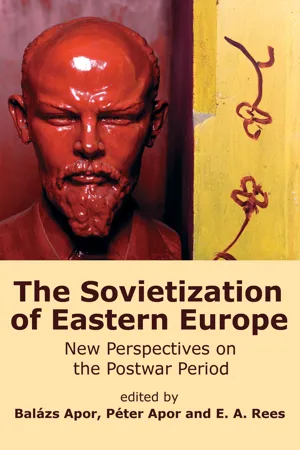
eBook - ePub
The Sovietization of Eastern Europe
New Perspectives on the Postwar Period
- 364 pages
- English
- ePUB (mobile friendly)
- Available on iOS & Android
eBook - ePub
The Sovietization of Eastern Europe
New Perspectives on the Postwar Period
About this book
Information
Part I
Theories of Sovietization
Introduction
The Sovietization of Eastern Europe
E. A. Rees
The sovietization of Eastern Europe involved the transplantation of institutions and methods developed in the USSR into the very different environments provided by the states of Eastern Europe after 1945. This volume examines these processes. Sovietization was shaped both by Soviet ideology and by deeper Russian cultural values and assumptions. Whereas modernization in the Russian Empire had been equated with westernization and western civilization, after 1917, the Bolsheviks equated modernization with sovietization, which was collectivist and anti-capitalist, based upon state intervention in the ordering of economic and social life as part of a messianic project of creating a new Soviet civilization.1 The Soviet regime lasted over seventy years, reaching its apogee in the Brezhnev era (1964-1981). Throughout this period, the Soviet model underwent significant internal transformations, which reflected, in part, the changes in the wider world.
The term sovietization implies the creation of a specific Soviet system with its own institutional structures and practices, comprising economic, political, social and cultural sub-systems, characterized by particular means of system integration, and distinguished by particular methods of rule. As such, it can be analyzed in terms of its capacities and potentialities, its structural limitations, and the factors that might lead to its breakdown or failure.
Sovietization had a dual aspect, firstly, as part of the Soviet imperial project in Eastern Europe in the decades after 1945, and secondly, as part of a Soviet socialist strategy of modernization. These two aspects of the sovietization project were held in tension, which shaped the model’s development and ultimate demise. The volume examines how this transference of ideas and practices was effected, and the way in which these ideas and practices were absorbed, adapted and resisted by the societies into which they were implanted. Sovietization involved a radical re-conceptualization of the past, the present and the future. It was related to a strategy of indoctrination, which aspired to make the official ideology an integral part of the life of the individual, through the transformation of all aspects of human experience and the fundamental refounding of cultural life. This is explored in terms of the transformation of the structures of power and authority within society, and, linked to it, a fundamental new conception of the way in which the economic life of the society, and its engagement with developing technology, could be transformed. The study of this transplantation process will seek to bring out how far the cultures, traditions and practices of the various countries of Eastern Europe proved receptive or resistant.
Sovietization, as a term, has both an analytical dimension, which explains the nature of the inner workings of the Soviet system of rule, and a normative dimension, which carries either a positive or a negative evaluation. It was first used in the Soviet Union itself, as a term that carried very positive connotations regarding the establishment of a new superior system for the organizing of human affairs. However, it came to be widely used in a pejorative sense in the 1940s and 1950s by critics of Soviet rule over Eastern Europe. Thereafter, the term, both in the USSR and in the West, fell into disuse. Since 1989, its use has been revived by East European and western scholars, and, in this volume, we argue for its analytical value.
Soviet leaders used the term ‘sovietization’ (sovietizatsia) amongst themselves, as shown by Lenin’s correspondence concerning the consolidation of control over the Transcaucasus and over the Baltic states in 1918-21.2 It was rarely, if ever, used by these leaders in public, but it appeared in press articles and even in party and state documents. This is one instance in which there was a certain distinction between private and public discourse. As sovietization was often done by stealth, it was impolitic to speak of it too explicitly.
We have no well authenticated use by Stalin of the term sovietization. It has been asserted that in a speech to the Politburo on 19 August 1939, on the terms of the Nazi-Soviet pact, Stalin offered a survey of the provisions of the treaty that would establish Soviet control over the Baltic states and Eastern Poland, and extend the Soviet sphere of influence to Romania, Bulgaria and Hungary. In this speech he is purported to have discussed the possibility of establishing a Soviet regime in Germany in the event of her being defeated in war, and to have also speculated on the ‘sovietization’ of France. The contents of this speech were published in a French journal already in 1939. They were published in Russia in 1994. The document’s authenticity is strongly contested by some specialists, and the probability is that it is a forgery.3
In reality the extension of the Soviet sphere of influence over Central and Eastern Europe after 1945 involved regulating inter-state relations, delimiting the borders of these states, determining their ethnic composition through expulsions and population transfers, fixing their constitutions, and deciding on the compositions of their governments. This served as the prelude to the sovietization of these countries. Sovietization involved the adaptation of the original model to the very distinctive circumstances of the individual countries of the region. Over time the model was further modified to take account of new and changing circumstances.
Communization or Sovietization?
The first countries to be sovietized were those which had made up the former Russian Empire. After the October Revolution, sovietization was first imposed upon Russia itself, then upon Ukraine4 and Byelorussia.5 With the Bolshevik victory in the Civil War, it was extended over the White and nationalist controlled areas of Siberia, North Caucasus, and then into the Transcaucasus and Central Asia.6 The sovietization of most of these regions was a concomitant of their conquest by military force. The establishment of political control also involved breaking peasant and working class opposition.
In the 1920s, sovietization took a new form, and was accompanied by a policy of fostering non-Russian languages and cultures (Ukrainization, Byelorussianization) and indigenization (korenizatsiya), as part of a process of state and nation building, whereby traditions were invented and adapted. In Stalin’s memorable phrase, the aim was to create policies ‘national in form, socialist in content’. After 1929, these policies were modified with a new emphasis on Russification. It was also reflected in the exportation of the Revolution, and the sovietization of conquered territories – initially in 1939 over the Baltic republics7 and eastern Poland,8 and again, in 1945, with the incorporation of these territories, as well as Moldova and Ruthenia, within the USSR.
Sovietization in the USSR went through phases that are well-known: War Communism 1918-1921, the New Economic Policy 1921-1928, and the Command Administrative Economy from 1928/9 onwards. Each phase constituted a specific variant of the Soviet model, and was intimately connected with wider aspects of the unfolding strategies of the Bolshevik regime; its policies towards the peasantry, the working class, the intelligentsia; its policies towards the Russians and non-Russian peoples; and its policies towards women. Sovietization created new structures of government, and established new relationships between the state and these disparate social groups. It was crucially connected to the way in which identities were ascribed to different groups and social classes.
Sovietization was an all-embracing, transforming conception of politics. At the temporal level, it involved the adoption of a new calendar, punctuated by public rituals, and the creation of a particular notion of historical time. Spatially, sovietization was reflected in the renaming of towns, streets, schools, farms and factories, in the new architecture, monuments and sculptures. It was reflected in the remaking of the countryside, the remolding of the non-Russian regions, in the conquest of the remote, inaccessible regions of the USSR, including the Arctic.9 Stalin’s plan for the transformation of nature in the late 1940s reflected another aspect of the visionary aspiration of sovietization to reshape geographic space.
The sovietization of the public and the private sphere was reflected in the intensification of indoctrination, the creation of new behavioral patterns, new communication codes, which sought to instill new disciplinary norms and to nurture an affective relationship between the individual and the state, embodied by its leader.10 The new Soviet civilization was informed by a strong utopian, revolutionary, iconoclastic impulse, which, in the 1930s, was subsumed by the priorities of political control, and by the state direction of all aspects of development.11
The early Soviet regime enforced a program of social leveling, the restructuring of society, and the proletarianization of the party and state apparatus. Proletarianization was also reflected in manners, dress and habits of speech. After the Revolution, the cities were proletarianized, with the disappearance of the high-class shopping areas, the financial districts, and exclusive residential quarters. Industrial development combined a strategy of implanting proletarian centers to ensure control of rural areas and national regions. Modernization involved the eradication of all that was conceived as being non-proletarian and non-socialist.
Sovietization was allied to the development of specific organizational principles, especially those embodied by the Party, in terms of democratic centralism. This was termed—at the time—as Bolshevization.12 During the Stalin era, Bolshevik organizational principles were extended to all other institutions in the USSR.13 In the 1920s, the communist parties in the Communist International were purged, re-organized and effectively Bolshevized.
At the outset, a distinction needs to be drawn between communization and sovietization. ‘Communism’ was always an on-going project, part of an ideological aspiration, many of whose utopian pretensions were modified or jettisoned. The Soviet system, in contrast, was constituted by concrete institutional structures and practices, established by the end of the 1920s, which proved extremely durable and which survived in a more or less modified form until 1985, although some of these structures and practices were adapted over time in order to cope with new tasks.
The political structures of this system were established early on, with the Communist Party occupying the central position within the one party state, buttressed by the state bureaucracy, the secret police and the military. The Party conceived of itself as an élitist, militant vanguard party. Its militarized conception of politics was shaped by the ideology of class warfare, and by the experience of the underground and of Civil War. In the mass organizations, such as the soviets, youth organizations acted as surrogates of the Party, whilst the trade unions, in Lenin’s phrase, acted as ‘transmission belts’ which connected the political leadership with society. Soviet administrative practices were, in large measure, derived from military models which, in the 1920s, were already being criticized as primitive and at variance with the practices of the most advanced Western countries.14
Sovietization involved the politicization and ideologization of all aspects of life, which effectively negated politics as the free exchange of opinion, negotiation and the open articulation of demands.15 The political sphere was monopolized by the party, and was neither constrained by any countervailing power nor checked by the rule of law. The dominance of the political regime severely limited the autonomy of the social, economic, and cultural sub-systems. The manipulative and coercive aspect of political power was highly pronounced, whilst the prevalence of systems of control and surveillance created opacity with regard to political and social processes.
The Stalinist system attempted to create a new culture, which encompassed the life of the individual in its diversity.16 It aspired to the fundamental restructuring of society and culture, whereby class membership was ascribed by the regime, identities were remolded, and a particular Soviet conception of kulturnost’, which aimed at creating the new Soviet man and woman, was propagated.17 Through the sovietization of the system of education (obrazovanie) and upbringing (vospitanie), the regime sought to restructure social consciousness, to inculcate socialist values, to foster Soviet patriotism, whilst subverting traditional thoughts and practices, in part through an unprecedented assault on organized religion.18 The life experiences of people were transformed; through the sovietization of the family, childhood, gender identities and relations,19 through the transformation of workplace relations, recreation and leisure.
All fields of knowledge (textbooks, encyclopedias, dictionaries, manuals, maps) were restructured as part of the creation of a wholly new Soviet weltanschauung.20 It was associated with the propagation of a ‘consequentialist’ conception of ethics and a new Soviet morality.21 The regime sought to create its own language, its own concepts, its own value system, and its own discourses.22 Stephen Kotkin coined the term ‘speaking Bolshevik’ to illustrate the extent to which the state achieved a remolding of mass consciousness and the internalization of the official value system in the 1930s.23 But the official language could be subverted.24
Sovietization aimed at the transformation of mass culture; through education and censorship, and the development of artistic policies shaped by the ideals of ‘socialist realism’. This represented a shift away from a narrowly conceived ‘proletarian’ conception of art of the early revolutionary era, and sought to establish something, more universal, more classical, and more related to the Russian realist cultural tradition.25 Socialist realism encapsulated three basic principles: narodnost (the spirit of the people), klassovost (spirit of the class) and partiinost (party mindedness).26 In this, Stalin envisaged writers as ‘engineers of humans’ souls’. This also involved a commitment to the promotion of high culture, as well as to popular culture, with its sentimentalized, folkloric celebration of the people (narod) and their past.27
The closure of the public sph...
Table of contents
- Cover
- Subtitle
- Published and Forthcoming by New Academia Publishing
- Title
- Copyright
- Contents
- Illustrations
- Foreword
- Part I Theories of Sovietization
- Part II Technological Sovietization
- Part III Consumerism and Leisure
- Part IV Sovietized Rituals
- Part V Sovietization and Religion
- Part VI The Sovietization of History
- Conclusion: Crisis of the Soviet Model and De-Sovietization
- Notes
- Contributors
Trusted by 375,005 students
Access to over 1.5 million titles for a fair monthly price.
Study more efficiently using our study tools.
Frequently asked questions
Yes, you can cancel anytime from the Subscription tab in your account settings on the Perlego website. Your subscription will stay active until the end of your current billing period. Learn how to cancel your subscription
No, books cannot be downloaded as external files, such as PDFs, for use outside of Perlego. However, you can download books within the Perlego app for offline reading on mobile or tablet. Learn how to download books offline
Perlego offers two plans: Essential and Complete
- Essential is ideal for learners and professionals who enjoy exploring a wide range of subjects. Access the Essential Library with 800,000+ trusted titles and best-sellers across business, personal growth, and the humanities. Includes unlimited reading time and Standard Read Aloud voice.
- Complete: Perfect for advanced learners and researchers needing full, unrestricted access. Unlock 1.5M+ books across hundreds of subjects, including academic and specialized titles. The Complete Plan also includes advanced features like Premium Read Aloud and Research Assistant.
We are an online textbook subscription service, where you can get access to an entire online library for less than the price of a single book per month. With over 1.5 million books across 990+ topics, we’ve got you covered! Learn about our mission
Look out for the read-aloud symbol on your next book to see if you can listen to it. The read-aloud tool reads text aloud for you, highlighting the text as it is being read. You can pause it, speed it up and slow it down. Learn more about Read Aloud
Yes! You can use the Perlego app on both iOS and Android devices to read anytime, anywhere — even offline. Perfect for commutes or when you’re on the go.
Please note we cannot support devices running on iOS 13 and Android 7 or earlier. Learn more about using the app
Please note we cannot support devices running on iOS 13 and Android 7 or earlier. Learn more about using the app
Yes, you can access The Sovietization of Eastern Europe by Balzs Apor, Péter Apor, Rees E. A., Balzs Apor,Péter Apor,Rees E. A. in PDF and/or ePUB format, as well as other popular books in History & 20th Century History. We have over 1.5 million books available in our catalogue for you to explore.