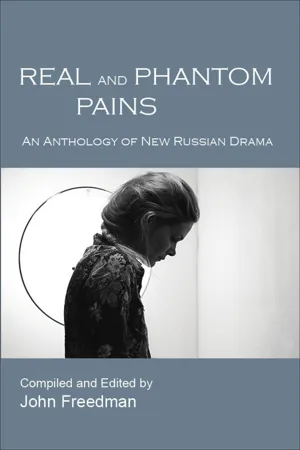
An anthology of ten plays embodying the Russian literary movement that began in the late twentieth century.
The plays selected for this anthology reflect the issues and styles typical of the new wave of dramatic writing in Russia. New drama flourished (almost) exclusively in small spaces, often in dingy basements that employed and accommodated small numbers of people. The big theaters largely turned a blind eye to what was happening on small stages and in backrooms in playhouses, libraries, and community centers in a few chosen hot spots around Russia: primarily Moscow, Yekaterinburg and Togliatti. In many cases, they took actively hostile stances toward it. This would change, however. And by the beginning of the century's second decade, new drama was threatening to become a mainstream phenomenon. Not every theater staged plays associated with new drama, but almost every one began staging plays influenced by the themes, methods, and language of the new drama movement.
Featuring work from Yury Klavdiev, Olga Mukhina, Pavel Pryazhko, Vasily Sigarev, Maksym Kurochkin, Mikhail Durnenkov, Vyacheslav Durnenkov, Yaroslava Pulinovich, Yelena Gremina, and Maxim Osipov.
"Few people know more about what is happening on the Moscow scene than John Freedman (including few Russians). As Moscow Times theater critic throughout the post-Soviet period John could well have seen more theatrical productions in Russia than anyone else. I can't imagine anyone who would do a better job." —Blair A. Ruble, Director, Program on Global Sustainability & Resilience, Woodrow Wilson Center
"While other existing volumes focus on 18th, 19th, and early 20th century Russian drama, Freedman's edition would present the unique and important contributions of the new generation of Russian writers portraying the realities and experiences of a post-Soviet generation. John has carefully selected a representative cohort of ten of the most visible, productive, and influential of these writers for the volume." —Thomas J. Garza, University Distinguished Teaching Associate Professor, University of Texas at Austin
- 505 pages
- English
- ePUB (mobile friendly)
- Available on iOS & Android
eBook - ePub
About this book
Information
Maksym Kurochkin
In Brief:
•Born February 7, 1970, in Kiev.
•Currently lives in Moscow.
•Began writing in 1993.
•First play produced was Fighter Class ‘Medea’ at the Russian Drama Theater in Vilnius, Lithuania.
•Breakthrough in 1998 when his play Steel Will won the Anti-Booker Prize’s Three Sisters award for “exploring new avenues in drama.”
•First major success was Oleg Menshikov’s production of Kitchen (2000).
•Herbivores opened at the Meyerhold Center in Moscow in 2014.
•Wrote approximately 30 plays by 2014.
•Plays have been translated into Ukrainian, English, German, French, Polish and Slovak.
•Performed as a theater actor in Two in Your House (2012) and Race (2014), both at Teatr.doc.
•Performed as a film actor in Vera Storozheva’s Sky, Plane, Girl (2002) and Mikhail Brashinsky’s Sheer Ice (2003).
•Author of seven screenplays for television and big screen features, of which he considers the Shame novella in the Short Circuit compilation film (2009), and Atomic Ivan (2012) to be the most successful.
Maksym Kurochkin studied astroarcheology at Kiev University in the mid-1990s, writing a thesis on pre-Christian Slavic monuments. Although he chose to write his plays in Russian from the beginning of his career, he maintains close links to Ukraine and Ukrainian culture. This is expressed in a small way by the fact that he chose to base the transliteration of his first name into English on the Ukrainian spelling (Maksym) rather than the Russian (which would be Maksim or Maxim). It is expressed in a deeper way in many of his plays through the frequent, paradoxical mix of cultures and languages. His play Steel Will mixes Polish, Ukrainian and Russian influences in its language and its sensibility. Fighter Class “Medea” takes the writer’s attachment to, and pride in, his Ukrainian heritage to great comic lengths: In the final battle of the last war on earth (the battle of the sexes as it turns out), a Ukrainian sergeant is the ranking officer in a rag-tag crew whose other members are a Russian and an American with the rank of private. One of his first plays, Askold’s Dir, which tells the tale of Kievan Prince Askold and his associate Dir, reaches back to the 9th century when Rus, the precursor to modern Russia, was centered in what we now know as Ukraine. Not surprisingly, during the conflict between Ukraine and Russia in early 2014, Kurochkin proclaimed that from heretofore he should be identified as a Ukrainian playwright.
Almost all of Kurochkin’s plays wreak havoc on our mundane understanding of time. The past, the present and the future commingle in one large, ululating temporal stew. Steel Will takes place in the medieval era and the distant future simultaneously. The Schooling of Bento Bonchev is set in the indefinite future, a time when humans no longer remember the point of sex, although it feels very much like the present. Titus the Irreproachable is a vividly-colored dramatic canvas that uses a sci-fi setting (a spaceship in the distant future after Planet Earth has already died) to grapple with contemporary problems that have existed for thousands of years.
Kurochkin is a writer of effervescence, exuberance and irrepressible imagination. His plots are rich and unexpected, his characters are vivid and picturesque. One of his signature plays, Vodka, Fucking and Television, observes the predicament of a beleaguered writer struggling with writer’s block. The only way he can imagine pulling out of his fruitless funk is to dismiss one of his three most crippling vices, as identified in the play’s title.
Kitchen is Kurochkin’s masterpiece, at least to this point in his career, and it incorporates something of almost every stylistic characteristic mentioned here in regards to his other plays. It toys boldly with the traditional concepts of time and identity; it puts forth an “impossible” plot; is peopled with eccentric, highly compelling characters; and comprises a rich mix of various cultural signs and traditions from within and outside the Slavic world.
One of the biggest plays of its era in sheer number of pages and words, it is far too complex to summ...
Table of contents
- eBook Cover
- Title Page
- Preface
- More than Mere Drama: The Phenomenon of New Russian Drama: An Introduction
- Yury Klavdiev: Martial Arts
- Olga Mukhina: Flying
- Pavel Pryazhko
- Vasily Sigarev: Phantom Pains
- Maksym Kurochkin: Kitchen
- Mikhail Durnenkov: TRASH
- Vyacheslav Durnenkov: Exhibits
- Yaroslava Pulinovich
- Yelena Gremina: One Hour, Eighteen Minutes
- Maxim Osipov: Scapegoats
Trusted by 375,005 students
Access to over 1.5 million titles for a fair monthly price.
Study more efficiently using our study tools.
Frequently asked questions
Yes, you can cancel anytime from the Subscription tab in your account settings on the Perlego website. Your subscription will stay active until the end of your current billing period. Learn how to cancel your subscription
No, books cannot be downloaded as external files, such as PDFs, for use outside of Perlego. However, you can download books within the Perlego app for offline reading on mobile or tablet. Learn how to download books offline
Perlego offers two plans: Essential and Complete
- Essential is ideal for learners and professionals who enjoy exploring a wide range of subjects. Access the Essential Library with 800,000+ trusted titles and best-sellers across business, personal growth, and the humanities. Includes unlimited reading time and Standard Read Aloud voice.
- Complete: Perfect for advanced learners and researchers needing full, unrestricted access. Unlock 1.5M+ books across hundreds of subjects, including academic and specialized titles. The Complete Plan also includes advanced features like Premium Read Aloud and Research Assistant.
We are an online textbook subscription service, where you can get access to an entire online library for less than the price of a single book per month. With over 1.5 million books across 990+ topics, we’ve got you covered! Learn about our mission
Look out for the read-aloud symbol on your next book to see if you can listen to it. The read-aloud tool reads text aloud for you, highlighting the text as it is being read. You can pause it, speed it up and slow it down. Learn more about Read Aloud
Yes! You can use the Perlego app on both iOS and Android devices to read anytime, anywhere — even offline. Perfect for commutes or when you’re on the go.
Please note we cannot support devices running on iOS 13 and Android 7 or earlier. Learn more about using the app
Please note we cannot support devices running on iOS 13 and Android 7 or earlier. Learn more about using the app
Yes, you can access Real and Phantom Pains by John Freedman in PDF and/or ePUB format, as well as other popular books in Literature & Drama. We have over 1.5 million books available in our catalogue for you to explore.