WINNER OF THE BEST BOOK AWARD PUBLISHED IN 2021 BY THE FILIPINO STUDIES SECTION IN THE ASSOCIATION OF ASIAN AMERICAN STUDIES
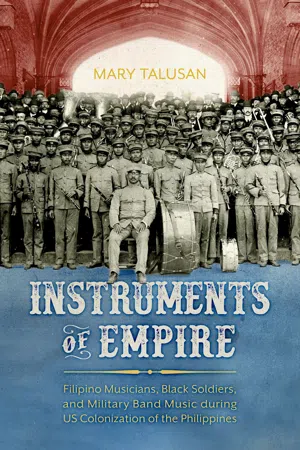
At the turn of the twentieth century, the United States extended its empire into the Philippines while subjugating Black Americans in the Jim Crow South. And yet, one of the most popular musical acts was a band of "little brown men," Filipino musicians led by an African American conductor playing European and American music. The Philippine Constabulary Band and Lt. Walter H. Loving entertained thousands in concert halls and world's fairs, held a place of honor in William Howard Taft's presidential parade, and garnered praise by bandmaster John Philip Sousa—all the while facing beliefs and policies that Filipinos and African Americans were "uncivilized."
Author Mary Talusan draws on hundreds of newspaper accounts and exclusive interviews with band members and their descendants to compose the story from the band's own voices. She sounds out the meanings of Americans' responses to the band and identifies a desire to mitigate racial and cultural anxieties during an era of overseas expansion and increasing immigration of nonwhites, and the growing "threat" of ragtime with its roots in Black culture. The spectacle of the band, its performance and promotion, emphasized a racial stereotype of Filipinos as "natural musicians" and the beneficiaries of benevolent assimilation and colonial tutelage. Unable to fit Loving's leadership of the band into this narrative, newspapers dodged and erased his identity as a Black American officer.
The untold story of the Philippine Constabulary Band offers a unique opportunity to examine the limits and porousness of America's racial ideologies, exploring musical pleasure at the intersection of Euro-American cultural hegemony, racialization, and US colonization of the Philippines.
eBook - PDF
Instruments of Empire
Filipino Musicians, Black Soldiers, and Military Band Music during US Colonization of the Philippines
- 281 pages
- English
- PDF
- Available on iOS & Android
eBook - PDF
Instruments of Empire
Filipino Musicians, Black Soldiers, and Military Band Music during US Colonization of the Philippines
About this book
Trusted by 375,005 students
Access to over 1.5 million titles for a fair monthly price.
Study more efficiently using our study tools.
Information
Publisher
University Press of MississippiYear
2021Print ISBN
9781496835673
9781496835666
eBook ISBN
9781496835703
Subtopic
Military & Maritime HistoryTable of contents
- Cover
- INSTRUMENTS OF EMPIRE
- Title
- Copyright
- CONTENTS
- Dedication
- Acknowledgments
- Introduction: World’s Fairs, Symphony Halls, and America’s Racial Others
- 1 Instruments of Empire: Brass Bands, Black Soldiers, and American Imperialism in the Philippines
- 2 Marching to Racial Progress: Civilizing Filipinos at the 1904 St. Louis World’s Fair
- 3 Hearing with an Imperial Ear: Racializing the PC Band on their Tour of America in 1909
- 4 Sounding Philippine Nationalism at the Panama-Pacific International Exposition of 1915
- 5 Musical Resonances of Empire: The Golden Gate International Exposition and the End of an Era
- Notes
- Bibliography
- ABOUT THE AUTHOR
Frequently asked questions
Yes, you can cancel anytime from the Subscription tab in your account settings on the Perlego website. Your subscription will stay active until the end of your current billing period. Learn how to cancel your subscription
No, books cannot be downloaded as external files, such as PDFs, for use outside of Perlego. However, you can download books within the Perlego app for offline reading on mobile or tablet. Learn how to download books offline
Perlego offers two plans: Essential and Complete
- Essential is ideal for learners and professionals who enjoy exploring a wide range of subjects. Access the Essential Library with 800,000+ trusted titles and best-sellers across business, personal growth, and the humanities. Includes unlimited reading time and Standard Read Aloud voice.
- Complete: Perfect for advanced learners and researchers needing full, unrestricted access. Unlock 1.5M+ books across hundreds of subjects, including academic and specialized titles. The Complete Plan also includes advanced features like Premium Read Aloud and Research Assistant.
We are an online textbook subscription service, where you can get access to an entire online library for less than the price of a single book per month. With over 1.5 million books across 990+ topics, we’ve got you covered! Learn about our mission
Look out for the read-aloud symbol on your next book to see if you can listen to it. The read-aloud tool reads text aloud for you, highlighting the text as it is being read. You can pause it, speed it up and slow it down. Learn more about Read Aloud
Yes! You can use the Perlego app on both iOS and Android devices to read anytime, anywhere — even offline. Perfect for commutes or when you’re on the go.
Please note we cannot support devices running on iOS 13 and Android 7 or earlier. Learn more about using the app
Please note we cannot support devices running on iOS 13 and Android 7 or earlier. Learn more about using the app
Yes, you can access Instruments of Empire by Mary Talusan in PDF and/or ePUB format, as well as other popular books in Media & Performing Arts & Military & Maritime History. We have over 1.5 million books available in our catalogue for you to explore.