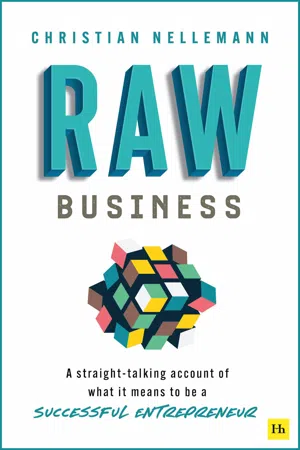
eBook - ePub
Raw Business
A straight-talking account of what it means to be a successful entrepreneur
- English
- ePUB (mobile friendly)
- Available on iOS & Android
eBook - ePub
Raw Business
A straight-talking account of what it means to be a successful entrepreneur
About this book
Want to know what it takes to run a successful business? How to set up and grow a company? How to effectively manage your people and create a prosperous work environment?
Raw Business holds the answers.
Drawing on the life lessons and core principles developed over a 30-year career running home-based to small and now multi-million-pound businesses, this book outlines Christian Nellemann's trusted methods for achieving success.
Filled with practical advice for shaping good working habits, recruiting the right people, and building an effective sales team, it is an essential read for any entrepreneur.
It's a book on beating the odds; staying afloat where so many sink and growing where so many shrink.
Raw Business contains the raw and unvarnished advice that you need to build and grow a successful company.
Information
Topic
Negocios y empresaSubtopic
Desarrollo empresarialPart One: A Life Of Lessons Learned
Chapter 1: Childhood
I have had very mixed feelings about writing and publishing this book. In fact, I’ve been sitting on the final draft for the best part of a year and a half. On the one hand, I felt that passing on the lessons I’ve learnt and the scars I’ve accumulated throughout a 30-year career would potentially benefit someone. But on the other hand, I was self-consciously fearful that people would find it pretentious or would find the content dreadful.
Yet I am almost always asked what the fundamentals of running a successful business are? Can my success be replicated? What are the magic ingredients of success? What’s the hidden formula? The secret sauce?
As a result, I’ve spent a fair amount of time thinking and talking about this, and I realised that my views are often different and, strangely enough, counterintuitive. A fair amount of advice you will have heard before, so I wanted to share my own unique experience of the business world too, in the hope that I can point hungry, ambitious entrepreneurs in the right direction.
If I can inspire just one entrepreneur to become successful or help someone avoid the ever-looming pitfalls that I fell victim to, then this foray into authorship will have been worthwhile.
There are a couple of reasons for writing this book. First, looking back over a career of building multi-million-pound businesses, I realised that my story was interesting because it gives a real insight into one of the most vital yet overlooked aspects of any successful business: how to build a fantastic sales team. Managing a sales operation well is fundamental to the success of any business, no matter what area it operates in, and yet many entrepreneurs have no idea how to create a sales team that really delivers.
Building an effective sales team is not difficult, but it does take hard work. Surprisingly, it is often left as an afterthought, something that is built on a foundation of little more than hope – hope that it’s somehow going to just happen, that a team will just come together, and everything will fall into place. And that’s where the problems start.
I have spent the last 30 years nurturing and training good salespeople, in order to create brilliant sales teams and hence successful companies. I wanted to share the knowledge I have learnt so that others can benefit from the very expensive ‘school fees’ I’ve had to pay along the way.
Another reason for putting pen to paper is that I would like to discuss the important role that culture plays within business. I am hoping that new employees of XLN will have a better understanding of why we do things the way we do and why XLN is such a different place to work.
Finally, I have two very young sons who have little to no interest in what Daddy does at work at the moment. If nothing else, I wanted there to be some sound fatherly advice to help them navigate life in case I’m not here when they need it.
This is primarily a business book, but rather than jump straight to my tips and advice without any perspective, I will start by telling the story of my journey as an entrepreneur right back from childhood. I think it’s important to put things in context and provide a backdrop illustrating where my ideas were born, my advice was fashioned, and my core principles were developed.
I realise that everything I have learned in my life has emerged from influences I was exposed to while growing up and in particular, the wisdom and understanding that I gained from my father. I have been very fortunate to have had great mentors all throughout my life and career, and I owe it to all these people to pass their wisdom on.
We are, after all, the sum of our friends, family, and past experiences.
Right back at the beginning
My story begins in Denmark, in a small town called Kolding, not far from the German border. Kolding has a population of 60,000 people and is about the seventh largest town in Denmark, which is not saying much. Several industrial companies are based there but it is perhaps most noteworthy for its thirteenth-century castle, which is now home to the municipal museum of modern art, called the Koldinghus Museum.
It was the kind of place where even if you were successful, you didn’t flaunt your wealth. Rich farmers and business people would drive old, inconspicuous cars so they didn’t stand out, and their expensive watches would be hidden up their sleeve. Most had their feet firmly planted in the fertile soil – it reminds me most of the Yorkshire mentality.
My arrival into the world came as something of a surprise because my mother had been told that she could not have children. My birth also caused a bit of drama. I was born yellow, and the doctors thought I had serious, life-threatening levels of jaundice. I was immediately baptised and rushed in an ambulance, during a snowstorm, to another larger city’s hospital, where I was in an incubator for a while. But I made it and came home.
Right from the start I was an adventurous child. I was always full of energy and was just ‘go go go’ all the time. I would be up at 5am and wouldn’t stop moving until I went to bed. I was always up to all sorts of tricks. The first word I could say was ‘hoover’, and from an early age I would get the hoover out and start cleaning. And then I would get all the pots and pans out of the kitchen cupboards, much to my mother’s annoyance.
At the age of three, I would unscrew light sockets. And as I grew older, I would run wild with my younger brother Peter and our friends. We were fearless, always making dens and swinging in trees over the road when cars were driving by. I must have been a bit of a nightmare for my parents. It got to the point where, if my mum was going over to see a friend, her friends would say, “you don’t have to bring Christian”.
My father owned a department store in town called Lumbye Inspiration and a timber business called Lumbye Industry. This afforded my family a comfortable lifestyle with a big house right on the fjord where we could swim and sail boats. My parents were very close friends with about six other families who lived close by and we spent a lot of time together. Every Friday and Saturday evening our house would be full of people drinking cocktails and eating little cocktail sausages – all the rage in the mid- to late-seventies – while the children ran around and played. The six families had holiday homes in the same place too, on an island called Fanoe, where we would all decamp during the summer months of June and July.
My father’s business was very much part of our lives and as my younger brother Peter and I grew up, we would rarely see him at home because he was always working. He never came to events, such as our school sports day, so at the weekends, holidays and after school, I would go into the department store or the timber yard and hang around with my dad while he worked.
He could sometimes be strict though and we were quite frightened of him. Whenever I asked him whether I could come into work with him he would say yes, but if I wasn’t ready on time, he would drive off without me. I remember very clearly to this day one morning where we had eaten breakfast together and I had asked to come with him to work. My dad would always leave the breakfast table, visit the bathroom and then leave. I mistimed his bathroom break and as I walked outside to the garage to get into the car with him, I saw his car already far down the road. That taught me an incredibly valuable lesson: be on time!
My dad taught me how to grow up fast. There’s no doubt that he built my character with his focus on punctuality, commitment and drive. He always drummed into me that if you are going to do something, then you do it well and do it well the first time round.
Motivation
From a very early age I knew that I wanted to be a businessman too, like my father, and his father before him. Either that or a gangster, as I apparently told my somewhat concerned mum at the tender age of six. One thing was clear; I wanted to be successful, and I wanted to be rich.
I wanted to have all the nice things in life, like cars, boats and houses, and I wanted a lot of wonderful experiences, such as travel and great food, all of which required a huge amount of money.
I also understood very early on that money buys freedom. My dad always told me that when you make your own money, you can make your own decisions. So I was always thinking about how I could start making some money of my own.
My grandmother, whom I absolutely adored, lived in a large apartment above my f...
Table of contents
- Contents
- Introduction
- About Me
- Part One: A Life Of Lessons Learned
- Part Two: My Core Principles
- Formula For Success
- Part Three: Putting It Into Practice
- Building A Business
- Letter To My Son Milo
- The Deal That Wasn’t To Be
- Biggest Curveball In History
- What’s Next: The Future of XLN
- Acknowledgements
- Publishing details
Trusted by 375,005 students
Access to over 1.5 million titles for a fair monthly price.
Study more efficiently using our study tools.
Frequently asked questions
Yes, you can cancel anytime from the Subscription tab in your account settings on the Perlego website. Your subscription will stay active until the end of your current billing period. Learn how to cancel your subscription
No, books cannot be downloaded as external files, such as PDFs, for use outside of Perlego. However, you can download books within the Perlego app for offline reading on mobile or tablet. Learn how to download books offline
Perlego offers two plans: Essential and Complete
- Essential is ideal for learners and professionals who enjoy exploring a wide range of subjects. Access the Essential Library with 800,000+ trusted titles and best-sellers across business, personal growth, and the humanities. Includes unlimited reading time and Standard Read Aloud voice.
- Complete: Perfect for advanced learners and researchers needing full, unrestricted access. Unlock 1.5M+ books across hundreds of subjects, including academic and specialized titles. The Complete Plan also includes advanced features like Premium Read Aloud and Research Assistant.
We are an online textbook subscription service, where you can get access to an entire online library for less than the price of a single book per month. With over 1.5 million books across 990+ topics, we’ve got you covered! Learn about our mission
Look out for the read-aloud symbol on your next book to see if you can listen to it. The read-aloud tool reads text aloud for you, highlighting the text as it is being read. You can pause it, speed it up and slow it down. Learn more about Read Aloud
Yes! You can use the Perlego app on both iOS and Android devices to read anytime, anywhere — even offline. Perfect for commutes or when you’re on the go.
Please note we cannot support devices running on iOS 13 and Android 7 or earlier. Learn more about using the app
Please note we cannot support devices running on iOS 13 and Android 7 or earlier. Learn more about using the app
Yes, you can access Raw Business by Christian Nellemann in PDF and/or ePUB format, as well as other popular books in Negocios y empresa & Desarrollo empresarial. We have over 1.5 million books available in our catalogue for you to explore.