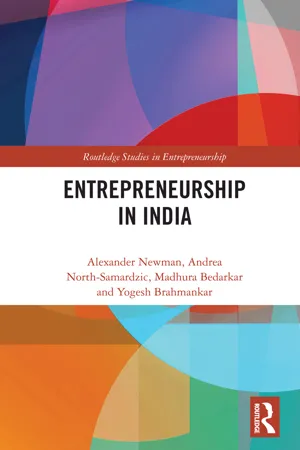
Entrepreneurship in India
  1. 188 pages
  2. English
  3. ePUB (mobile friendly)
  4. Available on iOS & Android
eBook - ePub

About this book

The economic liberalization in India over the last three decades has provided a wealth of opportunity for entrepreneurs looking to start and expand their businesses. Since the economy opened up in the 1990s, entrepreneurial activity in the private sector has been largely responsible for the strong economic growth experienced in the country. India is presently the world's third largest source of start-ups, and was ranked the second most entrepreneurial country in the world in the recent Global Entrepreneurship Monitor (GEM) report, ahead of large economic powerhouses such as the United States, China and the UK.

Entrepreneurship in India looks at the dynamic and changing nature of entrepreneurship in India. The book examines the history of entrepreneurship in India, different entrepreneurship models adopted, the entrepreneurial ecosystem and looks at the future of entrepreneurship in the country.

This book will benefit businesspeople, policy makers and researchers looking to understand more about entrepreneurship in India, and offers guidance to foreign businesses looking to engage with entrepreneurs in India.

Trusted by 375,005 students

Access to over 1.5 million titles for a fair monthly price.

Study more efficiently using our study tools.

Information

Publisher
Routledge
Year
2021
Print ISBN
9780367497699
eBook ISBN
9781000460001

1 India's entrepreneurial transformation

DOI: 10.4324/9781003047285-1

Introduction

Although the Indian economy grew slowly for the first three decades after inde pendence, due to state control over the economy, since the mid-1990s it has begun to open up its markets through economic liberalization. After fundamental reforms in the 1990s and early part of the 21st century, India transformed into a market economy. Presently India is the fifth largest economy in the world and is home to 1.3 billion people. In 2018 alone India’s economy grew at 7 per cent, making it one of the fastest growing large economies in the world. According to the International Monetary Fund, India is expected to become one of the top three economies in the world in the next 10–15 years.1
The economic liberalization in India over the last three decades has provided a wealth of opportunity for entrepreneurs looking to start and expand their businesses. Since the economy opened up in the 1990s, entrepreneurial activity in the private sector has been largely responsible for the strong economic growth experienced in the country. Micro, small and medium-sized enterprises (MSMEs) make a significant contribution to India’s economy. As of the end of 2019 there were around 63.3 million MSMEs that provided employment to over 110 million people and accounted for around 28.9 per cent of India’s GDP.2
In the recent Global Entrepreneurship Monitor report, India was ranked the second most entrepreneurial country in the world, just behind Chile, and ahead of large economic powerhouses such as the United States, China and the UK.3 It ranks very highly on a number of categories, including the extent to which individuals perceived there to be entrepreneurial opportunities in their environment, their own entrepreneurial capabilities, and their intentions to engage in entrepreneurship. The extent to which Indians believed entrepreneurship to be a good career choice and that high status was provided to entrepreneurs by members of society were also much higher than average. Such data suggests that India is an extremely entrepreneurial country, and that entrepreneurship is highly valued in Indian society.
This book is designed to provide a broad overview and understanding of how entrepreneurship has emerged in India, the current state of entrepreneurship, and the entrepreneurs who have driven the growth of small and medium enterprises into scaled and successful organizations.

Entrepreneurship in India

Open the business section of any major national or local newspaper in India and you will see a story about a successful entrepreneur who has founded one of India’s unicorn businesses or a new start-up that has just been launched. Read the matrimonial advertisement sections in the Times of India or other large national newspapers and you will see families boasting about their son or daughter being a successful entrepreneur when looking for a marriage partner for their child.
If you walk along the streets of any large or medium-sized city in India you will witness the entrepreneurial spirit of the Indian people as they engage in entrepreneurial activity ranging from street vendors selling goods on the street corner to sole traders selling the latest electronic products at the local market. If you travel through any of the special economic zones set up by the Indian Government since the 2000s, you will see domestic private business thriving alongside leading multinational firms. In Bangalore, take a taxi outside of the city to one of the numerous technology parks, and you will see new start-ups operating inside many of the incubators and co-working spaces launched across the city. India’s Silicon Valley, as it is called, is now home to the world’s fourth largest technology hub which accounts for nearly 10 per cent of the country’s gross domestic product.
Travel to rural India and you will see women artisans on street corners producing handicrafts for sale, and farmers bringing their fresh produce for sale at the local market on the back of rickshaws and motorbikes.
Walk into any of the major universities and colleges across India and you will see students taking part in entrepreneurship competitions and clubs, looking to launch the next unicorn start-up and become multi-millionaires. Switch on the TV and you will see TV shows focusing on entrepreneurship such as Awaaz Entrepreneur, the TVF Pitchers Show and the Vault. Connect to streaming services such as Netflix and you will be able to watch documentaries and TV dramas about Indian entrepreneurs such as Bad Boy Billionaires and Upstarts.
Wherever you travel in India, entrepreneurship is a part of life. In recent years the number of new businesses in India has boomed. India is now the world’s third largest source of start-ups. New company registration has grown from around 15,000 per year in the 1980s to around 100,000 in the 2010s.4 By the end of 2020 India was home to 34 unicorn enterprises with a value of over $1 billion including Flipkart, Paytm, Ola Cabs, Zomato and Snapdeal.5 To support the growth of entrepreneurship we have seen the growth of entrepreneurial ecosystems in many of the big cities. According to a recent report, India is home to three of the top global start-up hubs – Bangalore, Delhi and Mumbai.6 India was ranked third behind just the United States and China for the amount of venture capital investment in the country since 2015.
Both the national and state governments have taken steps to support entrepreneurship in India. In 2015, the national government launched the policy think tank, the National Institution for Transforming India, also known as NITI Aayog, to support the growth of entrepreneurship in India. NITI Aayog has worked with the Indian Government to launch a whole host of schemes including the ‘Atal Innovation Mission’ ‘Start-Up India’ and ‘Digital India’. The Atal Innovation Mission nurtures entrepreneurship and innovation through promoting a supportive ecosystem. It has launched numerous programmes to support entrepreneurship including Atal Tinkering Labs, Atal Incubators, Atal New India Challenges, the Atal Community Innovation Centre and ARISE.
In 2016, the Modi government launched the flagship initiative ‘Start-Up India' to build a strong entrepreneurial ecosystem to support start-ups and drive economic growth through the generation of employment opportunities.7 The initiative included measures such as a fund of 100 billion INR, financial support for incubators, the establishment of tinkering laboratories, tax breaks for new startups and a simplified registration process when setting up a business. Through education partners, Start-Up India also provides access to free and low-cost training courses for entrepreneurs such as financial accounting, data analytics and web development.
The ‘Digital India’ initiative was also launched by the government in 2015 to support entrepreneurial activity in less-developed parts of the country through the creation of broadband highways, and the provision of universal access to mobile connectivity and public access to the internet. It is hoped this initiative will support the growth of entrepreneurship through fostering digital literacy among entrepreneurs and the use of digital payment and sales systems.
State governments have also introduced a whole host of policies to foster entrepreneurial activity ranging from the provision of low-interest loans and credit guarantee facilities to establishing initiatives and programmes. State governments have also invested heavily in launching incubators and accelerators in India. There are presently estimated to be over 250 across the whole country.8 They include Kerala’s Startup Mission and Telangana’s T-Hub.
India as a market holds tremendous opportunity for both domestic entrepreneurs and international entrepreneurs seeking to capitalize on consumer spendinggrowth. Consumer spending has steadily increased over time9 and is poised to recover and return to growth once the COVID-19 pandemic subsides.10 It has been predicted by the World Economic Forum that by 2030, India will become the world’s third largest consumer market.11 The proportion of the middle class, who are more likely to spend across all market categories and upgrade their existing purchases into more premium products, are expected to grow significantly, especially in rural areas. As India has one of the largest populations of young people, Millennials and Gen Z will actively shape consumption preferences due to greater access to technology.12 As such, technology-enabled business models will become more widespread.13 For entrepreneurs, this will require the development of more personalized and customized business models for local contexts and a strong ‘founder’s mindset’ driven by passion.14

Barriers to entrepreneurship

Despite the success that India has witnessed as regards the growth in entrepreneurial activity, entrepreneurs in India, especially female entrepreneurs and those from low socio-economic groups, continue to face barriers when starting and expanding new ventures. High levels of gender inequality in Indian society mean that the rates of female entrepreneurship are much lower than those of males.15 India lags behind the rest of the world when it comes to women’s entrepreneurial participation rates.
Entrepreneurs also face difficulties when doing business in India due to high levels of red tape and bureaucracy. Compared to other countries in the world it is relatively costly and time consuming in India to start a business. India also ranks poorly when it comes to enforcing contracts in the court system and registering property.16 Entrepreneurs in many areas of the country also find it hard to access finance to establish and expand their businesses.
Expanding an enterprise in India is more complex than in other nations, not merely due to institutional hurdles. India is an extremely diverse nation with 22 major languages, not including hundreds of local dialects. Regional differences are pronounced with different cultural attitudes, beliefs, values and religions. This means that expanding a business beyond a region can feel like expanding into another country. Entrepreneurs not only need to navigate different bureaucratic systems, but also need to manage cultural and linguistic differences. The most successful entrepreneurs are the ones who have the local connections and knowledge to navigate these differences and capitalize on the diversity within India, seeing it as a benefit rather than a hindrance to entrepreneurship.

Outline of the book

This book has ten chapters, including this introduction. Each chapter focuses on a different aspect of entrepreneurship in India. Chapter 2 looks at the history of entrepreneurial development in India. As well as examining how entrepreneurship has evolved over time as a result of societal changes, this chapter also examines how recent changes in government policy have led to the development of entrepreneurship....

Table of contents

  1. Cover
  2. Half Title
  3. Series Page
  4. Title Page
  5. Copyright Page
  6. Table of Contents
  7. List of tables
  8. Acknowledgements
  9. 1 India’s entrepreneurial transformation
  10. 2 History of entrepreneurship in India
  11. 3 India’s entrepreneurs and private enterprises
  12. 4 Women’s entrepreneurship in India
  13. 5 Case studies of women entrepreneurs in India
  14. 6 Financing entrepreneurship in India
  15. 7 Indian culture and its influence on entrepreneurship
  16. 8 Dealing with the government
  17. 9 Doing business with Indian entrepreneurs
  18. 10 The future of entrepreneurship in India
  19. References
  20. Index

Frequently asked questions

Yes, you can cancel anytime from the Subscription tab in your account settings on the Perlego website. Your subscription will stay active until the end of your current billing period. Learn how to cancel your subscription
No, books cannot be downloaded as external files, such as PDFs, for use outside of Perlego. However, you can download books within the Perlego app for offline reading on mobile or tablet. Learn how to download books offline
We are an online textbook subscription service, where you can get access to an entire online library for less than the price of a single book per month. With over 1.5 million books across 990+ topics, we’ve got you covered! Learn about our mission
Look out for the read-aloud symbol on your next book to see if you can listen to it. The read-aloud tool reads text aloud for you, highlighting the text as it is being read. You can pause it, speed it up and slow it down. Learn more about Read Aloud
Yes! You can use the Perlego app on both iOS and Android devices to read anytime, anywhere — even offline. Perfect for commutes or when you’re on the go.
Please note we cannot support devices running on iOS 13 and Android 7 or earlier. Learn more about using the app
Yes, you can access Entrepreneurship in India by Alexander Newman,Andrea North-Samardzic,Madhura Bedarkar,Yogesh Brahmankar in PDF and/or ePUB format, as well as other popular books in Business & Business General. We have over 1.5 million books available in our catalogue for you to explore.