- 350 pages
- English
- ePUB (mobile friendly)
- Available on iOS & Android
eBook - ePub
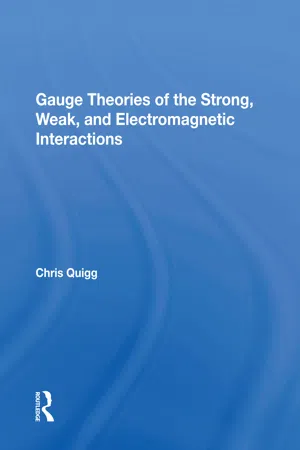
Gauge Theories Of Strong, Weak, And Electromagnetic Interactions
About this book
This monograph presents a coherent and elementary introduction to Gauge theories of the fundamental interactions and their applications to high-energy physics. It deals with the logic and structure of local Gauge symmetries and Gauge theories, from quantum electrodynamics through unified theories of the interactions among leptons and quarks. Many explicit calculations provide the reader with practice in computing the consequences of these theories and offer a perspective on key experimental investigations. First published in 1983, this text is ideal for a one-semester course on Gauge theories and particle physics. Specialists in particle physics and others who wish to understand the basic ideas of Gauge theories will find it useful as a reference and for self-study.
CHAPTER 1
INTRODUCTION
DOI: 10.1201/9780429034978-1
High-energy physics, the science of the ultimate constituents of matter and the interactions among them, has undergone a remarkable development during the past decade. A host of new experimental results made accessible by a new generation of particle accelerators and the accompanying rapid convergence of theoretical ideas have brought to the subject a new coherence and have raised new aspirations. Many thoughtful scientists are expressing optimism that a grand synthesis of natural phenomena is at hand.1 Indeed, it will be seen in the course of this volume that a unified description of the strong, weak, and electromagnetic interactions may not be just a distant dream. A qualitatively satisfactory, if not entirely satisfying, unified theory may already exist. The most sanguine observers accept this sort of “grand unification” as a fait accompli and argue that a complete Theory of the World awaits only the incorporation of gravitation.
Ours is hardly the first time in history that physicists have believed themselves close to an enduring understanding of the laws of Nature. What, then, are the grounds for believing that (whether or not “the end” is in sight) important progress is under way? Essential elements are the significance of the quark-model description of hadrons, the nonobservation of quark or lepton substructure, the notable successes of the Weinberg–Salam model of the weak and electromagnetic interactions, and the low abundance of free quarks.
The utility of the quark model as a classification tool that provides a systematic basis for hadron spectroscopy has long been appreciated. Recognition that the quark language also permits an apt description of the dynamics of hadronic interactions has come more recently. The quark-parton model underlies a quantitative phenomenology of deeply inelastic lepton–hadron scattering and of electron–positron annihilation into hadrons. The interpretation of violent collisions of hadrons in terms of the hard scattering of pointlike constituents, although for the moment somewhat schematic, is extremely appealing as well.
An elementary particle, in the time-honored sense of the term, is structureless and indivisible. Although history cautions that the physicist’s list of elementary particles is dependent upon experimental resolution, and thus subject to revision with the passage of time, it also has rewarded the hope that interactions among the elementary particles of the moment would be simpler and more fundamental than those among composite systems. Neither quarks nor leptons exhibit any structure on a scale of about 10−16 cm, the currently attained resolution. We thus have no experimental reason but tradition to suspect that they are not the ultimate elementary particles. For nearly all of this book they will be considered as the fundamental fermions.
The appeal of unified theories of weak and electromagnetic interactions is at once esthetic and practical. The effective weak-interaction Lagrangian that evolved from Fermi’s description of nuclear β-decay, and provided a serviceable low-energy phenomenology, is now seen to be the limiting form of a renormalizable field theory. ...
Table of contents
- Cover
- Half Title
- Series Page
- Title Page
- Copyright Page
- Editor’s Foreword
- Contents
- Preface
- Chapter 1 Introduction
- Chapter 2 Lagrangian Formalism and Conservation Laws
- Chapter 3 The Idea of Gauge Invariance
- Chapter 4 Non-Abelian Gauge Theories
- Chapter 5 Hidden Symmetries
- Chapter 6 Electroweak Interactions of Leptons
- Chapter 7 Electroweak Interactions of Quarks
- Chapter 8 Strong Interactions among Quarks
- Chapter 9 Unified Theories
- Epilogue
- Appendix A: Notations and Conventions
- Appendix B: Observables and Feynman Rules
- Appendix C: Physical Constants and Definitions
- Author Index
- Subject Index
Trusted by 375,005 students
Access to over 1.5 million titles for a fair monthly price.
Study more efficiently using our study tools.
Frequently asked questions
Yes, you can cancel anytime from the Subscription tab in your account settings on the Perlego website. Your subscription will stay active until the end of your current billing period. Learn how to cancel your subscription
No, books cannot be downloaded as external files, such as PDFs, for use outside of Perlego. However, you can download books within the Perlego app for offline reading on mobile or tablet. Learn how to download books offline
Perlego offers two plans: Essential and Complete
- Essential is ideal for learners and professionals who enjoy exploring a wide range of subjects. Access the Essential Library with 800,000+ trusted titles and best-sellers across business, personal growth, and the humanities. Includes unlimited reading time and Standard Read Aloud voice.
- Complete: Perfect for advanced learners and researchers needing full, unrestricted access. Unlock 1.5M+ books across hundreds of subjects, including academic and specialized titles. The Complete Plan also includes advanced features like Premium Read Aloud and Research Assistant.
We are an online textbook subscription service, where you can get access to an entire online library for less than the price of a single book per month. With over 1.5 million books across 990+ topics, we’ve got you covered! Learn about our mission
Look out for the read-aloud symbol on your next book to see if you can listen to it. The read-aloud tool reads text aloud for you, highlighting the text as it is being read. You can pause it, speed it up and slow it down. Learn more about Read Aloud
Yes! You can use the Perlego app on both iOS and Android devices to read anytime, anywhere — even offline. Perfect for commutes or when you’re on the go.
Please note we cannot support devices running on iOS 13 and Android 7 or earlier. Learn more about using the app
Please note we cannot support devices running on iOS 13 and Android 7 or earlier. Learn more about using the app
Yes, you can access Gauge Theories Of Strong, Weak, And Electromagnetic Interactions by Chris Quigg in PDF and/or ePUB format, as well as other popular books in Physical Sciences & Chemistry. We have over 1.5 million books available in our catalogue for you to explore.