The indispensable sage, fierce enemy, silent sidekick: the role of Native Americans in film has been largely confined to identities defined by the ‘white’ perspective. Many studies have analysed these simplistic stereotypes of Native American cultures in film, but few have looked beyond the Hollywood Western for further examples. In this incisive study, distinguished film scholar Edward Buscombe examines cinematic depictions of Native Americans from a global perspective.
Buscombe opens with a historical survey of nineteenth-century visual culture – from dime novels to Wild West shows on stage. He explains how, in the early years of film-making, many Westerns were sympathetic to Native Americans. Yet, by the 1920s, if Native Americans appeared on screen at all they were invariably hostile. Questioning the implicit assumptions of prevailing critiques, Buscombe looks abroad to reveal a distinctly different portrait of Native Americans. He focuses on the lesser-known Westerns made in Germany – such as East Germany’s Indianerfilme, in which Native Americans were Third World freedom fighters battling against Yankee imperialists. These alternative portrayals of Native Americans offer a vastly different view of their cultural position in American society.
‘Injuns!’ is an original, cogent account of the cultural images of Native Americans through history and around the globe, revealing new and complex issues in our understanding of how indigenous peoples have been represented in mass culture.
- English
- ePUB (mobile friendly)
- Available on iOS & Android
eBook - ePub
About this book
Information
Topic
Ciencias sociales | 1 the formation of a genre |
I first visited the United States in 1977 to teach in the Midwest at the University of Iowa, a state named after an Indian tribe, although I never saw an Indian the whole time I was there. When the semester was over I drove my car from Iowa to Los Angeles. Being already a keen student of the Western movie, I made sure my itinerary passed through Monument Valley, where I genuflected to the memory of John Ford. We stopped for breakfast at a small café at Mexican Hat, a hamlet at the Utah end of the valley. At one side of the café was a group of people eating. Stocky in stature, with wide, brown faces, they wore jeans and straw cowboy hats. I made a remark to my companion, assuming these people were Mexicans. Don’t you know who they are, she asked. She told me they were Indians. By that time I had probably seen several hundred Westerns and thought I knew what an Indian looked like. Obviously I didn’t.
Where do white people’s ideas about Indians come from? Undoubtedly, the most pervasive and potent contemporary source is the cinema. Throughout most of the history of Hollywood, until it began to lose its appeal in the 1960s, the Western was the major genre of American cinema, comprising between a fifth and a quarter of all feature films made in the period 1910–1960. In the last century something like seven thousand Western feature films were produced in all, and a substantial proportion of these deal with Indians.1 For every white American who has ever seen, still less met, an Indian, there must be a thousand whose only experience of Indians has been on film. And of course for Europeans this will be even more the case.
Western films, it hardly needs stating, afford a highly skewed version of Indian life. In the first place, they do not reflect the diversity of Indian culture. At the time of the first encounters with whites, there were at least 300 distinct Indian languages in America north of Mexico. The cultures that spoke these tongues lived widely differing existences. In the south-east Indians grew corn in irrigated fields. On the great plains Indians lived by hunting buffalo – on foot, since there were no horses in the Americas until Europeans introduced them. In the deserts of the Great Basin Indians lived by gathering roots and seeds, constructing temporary shelters from branches and grass. In the south-west the Pueblo Indians lived in multi-storey adobe houses and farmed corn, squash and beans. In the north-west Indians lived in huge log houses and fished salmon in the rivers or went to sea in canoes and hunted whales.
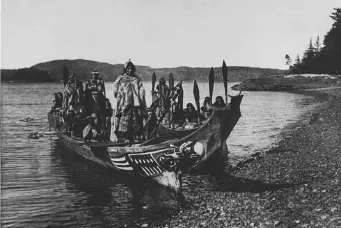
Edward S. Curtis, The Wedding Party: Qagyhuhl, 1915.
In the movies only a fraction of this diversity gets onto the screen. Representation is confined to little more than half a dozen tribes: Sioux, Cheyenne, Blackfoot, Comanche, Apache, Kiowa, with an occasional appearance by Seminoles, Utes or Shoshone. A small number of films set in the eighteenth century feature Indians of the north-east, such as the Iroquois and Hurons. Oddly, perhaps, given the provenance of the films themselves, the numerous tribes of Californian Indians virtually never appear in the cinema.
The historical spread of the films is as restricted as the geographical one. The great majority of Westerns take place within the period between the end of the Civil War in 1865 and the turn of the century. The effect of this concentration upon such a small segment of history is to freeze the Indians in time. This is the way they have always been, we assume. And since so few films portraying Indians are set in the present day, there is a tendency on the part of white audiences to assume that, unlike the rest of society, Indians have not developed since the nineteenth century.
Often in the cinema Indians, faced with the threat of forcible eviction by whites, speak of their ancestral lands, sacred since time immemorial, as if to confirm that Indian life is immutable. In fact, Indian societies have undergone momentous historical changes, both before Columbus and since. Two things, besides the obvious and shattering effect of white invasion, have most altered Indian society. First was the discovery of how to grow corn, which occurred in Mexico around 3500 BC. By AD 1000 corn had spread up the Mississippi and into the Ohio Valley, enabling large populations to form in permanent townships whose economies were based on agriculture. ‘Around the time the Normans were invading England and Christendom was embarking on the first Crusades, Mississippian culture peaked near present-day St Louis with the emergence of the largest town in pre-Columbian North America, a paramount chiefdom unlike anything seen before or since.’2 This town, subsequently named Cahokia by archaeologists, was constructed of more than a hundred massive earth-mounds, the remains of some still visible today. One covered sixteen acres at its base. The town may have contained ten thousand people. Yet, for reasons imperfectly understood, the civilization based there went into a decline in the fourteenth century, well before Europeans arrived. Hollywood has made scores of films dealing with the ancient civilizations of Egypt, Greece, Rome and elsewhere, but has yet to find pre-Columbian Indians a viable subject.
The second dramatic change in Indian societies came about as a result of horses escaping from the Spanish and gradually spreading over the continent. By 1680 Indians in Texas and New Mexico had their own horses. The result was a complete change of lifestyle for many Indian tribes, who, though still beyond the reach of white domination, benefited from this product of white culture. The Cheyenne had been a corn-growing people before acquiring horses in the eighteenth century and switching to hunting buffalo (for which their language evolved 27 different words depending on the animal’s sex, age and condition).3 Another group, the Numu people, as they called themselves, had originally been based in the northern Rocky Mountains, but the acquisition of horses encouraged them to venture out onto the plains. When the Spanish first encountered them in the eighteenth century they gave them the name used by their Ute neighbours and called them Comanche. By the end of that century their skill with horses (their language had seventeen different words for a horse based solely on its colouring) gave them dominance over much of the southern plains, pushing the Apaches into the mountains of New Mexico.4 Thus the Comanche who appear so often in Westerns set in Texas, such as John Ford’s The Searchers (1956), are in fact quite recent arrivals, even more so than the Spanish.
Why does this variety of cultural and historical experience not find its way into the cinema? We must start with the fact that movies are made for the mass audience. At the last census in 2000, the total population of the United States was 281.4 million; the total Indian population was 4.1 million, or 1.5 per cent. (This includes both people who defined themselves as solely of Indian extraction, and those of partly Indian origin.) A film industry aimed at a mass market and dedicated to making profits is not likely to cater for such a small minority if their tastes or interests are radically different from the majority. It does not necessarily follow that Hollywood will seek only to reinforce existing ideas and beliefs; money can sometimes be made by challenging received wisdom. But if, as some would certainly argue, whites’ perception of Indians and Indians’ perception of themselves are so far apart as to be mutually incompatible, then if forced to choose between the two we would expect Hollywood to make films that are more in tune with the ideas of whites than of Indians. A film whose terms of reference were totally within an Indian mind-set might be a difficult thing for the popular white audience to understand, let alone sympathize with. Hollywood has made scores, even hundreds, of films that have tried to recognize injustice towards the Indians, or see their point of view. But ultimately they have been all from a white perspective. If an Indian ‘problem’ is recognized, it is always from the standpoint of how is this a problem for white people? How could or should white people deal with it?
Almost invariably, if a film includes Indians, they will be shown in some sort of relationship with whites. Whereas whites in Westerns can comfortably exist without Indians being present, if Indians are shown then we see them in contact with white people, usually in a relationship of antagonism. There are a very few exceptions to this rule, which we shall come to later, but it is clear that by and large Indians are found interesting only in so far as they relate to us, the whites, and not in and of themselves. Interestingly, this is not necessarily the case in other media. In novels Indians are often the subjects, without their needing to be seen in relation to whites. But novels are not a mass medium, or not necessarily so. A novel can be viable with a readership of a couple of thousand people. For a movie, even an audience of a couple of million is judged a failure.
However, it is not simply a matter of what audiences will or won’t accept. Film genres, like other cultural products, have a history. There are reasons why genres take the form they do, which have to do with their origins and the circumstances in which they are formed. Genre may be seen as a means of organizing artistic production so as to minimize unpredictability. Audiences need to know, in advance of buying a ticket for a performance, that the film they are going to see is one that will appeal to them. Contrary to what is sometimes asserted, genre films are not ‘all the same’. If that were so, they would not supply the novelty that is an essential part of the filmgoing experience. But too much novelty makes it hard to guarantee satisfaction. There must be a level of similarity to those experiences we have pleasurably consumed in the past. If we like Westerns, the chances are that we will like the new one on offer. While this is undoubtedly the reason why genre has such a powerful hold in popular cinema, however, assuring satisfaction to the audience and continuing profits to the producers, and making it possible for the wheels of the industry to keep turning, at the same time genres can take on a momentum that is in part independent of both audiences and producers. Genres have a life of their own, as a result of the specific circumstances in which they come into being.
Thus the reason why Westerns represent Indians in the ways they do is not simply a function of their role as mass entertainment for a contemporary white audience. The genre of the Western began at a particular historical moment, in response to a particular set of circumstances, and this determined to a great extent its special characteristics. The view of Indians that was laid down at the time the genre was formed is still embedded deep within its structure, as the rocks laid down in earlier eras determine the structure of the land above, despite the shaping influences of more recent events such as erosion.
As we shall see, during its development the Western acquired a set of conventions both in relation to its visual iconography and also in terms of its typical narrative structures. Though whites had made pictures of Indians from the sixteenth century onwards, and though there had been stories about encounters with Indians from an equally early date, it was not until the later nineteenth century that the wide range of material, both visual and narrative, that had been gathered up around the broad topic of the American West became codified into the Western genre as we know it, a ready-made set of stories and conventions for the cinema to exploit.
Feature films are first and foremost stories, and in the nineteenth century one of the most popular media for telling stories about Indians was the theatre. James Nelson Barker’s play The Indian Princess; or, La Belle Sauvage, described as an ‘operatic mélo-drame’, was first performed in 1808. It relates the story, already familiar at the time, of Pocahontas, the daughter of Powhatan, an Indian chief in colonial Virginia in the early seventeenth century. According to the legend, though modern scholars have doubted its veracity, Pocahontas rescued Captain John Smith from being killed by her people. What is not in dispute is that she subsequently married John Rolfe, journeyed with him to London in 1616, was presented to King James I at court but died a year later, and was buried in Gravesend.
In the play Pocahontas is represented as a true friend of the whites, despite opposition from her compatriots, pleading with her father for Smith’s life.5 Already we have, so common in such stories, the division into good and bad Indians. The good ones are those who help the whites. The beautiful Indian princess (almost invariably an Indian woman needs to be of high birth if she is to be a suitable match for a white man) is already a fixture.6 Sexual relations between white women and Indian men, if treated at all, are usually regarded as offensive.
Dozens of Indian plays were performed in the 1830s and ’40s. George Washington Custis, a foster step-grandson of the first President, produced his own version of the Pocahontas tale in 1830, which continued to circulate the ‘myth of the supportive and assimilating Indian’.7 The year before, one of the most popular of all Indian plays had been premiered. This was John Augustus Stone’s Metamora; or, The Last of the Wampanoags, which starred the actor Edwin Forrest in a role he was to sustain for...
Table of contents
- Front Cover
- Half Title
- Title Page
- Copyright
- contents
- introduction
- 1 the formation of a genre
- 2 the liberal western
- 3 passing as an indian
- 4 indians in the european western
- 5 indians not injuns
- references
- select bibliography
- acknowledgements
- photo acknowledgements
- index
Trusted by 375,005 students
Access to over 1.5 million titles for a fair monthly price.
Study more efficiently using our study tools.
Frequently asked questions
Yes, you can cancel anytime from the Subscription tab in your account settings on the Perlego website. Your subscription will stay active until the end of your current billing period. Learn how to cancel your subscription
No, books cannot be downloaded as external files, such as PDFs, for use outside of Perlego. However, you can download books within the Perlego app for offline reading on mobile or tablet. Learn how to download books offline
Perlego offers two plans: Essential and Complete
- Essential is ideal for learners and professionals who enjoy exploring a wide range of subjects. Access the Essential Library with 800,000+ trusted titles and best-sellers across business, personal growth, and the humanities. Includes unlimited reading time and Standard Read Aloud voice.
- Complete: Perfect for advanced learners and researchers needing full, unrestricted access. Unlock 1.5M+ books across hundreds of subjects, including academic and specialized titles. The Complete Plan also includes advanced features like Premium Read Aloud and Research Assistant.
We are an online textbook subscription service, where you can get access to an entire online library for less than the price of a single book per month. With over 1.5 million books across 990+ topics, we’ve got you covered! Learn about our mission
Look out for the read-aloud symbol on your next book to see if you can listen to it. The read-aloud tool reads text aloud for you, highlighting the text as it is being read. You can pause it, speed it up and slow it down. Learn more about Read Aloud
Yes! You can use the Perlego app on both iOS and Android devices to read anytime, anywhere — even offline. Perfect for commutes or when you’re on the go.
Please note we cannot support devices running on iOS 13 and Android 7 or earlier. Learn more about using the app
Please note we cannot support devices running on iOS 13 and Android 7 or earlier. Learn more about using the app
Yes, you can access Injuns! by Edward Buscombe in PDF and/or ePUB format, as well as other popular books in Ciencias sociales & Historia y crítica cinematográficas. We have over 1.5 million books available in our catalogue for you to explore.