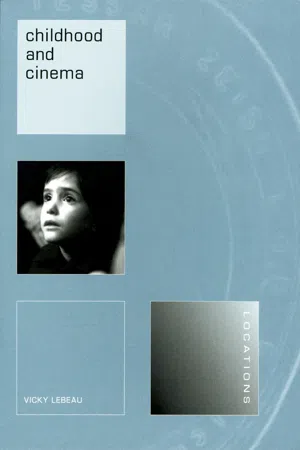
Since its inception the world of cinema has embraced the image of the child and both extended and challenged its representations. Vicky Lebeau explores the complex and ongoing adventure of childhood on screen and examines how the child in film has been used to embody the aspirations and anxieties of modern life. Moving from early to contemporary cinema – a process that includes discussions of films such as Victorian ‘Child Pictures’, The Spirit of the Beehive, L'Enfant sauvage, 400 Blows, Lolita, The Enigma of Kaspar Hauser, Tarnation and The Woodsman – she uncovers the compulsion of film-makers to visualize the child and their need to use childhood as a way of reflecting on sexuality, language, death and difference. By bringing together childhood and cinema as two institutions of modern culture, this book ultimately uses the figure of the child – as image, as narrative, and as myth – to reflect on the form and significance of cinema itself.
Thought-provoking and engaging, Childhood and Cinema is an original and challenging contribution to studies in childhood and visual culture that will be of interest to readers in the fields of literature, film and cultural studies.
- English
- ePUB (mobile friendly)
- Available on iOS & Android
eBook - ePub
Childhood and Cinema
About this book
Information
Subtopic
Film & Video1 the child, from life
So the hand of the child, automatic, Slipped out and pocketed a toy that was running along the quay. I could see nothing behind the child’s eye.1
On 28 December 1895, at the Grand Café in Paris, Louis Lumière’s Repas de bébé was one of the first public demonstrations of what this new form of visual technology, the Cinématographe Lumière, could do. Less than one minute in length, Lumière’s brief view of a baby, sharing a meal with her mother and father, carves out its place at the complex origins of cinema: Repas de bébé was among the earliest, and now canonical, films produced by the Lumière brothers to promote their Cinématographe, a combined camera-projector designed to record, and to project on screen, a sequence of images imprinted on a strip of celluloid film.
To look at Repas de bébé today is to encounter both the difference of early cinema – the flickering image, the static shot, its visual ‘flatness’ – and an uncanny sense of the familiar. Lumière’s film (of his brother Auguste, in fact, together with his wife and child) resembles a Victorian family photograph, those faded sepia prints that, as André Bazin has suggested, register the ‘disturbing presence of lives halted at a set moment in their duration’.2 Capturing a few brief, but successive, moments in the life of a bourgeois French family, Repas de bébé both repeats and extends the technology of the photograph, its apparently naturalistic depiction of the world; as the film critic Noël Burch observed, Repas de bébé was ‘probably the first film to catch faces “from life”’: the unique ‘presence’ of the photographic image combined now with the illusion of movement – the shuddering into motion of the still photograph, the flow of images across the screen – so vital to the innovation, and commercial attraction, of early film.3 ‘Suddenly a strange flicker passes through the screen, and the picture stirs to life’, wrote Maxim Gorky on first viewing the film at the Nizhni Novgorod fair on 4 July 1896. ‘I doubt my ability to describe it.’4
With its companion piece Enfants aux jouets (part of the Lumière programme at the Polytechnic Institution in London in 1896), Repas de bébé was one of cinema’s first depictions of the child as a form of public spectacle: this ‘idyll of three’, ‘a young couple with its chubby first-born’, as Gorky continued.5 At least four of the ten films on the Lumières’ programme at the Grand Café featured babies or children (Repas de bébé, La Pêche aux poissons rouges, Le Jardinier, La Mer). In fact, the films produced and shown in Europe and the United States in the first decade of cinema suggest how far this new technology was caught up, immediately, in the project of visualizing the child: Babies Playing (1895), Boys Scrambling for Pennies under the West Pier (1896), Children Paddling and Playing on the Sands (1896), Babies Quarrel (1896), Scrambling Urchins (1896), The Twins’ Tea Party (1896), A Pillow Fight (1897), Washing the Baby (1897), Nursing the Baby (1897), Premiers pas de bébé (1897), Children Paddling at the Sea Side (1897), Children in the Nursery (1898), The Babies’ Quarrel (1899), La Petite Fille et son chat (1899), Boys Sliding (1900), An Over-Incubated Baby (1901), Baby’s Meal (1901), Children Bathing (1901), Babies Rolling Eggs (1902), Baby’s Bath (1902), Crying for his Bottle (1902), The Sick Kitten (1903), The Baby (1903), La Petite Alma, Baby Acrobat (1903), Annual Baby Parade (1904), The Baby and the Puppies (1904), Cry Baby (1905). The list could go on, and on.
With its pictures of ‘Child Life’, cinema locates the child in a new and moving field of vision. Babies eat, drink, crawl, walk, smile, and cry on screen; children play, run, bathe, quarrel. Often shown in the course of a variety programme, the genre, it seems, was quickly established. ‘This is the most famous children’s picture ever made’, declared the American Mutoscope and Biograph Catalogue, introducing A Pillow Fight in March 1897:
In the opening of the scene, four little tots are shown in bed. One of them awakes, and bent on mischief, starts a pillow fight; in the course of which two of the pillows break allowing the feathers to fly in every direction.6
Encored until re-shown on its release in Boston, A Pillow Fight was an immediate success, helping to sustain what appears to have been a minor craze for pictures of small groups of children – typically, two to four young girls – fighting one another with pillows (pillow fights, it should be said, were generic in early cinema). Two months later, on 24 May 1897, rival film company, Edison responded by copyrighting Pillow Fight. ‘A comic subject, clear, bright and characteristic’, runs the Edison Catalogue entry for this film. ‘Shows four girls in their night dresses, engaged in an animated pillow fight.’ Featuring three little girls, New Pillow Fight, also released in 1897, was one of Sigmund Lubin’s first films: ‘This is a very amusing scene, showing three little girls indulging in a pillow fight’ (one of the girls featured was Lubin’s daughter, Emily). By January 1903 Lubin was able to market Pillow Right, Reversed, in which, as the title suggests, the ‘popular subject’ is shown backwards, beginning with the fight in progress and concluding with the children ‘finally reposing in their downy couch fast asleep’.
Forging its visions of the child in motion, cinema also began to forge itself through its images of babies and young children. One of the most popular, and commercially successful, genres of early film, what are described variously as ‘child pictures’, ‘children’s pictures’, or pictures of ‘Child Life’ were caught up into the work of making meaning, of fashioning a story – albeit rudimentary – from the movements of bodies and faces projected on screen. As the experience of watching an image that moves became more or less naturalized over the course of the twentieth century, so it has become increasingly difficult to grasp the challenges that confronted the first film-makers in their attempts to use cinema as a narrative form. By contrast with the now familiar experience of watching mainstream cinema, beyond the announced subject of the film, what did the spectators of early cinema look at, what did they look for, in the busy pictures displayed before them? Contingency, detail, visual ‘noise’ are part of what the camera, the photograph, whether still or moving, brings with it; in fact, as far as the emergence of film as a medium for telling stories is concerned, the problem was how to turn that excess of the visual to the purposes of narrative (of knowing where to look, as it were).
Cue the child. On the initial evidence of the child pictures, Victorian cinema began to bind that excess of the visual through the image of the child, investing the child as spectacle at the same time as it drew on the stories, and values, attached to children and childhoods. ‘The baby is so amusing,’ Gorky reflected, probably ironically, on Repas de bébé, a picture he found very much at odds with the excited, eroticized context of its exhibition at the Nizhni Novgorod fair: ‘Has this family scene a place at Aumont’s?’7 In the child pictures, in other words, the shock of the new – the ‘“living picture” craze’, as it quickly became known – arrived through the image of a child: it was as cultural icon – or, perhaps, cultural stereotype – that the genre of the child entered cinema, helping to make the first films available, or recognizable, to their audiences (marketing the child pictures through the late 1890s and early 1900s, film producers and exhibitors could take it for granted, clearly, that the image of a child was a source of both amusement and interest to their prospective audiences).
But if the visual archive of the child in motion begins in these pictures, that archive is now largely lost to public view. In general terms, it may be difficult, if not impossible, to reconstruct the diverse forms of exhibition and reception of early cinema (on some estimates, fewer than 20 per cent of films made during the first two or three decades of cinema is extant). In the case of the child pictures – frequently mentioned but not much discussed in classic histories of film – what we know of them is often derived from trade papers as well as the commercial catalogues printed by the rival film companies – Edison, American Mutoscope and Biograph, Lubin, amongst others – during the first decade or so of film production. In fact, anticipating the audiences for these short films, the catalogues are an invaluable resource for thinking about how children were represented – imaged, narrated – at the origins of cinema. The brief promotional descriptions of the features available to exhibitors for hire or purchase indicate how and why, beyond the immediate novelty of the ‘animated photographs’, spectators were expected to want to look at particular films, or film genres. ‘A group of seven children gathered about a tub of soap suds, pushing and jostling for preference’ was how the Edison Catalogue introduced Making Soap Bubbles in April 1897:
This is an exterior scene, full of animation and free from artificiality. The figures are clearly defined, well in the foreground, and the group well composed. The familiar scene of children blowing soap bubbles from clay pipes is here shown under natural conditions.
It was another popular theme. Biograph’s Soap Bubbles, in which ‘four little girls have a merry time blowing soap bubbles’, was released a few months later (Charles Vernon Boys’s study Soap Bubbles: Their Colours and the Forces which Mould Them, first published in 1890 and still in print today, also suggests the pull of this notoriously transient topic). In this instance, one of the points of comparison for both Edison and Biograph may well have been John Everett Millais’s well-known painting Bubbles (1886): the ‘most exquisite and dainty child ever dreamed up, with the air of a baby Poet as well as of a small angel’, as Marie Corelli insisted to Millais in 1895, protesting Pears’ use of his painting as an advertisement for soap.8 By contrast, not withstanding the careful composition of its small crowd of children, Edison’s Vitascope offered the pushing and shoving between children, the animation of their play, as part of its natural, and familiar, domain: the camera as uninhibited by the child, it would seem, as the child is by the camera (and by the presence of the adults wielding it). ‘A pretty and natural picture’, runs the description of Children Bathing in the Edison Catalogue of 1901, ‘in which the principal actors are two tiny tots . . . The water effects are splendid, and this is a beautiful subject of “Child-life.”’
Promoting the innovations of early cinema – the ‘magnificent reproduction of living forms’, to cite an advertisement for the Vitascope in 1896 – the film companies also market the difference of the moving image of the child on film, its intervention in the already well-established market in images of children and childhood.9 More generally, in common with other genres of early film, the child pictures participated in the fascinated study of movement that, in the second half of the nineteenth century, had become inseparable from the use of visual technologies to supplement observations made by the human eye. Like Edison’s early kinetoscope film Fred Ott’s Sneeze (1894), for example, and George Demenÿ’s Demenÿ Making a Grimace, Louis Lumière’s Premiers pas de bébé, shot in 1897, or Lubin’s Baby’s First Step, distributed in 1903, would not be out of place in Eadweard Muybridge’s well-known studies of human and animal locomotion undertaken during the 1880s. Using multiple instantaneous cameras, Muybridge had produced hundreds of photographs of men, women and children ‘in motion’. ‘Child running’; ‘Child crawling on hands and knees’; ‘Child crawling up stairs’ are typical of the sequences to appear in ‘Females (Semi-Nude & Transparent Drapery) & Children’, the sixth volume of his Animal Locomotion: An Electro-Photographic Investigation of Consecutive Phases Of Animal Movements, published in 1887.10 Notably, Muybridge was also able to animate his photographs by projecting them through the zoopraxiscope he had developed for that purpose – to the delight, and astonishment, of both professional and public audiences.
In its attempts to recreate the effects of lifelike movement, Animal Locomotion has been described as an immediate precursor of cinema. Muybridge stopped and started his photographs to reveal what in motion the human eye cannot see, making movement as such more visible, at the same time as he made the pleasures of the moving image available to his audiences (in this instance, as Linda Williams has pointed out, the ‘desire to see and know more of the human body underlies the very invention of cinema’).11 Recalling his first sight of the Cinématographe at the Grand Café, the filmmaker Georges Méliès described how the Lumières demonstrated the novelty of their invention by projecting a still photograph of the Place Bellecour in Lyon before cranking up the projector. ‘They got us all stirred up for projections like this?’, Méliès complained to his neighbour. ‘I’ve been doing them for over ten years.’ But, he continued:
I had hardly finished speaking when a horse pulling a wagon began to walk towards us, followed by other vehicles and then pedestrians; in short, all the animation of the street. Before this spectacle we sat with gaping mouths, struck with amazement, astonished beyond all expression.12
A powerful story, this, reflecting the thrills of the ‘living pictures’ as well as the practices of exhibiting film at the end of the nineteenth century. Said to be the very standard of the reproduction of the real, the photograph was at once contained and surpassed by the movement that so captivated the spectators of early film. In this instance, the transition from the still photograph to the moving image, from photography to cinema, becomes a feature of the exhibition of film as such, its claims to animation – ‘all the animation of the street’, in Méliès’ terms – to life. ‘You’ve seen pictures of people in books, all frozen stiff ’, cried a showman a few years later, enticing passers-by into a derelict London shop, transformed into a temporary cinema. ‘Well, go inside and see for yourself, living pictures for a penny.’13 In fact, it may be that one of the initial effects of the cinematograph was to recast the stillness of the inanimate image – illustration, painting, photography – as a form of artifice, or, more strongly, lifelessness. ‘Now life is collected and reproduced’, runs an article in Le Radical, also in response to the Lumière première. ‘[I]t will be possible to see one’s loved ones active long after they have passed away.’14
It is a comment that, as Burch has pointed out, introduces a certain ‘mortuary note’ in the reception of the Cinématographe: the reproduction of life, life-like representation, is significant because we, and our loved ones, are going to die (‘death will have ceased to be absolute’, wrote a journalist for La Poste on 30 December 1895).15 Or, reproducing movement, cinema aligns itself with the basic sign of life: animation, a symbolic quality, as much as a biological fact. ‘Movement ...
Table of contents
- Front Cover
- Half Title
- Title Page
- Copyright
- contents
- introduction
- 1 the child, from life
- 2 cinema, infans
- 3 child, sexuality, image
- 4 the child, from death
- conclusion
- references
- select bibliography
- acknowledgements
- photo acknowledgements
- index
Trusted by 375,005 students
Access to over 1.5 million titles for a fair monthly price.
Study more efficiently using our study tools.
Frequently asked questions
Yes, you can cancel anytime from the Subscription tab in your account settings on the Perlego website. Your subscription will stay active until the end of your current billing period. Learn how to cancel your subscription
No, books cannot be downloaded as external files, such as PDFs, for use outside of Perlego. However, you can download books within the Perlego app for offline reading on mobile or tablet. Learn how to download books offline
Perlego offers two plans: Essential and Complete
- Essential is ideal for learners and professionals who enjoy exploring a wide range of subjects. Access the Essential Library with 800,000+ trusted titles and best-sellers across business, personal growth, and the humanities. Includes unlimited reading time and Standard Read Aloud voice.
- Complete: Perfect for advanced learners and researchers needing full, unrestricted access. Unlock 1.5M+ books across hundreds of subjects, including academic and specialized titles. The Complete Plan also includes advanced features like Premium Read Aloud and Research Assistant.
We are an online textbook subscription service, where you can get access to an entire online library for less than the price of a single book per month. With over 1.5 million books across 990+ topics, we’ve got you covered! Learn about our mission
Look out for the read-aloud symbol on your next book to see if you can listen to it. The read-aloud tool reads text aloud for you, highlighting the text as it is being read. You can pause it, speed it up and slow it down. Learn more about Read Aloud
Yes! You can use the Perlego app on both iOS and Android devices to read anytime, anywhere — even offline. Perfect for commutes or when you’re on the go.
Please note we cannot support devices running on iOS 13 and Android 7 or earlier. Learn more about using the app
Please note we cannot support devices running on iOS 13 and Android 7 or earlier. Learn more about using the app
Yes, you can access Childhood and Cinema by Vicky Lebeau,Lebeau, Vicky in PDF and/or ePUB format, as well as other popular books in Media & Performing Arts & Film & Video. We have over 1.5 million books available in our catalogue for you to explore.