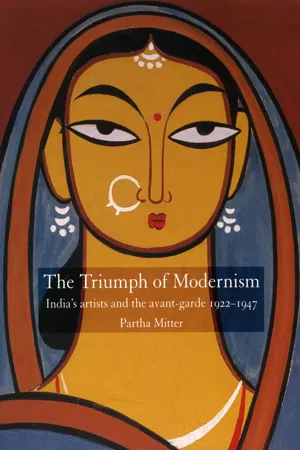
This richly illustrated book explores the contested history of art and nationalism in the tumultuous last decades of British rule in India. Western avant-garde art inspired a powerful weapon of resistance among India’s artists in their struggle against colonial repression, and it is this complex interplay of Western modernism and Indian nationalism that is the core of this book.
The Triumph of Modernism takes the surprisingly unremarked Bauhaus exhibition in Calcutta in 1922 as marking the arrival of European modernism in India. In four broad sections Partha Mitter examines the decline of ‘oriental art’ and the rise of naturalism as well as that of modernism in the 1920s, and the relationship between primitivism and modernism in Indian art: with Mahatma Gandhi inspiring the Indian elite to discover the peasant, the people of the soil became portrayed by artists as ‘noble savages’. A distinct feminine voice also evolved through the rise of female artists. Finally, the author probes the ambivalent relationship between Indian nationalism and imperial patronage of the arts.
With a fascinating array of art works, few of which have either been seen or published in the West, The Triumph of Modernism throws much light on a previously neglected strand of modern art and introduces the work of artists who are little known in Europe or America. A book that challenges the dominance of Western modernism, it will be illuminating not just to students and scholars of modernism and Indian art, but to a wide international audience that admires India’s culture and history.
- English
- ePUB (mobile friendly)
- Available on iOS & Android
eBook - ePub
The Triumph of Modernism
About this book
Information
Topic
KunstSubtopic
Kunst AllgemeinReferences
The Bengali calendar used here bears the following relationship to the Christian one, for instance 1352 = 1945AD.
Prologue
1 J.-P. Sartre, Black Orpheus, trans. S. W. Allen (Paris, 1951), p. 39, quoted in R. Linley, ‘Wifredo Lam: Painter of Negritude’, Art History, II/4 (December 1988), p. 533. See L. S. Sims, Wifredo Lam and the International Avant-Garde, 1923–1982 (Austin, TX, 2002). Césaire was an iconic West Indian poet of Negritude.
2 W. G. Archer, India and Modern Art (London, 1959), may be taken as a classic example of the study of non-Western art essentially as a derivative enterprise. In an essay on ‘decentring modernism’, to be published in Art Bulletin (Intervention series), I develop the relationship of power and authority between the West and its others as expressed in histories of non-Western avant-garde art and possible ways of thinking beyond current practices.
3 W. Rubin, ‘Primitivism’ in 20th Century Art: Affinity of the Tribal and the Modern (New York, 1984). I do not need to rehearse here the arguments and rebuttals in this controversy except to add that Hal Foster, ‘The “Primitive” Unconscious of Modern Art’, October, XXXIV (Fall 1985), pp. 45–70, and James Clifford, ‘Histories of the Tribal and the Modern’, Art in America (April 1985), pp. 164–215, offer trenchant critiques of the Western art historical canon. For my own work on Western representations of Indian art, see Much Maligned Monsters: History of Western Reactions to Indian Art (Oxford 1977), especially chap. VI. See also critique of Eurocentric discourses of modernism by Latin American critics, R. A. Greeley, ‘Modernism: What El Norte Can Learn from Latin America’, Art Journal (Winter 2005), pp. 82–93.
4 M. Baxandall, Patterns of Intention (Berkeley, CA, 1985), pp. 85ff., on the passage: ‘influence is a curse of art criticism primarily because of wrong-headed grammatical prejudice about who is the agent and who the patient: it seems to reverse the active-passive relation which the historical actor [the artist] experiences and the inferential beholder will wish to take into account’.
5 Thomas Crow, The Intelligence of Art (Chapel Hill, NC, and London, 1999). Elizabeth Cropper in The Domenichino Affair (New Haven, CT, 2006) persuades us of the limitations of applying Vasarian teleological concepts of mimesis and authorship.
6 J. Clark, ‘Open and Closed Discourses of Modernity in Asian Art’, in Modernity in Asian Art, ed. J. Clark (Sydney, NSW, 1993), pp. 1–17. Clark applies Umberto Eco’s theory of semiotics to the process of knowledge transfer, distinguishing between open and closed systems of discourses.
7 A. Stokes, ‘Reflections on the Nude’, The Critical Writings of Adrian Stokes (London, 1978), pp. 336–7. I am indebted to Stephen Bann for the reference. Criticism of the avant-garde, particularly with an engagement with Marxism, is a vast field, going back to Walter Benjamin and Carl Einstein with Clement Greenberg’s influential defence of the aesthetics of autonomy in the 1930s providing the benchmark through the 1950s and ’60s. In the post-war era, the powerful and nuanced works of the October group of postmodern critics, Rosalind Krauss and Hal Foster, social historians of art, namely T. J. Clark and Thomas Crow, and the theoreticians of visual culture have defined the field. I cannot do more than briefly acknowledge the importance of these works here.
8 For a revisionist discussion of this problem in Renaissance art, see Emilia e Marche nel Renascimento: L’Identita Visiva della ‘Periferia’, curated by Giancarla Periti (Azzano San Paolo, 2005), introduction by Pier Luigi De Vecchi and Giancarla Periti, pp. 7–11. Taking up Enrico Castelnuovo and Carlo Ginsberg’s essay, ‘Centre and Periphery’, in History of Italian Art, I, trans. C. Bianchini and C. Dorey, preface by P. Burke (Cambridge, 1994), pp. 29–112, Periti argues that the centre–periphery relationship in art is not spatial but art historical, which articulates hierarchical power relations.
9 Crow, The Intelligence of Art.
10 Keith Moxey, ‘Discipline of the Visual: Art History, Visual Studies and Globalization’, in Genre, 36 (2003), pp. 429–48. N. G. Canclini, Hybrid Cultures: Strategies for Entering and Leaving Modernity, trans. C. Chiappari and S. Lopez (Minneapolis, MN, 1995). G. Kapur, ‘When was Modernism in Indian Art?’, in When Was Modernism? Essays on Contemporary Cultural Practice in India (New Delhi, 2000), pp. 298–9. P. Bourdieu, ‘The Production of Belief: Contributions to an Economy of Symbolic Goods’, trans. R. Nice, in Media, Culture and Society: A Critical Reader, ed. R. Collins et al. (London, 1986), pp. 154–5. G. Mosquera, ‘Modernity and Africana: Wilfredo Lam on his Island’, in Fondació Joan Miró, cited in Sims, Wilfredo Lam, p. 174.
11 In ‘Border Lives: The Art of the Present’, in The Location of Culture (London, 1994), pp. 1–9, H. K. Bhabha, a proponent of the subversive function of hybridity, states: ‘[The] interstitial passage between fixed identifications opens up the possibility of a cultural hybridity that entertains difference without an assumed or imposed hierarchy.’ See the critics of hybridity, Journal of American Folklore, Special Issue: Theorising the Hybrid, CXII/445 (Summer 1999), especially Andrew Causey’s thoughtful paper.
12 See the critical engagement with these issues in K. Mercer, ed., Cosmopolitan Modernisms (Cambridge, MA, 2005).
13 T. Kuhn, The Structure of Scientific Revolutions (Chicago, IL, 1962).
14 This is especially true of the Greeks, despised by the conquering Romans for their lack of valour, and yet revered by them for their art and intellect.
15 R. Schwab, La Renaissance orientale (Paris, 1950). On G. F. Hamann and the German rejection of Western Enlightenment, see F. Manuel, The Eighteenth Century Confronts the Gods (Cambridge, MA, 1959).
16 Today it is intimately connected with post-modern and post-colonial thought. See J. J. Clarke, Oriental Enlightenment: The Encounter Between Asian and Western Thought (London, 1997), who argues persuasively that any serious history of Western thought must take note of the impact of philosophical ideas from India, China and Japan on the West. See also W. Halbfass, India and Europe: An Essay in Understanding (New York, 1988). On Heidegger and Eastern thought, see infra, p. 341.
17 J. Head and S. L. Cranston, Reincarnation, an East West Anthology (New York, 1961), on Tolstoy’s interest in Indian thought. See L. P. Sihare on Bergson and Worringer, p. 30.
18 E. Forgács, The Bauhaus Idea and Bauhaus Politics, trans. J. Bátki (Budapest, 1995), p. 78.
19 P. Mitter, Art and Nationalism in Colonial India, 1850–1922: Occidental Orientations (Cambridge, 1994). See also Tapati Guha-Thakurta, The Making of a New ‘Indian’ Art: Artists, Aesthetics and Nationalism in Bengal, ...
Table of contents
- Front Cover
- Half Title
- Title Page
- Copyright
- Contents
- Prologue
- ONE The Formalist Prelude
- TWO The Indian Discourse of Primitivism
- THREE Naturalists in the Age of Modernism
- FOUR Contested Nationalism: The New Delhi and India House Murals
- Epilogue
- References
- Bibliography
- Acknowledgements
- Photo Acknowledgements
- Index
Trusted by 375,005 students
Access to over 1.5 million titles for a fair monthly price.
Study more efficiently using our study tools.
Frequently asked questions
Yes, you can cancel anytime from the Subscription tab in your account settings on the Perlego website. Your subscription will stay active until the end of your current billing period. Learn how to cancel your subscription
No, books cannot be downloaded as external files, such as PDFs, for use outside of Perlego. However, you can download books within the Perlego app for offline reading on mobile or tablet. Learn how to download books offline
Perlego offers two plans: Essential and Complete
- Essential is ideal for learners and professionals who enjoy exploring a wide range of subjects. Access the Essential Library with 800,000+ trusted titles and best-sellers across business, personal growth, and the humanities. Includes unlimited reading time and Standard Read Aloud voice.
- Complete: Perfect for advanced learners and researchers needing full, unrestricted access. Unlock 1.5M+ books across hundreds of subjects, including academic and specialized titles. The Complete Plan also includes advanced features like Premium Read Aloud and Research Assistant.
We are an online textbook subscription service, where you can get access to an entire online library for less than the price of a single book per month. With over 1.5 million books across 990+ topics, we’ve got you covered! Learn about our mission
Look out for the read-aloud symbol on your next book to see if you can listen to it. The read-aloud tool reads text aloud for you, highlighting the text as it is being read. You can pause it, speed it up and slow it down. Learn more about Read Aloud
Yes! You can use the Perlego app on both iOS and Android devices to read anytime, anywhere — even offline. Perfect for commutes or when you’re on the go.
Please note we cannot support devices running on iOS 13 and Android 7 or earlier. Learn more about using the app
Please note we cannot support devices running on iOS 13 and Android 7 or earlier. Learn more about using the app
Yes, you can access The Triumph of Modernism by Partha Mitter in PDF and/or ePUB format, as well as other popular books in Kunst & Kunst Allgemein. We have over 1.5 million books available in our catalogue for you to explore.