Reflective Practice for Professional Development provides an accessible introduction to the theory and practice of reflection. In ten concise chapters it explores how reflecting on experiences can be used for professional development and help progress knowledge and skills.
Using scenarios, questions and stories, the reader is encouraged to apply the content to their own context, demonstrating the importance of reflection in helping us to make sense as well as make the most of our professional experience. Exploring key themes such as the importance of criticality, models of reflection and connections between thought, language and actions, it considers the ways in which reflection can widen perspectives, generate deeper understanding of professional challenges and enhance creativity.
Full of practical tools and approaches for enriching and recording reflections, this insightful book aims to simplify reflective practice for teachers. It is an ideal guide for anyone who needs to build reflection into their practice or their studies.
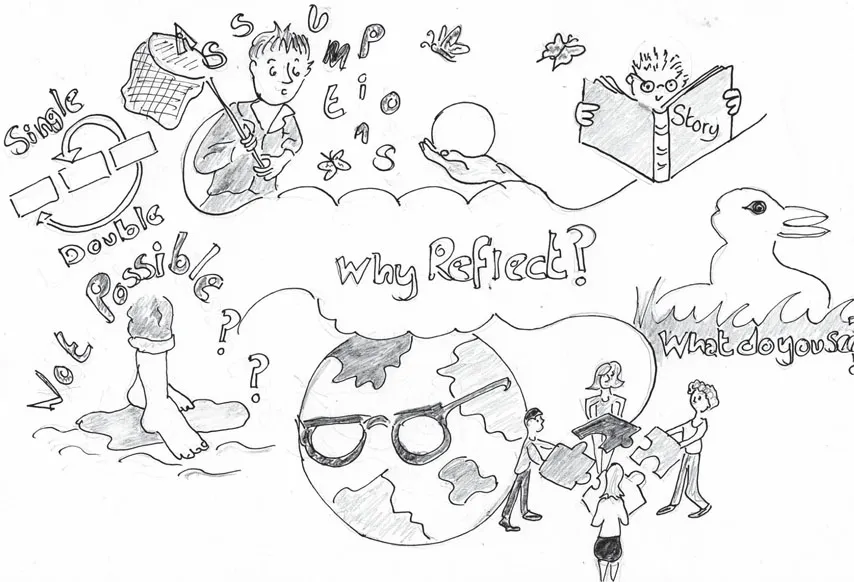
According to Heraclitus change is a constant in life. The suggestion that ‘It is not possible to step into the same river twice’ (Khan, 1979: 169) illustrates the idea that water is constantly flowing, new water arriving as the old departs, making the conditions of the river dynamic. Heraclitus probably had a point – just look at the advances in technology over the last 20 years for examples of how quickly things can change. In the year 2000, Tony Blair was Prime Minister, J. K. Rowling published Harry Potter and in the early noughties, the iPod was invented, Facebook was launched and YouTube was created. Change is all around us, impacting on our personal and professional lives and yet there is often a reluctance to reflect on yesterday in order to effect positive change for tomorrow. Our fast-paced society has driven most of us into a state of constant action and our days are filled to the brim – so much so that we rarely stop to take a break, let alone pause or, as Davies suggests, stand and stare: ‘What is this life if, full of care, we have no time to stand and stare?’ (Davis, 1911: online) In this chapter we will discuss the importance of taking time to reflect on professional practice and will consider some of the benefits of doing so. In particular, we will consider the ways in which reflection provides an opportunity to challenge our perspectives and provides scope for deeper learning.
What is reflection and why should we do it?
Reflection is a natural part of our daily lives but can also be something we choose to do deliberately. The process involves an exploration of thoughts and actions and provides the opportunity to evaluate events, so the reasons we may wish to reflect are many. Through reflection we can consider professional values and develop different understandings and approaches. It is also a way of helping us gain insights into the image we project to others. Reflection on professional practice is a positive way of managing change as it provides an opportunity to open our practice up to scrutiny in a way that is safe and in our control.
It can also be a way of sharing our ‘stories’ (Bolton, 2001) and offers an opportunity to make sense of our experience by co-constructing understanding through discussion with others. However, when we tell and retell our version of events to a range of people, we need to be aware that we may be doing so with a less than critical eye, ‘tucking ourselves securely under a quilt patchworked out of safe and self-affirming accounts (Ibid.: 1). In this way we are expressing a view that is acceptable to us, making comfortable assumptions and reinforcing our current view of the world.
But what if we want to learn from a particular incident? Perhaps we would like to develop our skills in managing a similar experience in the future? For this to happen we need to examine the event from different angles by reviewing our own and others’ beliefs about it by ‘hunting assumptions’ – trying to find out what our assumptions are and testing their validity (Brookfield, 2012: 7).
Through critical reflection we may avoid simplistic cause-and-effect deductions, begin to challenge previously held beliefs and really start to unpick how and why we see things the way we do. Effective reflection, therefore, is something which provides the opportunity not only to tell our stories in ways which allow us to feel secure but also provides a basis from which to critically examine them.
In a professional context, reflective practice also has the important role of challenging hegemony – in this case the dominance of particular beliefs relating to a profession often dictated by powerful influencers such as government departments or professional bodies. Very often these things become so embedded into practice, they are beyond question.
Hegemonic practice in a professional context is informed by what is considered to be ‘good’ or ‘the right way to do things’ and is underpinned by technical rationalism (Schön, 1983). In theory this provides a logical approach – which can be attractive to new and experienced practitioners, but it can also result in the application of generic practice, not always applicable in specific contexts. A typical example of this is the accepted practice for teachers to share learning objectives with their students at the beginning of the lesson and then check them regularly throughout the lesson. It is debateable whether or not this actually enhances students’ ability to learn but is so embedded it has become a rule of operation. In all professions there are forms of such accepted practice that are so commonplace they are almost sacrosanct.
Such rational practice is often adopted (or adapted) from research or well publicised ideas from powerful others giving it a gravitas which can be difficult to argue with. Research should of course have a place in shaping practice, but we also need to be wary of dualistic thinking, the kind of either/or thought that does not take into account contextual detail.
Even if Heraclitus is right and we live in a state of constant change, there are many good reasons to reflect, not only on professional practice but on life. As people, we may well be different to yesterday and the ‘rivers’ we step into may be in a state of continual transformation, but there are also transferable aspects to most experiences – and these are the things we can influence. In short, whilst we cannot change the situation, we can certainly change our responses to it. For this reason alone, reflection is a useful and developmental activity, so here are my top ten reasons for doing it.
Reflection provides a safe forum to be objective and critically analyse our practice.
It allows us to view things from a range of perspectives.
It helps us to identify any new skills we may need to develop.
It helps us to see how others might view us and what impact that might have on professional or personal relationships.
It helps us to consider how and why we make certain decisions, so that we may choose to make different ones another time.
It helps us to establish our values.
It provides a way of analysing areas of difficulty.
It may help us to manage difficult or painful episodes by looking at them objectively and may be a way of helping us to cope with professional life!
It can be a strategy for challenging current practice and constructing new learning by identifying other ways of doing things.
Sharing our reflections with others helps to develop more collegiate approaches.
Weltanschauung
An important consideration within all of this is the influence of weltanschauung, which relates to the ‘go to’ ways in which we interpret aspects of our lives. This is sometimes referred to as ‘world view’; although my interpretation of world view is a cognitive process which represents how we have learnt to see things. Weltanshauung is more than a philosophy or understanding of the world as it encompasses judgements, perception, ways of thinking, attitudes and norms of behaviour. It can even influence tastes and interests. It may be present at a societal level, represented by a particular culture’s judgement of what is good or important, as well as at an individual level, revealed in the values we choose to adopt and the ways in which these influence us. It could be described as a mindset or lens through which we experience and interpret the things directing everyday functioning down to the most mundane details. In this way it influences what we perceive, how we get around in the world and how we relate to other people. As a result, people often see things in very different ways:
Lillian was bewildered by the enormous discrepancy which existed between Jay’s models and what he painted. Together they would walk along the same Seine river, she would see it silky grey, sinuous and glittering, he would draw it opaque with fermented mud, and a shoal of wine bottle corks and weeds caught in the stagnant edges.
(Anais Nin, 1961: 124)
This excerpt taken from Anais Nin’s Seduction of the Minotaur illustrates this beautifully. Not only do the two characters see things differently, it gives the impression they experience things quite differently and suggests that this accounts for the ‘discrepancy’ between the artist’s models and the way they are depicted. In much the same way, we have all learnt to see things in established ways, which Nin suggests is representative of our sense of being, of who we are: ‘We don’t see things as they are, we see them as we are’.1
The habitual nature of these ‘go to’ responses suggests that thoughts are governed beyond pure intellect and as such, initial perceptions, understandings or actions are not necessarily foremost in our awareness. This doesn’t mean they can’t be brought into awareness of course. With a little time, an open mind and a few strategies to prompt us we all have the potential to expand our thinking.
The power of metaphor
Lakoff and Johnson (1980) propose that the way in which we process and interpret information is largely metaphorical and is evident in the little things we do every day as well as the language we use, and it is by examining language that we may also explore thoughts and actions. As suggested by Winter, ‘We do not “store” experience as data, like a computer: we “story” it’ (1988: 235). Therefore language and its interpretation is key in developing our depth of understanding and is something which undoubtedly forms part of the reflective process.
5-minute reflection – Downloading
Spend five minutes writing down your thoughts about the day. Do not edit them, just write until the time is up. When you have finished, go back and highlight anything that seems significant in terms of the words you have chosen. Are there any words repeated? Have you focussed on particular aspects of the day? Are there any connections between the two? Do any metaphors fit today’s story?
The downloading activity is a strategy for gathering unedited thoughts in order to analyse the language you are using. This provides a clue to the sorts of stories being created about particular events and may offer some nuggets for further reflection. What is particularly useful about this strategy is the process of editing written work – in doing this we really have to think about our choice of words and have the opportunity to analyse our perception of events. It is a starting point to criticality.
It could be argued that the essence of reflection lies within our ability to think critically about what we encounter, and according to Brookfield this is essential if we want to achieve our goals: ‘if you can’t think critically you will behave in ways that have less chance of achieving the results you want’ (2012: 1).
Types of learning
In a professional context, we could argue that ‘effective reflection’ is that which has an impact on the ways we work. It may offer fresh understandings, greater clarity or a platform for the development of new ideas, and for most people this means that reflection should lead to learning.
For many people when reflecting on the day-to-day problems life throws at us, expressing thoughts and feelings abo...
Table of contents
Cover
Half Title
Title
Copyright
Dedication
Contents
List of figures
List of tables
Acknowledgement
Introduction
1 Why should we reflect?
2 Learning through practice
3 Models of reflection
4 The importance of critical thinking
5 Defusing the dynamite
6 Tools for reflection
7 Reflection for creativity
8 Joining up the dots
9 Reflecting with others
10 Turning reflection into action
Final thoughts
Appendix: Overview of 5- and 10-minute reflection strategies
Index
Trusted by 375,005 students
Access to over 1.5 million titles for a fair monthly price.
Study more efficiently using our study tools.
Frequently asked questions
Yes, you can cancel anytime from the Subscription tab in your account settings on the Perlego website. Your subscription will stay active until the end of your current billing period. Learn how to cancel your subscription
No, books cannot be downloaded as external files, such as PDFs, for use outside of Perlego. However, you can download books within the Perlego app for offline reading on mobile or tablet. Learn how to download books offline
Perlego offers two plans: Essential and Complete
Essential is ideal for learners and professionals who enjoy exploring a wide range of subjects. Access the Essential Library with 800,000+ trusted titles and best-sellers across business, personal growth, and the humanities. Includes unlimited reading time and Standard Read Aloud voice.
Complete: Perfect for advanced learners and researchers needing full, unrestricted access. Unlock 1.5M+ books across hundreds of subjects, including academic and specialized titles. The Complete Plan also includes advanced features like Premium Read Aloud and Research Assistant.
Both plans are available with monthly, semester, or annual billing cycles.
We are an online textbook subscription service, where you can get access to an entire online library for less than the price of a single book per month. With over 1.5 million books across 990+ topics, we’ve got you covered! Learn about our mission
Look out for the read-aloud symbol on your next book to see if you can listen to it. The read-aloud tool reads text aloud for you, highlighting the text as it is being read. You can pause it, speed it up and slow it down. Learn more about Read Aloud
Yes! You can use the Perlego app on both iOS and Android devices to read anytime, anywhere — even offline. Perfect for commutes or when you’re on the go. Please note we cannot support devices running on iOS 13 and Android 7 or earlier. Learn more about using the app
Yes, you can access Reflective Practice for Professional Development by Carol Thompson in PDF and/or ePUB format, as well as other popular books in Education & Education General. We have over 1.5 million books available in our catalogue for you to explore.