Four political analysts explore the importance of local issues to global business and politics in this fully updated edition of
The Kimchi Matters.
Today's focus on globalization has obscured the fact that political stability and economic growth are determined at the local level. Investors and foreign policymakers set themselves up for failure when they don't consider the unique local dynamics of a particular country or region. This is equally true for companies venturing abroad and for politicians facing geopolitical challenges.
In their 2003 book
The Kimchi Matters, the authors demonstrated how globalization made it more important than ever to understand the political economies of distant countries. Now they have returned to that acclaimed work with updated accounts of situations around the world—including in Russia, India, China, Argentina, and Brazil—and refine the principles they laid out in the first edition.
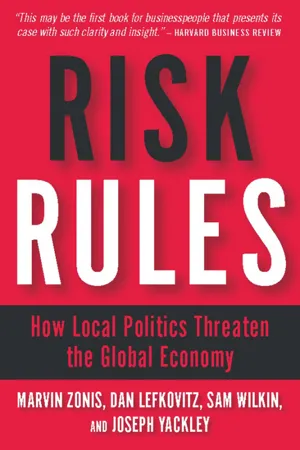
eBook - ePub
Risk Rules
How Local Politics Threaten the Global Economy
- 386 pages
- English
- ePUB (mobile friendly)
- Available on iOS & Android
eBook - ePub
Risk Rules
How Local Politics Threaten the Global Economy
About this book
Information
Part 1
Discontent

OUR INQUIRY BEGINS WITH THE PEOPLE, THE FOUNDATION UPON which a country’s political stability is constructed.
Some might say that to accord ordinary people such a primary role would be a mistake. After all, Freedom House estimated in mid-2009 that less than half of humanity lives in free societies. Surely, people living under closed regimes, with little real say in how they are governed, do not represent the foundation of a country in any meaningful sense. And keep in mind that many of these countries are colonial fictions, their borders drawn arbitrarily by European mapmakers. In such countries, there are peoples, not a people—nations, not a nation. Without a common history, culture, or identity, individuals cannot feel the bonds of association or community.
Fair enough. But one of the countries most affected by a popular uprising in recent years was Indonesia, a repressive, dictator-led, postcolonial hodgepodge of thousands of islands and hundreds of languages. It is not as if the Indonesian public rose up as one to toss out a bad government during the crisis of 1997–1998. Rather, groups of angry Indonesians primarily set upon each other. But it was this turmoil that eventually led to the fall of the government. As such, the people played a crucial political role.
Public involvement in politics rarely if ever entails coherent action by an entire society. Yet a few small groups—for example, university students, religious militants, labor unions—can have a profound impact. The middle classes are perhaps the most powerful when it comes to political action. Their education makes them both effective and aware, and their ranks frequently include the friends, neighbors, and families of civil servants and army and police leaders. Once the middle classes rise up, they are not so easily ignored or dispatched. (It was the middle class that rose up first in Indonesia and now across the Middle East.)
Hence we must pay close attention to understanding what moves the people. In particular, what compels ordinary people, those without personal political ambitions, to take political action, often at risk to life and limb? Their basic motivations are anger and discontent. People who are largely content with their lives are unlikely to jeopardize house and home by taking political action. But angry people are easier to motivate, especially if they can be convinced that political action—which could range from organizing and taking part in antigovernment demonstrations to killing neighbors from a different ethnic group—will, somehow, solve their problems.
It was popular discontent that drove such dramatic world-historical events as the French Revolution and the Free India movement. On a more mundane level, discontent drives labor strikes in Brazil, the growth of radical Islam in the Arab world, and separatist terrorism in Spain. Discontented people—sometimes very small numbers of discontented people—are capable of destabilizing countries and their economies.
But discontent also affects stability in a more indirect fashion. A government facing an angry public is an uncertain government. And uncertain governments are known for making bad decisions. An uncertain government may be afraid to undertake necessary but painful economic reforms. It may try to distract the public with foolish military adventures. It may try to buy off the public with wasteful handouts. It may print money in a desperate attempt to stimulate the economy. It may censor the media to stifle opponents. It may try to rally support by playing one ethnic group off another. It may blame the country’s problems on foreign investors and take hostile action against them. All are cases of governments responding ineptly to popular discontent, and all can have disastrous consequences for the companies and individuals caught up in such dynamics.
dp n="34" folio="3" ? CHAPTER ONE
“We Practically Own Everything…”
CORRUPTION
THE WALLS ARE THE FIRST SIGN ONE HAS STUMBLED UPON THEIR territory. High and often topped by fences or razor wire, these walls enclose a variety of buildings: whitewashed villas in the tropics, sprawling haciendas in Latin America, Black Sea dachas in Russia, the odd restored colonial mansion, the occasional faux Mogul Palace. This diversity may be cause for confusion. But then a gate opens and a gleaming silver Mercedes, windows tinted, speeds out on some urgent errand. And then you are certain. This home belongs to one of the Wabenzi.
The Wabenzi are an unusual “tribe.” The name was coined by some disgruntled African, tired of seeing wealthy elites racing around in deluxe Mercedes. And so he dubbed them the “people of the Benz” (or, in Swahili: “Wabenzi”). The name traveled to Kenya, Tanzania, South Africa, and points beyond, to describe the rich in those countries, who share a fondness for German luxury cars. (In Nigeria, the same tribe is known as the “Beento,” since they have been to exotic foreign locales on expensive vacations.)
Imagine a chance encounter between the proverbial Average Citizen of an impoverished country and one of the Wabenzi. A glinting Mercedes flies past a rickety bicycle on a dusty street. In our simplified world, the man on the rickety bike thinks one of two things: “Those Wabenzi are successful. They worked hard for what they have. If I do the same that could be me, or my children.” Those are the words of a man who believes in the system. David Brooks described the prevalence of just this sort of sentiment in the United States: “Americans… have always had a sense that great opportunities lie just over the horizon, in the next valley, with the next job or the next big thing. None of us is really poor; we’re just pre-rich.”
But maybe the chance encounter does not go so well. Perhaps our Average Citizen lives in a country where rags-to-riches stories are not so common or where economic growth has just collapsed, shutting off possibilities for more to get rich. Perhaps this is a country where all of the Wabenzi are related to the president and the Average Citizen is not. Perhaps in this country one must pay bribes to obtain simple things like a driver’s license or a permit to sell wares in the street. Perhaps, in order to obtain a phone line without waiting years, one must pay a hefty “gift.” Perhaps, moments before this encounter, our Average Citizen has been shaken down by a corrupt cop, who threatened him with fines or imprisonment if he failed to hand over the money in his pocket. In this case our man on the rickety bike might have a very different reaction. He might think, “Those Wabenzi are crooks. The only people who make it in this country are corrupt or know somebody.” That is a man who feels a profound sense of injustice. He feels that avenues of advancement are closed off for him and his family. He thinks the system is rigged.
Will our Average Citizen on his rickety bike be for the system or against it? Perhaps he is young, charismatic, ambitious and determined. In that case he is potentially one of society’s greatest leaders, or one of its most dangerous. He is a budding Bill Gates or maybe a Mao Zedong. In this moment—repeated thousands of times every day for Average Citizens around the world—hangs the potential for growth or turmoil. Here begins, on a personal level, a dynamic of either prosperity or instability.
Certainly, that is one simplification too many. Different people have different reactions to the Wabenzi. Even if many Americans are “pre-rich” and many Indonesians joined violent protests against their country’s wealthy elite, there are still American communists and Indonesian MBAs.
dp n="36" folio="5" ?But anyone skeptical of the political power of corruption, or who thinks corruption is a sustainable political dynamic, or who believes that corruption does not matter for foreign businesses, must understand the story of the Philippines.
THE PHILIPPINES
When Ferdinand Marcos became president of the Philippines in 1965, he was a leader of great promise for a country on the brink of great things: a brilliant lawyer, a political genius, and a war hero awarded more than thirty medals for his heroism fighting the Japanese in World War II (or so he claimed). His wife, Imelda Romualdez Marcos, a former Miss Manila, was beautiful and capable. His country was abundant in timber, sugar, coconuts, and minerals, and its manufacturing sector had grown by 12 percent per year during the 1950s. The “Asian Tigers”—Korea, Taiwan, Singapore, Hong Kong—were just beginning their own races to prosperity within a single generation. The newly independent Philippines was at the starting line with them.
But then Marcos made some expedient decisions. It’s easy, in retrospect, to see how he fell into the first of these. Marcos won reelection to the presidency in 1969 just as things were coming undone. The crops had failed because of a bad monsoon. The Communist Party of the Philippines was launched in 1968; it sprouted a violent guerrilla arm in 1969. None of this was really the president’s fault, but nobody likes bad news. Opposition to Marcos’s rule grew.
Marcos’s reaction to this opposition was perhaps excessive. But the late 1960s was the era when any anticommunist leader was considered, at least by the United States, a good leader, and the U.S.—the Philippines’ main patron—was not too picky about human rights violations by its allies. Marcos faked a series of terror attacks and assassination attempts, and then declared martial law to calm the “crisis.” He jailed opposition politicians, closed newspapers and radio stations, and gave sweeping authority to the military and police forces. A new constitution allowed Marcos to rule by decree, and few checks remained on the president’s power.
dp n="37" folio="6" ?But even a dictator needs friends. If his charisma was failing him, well, there was always the power of the purse. Marcos turned to time-honored values in the Filipino political system: utang na loob (obligation through favors), pakikisama (smooth interpersonal relationships), and pamilya (kinship ties). He lavished patronage on politicians, the military, and the police force. He appointed natives of his home province of Ilocos Norte to key positions in the military and civil service. In short, he bought support. Through corruption and patronage, Marcos nurtured a Filipino political and economic elite that would be loyal to him.
To be sure, Marcos was corrupt before martial law had been imposed—he had opened his first Swiss bank account in 1967 with $1 million—but after 1972, Marcos’s patronage created a tiny, close-knit elite with almost unimaginable economic power. Eduardo Cojuangco Jr., scion of one of the country’s wealthiest landowning families, ended up with a monopoly over the country’s lucrative coconut industry, by way of presidential decrees. Soon Cojuangco was running the United Coconut Oil Mills, the United Coconut Planters Bank, and the Coconut Planters Life Insurance Corporation. Roberto Benedicto, Marcos’s former fraternity brother at the University of the Philippines Law College, was given the sugar industry as his personal fiefdom. Benedicto headed the National Sugar Trading Corporation, the Philippines Sugar Commission (the sugar regulatory body), and two banks that financed the sugar industry. Just for good measure, he also owned the Philippines’ largest radio and television network. Others cronies included Lucio Tan, an immigrant from China who went from working in a cigarette factory to owning Fortune Tobacco a year into Marcos’s term, and Rodolfo Guenca, who received lucrative government contracts as the head of the Construction and Development Corporation.
But above all, Marcos was a family man. Ferdinand and Imelda Marcos themselves had their fingers in almost every pie in the country. Marcos used his former fraternity brother, Benedicto, as a front man for his involvement in at least five communications companies. The Marcos family held stakes in three hundred corporations by 1984; Ferdinand Marcos personally headed twenty-five of these. The Marcos holdings included one company brazenly called Sadlemi (“Imelda’s” spelled backwards). Years later, Imelda would admit, “We practically own everything in the Philippines from electricity, telecommunications, airline, banking, beer, and tobacco, newspaper publishing, television stations, shipping, oil and mining, hotels and beach resorts down to coconut milling, small farms, real estate, and insurance.”

It is hard to say when corruption ceased to be a means to hold power, and instead became the only goal of the Marcos administration. But at some point, Marcos clearly ceased to care about his country, if indeed he ever did care. Marcos and his cronies needed a way to get their plunder out of the Philippines. They preferred Swiss bank accounts and pricey foreign real estate. Investigations by the U.S. Congress revealed that the Marcoses had properties in New York City worth some $350 million.
As a key U.S. ally, pumped with economic aid, Marcos was not about to run out of money, and this kept the Marcos bribeocracy afloat long after it should have run aground. But powerful dynamics had been set in motion. Patronage had bought Marcos powerful friends, but also created many more determined enemies. Filipino businesspeople struggled with a system rigged against their success. For those shut out of the Marcos crony network, the playing field was skewed. Filipino banks lent only to the well-connected. Foreign banks lent primarily to those businesses that had arranged government loan guarantees, which were, of course, only given to friends of the government. Businessmen were incensed, seeing the Marcos elite import millions of dollars worth of foreign electronics gear and luxury goods each year, while honest businesses were denied the hard currency they needed to import supplies and capital goods on the grounds that there was a “foreign exchange shortage.”
Stories of the Marcoses’ ridiculous extravagance began to leak out, sparking anger among the middle classes. When Marcos’s daughter got married in June 1983, the president flew in twenty-four planeloads of guests to his home province of Ilocos Norte, including the eighty-six-piece Philippine Philharmonic Orchestra. (An earthquake that struck the island two months later was called divine retribution for Marcos’s wastefulness.) A slew of grotesque projects littered the country as literal monuments to the president’s misrule, such as a Mt. Rushmore-esque Marcos bust carved into a mountain in northern Luzon. When asked how some of her family and friends had become so wealthy, Imelda Marcos answered, “Well, some are smarter than others.”

Those left out of this plunder were understandably enraged. Marcos’s patron, the United States, began to pressure him in the early 1980s to loosen the reins and democratize the country. When Marcos did so, the anger of the middle classes began to bubble to the surface. An opposition movement began to grow. Then, in 1983, when popular opposition leader Benigno Aquino returned to the country after three years of exile in the United States, Filipino government forces gunned him down at the airport.
This only furthered the cause of the opposition. In 1984, opposition politicians captured fifty-eight out of 183 seats in Congress, despite Marcos’s efforts to fix the election. In 1985, the opposition legislators moved to impeach Marcos on charges of “graft and corruption.” Though the impeachment failed, the opposition took the opportunity to air its claims in public: that Marcos had been siphoning funds from the Treasury, amassing ill-gotten wealth from foreign investments, and appointing cronies to influential positions.
This public airing of the dirty laundry served to harden opposition to Ferdinand and Imelda’s rule. If the people could not work through the system, they would work around it. “People Power,” one of the great nonviolent protests movements of the twentieth century, coalesced around Corazon Aquino, the slain opposition leader’s diminutive widow.
The middle class and business communities were the first to join the opposition politicians in wearing the signature “People Power” yellow. They were incensed that the government had used billions of taxpayer dollars to bail out the bankrupt firms of Marcos’s cronies. Jaime Ongpin, CEO of the Philippines’ oldest mining company and a fierce Marcos critic, estimated that between $6 billion and $7 billion of the country’s foreign debt was “wasted because of misallocation to crony-type projects.” They were also furious that Marcos exempted well-connected companies from government audit. Using family connections in the Bureau of Internal Revenue, Marcos permitted family and friends to avoid taxes.
dp n="40" folio="9" ?By 1986, political instability was sweeping the Philippines. Marcos called elections eighteen months early in 1986, hoping to catch the opposition unprepared. Though few believed Marcos would surrender power, even if defeated, Filipinos still flocked to the polls to lend Aquino their support.
By official count, Marcos defeated Aquino by a small margin. But observers alleged vote-buying, ballot-rigging, ballot-snatching, and voter intimidation. For four days after the election, People Power protested the poll result and demanded Marcos’s resignation. The final blow came when the armed forces withdrew their support for the government. Younger officers had grown disillusioned with the corruption in the country and in the higher rungs of the army (where Marcos’s cronies were clustered). Fidel Ramos, vice chief of staff of the Filipino armed forces (who would go on to become president of the Philippines from 1992 to 1998), was a crucial domino who fell in the direction of People Power. When it came time for officers to decide whether to shoot the protestors or hold their fire, they abandoned Marcos. With Imelda and a few choice cronies in tow, Marcos abandoned Malacañang Palace in a U.S. Army helicopter and then hopped a U....
Table of contents
- Title Page
- Preface
- Risk Rules:
- Part 1 - Discontent
- Part 2 - Managing Discontent
- Part 3 - Leadership
- Part 4 - Policy
- CONCLUSION
- NOTES
- INDEX
- Copyright Page
Trusted by 375,005 students
Access to over 1.5 million titles for a fair monthly price.
Study more efficiently using our study tools.
Frequently asked questions
Yes, you can cancel anytime from the Subscription tab in your account settings on the Perlego website. Your subscription will stay active until the end of your current billing period. Learn how to cancel your subscription
No, books cannot be downloaded as external files, such as PDFs, for use outside of Perlego. However, you can download books within the Perlego app for offline reading on mobile or tablet. Learn how to download books offline
Perlego offers two plans: Essential and Complete
- Essential is ideal for learners and professionals who enjoy exploring a wide range of subjects. Access the Essential Library with 800,000+ trusted titles and best-sellers across business, personal growth, and the humanities. Includes unlimited reading time and Standard Read Aloud voice.
- Complete: Perfect for advanced learners and researchers needing full, unrestricted access. Unlock 1.5M+ books across hundreds of subjects, including academic and specialized titles. The Complete Plan also includes advanced features like Premium Read Aloud and Research Assistant.
We are an online textbook subscription service, where you can get access to an entire online library for less than the price of a single book per month. With over 1.5 million books across 990+ topics, we’ve got you covered! Learn about our mission
Look out for the read-aloud symbol on your next book to see if you can listen to it. The read-aloud tool reads text aloud for you, highlighting the text as it is being read. You can pause it, speed it up and slow it down. Learn more about Read Aloud
Yes! You can use the Perlego app on both iOS and Android devices to read anytime, anywhere — even offline. Perfect for commutes or when you’re on the go.
Please note we cannot support devices running on iOS 13 and Android 7 or earlier. Learn more about using the app
Please note we cannot support devices running on iOS 13 and Android 7 or earlier. Learn more about using the app
Yes, you can access Risk Rules by Marvin Zonis,Dan Lefkovitz,Sam Wilkin,Joseph Yackley in PDF and/or ePUB format, as well as other popular books in Business & Business General. We have over 1.5 million books available in our catalogue for you to explore.