- 224 pages
- English
- ePUB (mobile friendly)
- Available on iOS & Android
eBook - ePub
About this book
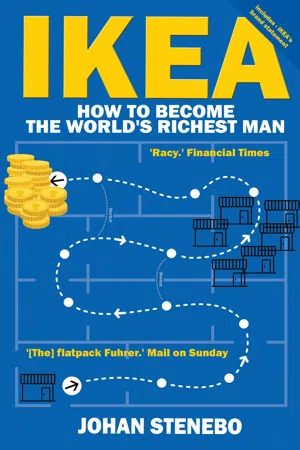
How did IKEA become the world's largest design brand, as popular as Lego, CocaCola and Nike? Still privately held, the company is renowned for its secrecy. In this candid analysis, former IKEA top director Johan Stenebo writes for the first time from inside corporation how the company transformed itself from one rural Swedish store of all sorts to a global behemoth with a turnover of over $30 billion and 700 million visitors a year purely on cash flow. Revealing IKEA's daring and unique business model warts and all, he covers the leadership of IKEA's controversial founder Ingvar Kamprad, whose right-hand man he was, and IKEA's resourceful ways of brand management using companies like Greenpeace and WWF to cover environmental issues.
Information
Part 1
Ingvar Kamprad
The founder of IKEA
1
The Secret Behind IKEA
Pages upon pages have been written about IKEA and its extraordinary success in newspapers and books. At universities it has almost become a must to bring up the company as a text-book example for further inspection. Many have tried to answer the question why IKEA has been so successful. Obviously I also have an idea of what has made the company go from strength to strength. My view is informed by the decades I have worked for the company in all its departments. I have experienced great progress, but also terrible failures.
Simplicity is a virtue
The familiar quotation by Ingvar that ‘simplicity is a virtue’ is central to the success story. Only mediocre people propose complicated solutions, he preaches. With this approach I shall also consider the IKEA phenomenon. What single factors have had the strongest influence on IKEA?
First and foremost, the genius Ingvar Kamprad himself since he is the father of most things, albeit not everything, within IKEA. After that the IKEA-machinery, the global value chain from forest to customer, that Ingvar and his team have built and tuned to perfection. Last but not least the IKEA-culture that Ingvar has created and which makes the IKEA-machinery function precisely and at maximum speed.
Let us examine them one by one. We begin with the phenomenon Ingvar Kamprad.
2
The Man and the Myth
In order to understand IKEA one must also understand its founder. Who is he? Truly?
The palace coup
November 1994, Kölles Gård, Humblebæk, South of Helsingör in Denmark
Kölles Gård is a charming building similar to a guest-house in just as charming surroundings a stone’s throw from Öresund. Kamprad bought the property in the seventies when he abandoned Sweden for Denmark in order to avoid Swedish taxes. Today, it has housed the board of directors of the IKEA group for over a decade.
Daylight was fading slowly turning afternoon into evening. Cold winds from the sea lashed the property and its surrounding parkland. It was late Autumn and piles of shrivelled beech leaves happily whirled around in the wind. The only thing out of the ordinary were rows of parked cars outside the hedge that surrounded the house. Reporters stood around in groups outside and keenly watched any sign of activity from inside the house. Photographers with camera lenses as long as your arm were gazing at the building window by window. Flashes now and then lit up the apricot coloured façade. The building seemed dark and abandoned with the exception of a few lit up windows.
In the warmth inside was, amongst others, IKEA’s chief executive Anders Moberg, serenely calm as usual but showing the seriousness of the situation on his pale face. The group around the table had to take a stand on how to handle the situation that had arisen, and that none of them had been able to imagine only a few days earlier.
The unthinkable had happened. The founder and owner of IKEA had been denounced as a Nazi sympathizer and a member of the Swedish neo-Nazi movement during the forties and the fifties. Ingvar and his assistant Staffan Jeppsson were working feverishly in another room in order to try and find a way out of the dark clouds that had now descended on the old man. The tabloid Expressen had released the scoop at full force and the news was spreading like wildfire across the world.
‘If the worst comes to the worst, if Ingvar is not be able to handle the situation, there remains only one solution for us.’ The words were hovering in the stifling air in the room where Anders Moberg and the top leadership of IKEA were sitting.
‘If Ingvar does not find a solution soon and the situation does not calm down, then IKEA will once and for all have to distance itself from Ingvar.’
Thus it had been said. The genie was out of the bottle.
Consider the last paragraph again and its significance. Exactly who said what, I do not know. But the incident was relayed and interpreted for me by Anders Moberg. Could it be said clearer? Ingvar Kamprad is not synonymous with the company IKEA. IKEA is larger than its founder, despite his enormous importance for the development of the company. Ingvar may, in fact, be deposed or rather put aside if he seriously threatens to harm his company.
At this point Ingvar did a complete turnaround and put all his cards on the table, confessed everything and asked his co-workers, not least those of Jewish decent, for forgiveness. With this the story was, in the main, finished with. This rhetoric feat was brilliantly carried out by a man of whom one does not expect anything less. It was used as a textbook example by media educators the world over for a long time.
The driving force
A lot of people have wondered, what is it that spurs Ingvar on? What is it that makes him drive himself so very hard? Because that is what he does.
To suggest as is done in the official version that he is obsessed with proving ‘to people that beautiful furniture does not have to be expensive’ is at best a serious misunderstanding and at its worst a conscious falsification. Basically, he is driven by an enormous need to be validated and nothing else. He wants to show the world around him and himself that the impossible is possible. This becomes very obvious when one works with him, as he over and over again adopts the persona of the underdog. It is this way of doing things that first becomes obvious in Ingvar. He may say something depreciatory about some respected and distinguished design critic for one of the big newspaper barons in Stockholm. He formulates strategies and the IKEA-culture from a down-up perspective: IKEA should never boast, but let the results tell their story. He tries hard to cast himself as the underdog by describing himself as a somewhat dim, alcoholic dyslectic. We will come back to this.
Once Ingvar told me that he only has one close friend. A Swiss man whom he now and then goes on trips with. To my mind and to most people of my generation this sounds rather as if ‘the friend’ was more of a pal or an acquaintance, since the relationship was not more frequent or closer. Other people he socialises with are usually colleagues, apart from his family. So people he pays to work for him. Consequently, their friendship is directly connected to their pay packet. In this place of loneliness the outlook of the underdog can only strengthen.
When Ingvar is able to rub shoulders with the establishment particularly in Sweden, the Wallenbergs, the media and the politicians, through honours and doctorates, then he feels special. Chosen. His need for validation is so great that he resents his company directors being seen in the media limelight. Anders Moberg often asked my advice about whether he should dare accept an interview lest he stole the attention from Kamprad, and what Ingvar thought about it. If there was the slightest hesitation, he would rather decline than risk provoking the wrath of Kamprad.
Conscious leadership
On one of my first days at work at the group’s head office in Humlebæk, Ingvar was in the office. Normally he is either travelling, at home in Switzerland or, occasionally, on a working holiday at his vineyard in France for a couple of weeks. Ingvar and Anders Moberg met just by my desk. Anders went to say hello when something strange happened to his expression. The self-confidence, the assurance and resoluteness disappeared. Instead he had that staring, almost mouth-open gaze that signals fear, which was further accentuated by the strained smile. I felt pure fear rush through my body. If Anders Moberg, the paragon of a strong leader, had such towering respect for Kamprad what should I, a simple assistant, feel? This encounter shaped my behaviour towards Ingvar for well over a year, until I slowly began to realize that he was not that dangerous after all. Quite the contrary.
Range week, the so called IK-days, at the IKEA of Sweden AB head-office Blåsippan in Älmhult, early Autumn 1996.
As Ingvar’s assistant I follow him closely from one range presentation to another. The week is the culmination of one year’s work that concludes in two to three hours together with the founder. During these hours one’s work is presented, judged and either given the go-ahead, or rejected.
‘This is the worst rubbish I have seen in a long while. How fucking silly can it possibly get? What a disappointment, Johan.’
Ingvar and I had just been witnessing the biggest fiasco of the week. The group had been given the task to develop an outline for home recycling. Their solution was a green tub and a white tub. In plastic. The presentation was deplorable and the excuses during the rather short discussion afterwards even worse. Ingvar asked some questions and took a view on the proposed materials. Afterwards he said thank you in a friendly way and carried on. Only as we were in the car on the way home did he reveal his true feelings.
It is precisely in situations like this that Ingvar’s talent for leadership becomes most obvious. I have never met a man with more patience. I have also never met a person who is more aware how he is considered by his surrounding and who uses it as an important tool to obtain power. He is brilliant at standing in the background and allowing others to speak, even if he dislikes what he sees. He sometimes discusses his views, sometimes he lets go. At times, days may pass between the proposals. Sometimes years. But he seems to know exactly when and how he must intervene in the decision process in order for the correct path to be maintained. One good example is the so called the Multipurpose system (later called MPS), which took 30 years of nagging punctuated by years of silence.
This system was an idea for an integrated standard of measurements for kitchens, bathrooms, bedrooms and living rooms that Ingvar hatched in the seventies and that he kept coming back to with ever greater intensity in 1996 than before. Why? IKEA had just undergone a major restructuring where IKEA of Sweden AB (IoS), the range-and purchase corporation, had become the power hub of the company. Being business area manager at IoS became the new position of power. A number of less successful managers had been removed and new ones – long serving managers within IKEA – had replaced them. He probably wanted to try to present the idea again in order to see what happened. More about the Multipurpose system later on in the book.
The same thing happened in 1995 when he was bouncing around ideas about a completely new range of lighting from China and encouraged his men (as they were only men) to search more actively for really cheap energy-saving bulbs there. It ended with them finding a bulb that was 90 per cent cheaper than those of competitors and so made history on a small scale. What Ingvar had done was to place himself in the circle of his men and discuss, ask and listen, and sometimes plead: ‘Please you clever lighting guys, would it not be possible to…’
I am pretty certain that Ingvar knew or at least suspected the answer to many of his questions. He probably already knew exactly which suppliers they ought to go to. But his poker face is impenetrable. One year on, the same men stand around him almost bursting with pride over having managed to solve all the challenges. Because they themselves have solved the problems, the prestige and, with that, the confidence in the product is theirs. At a first glance this generosity towards his co-workers may seem strange coming as it does from a man who demands to have all the attention himself, especially when it comes to the media. But Ingvar is an extremely complex person, full of contradictions and difficult to really understand.
Often Ingvar does not do much more than bounce ideas around and inspire other people in the important range work at IKEA. He knows that if only the right people are in the room at least some ideas will eventually become reality.
Another thing he often does a lot of – especially when ranges are being examined; he jokes frequently in a shrewd and deeply sarcastic way. He himself is more often than not the target of his own jokes. Most of the time he manages to stay on the correct side of rudeness and creates a jolly atmosphere. Not everyone always understands the crushing irony, perhaps, but many see him as a man with a great sense of humour.
Ingvar is in the middle of the group of some twenty people. He wants to ask some specialist a question in order to carry the discussion forward.
‘Bosse, where is Bosse?’ Ingvar intones.
Before anybody has time to answer, including Bosse, he continues: ‘Has he already gone home then? Well, that is not very clever’.
The commotion that follows is just as funny every time and so is the haunted expression on the face of the main character before he makes himself known.
‘I see, you’re still here, dear Bosse. How nice that you have a moment for us. We are looking at your range you see’, Ingvar continues with exaggerated emphasis.
His sense of humour becomes even more tart when there is only the two of you.
An experienced product developer had just presented his – in his own opinion – ingenious coffee table to me and Ingvar. The meeting ended and the colleague had left us. ‘Well, well Johan, the only big thing there was his moustache’, Ingvar said with regret in his voice about the slender and short product developer with a large beard.
This sense of humour is yet another dimension of Kamprad’s leadership. He will only joke in the presence of a chosen few, meaning the usual gang at Blåsippan in Älmhult, but never at a strategic purchase meeting with more important managers. It is cunningly clever.
Sometimes when representatives of one part of the business have been lured into, in the heat of the moment, promising Ingvar too much and the consequences start to become clear to the group of product developers, managers and purchase strategists, Ingvar suddenly comes out with: ‘When before Christmas can you be ready with this new range?’
Without fail everybody present is immediately taken aback before they realize the sarcastic undertone in his unreasonable demand. A new range takes two to three years to develop, and range week is at the beginning of September. That would in other words give the team a couple of months to manage several years of development work. The observant participant at the same time realizes that this is not drollness but Ingvar’s way of expressing that he is keen.
Should the IKEA range team, on the other hand, try to get out of Ingvar’s demand for the quick delivery of a product, they will invariably get the sarcastic answer in a grumpy Småland dialect: ‘I see, well, man is nowadays capable of flying to the moon, but a coffee cup for less than 5 kronor (£.50 / $.70) you cannot do…’
When it comes to discussing, twisting and turning arguments Ingvar is just as untiring and brilliant. He knows most about most things to do with IKEA, down to the smallest detail: materials, prices, production, raw materials, range, design, commercial handling. He moves brilliantly from the tiniest detail down to quality of glass, to raw materials, prices and to group strategies that determine the range and purchases and back again. Ingvar is capable of moving back and forth between details and guiding principals like no one else. By debating in a vague, almost tentative way, with his enormous knowledge and 70 years experience, he always gets a discussion going. Sometimes he chooses to argue for a standpoint that he knows will provoke the participants. At the next meeting he may without warning suddenly have changed positions. That’s when he wants to hear the arguments against to the solution he himself, secretly, favours.
If someone sits tight and is difficult to convince he puts the questions directly to different people, depending on area of responsibility. Once he gets going Ingvar can keep a discussion going for hours. People look as if they are about to faint, need to go to the bathroom, perhaps want to eat. Not Ingvar. He stands in the middle of the group of people, with his hands together under his stomach ...
Table of contents
- Cover
- Title Page
- Table of Contents
- Foreword
- The rise and fall of IKEA UK
- Introduction
- Part 1 : Ingvar Kamprad
- Part 2 : The Company
- Part 3 : The Future
- Afterword
- Appendix : The testament of a furniture dealer
- Copyright
Trusted by 375,005 students
Access to over 1.5 million titles for a fair monthly price.
Study more efficiently using our study tools.
Frequently asked questions
Yes, you can cancel anytime from the Subscription tab in your account settings on the Perlego website. Your subscription will stay active until the end of your current billing period. Learn how to cancel your subscription
No, books cannot be downloaded as external files, such as PDFs, for use outside of Perlego. However, you can download books within the Perlego app for offline reading on mobile or tablet. Learn how to download books offline
Perlego offers two plans: Essential and Complete
- Essential is ideal for learners and professionals who enjoy exploring a wide range of subjects. Access the Essential Library with 800,000+ trusted titles and best-sellers across business, personal growth, and the humanities. Includes unlimited reading time and Standard Read Aloud voice.
- Complete: Perfect for advanced learners and researchers needing full, unrestricted access. Unlock 1.5M+ books across hundreds of subjects, including academic and specialized titles. The Complete Plan also includes advanced features like Premium Read Aloud and Research Assistant.
We are an online textbook subscription service, where you can get access to an entire online library for less than the price of a single book per month. With over 1.5 million books across 990+ topics, we’ve got you covered! Learn about our mission
Look out for the read-aloud symbol on your next book to see if you can listen to it. The read-aloud tool reads text aloud for you, highlighting the text as it is being read. You can pause it, speed it up and slow it down. Learn more about Read Aloud
Yes! You can use the Perlego app on both iOS and Android devices to read anytime, anywhere — even offline. Perfect for commutes or when you’re on the go.
Please note we cannot support devices running on iOS 13 and Android 7 or earlier. Learn more about using the app
Please note we cannot support devices running on iOS 13 and Android 7 or earlier. Learn more about using the app
Yes, you can access IKEA by Johan Stenebo in PDF and/or ePUB format, as well as other popular books in Business & Business Development. We have over 1.5 million books available in our catalogue for you to explore.