When Tinker Bell followed Peter Pan to Hollywood in the 1950s, fairies vanished into the realm of child-lore. Yet in 1923 30-yearold J.R.R. Tolkien's visit to his aunt's house Bag's End inspired a story about hedgerowfairies or 'Hobbits', and three years earlier Sherlock-Holmes author Arthur Conan Doyle published the Cottingley fairy photographs. In Ireland, a generation before, family members had torched a woman to death thinking she was a fairy, while William Butler Yeats met a fairy queen in a coastal cave.
Today British and Irish fairy-interest has recovered its old lustre, and gathered here is the latest learning from leading folklorists and historians. A tidal-wave of new fairy sightings has been uncovered by the digitisation of British and Irish newspapers and ephemera. There are fairy sightings in urbanised locations and remote rural areas; characters and means to ward off evil fairies vary radically from place to place. In Sussex, there is the helpful 'Master Dobbs' or Dobby, while in Ireland fairies may be the dead, and Scotland harbours the terrifying Whoopity Stoorie.
In addition, Magical Folk includes findings from The Fairy Census, the first scholarly survey of modern fairy sightings in Britain and Ireland, demonstrating that the connection with the past continues unbroken. Another new discovery is that fairies travelled across the Atlantic well before Tinker Bell made it onto the silver screen. The most homesick fairies may have been the ones who dunked one Roderick repeatedly in the Atlantic Ocean as they dragged him to Ireland and back to his Canadian home!
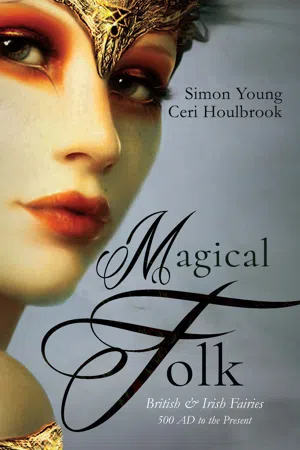
eBook - ePub
Magical Folk
British and Irish Fairies - 500 AD to the Present
- 320 pages
- English
- ePUB (mobile friendly)
- Available on iOS & Android
eBook - ePub
Magical Folk
British and Irish Fairies - 500 AD to the Present
About this book
Information
1
FAIRY QUEENS AND PHARISEES

Since Victorian folklorists defined their field of study as being old traditions surviving unchanged in undisturbed rural communities, they concentrated their attention on the fringe areas of Britain, ignoring counties close to London as being too strongly influenced by industrialization, city life, and education. This no doubt explains why so little was written about Sussex lore, and why information about its fairies is scanty and scattered.
The Fairy Queen at Rye
The earliest mention of fairies in Sussex is to be found in the incomplete and somewhat confusing records of testimonies submitted at a trial held at Rye in 1607. Two women, Susan Swapper and Anne Taylor (also known by her maiden name of Anne Bennett), were accused of ‘counselling with and feeding wicked spirits in order to obtain treasure’, this being a capital offence under the Witchcraft Act of 1604. Susan was found guilty and sentenced to be hanged, but was in fact simply imprisoned; Anne’s case was deferred and she was later further charged with causing the death of Thomas Hamon, Mayor of Rye, by witchcraft. She was acquitted of all charges in 1609, and Susan was released from prison in 1611.
The case has been thoroughly analysed by the historian Annabel Gregory on the basis of documents held in the East Sussex Record Office and her research into the social structure of the town;1 she shows that the accusations were motivated by a local political rivalry, and that Anne Taylor was the primary target. Diane Purkiss, selecting different passages from the same documents, highlights their relevance to fairy beliefs.2 There also exists a single page document, seemingly copied from the trial records and describing Susan Swapper’s visions, which was published by G. Slade Butler, a believer in psychic phenomena.3
Susan tells how once, apparently a few years prior to her trial, as she was lying in bed at midnight, ‘there appeared unto her four spirits in the likeness of two men and two women’, whose looks and clothes she describes. Next night they came again, and one, a woman in a green petticoat, said, ‘Sue, come and go with me or else I will carry thee.’ At this, being frightened, she woke her husband, crying, ‘Here is a thing that will carry me away’. He could see nothing, and the visions vanished. Next time they came, the woman in the green petticoat told Susan to go to her neighbour Anne Taylor, dig in her garden and plant sage there, ‘and then you should be well’.
The following afternoon Susan and Anne started digging, but there is no more mention of planting sage; instead, they searched for a buried treasure which Anne thought she was heir to. They found nothing, but Susan recovered from her sickness. Some weeks later she saw the four spirits again, and they told her to take Anne to dig in a certain field, which had once belonged to her, where they would find a three-legged pot full of gold. There, Susan again saw one of her spirits, who pointed out a man in black and a woman in green walking in the field. Susan asked who they were, and the spirit replied that ‘the woman is Queen of the Fairies, and that if she would kneel to her she would give her a living.’ Susan refused to do so, the Queen vanished, and Susan went home very sick and frightened.4 Later she told Anne, who declared that she herself had seen ‘eighty or a hundred’ such spirits, ‘and they were all fairies’. However, at her trial Anne and her husband George gave a very different interpretation: they now said Susan’s spirits were angels coming ‘to cut off the wicked from the earth’ and that ‘at eleven months’ end there should no man living be left to tread upon the Earth’.5
Obviously it would be safer for Anne, being on trial for witchcraft, to say Susan had received a religious message from angels rather than following instructions from fairies, and the vagueness of the terms ‘spirit’ and ‘fairy’ made the evasion possible. As Emma Wilby has pointed out:
[T]rying to make any hard and fast distinction between categories of spirits in early modern Britain is impossible…The term ‘fairy’, for example is a misleadingly broad generic term which, in the period, covered a wide range of supernatural entities.6
In Susan’s own account, however, her visionary visitors have nothing angelic about them, nor do the angels of religious belief have any association with treasures hidden underground. But the fairies of early modern England did, as Diane Purkiss points out,7 and especially the Fairy Queen. So strong was the belief that petty crooks could exploit it; in Hampshire in 1595 a thieving woman promised her dupes that the Queen of the Fairies would reveal a treasure buried in their garden.8
There is no indication whatsoever that Susan intended to exploit her visions in order to cheat or rob the Taylors; her crime, in the eyes of the law of 1604, was to ‘consult… feede or rewarde any evill and wicked Spirit’. This she had undoubtedly done, and so had Anne Taylor. Susan told the court that once when she went to Anne’s house, the latter:
[D]id make four Nosegays and delivered them unto this examinate [i.e. Susan] to give unto the Four Fairies as she termed them, the which Nosegays she did lay in the window for that the familiars were not there at her coming. And afterwards they were taken away as she thinketh by the spirits, for that no body else could come there, the doors being shut.9
As for Anne, one of the witnesses reported a conversation in which she said she had once given Susan an apple to offer one of her spirits who was with child, ‘and a piece of sugar too.’10 In legal terms, ‘spirits’ and ‘fairies’ were simply ‘familiars’ and anyone who had dealings with them could be charged with witchcraft.
A Fairy Funeral
Our next Sussex fairy encounter could hardly be more different. It occurred one summer day sometime between 1800 and 1803, when the poet, artist and visionary William Blake was living in Felpham, and he later described the experience in conversation with a fellow guest at a dinner. He describes the following scene as he was purportedly sitting in his garden:
There was great stillness among the branches and flowers, and more than common sweetness in the air; I heard a low and pleasant sound, and I knew not whence it came. At last I saw the broad leaf of a flower move, and underneath I saw a procession of creatures, of the colour and size of green and grey grass-hoppers, bearing a body laid out on a rose-leaf, which they buried with songs, and then disappeared. It was a fairy funeral!11
Here it is no longer a question of spirits which appear realistically human in their size and clothing, but of tiny, whimsical sprites such as Shakespeare described in A Midsummer Night’s Dream — a concept which was highly popular among later poets and painters, and which persisted well into the twentieth century, e.g. in the ‘Flower Fairy’ paintings of Cicely Mary Barker. However, the notion that fairies occasionally die and are buried does have some basis in folklore, as is attested by Charlotte Latham for Sussex:
There is a tradition in the parish of Pulborough of a fairy’s funeral, and the very place is pointed out to you. It is at the top of a green mound, known by the name of the Mount, and it would be hard to find a more fitting place for such a train to assemble at.12
Farmers and Fairies
Writing in 1854, the Sussex antiquarian and historian Mark Anthony Lower noted that ‘Several well-connected fairy stories were current, from ancient tradition, towards the close of the last [i.e.eighteenth] century; and we are enabled, through the aid of one who, himself a native of the South Downs, has now passed the “three-score and ten” of life, to preserve one or two of these all but obsolete legends’ — and proceeds to give two of them ‘as nearly as possible’ in the words of h...
Table of contents
- Cover
- Praise
- Title Page
- Dedication
- Contents
- Acknowledgements & Editors’ Note
- We Need to Talk about Fairies
- Fairy Tribes
- Biographies
- 1: Fairy Queens and Pharisees
- 2: Pucks and Lights
- 3: Pixies and Pixy Rocks
- 4: Fairy Magic and the Cottingley Photographs
- 5: Fairy Barrows and Cunning Folk
- 6: Fairy Holes and Fairy Butter
- 7: The Sídhe and Fairy Forts
- 8: The Seelie and Unseelie Courts
- 9: Trows and Trowie Wives
- 10: The Fair Folk and Enchanters
- 11: Pouques and the Faiteaux
- 12: George Waldron and the Good People
- 13: Piskies and Knockers
- 14: Puritans and Pukwudgies
- 15: Fairy Bread and Fairy Squalls
- 16: Banshees and Changelings
- Copyright
Trusted by 375,005 students
Access to over 1.5 million titles for a fair monthly price.
Study more efficiently using our study tools.
Frequently asked questions
Yes, you can cancel anytime from the Subscription tab in your account settings on the Perlego website. Your subscription will stay active until the end of your current billing period. Learn how to cancel your subscription
No, books cannot be downloaded as external files, such as PDFs, for use outside of Perlego. However, you can download books within the Perlego app for offline reading on mobile or tablet. Learn how to download books offline
Perlego offers two plans: Essential and Complete
- Essential is ideal for learners and professionals who enjoy exploring a wide range of subjects. Access the Essential Library with 800,000+ trusted titles and best-sellers across business, personal growth, and the humanities. Includes unlimited reading time and Standard Read Aloud voice.
- Complete: Perfect for advanced learners and researchers needing full, unrestricted access. Unlock 1.5M+ books across hundreds of subjects, including academic and specialized titles. The Complete Plan also includes advanced features like Premium Read Aloud and Research Assistant.
We are an online textbook subscription service, where you can get access to an entire online library for less than the price of a single book per month. With over 1.5 million books across 990+ topics, we’ve got you covered! Learn about our mission
Look out for the read-aloud symbol on your next book to see if you can listen to it. The read-aloud tool reads text aloud for you, highlighting the text as it is being read. You can pause it, speed it up and slow it down. Learn more about Read Aloud
Yes! You can use the Perlego app on both iOS and Android devices to read anytime, anywhere — even offline. Perfect for commutes or when you’re on the go.
Please note we cannot support devices running on iOS 13 and Android 7 or earlier. Learn more about using the app
Please note we cannot support devices running on iOS 13 and Android 7 or earlier. Learn more about using the app
Yes, you can access Magical Folk by Simon Young, Ceri Houlbrook, Simon Young,Ceri Houlbrook in PDF and/or ePUB format, as well as other popular books in Social Sciences & Folklore & Mythology. We have over 1.5 million books available in our catalogue for you to explore.