![]()
Part 1
Busting the Myths of Resilience
![]()
Chapter 1
Myth 1:
Resilience Is Being Tough
‘I don’t like self-absorption.’
‘There are no mistakes, only opportunities.
Resilient people always reframe mistakes.’
Chapter Overview
This chapter sets out to bust one of the greatest myths of resilience: that it’s about being tough. Whilst being strong is an outcome of resilience, being tough is not. Toughness leads to brittleness, the opposite of adaptability.
The chapter will help you connect with your own perceptions of resilience and toughness. It sets out how you can so easily get caught between unhelpful polarities of good versus bad in relationship to many drivers behind resilience, like being right versus wrong, or strong versus weak. It offers the Resilient Way, an alternative view to this polarisation that embraces a more flexible approach.
Finally, you then get the chance to review this kind of new thinking for yourself via reflective exercises.
The Resilience Scene
Hands up, do any of the following statements resonate with you? Or are they part of your organisation’s culture?
Don’t show your emotion unless you’re happy and smiling.
Just say everything is ‘fine’.
Don’t show you are feeling vulnerable.
Don’t show you are stressed.
Don’t show you don’t know.
Beat yourself up for being so stupid, but only after they have gone.
Do show when you’ve punched through the challenge.
Do show when you’ve beaten the opposition.
Do show when you’re ok.
Do show when you’re feeling smart.
Do show when you’ve done a lot of smart things.
Any of these statements running around your own head? Unvoiced possibly, but still driving your action? Do any of these drive your organisation? You may have a lot of learnt values from your upbringing, your workplace, your friends. You may collectively live this kind of culture. And these result in a set of values, not necessarily your own, that drive the way you live.
It ends up a bit like a set of polarities that you have to choose sides on:
Good | vs | Bad |
Strong | vs | Weak |
Win | vs | Lose |
Right | vs | Wrong |
Control | vs | Out of control |
Keep going | vs | Give up |
Power | vs | Powerless |
Knowledge | vs | Don’t know (aka stupid) |
Hard | vs | Soft |
Unemotional | vs | Emotional |
Just do it | vs | Try |
What about you?
Go through the attributes on the left-hand side, the Good side, and tick which you are drawn towards.
How many out of the Good ten are you strongly pulled towards?
What thoughts do you have whilst doing this exercise?
The Problem
The mantra becomes ‘If you want the Good side, you need to embrace all of the Good behaviours’. What an effort involved! No failure accepted, have to keep going at all costs, got to know-know-know, got to be ok in front of everyone.
The alternative? Not the Bad side, please! Many of the attributes on the right hand side are unattractive depending on your life values and those around you. In fact your primary motivators may be about being driven away from these – you’d do anything to ensure you don’t appear weak, wrong, a loser.
Go through the attributes on the right hand side, the Bad side, and cross through those you dislike.
How many of the ten attributes on the Bad side do you find distasteful?
How many do you really abhor?
What thoughts do you have whilst doing this exercise?
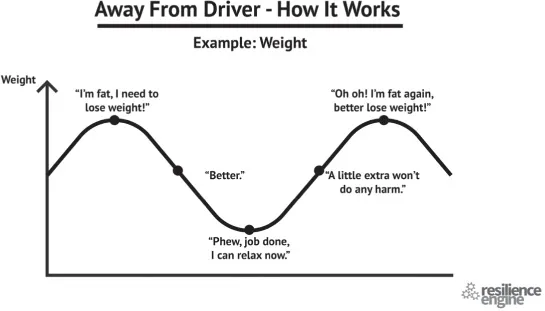
Becoming aware of whether you are drawn towards or driven away from4 in these matters is part of the deeper matter of resilience building. Being driven away is a temporary state: when you are close to the thing you want not to be, you create action to shift away. Once you are further away, you ease up the action a little; indeed you may stop it altogether.
Take the example of not wanting to be overweight. Weight management measures kick in strongly when the person is feeling overweight, what they might refer to in their internal self-talk as ‘fat’. They dislike feeling like this so move away from it, but their efforts to lose weight decrease and indeed stop altogether once the danger of feeling ‘fat’ is gone:
The you-have-to-be-tough mantra may come from either side, Good or Bad, but in The Resilience Engine’s experience, this myth is fuelled most strongly where someone has an ‘away driver’,4 to ensure they don’t look weak or stupid. This ‘away from’ engenders a kind of superhuman, always-on effort to ensure you appear the opposite of what you consider Bad:
If you feel you don’t know enough | | you aim to know lots and lots! |
If you feel like you’re emotional | | you aim to hide your emotions. |
If you feel you just can’t go on, and think this is weak | | you do the opposite, you go straight back with force, without necessarily changing anything. It’s as if you’re using your own self as a battering ram. And what gets battered is your resilience including your wellbeing. |
The ‘hijack’5
A lot of energy is spent making sure you don’t fall into looking like anything on the ‘Bad’ side. The level of hold that this can have on you is intense. As George Kohlrieser describes in ‘Hostage at the Table’,5 you can get ‘hijacked’. Our partners, The Healthy Workforce, talk about the ‘amygdala hijack’. This is when you suffer from brain freeze because of sensory overload and being emotionally charged. It’s where the cortisol, the ‘stress hormone’, shoots up whilst the oxytocin, the ‘cuddle hormone’, your feel-good hormone, shoots down. See Chapter 7 for more. The Resilience Engine observes this kind of ‘lock’ in many situations: in work, in home life, in decision making, in the dealing with difficult stuff, in planning a new process.
Culturally, whether in your workplace or in your communities, this can be massively exaggerated when looking at groups and teams.
This is how it is amongst team members who have learnt that failure is not acceptable. They work always to ensure success and that in turn might mean subtly toning down expectation or setting goals that are, whilst comfortable, not that motivating. Thus mediocrity gets borne.
Or the team that can’t handle emotion. Emotion or being emotional is bad. So don’t show it, keep it in, even if it eats you. Cramming your emotions down and down inside into some inner deep pocket with a strong zip so that it stays shut is simply unhealthy: not only do you not honour what you need in the moment, you risk three other much longer-term health and performance-impacting issues:
o The first is personal but has a big impact on others – emotions that are tucked away bubble up or even boil up at ...