![]()
PART 1
INSIDE
You need to understand the emotional realm of your employees and the work environment (or so you’ve been told) and that starts with understanding YOURSELF first – reflecting on you, not necessarily something you are used to or familiar with and probably not within your comfort zone. Don’t worry; there will be clear questions and practical exploration, not just airy-fairy blah blah blah.
The INSIDE section is about putting the focus on yourself; understanding everything you know about you and then reflecting on it to identify who you are at your core and hence what you bring to the world (and to those with whom you interact). You can’t realistically head to a destination, like Switzerland, without knowing that you are starting that trip from London or Toronto. Just like at work you can’t hit the sales target for the year if you don’t know the current sales figures. Self-awareness is a fundamental baseline if you are going to develop your skills.
By the end of Part 1 you will have accumulated and consolidated a variety of observations about you, both from your own perspective and from the perspectives of others. Your starting point will be the things you already know about yourself or have been told by others; this is the low-hanging fruit. If you’ve been on any leadership development or training courses, you’ll probably have assessments and learning outcomes which you can reference. Once you’ve done that, I will help you go beyond the known or obvious, to explore the new and unknown and help you uncover motivators, preferences and aspects of yourself of which you may not currently be aware.
Having kicked off your inventory about yourself then you will investigate the SO WHAT? How do you manage yourself knowing what you now know in order to live the life you want; have the impact you intend and get the results to which you aspire? Does that sound lofty? If implemented it can help you manage yourself to influence key stakeholders at work, appropriately and effectively. Your day-to-day actions will be more about creating the life you want through conscious choice rather than happenstance. This process is similar to the kind of SWOT analysis you might undertake in your business to help you know your company’s strengths and weaknesses and leverage them effectively to achieve the desired improvement and position in the marketplace.
![]()
PRINCIPLE 1
It Starts With You
Improved people skills and, by extension, leadership, starts with you because you are the only person you can change. I’m sure you’ve tried changing other people, such as your partner or boss. How did that go? You may have been lucky if they changed at all. The greatest opportunity for change lies in knowing yourself well and focusing on what’s within your control.
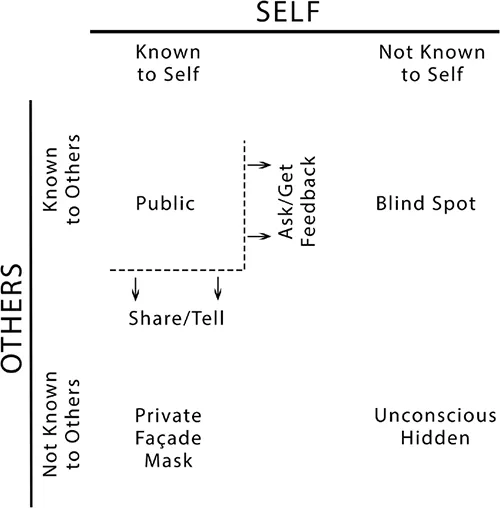
The starting point to people skills is to figure out your starting point. Who are you? A simple framework for what you are about to embark on is the Johari Window. It’s a simple 2x2 model created by psychologists Joseph Luft and Harrington Ingham in 1955 and is useful for self-awareness and understanding relationships to others.
Johari Window
This Principle will be all about you – first, bringing what you already know about yourself to the forefront of your mind. This is the gather and collation phase. Secondly, learning how to discover new insights about yourself or at least making some deeper things you know about yourself more conscious. This is the self-reflection and digging deeper phase. And finally, the Principle will end with a challenge to kickstart your understanding about your individuality and its impact on your effectiveness. This is the self-observation and curiosity phase.
Collate Existing Data about Yourself
Start by taking an inventory of all the available data you have on you. Look for all the evidence you have accumulated from recent years, including:
• Performance reviews
• 3600 surveys (surveys that your boss, team and peers have completed on you)
• Awards and certifications
• Complaints or criticisms
• What are your passions? What do you enjoy doing?
• Any feedback you’ve received, e.g. verbal accolades, congratulatory cards, letters and emails
• Any assessments you’ve had done such as the Myers-Briggs Type Indicator (MBTI), DiSC Workplace Profile, Discovery Insights, The Leadership Circle, Hogan, Belbin Team Roles Assessment, Point Positive, Realize2 Strengths, Gallup Strengths Finder, Enneagram, etc. (If you don’t have many of these types of assessment you can find some of them online with free or inexpensive versions to complete now)
• Comments from your friends and family (yes, really!)
If you don’t have any of the above, then send a simple email to a variety of personal and professional contacts asking them for input. You can use the following verbatim to make it fast and easy for yourself, don’t overthink it:
I am working on my leadership development (always a work in progress I feel) and would genuinely appreciate your input. Would you please respond to the following 4 questions with as much detail or specificity as you can (bearing in mind, your initial, quick response is best for both you and me):
1. What should I start doing?
2. What should I stop doing?
3. What should I continue doing?
4. What is unique about me versus other leaders/people you know or with whom you work?
Thank you so much for your feedback.
(As a bonus, the above model of start/stop/continue is a great way of asking for feedback. It gives people specific areas to think about rather than just ‘how am I doing?’ Or ‘give me some feedback’. Keep to the start/stop/continue sequence as it makes it easier for the respondent to start the exercise and allows them to finish on a positive, so they don’t feel bad.)
With regard to your friends and family, what comments would your partner or family members make about your strengths, weaknesses and that funny little quirk (potentially annoyance) that makes you distinctly you? What’s the thing they tease you about? Extend that inquiry to your close friends, especially your best friend.
If the comments of your personal and professional contacts are similar, that is not surprising, as you are the same person at your core, just in two different environments. If the comments of personal and professional are radically different, what does that mean for you? What’s happening inside you that ...