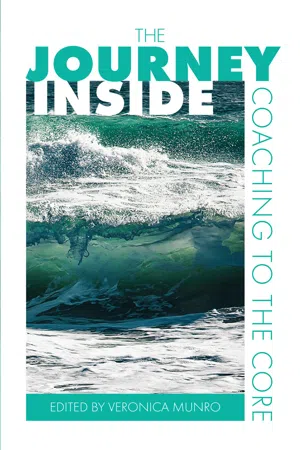
If you're coaching top-level executives, you need to deliver top-level results. Seven international expert coaches share their techniques for deepening your practice and your impact. Take your coaching to a more powerful level as you work down through the depths of the human psyche, where effective sustainable change is achieved. An essential book for anyone involved in helping others achieve at their highest potential.
'An immensely practical insight into first-class coaching skills. A must read for all professional coaches looking to perfect their technique.' - Nigel Jeremy, Chief Learning Officer, British Airways
- 288 pages
- English
- ePUB (mobile friendly)
- Available on iOS & Android
eBook - ePub
About this book
Information
I
THE CONSCIOUS MIND
Covered in this section
We always meet a client where they are in their thinking by pacing their conscious understanding of the challenges they face and the outcomes they wish to achieve.
By conscious, we mean that part of the mind used for logic, processing, reasoning, structuring ideas, rationalisation and analysis. When we initially engage with clients, we are engaging at this conscious level. It is a starting point for all our interactions, though not the end point. Clients come to us with a problem, challenge, issue or outcome that they can consciously articulate, though they typically do not have an understanding of the unconscious drivers of these, or indeed how to resolve them.
Change typically begins with consciously thinking about new behaviours and regular practice of these resulting from the coaching.
In this section, there are three chapters that introduce you to a variety of ways to work powerfully with clients at this level and deepen their understanding and awareness of their challenges and the impact of these, so that they can create new plans of action to resolve them. As coaches, it is also true that whilst working at this conscious level, the deepening awareness and shifts in our clients start to occur at the unconscious level as well.
Chapter 1: Turn Your Challenge Inside OUT: The Physical Metaphor Technique
Veronica Munro and Richard Haggerty
This creative technique is used to enable clients to get outside of their heads, and their current thinking, where they often find themselves stuck. The technique, developed from the ancient practices of military war games, enables clients to externalise their challenges and outcomes, and experiment creatively using everyday objects to more freely discover different strategies, options and solutions.
Chapter 2: Take the Plunge and Dive Deeper using Transactional Analysis
Shirley Attenborough
Shirley takes us through the practical use of Transactional Analysis and related tools to encourage clients to consciously explore the deeper levels inside themselves and make more effective shifts in their behaviours to achieve the results they desire.
Chapter 3: The Transformational Impact of Active Listening
Colin D. Smith
Colin shares with us guiding principles in building the skills and awareness of Active Listening and where to focus our attention, so that we can build the level of relationships with clients that can lead to change beyond conscious levels of being.
CHAPTER 1
TURN YOUR CHALLENGE INSIDE OUT
The Physical Metaphor Technique
A powerful and systematic hands-on technique for clients to take a challenge, externalise it, and develop new perspectives and strategies that allow them to notice opportunities so they can take concrete steps to move forward. This enables their conscious minds to access creative ideas that are outside their current awareness.
Covered in this chapter
• An engaging ‘hands-on’ process that is client-led
• How to use the physical environment to represent challenges and identify new strategies and actions
• The power of pre-framing to create full engagement from clients
• Dissociating from a challenge to get new viewpoints and solutions
• How to create a completely safe space for clients where there is no fear of failure
INTRODUCTION
Military war games started as games not dissimilar to chess in fifth-century Ancient Greece, and then later in Northern India. These evolved into battlefield simulations during the seventeenth and eighteenth centuries, and later into highly sophisticated military and economic war games across a range of organisations, industries and countries.
Conducting war games in the Napoleonic era, for instance, was a way of determining the best means to prevail given the known circumstances about an enemy location, and then look at possible options and strategies for fighting a battle. It introduced realism into the decision-making process so that when it was time to engage, the strategy which had the greatest chances of success had already been theoretically tried and tested, and could be implemented with confidence. The Physical Metaphor Technique (PMT) is a development of this tool in the context of coaching.
The purpose of the PMT is to facilitate a client to move from a challenge they have, through the use of this visual hands-on approach, to creating different scenarios and strategies, until they reach their outcome.
The PMT is designed to help your client identify new ideas, approaches, strategies and options to seemingly entrenched challenges. This can be achieved by using any immediate space in the environment around a client as a metaphor, and landscape, for the challenges, resources and potential solutions. In this way, it acts as a natural bridge to the client’s creative unconscious resources and solutions, and bypasses the sometimes more rigid limited thinking of the conscious mind. It is a powerful technique that assists the analytical part of the mind to work with much more freedom, whilst at the same time creating opportunities for clients to gain creative insights spontaneously from deeper levels of consciousness. This begins the journey within.
BENEFITS OF THE PHYSICAL METAPHOR TECHNIQUE IN COACHING
The PMT provides a safe space for clients to externalise the challenge, or situation, as a physically represented metaphor. This naturally dissociates the client from the challenge and any emotions attached, so they can witness what is happening more clearly. From this ‘third position,’ or alternative perspective, the client is able to look at the situation, unencumbered by past judgements and emotions. This allows fresh perspectives to come to mind and is more conducive to developing and testing a range of strategies and solutions with a sense of freedom.
Some of the challenges, and more complex areas, this particular intervention can help clients with are:
• Creating new winning strategies to beat the competition
• Identifying new streams of business or products within a highly competitive market
• Scoping out the opportunities and gaps in the market from different perspectives
• Building a successful strategy for the acquisition of another business / company
• Identifying different approaches for shifting the culture / organisational structure to achieve a significant edge over the competition
• Reviewing 360-degree feedback received from selected stakeholders across the organisation and working on the new behaviours required to meet their success criteria in selected areas.
PRE-FRAMING AND THE 7 STEP PROCESS
Pre-framing
‘Framing’ here refers to creating the context, and setting a strong intention: a lens or lenses through which the activities can be experienced. Establishing frames ahead of a coaching session (pre-framing) enables the coach to avoid common misunderstandings so the client interprets what is happening in a specific way, or set of ways. Setting clear frames (of reference) upfront can also make a new activity more clear, purposeful and enjoyable. It is, therefore, a powerful way to help the client to become more motivated and focused on the task in hand.
Pre-frames serve important functions. They:
• Establish rapport
• Create a sense of safety
• Establish credibility for the exercise
• Amplify motivation
• Create agreement to participate.
Gaining agreement from the client, before you start this technique, is essential. This primes your client to be thinking, ‘This could really help me and is worthy of my time and energy.’ They will also want to know that this is a technique they can experiment with in any way they wish, with any challenge they have. There are no right or wrong moves, only different strategies and options.
As you begin, offer some frames of reference upfront (pre-frames) that you feel match your client’s needs, and gain agreement. (Note: examples of words spoken by the coach are in italics for ease of reference.)
Examples of effective pre-frames and follow-up questions include:
Exploration frame
• Today, we are going to focus on you exploring and generating a range of strategies and solutions to your challenge. There will be a variety of these, and there are no right or wrong ones. Your role is to explore these and identify the most appropriate ones to achieve your outcome. OK?
Control frame
• Some people get stuck and don’t realise when their thinking is ‘inside the box.’ Today we are literally going to go ‘outside th...
Table of contents
- Cover Page
- Title Page
- Copyright Page
- Editor’s Note
- Contents
- List of Figures
- List of Tables
- Introduction
- Part I: The Conscious Mind
- Part II: The Unconscious Mind
- Part III: The Emotions
- Part IV: The Identity
- Part V: The Soul
- About the Contributors
Trusted by 375,005 students
Access to over 1.5 million titles for a fair monthly price.
Study more efficiently using our study tools.
Frequently asked questions
Yes, you can cancel anytime from the Subscription tab in your account settings on the Perlego website. Your subscription will stay active until the end of your current billing period. Learn how to cancel your subscription
No, books cannot be downloaded as external files, such as PDFs, for use outside of Perlego. However, you can download books within the Perlego app for offline reading on mobile or tablet. Learn how to download books offline
Perlego offers two plans: Essential and Complete
- Essential is ideal for learners and professionals who enjoy exploring a wide range of subjects. Access the Essential Library with 800,000+ trusted titles and best-sellers across business, personal growth, and the humanities. Includes unlimited reading time and Standard Read Aloud voice.
- Complete: Perfect for advanced learners and researchers needing full, unrestricted access. Unlock 1.5M+ books across hundreds of subjects, including academic and specialized titles. The Complete Plan also includes advanced features like Premium Read Aloud and Research Assistant.
We are an online textbook subscription service, where you can get access to an entire online library for less than the price of a single book per month. With over 1.5 million books across 990+ topics, we’ve got you covered! Learn about our mission
Look out for the read-aloud symbol on your next book to see if you can listen to it. The read-aloud tool reads text aloud for you, highlighting the text as it is being read. You can pause it, speed it up and slow it down. Learn more about Read Aloud
Yes! You can use the Perlego app on both iOS and Android devices to read anytime, anywhere — even offline. Perfect for commutes or when you’re on the go.
Please note we cannot support devices running on iOS 13 and Android 7 or earlier. Learn more about using the app
Please note we cannot support devices running on iOS 13 and Android 7 or earlier. Learn more about using the app
Yes, you can access The Journey Inside by Veronica Munro in PDF and/or ePUB format, as well as other popular books in Business & Decision Making. We have over 1.5 million books available in our catalogue for you to explore.