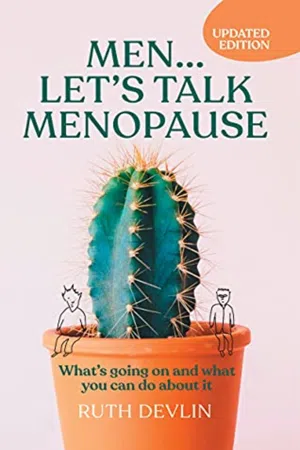
A comprehensive guide to the female menopause, written for men to help them understand this often perplexing topic. It addresses all the important aspects of the menopause, including the physical, psychological, genito-urinary and long term symptoms that can occur. It gives essential information on options available to cope with those symptoms plus good advice for men (and women!) on practical lifestyle choices. Short and easy to dip in and out of, with humorous illustrations and practical tips for what you can do (and what NOT to say), this is your essential handbook for surviving the change in YOUR life.
- 104 pages
- English
- ePUB (mobile friendly)
- Available on iOS & Android
eBook - ePub
About this book
Information
Topic
Medicine1
SOME BASIC FACTS
The general perception of a menopausal woman needs to change – they should be valued for their wisdom and life experience and as such be acknowledged as an invaluable asset to society. (Post Reproductive Health Journal 2017)
So what is the menopause? How long does it last? Will she return to normal? Is the Pope a Catholic?… Of course she will!
Feel like you don’t know anything? Please be assured you are not alone. There are thousands of men in exactly the same position as you, but alas, as a nation we tend to be all terribly British about it and we don’t, as a rule, talk about it down the pub!
Here are a few definitions to start with:
• Pre-menopause: the reproductive phase, when the hormones are relatively intact.
• Perimenopause: that “glorious” transitional period from the reproductive phase to the non-reproductive phase, so potentially still fertile – careful! Oestrogen levels are declining and it can be a turbulent time for both of you. It’s actually – and this is so important – the most symptomatic phase, and for some can be flipping awful and for anyone in the vicinity!
• Menopause/Post-menopause: the non-reproductive phase, when periods have stopped (can only be classed as menopausal after 12 continual months of no bleeding). The symptoms should be dissipating and life starting to calm down… honest!
• Prematurely menopausal: a proportion of women can become menopausal before the age of 45, some in their 20s and 30s and for various reasons. These women should be on hormone replacement therapy (HRT) and should seek medical advice.
How, when and for how long?
Menopause can either be:
• Spontaneous, so developing naturally;
• Surgically induced following, for example, having a hysterectomy (symptoms tend to be more intense);
• Iatrogenic following treatment, as in chemotherapy or radiotherapy.
It usually starts to happen any time from the age of 45 to 55, the classic age quoted by clinicians being 51 years old.
How long can it last… how long is a piece of string? Anywhere between four and ten years is the average, but it is such an individual medical condition.
What’s with all these symptoms? Does every woman get them?
Basically, all of the symptoms are due to declining levels of oestrogen. Every woman will go through this transitional phase but each woman will react differently.
Some sail through this transition; others find their symptoms so debilitating that it affects not only their general overall health but also their relationships and their work.
How can you help?
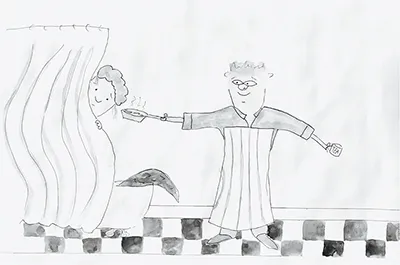
Firstly, a tip: never, and I mean never, say, “Oh it must be your hormones…”, “Oh, it’s definitely that time of month again…” or “Oh, go and take a chill pill…”. These comments are like a red rag to a bull.
Do, however, send her off for long cool showers (soaks in the bath can, on occasion, exacerbate the hot flushes), be a model listener and learn to bite your tongue when required, even when she is resembling a Komodo dragon! This is absolutely no time for you to have any form of man flu! What do you mean, how long do you have to do this for?!
Over the following three chapters I’ll go through symptoms that she could be experiencing and explain ways to help relieve those symptoms. Then, hopefully, quality of life will improve… for both of you.
The key word there is could. Most women experience several symptoms, but each woman is different, experiencing the symptoms in different ways and to different intensities, which is why it’s such a flipping tricky topic to tackle! You might be the luckiest man on the planet and she glides through her menopause without batting an eyelid, with her pelvic floor and libido remaining intact. Alternatively, she’s at the other end of the spectrum (sympathies), in which case, take a deep breath and read on…
The symptoms
I’ve split the main symptoms into three categories – Physical in Chapter 2, Psychological in Chapter 3 and Genitourinary in Chapter 4 (reproductive and urinary to you and me). There are also a few rare and long-term symptoms which you can find in Chapter 5.
OK, now brace yourself: there are over 30 symptoms that women can suffer from. Now you understand why she can resemble Cruella de Vil on occasion; there’s a lot to cope with!
Always remember that certain symptoms could be related to other medical conditions, so if unsure, anyone should get checked out by their GP to confirm it is the menopause and not something else.
Something to take on board – symptoms evolve, some quicker than others and to differing degrees. Just when you think you’ve got a handle on everything, another one might rear its ugly head… but then again you might lose one! So it’s a constant, ever-changing flow of events until reaching those post-menopausal years.

2
THE PHYSICAL SYMPTOMS
The human state includes far more than just the rational, analytical and intellectual behaviour based on physical objective facts but also includes the intuitive, the sensibilities and the spiritual. (British Medical Journal 2017 Margaret Turner-Warwick)
Everyone’s heard of hot flushes, of course; she may even have started to experience these. But – brace yourself – there are many more physical symptoms that can accompany the onset of menopause. Read on to find out more about them, and what helps!
Hot flushes and night sweats
Hot flushes are the exact reverse of “feeling damn hot”, I can assure you.
What happens?
The technical term is vasomotor symptoms. Hormones are all over the place as oestrogen levels start to drop, which causes the thermostat in the brain (that controls body temperature) to have a hissy fit now and again!
It affects 75% of women, with 25% getting really awful ones. That means she’s either going to look like she’s having “a wee glow” or like she’s just come off a squash court – get the picture? I can assure you that they are inconvenient, embarrassing and disruptive, and they will affect her quality of life. They can be infuriatingly random and can also be brought on by certain foods, drinks or situations. It gets worse… they can be accompanied by headaches, palpitation and dizziness. Yes, we are still on the first symptom!
Triggers and causes
The most common triggers can be dietary, including caffeine, alcohol (with red wine being very common), spicy foods or even just having a hot drink.
Stressfu...
Table of contents
- Cover Page
- Title Page
- Copyright Page
- Table of Contents
- Preface
- Introduction
- 1. Some basic facts
- 2. The physical symptoms
- 3. The psychological symptoms
- 4. The genitourinary symptoms (reproductive and urinary)
- 5. Rare and possible long-term symptoms
- 6. Lifestyle, diet and exercise
- 7. Hormone replacement therapy (HRT)
- 8. Alternative remedies and therapies
- Postscript… a final few words
- Useful links and reading
Trusted by 375,005 students
Access to over 1.5 million titles for a fair monthly price.
Study more efficiently using our study tools.
Frequently asked questions
Yes, you can cancel anytime from the Subscription tab in your account settings on the Perlego website. Your subscription will stay active until the end of your current billing period. Learn how to cancel your subscription
No, books cannot be downloaded as external files, such as PDFs, for use outside of Perlego. However, you can download books within the Perlego app for offline reading on mobile or tablet. Learn how to download books offline
Perlego offers two plans: Essential and Complete
- Essential is ideal for learners and professionals who enjoy exploring a wide range of subjects. Access the Essential Library with 800,000+ trusted titles and best-sellers across business, personal growth, and the humanities. Includes unlimited reading time and Standard Read Aloud voice.
- Complete: Perfect for advanced learners and researchers needing full, unrestricted access. Unlock 1.5M+ books across hundreds of subjects, including academic and specialized titles. The Complete Plan also includes advanced features like Premium Read Aloud and Research Assistant.
We are an online textbook subscription service, where you can get access to an entire online library for less than the price of a single book per month. With over 1.5 million books across 990+ topics, we’ve got you covered! Learn about our mission
Look out for the read-aloud symbol on your next book to see if you can listen to it. The read-aloud tool reads text aloud for you, highlighting the text as it is being read. You can pause it, speed it up and slow it down. Learn more about Read Aloud
Yes! You can use the Perlego app on both iOS and Android devices to read anytime, anywhere — even offline. Perfect for commutes or when you’re on the go.
Please note we cannot support devices running on iOS 13 and Android 7 or earlier. Learn more about using the app
Please note we cannot support devices running on iOS 13 and Android 7 or earlier. Learn more about using the app
Yes, you can access Men… Let’s Talk Menopause by Ruth Devlin in PDF and/or ePUB format, as well as other popular books in Medicine & Gynecology, Obstetrics & Midwifery. We have over 1.5 million books available in our catalogue for you to explore.