- 210 pages
- English
- ePUB (mobile friendly)
- Available on iOS & Android
eBook - ePub
About this book
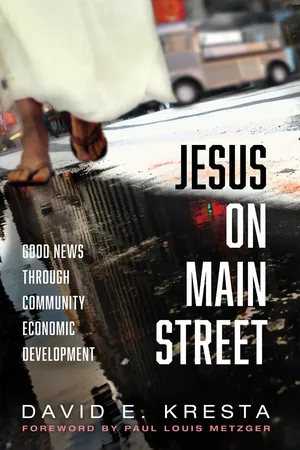
God loves just economies, but sadly the invisible hand of the market has chiseled huge cracks in our communities. Fortunately, Jesus announced freedom for the poor and oppressed, and by taking on his mantle we have a role to play in helping establish just economies here and now! Jesus on Main Street provides church leaders and church planters with a broad overview of Community Economic Development (CED), with practical steps to lead your church in following Jesus into those cracks. You'll be equipped with the CED "toolkit" including microbusinesses, makerspaces, business incubators, worker cooperatives, workforce development, commercial district revitalization, locality development, anchor institutions, and accountable development. A robust assessment and planning guide specifically for churches will help you create a collaborative CED strategy rooted in God's love for people and justice.
For churches looking to bring healing to their local economies, CED builds capacity for long-term equitable economic growth, catalyzing a movement of business creation, employment, and job creation that does not leave anybody behind. This is the promise and challenge of CED as we follow Jesus down Main Street and explore what good news for local economies looks like!
Information
Topic
Theology & ReligionSubtopic
Christian MinistryPart 1
Community Economic Development Overview
1
What Is Community Economic Development (CED)?
Depending on your background and experience, economic development may be a far-off concept reserved for specialized professionals working on international poverty alleviation, or closer to home, backroom wheeling and dealing amidst bankers, politicians, and real estate tycoons. Although economic development is a very rich and complex field, it nonetheless encompasses simple, everyday concepts such as jobs, savings, mom-and-pop shops, and big brands. While even a child can understand how they connect with the economy (“Mommy, can you buy me this?”), few adults understand the interconnected processes that dictate their response (“No sorry, my hours were cut at work”). Further mystifying economic development is the fact that most of us feel we are subjected to the economy, with positions of influence reserved for billionaire elites.
The importance of Community Economic Development (CED) to the mission of the church and the holistic health of our communities can best be seen by looking at why we need CED and comparing it to other practices and disciplines you may be familiar with. The starting point in building our definition of CED will be to compare it to more traditional forms of economic development. At the simplest level, economic growth is associated with increased economic output in the form of production and consumption, while economic development has much broader concerns revolving around the concept of “capacity.” This capacity comprises the assets and resources available to a neighborhood, city, region, or country to sustain long-term economic activity. Resiliency, flexibility, and equity are hallmarks of good economic development. In practice, however, many Traditional Economic Development (TED) activities are simply focused on stimulating more economic growth, with very little focus on development and even less on equity. Especially here in America, we’ve been conditioned to have faith in the mysterious invisible hand of the market. If we just stay out of the way and let businesses run unhindered, so the standard neoliberal story goes, everybody will be better off.
So why do we need CED? Because reality tells a very different story.
Three Cracks Addressed by CED
We need CED because there are several large cracks in the myth of the invisible hand providing economic opportunity for all.1 The first is growing inequality. While it is obvious that some people, as well as some groups, are economic winners, it is equally obvious that some people and groups of people are never quite able to reap the economic benefits that are supposedly there for the taking. The last thirty years have seen increasing economic inequality, reaching levels not seen since before the Great Depression. Renowned economist Joseph Stiglitz chronicles the growing divide in America, noting that in the recession “recovery” year of 2010, the top 1 percent garnered 93 percent of new income created that year.2 With a recovery like that, who needs a recession? But it hasn’t always been like this: the thirty years after World War II saw faster income growth at the bottom than at the top of the income scale. While the reasons for this shift from equitable economic growth to the current situation are complex and varied, the creation of the field of economic development and TED practices centered on business attraction and large-scale development projects are certainly implicated. Why? TED normally does not directly benefit lower-income groups and racial minorities, hoping instead that benefits will eventually trickle down from the rich to the poor. Because this trickle-down is very inefficient and often non-existent, TED contributes directly to increased inequality.
The failure of trickle-down economics is often accompanied with the assumption that the poor are poor because they don’t work hard enough to take advantage of opportunities or because they refuse to leave a “culture of poverty.” Others believe that inequality is simply unavoidable, misappropriating Jesus’ words that “the poor you will always have with you” (Matt 26:11) to argue against community development and poverty alleviation efforts. Rather than simply accepting poverty and maintaining faith in a dubious “rising tide lifts all boats” philosophy, CED works to explicitly address inequality by focusing on economic development that benefits all people, especially those at the lower rungs of the economic ladder.
This first crack of people-based inequality is intimately related to the second crack: place-based inequality. We are all familiar with reports ranking cities on any number of criteria such as livability, economic vitality, and even a “foodie index.” We see rising stars, media darlings, and perennial favorites vying for the top spots while other cities gain notoriety because they are seemingly stuck at the bottom. Inequality at the neighborhood level is rampant as well, with even a casual drive through any metropolitan area revealing tremendous disparity between neighborhoods, particularly in those cities at the top of the “best of” lists. While place-based differences may be visually obvious, the effect of these differences are not always apparent. Social scientists have found that where a person lives has a tremendous impact on their economic prospects. For example, a child growing up in Chicago’s western suburbs earns 30 percent more than a child growing up in close-in Chicago neighborhoods because of effects from where they live.3 As a result, CED is not content with success at the aggregate level of a metropolitan area or region, looking instead for economic vitality down to the neighborhood level.
Just as many accept the people-based inequality discussed above, place-based differences are often seen as inevitable, with each metropolitan area, city, or neighborhood responsible to fight for its share of the economic pie. TED embraces this competitive view whole-heartedly, with many dedicated professionals and elected local officials fighting tirelessly on behalf of their cities, battling other locales to attract new businesses promising high-paying jobs and investment. Sadly, the promised level of jobs rarely materializes over time as cities race to the bottom with costly concessions, literally begging businesses to come to them. These new jobs also typically require specialized training and high degrees of education, such that the beneficiaries are often highly qualified newcomers or existing residents who already have good jobs. TED justifies this by noting that existing lower-income residents will benefit through an “employment multiplier” with the creation of jobs in industries such as retail, food service, and domestic care to serve these higher-income newcomers. However, these service jobs typically offer low pay, no benefits, and often require considerable commutes because these workers cannot afford to live near the emerging areas of economic opportunity. This second crack of place-based inequality highlights the third and final crack, namely, a political economy tilted against lower-income groups and racial minorities.
By recognizing that political and economic power are intimately related, CED seeks to transform existing power relationships and envisions a society where all can thrive. CED is inherently disruptive to American neoliberalism’s undying faith in mobile capital and unregulated global markets, seeking instead to anchor capital in the community. CED recognizes that community vitality extends well beyond what TED and the market provides on its own. Not being content with remotely controlled corporations deigning to grace the community with their presence, CED utilizes community benefits agreements and other forms of accountable development (chapter 12) to hold large-scale corporate developments accountable to their communities. CED also interacts directly with community development efforts to increase the capacity of local residents to participate in economic opportunities through workforce development and advocacy for lower-income and minority workers. Although neither anti-corporate nor anti-capitalist, CED does emphasize locally owned enterprises and locally based economies that can withstand cor...
Table of contents
- Title Page
- Foreword
- Introduction
- Part 1: Community Economic Development Overview
- Part 2: Community Economic Development Toolkit
- Part 3: Community Economic Development Process
- Appendix: Reimagining Religious Spaces
- Bibliography
Trusted by 375,005 students
Access to over 1.5 million titles for a fair monthly price.
Study more efficiently using our study tools.
Frequently asked questions
Yes, you can cancel anytime from the Subscription tab in your account settings on the Perlego website. Your subscription will stay active until the end of your current billing period. Learn how to cancel your subscription
No, books cannot be downloaded as external files, such as PDFs, for use outside of Perlego. However, you can download books within the Perlego app for offline reading on mobile or tablet. Learn how to download books offline
Perlego offers two plans: Essential and Complete
- Essential is ideal for learners and professionals who enjoy exploring a wide range of subjects. Access the Essential Library with 800,000+ trusted titles and best-sellers across business, personal growth, and the humanities. Includes unlimited reading time and Standard Read Aloud voice.
- Complete: Perfect for advanced learners and researchers needing full, unrestricted access. Unlock 1.5M+ books across hundreds of subjects, including academic and specialized titles. The Complete Plan also includes advanced features like Premium Read Aloud and Research Assistant.
We are an online textbook subscription service, where you can get access to an entire online library for less than the price of a single book per month. With over 1.5 million books across 990+ topics, we’ve got you covered! Learn about our mission
Look out for the read-aloud symbol on your next book to see if you can listen to it. The read-aloud tool reads text aloud for you, highlighting the text as it is being read. You can pause it, speed it up and slow it down. Learn more about Read Aloud
Yes! You can use the Perlego app on both iOS and Android devices to read anytime, anywhere — even offline. Perfect for commutes or when you’re on the go.
Please note we cannot support devices running on iOS 13 and Android 7 or earlier. Learn more about using the app
Please note we cannot support devices running on iOS 13 and Android 7 or earlier. Learn more about using the app
Yes, you can access Jesus on Main Street by David E. Kresta in PDF and/or ePUB format, as well as other popular books in Theology & Religion & Christian Ministry. We have over 1.5 million books available in our catalogue for you to explore.