eBook - ePub
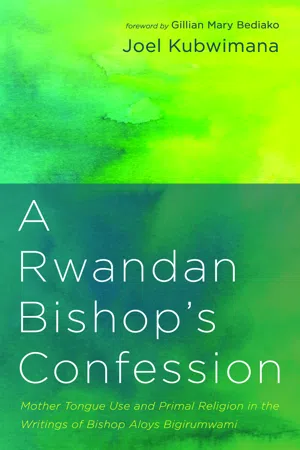
A Rwandan Bishop’s Confession
Mother Tongue Use and Primal Religion in the Writings of Bishop Aloys Bigirumwami
- 142 pages
- English
- ePUB (mobile friendly)
- Available on iOS & Android
eBook - ePub
A Rwandan Bishop’s Confession
Mother Tongue Use and Primal Religion in the Writings of Bishop Aloys Bigirumwami
About this book
In this book, I analyze why Bishop Aloys Bigirumwami prioritizes the use of the native language and the value of primal religions in spreading the gospel. According to Bigirumwami, the gospel should be taught in the native language, because it is the people's heart language. On the other hand, when the message is spoken in non-native languages, the gospel may spread but it does not reach the hearts of the people. As for the primal religions (tradition religions), for Bigirumwami they are part of what Jesus came to fulfill rather than abolish. In Rwanda, Western missionaries neglected the Rwandan primal religions by demonizing them, and the result was that the gospel was not planted in the good soil; the reason why the genocide against the Tutsi was executed in 1994 in a country where 91 percent of its population were Christians. A part of exploring the Christian mission history in Rwanda, this book points out the need to continue where Bigirumwami and others of his time left off in their effort of inculturation of the Christian faith in Rwanda and Africa in general.
Trusted by 375,005 students
Access to over 1.5 million titles for a fair monthly price.
Study more efficiently using our study tools.
Information
Topic
Theology & ReligionSubtopic
African History1
Western Missionaries Perceptions of the Pre-Colonial Rwandan Worldview and Its Impact
Introduction
This chapter deals with history of Rwanda as the setting for Bigirumwami’s life and work. The history of Rwanda can be divided into many periods, but three major periods are mainly used: pre-colonial, colonial, and post-colonial. Currently, a fourth period could be identified, the post–Tutsi genocide period. This chapter will focus on Rwandan primal religion in pre-colonial Rwandan society and in colonial Rwanda, focusing on the process of Christianizing Rwanda and its effects. This historical background will help in understanding the context in which Bigirumwami emerged.
Pre-Colonial Rwanda
The history of Rwanda holds many controversies. During December 14–18, 1998, the National University of Rwanda through the Faculty of History, Literature and Human Sciences organized an international seminar to discuss these controversies. Discussing the topic presented during the seminar, Byanafashe Déogratias clarified that “Les différentes présentations portaient sur les sujets de l’histoire du Rwanda parce que nous considérons que, de ce fait, ce sont des sujets sensibles à la falsification”58 [“The various presentations dealt with these topics of Rwandan history because we consider that, for this reason, they are susceptible to falsification”]. These controversial topics covered six themes: (1) “Les problèmes de méthodologie et de chronologie” [The problems of methodology and chronology]; (2) “Les considérations sur le peuplement» [Considerations on settlement] ; (3) «L’Etat-Nation et les frontières» [The nation-state and the borders]; (4) «Les relations traditionnelles entre rwandais» [The traditional relations among Rwandans] ; (5) «Le phénomène colonial et d’évangélisation» [The colonial phenomenon and evangelization]; (6) «Les changements politiques et leur nature, Enfin le Génocide et les Rescapés de 1994» [The political changes and their nature, finally the genocide and the survivors of 1994].59
Pre-Colonial Rwandan Society
Before the Nyiginya Clan dominated other clans and formed the Kingdom of Rwanda in 1312, starting with Ruganzu I Bwimba,60 there were many kingdoms led by clans around the region. These kingdoms included: Enengwe Kingdom; Singa Kangdom; the northern kingdom was Bugoyi; the central kingdom was Nduga; the eastern kingdom was Kinyaga; and the southern kingdoms were Burwi, Baanda Kingdom, Oongera Kingdom, the Ziggaba Kingdom, Gesera Kingdom, and the Gara Kingdom.61 In defining Rwanda, Muzungu Bernardin wrote, “Le Rwanda est une réalité humaine, sociale et géographique”62 [Rwanda is a human, social, and geographical reality]. In ancient Rwanda, the family was the pillar, as Rwanda was conceived as “one big family.” The individual identity was not separated from parents, lineage, clan, and place.63 Muzungu gives a good example from the genealogies list:
Sendashonga (nom individuel) wa Sebagangari (Fils de Sebagangari), Umunyiginya (nom du clan) w’Umuhindiro (nom du lignage) wo muri Nyaruguru (nom de la région qu’il habitait), i Runyinya (nom de la colline où se situait sa résidence).64
[Sendashonga (individual name) wa Sebagangari (son of Sebagangari), Umunyiginya (clan name) w’Umuhindiro (lineage name) wo muri Nyaruguru (name of the region where he lived), i Runyinya (name of the hill on which his resident was located).]
From the above example, we may understand how a Rwandan was not an isolated individual, but rather he/she was part of one big family. Another important element is that at no point did social classes from that time (Tutsi, Hutu, and Twa) changed into separate ethnic groups as promoted during the colonial period are mentioned. The name of the Tutsi class is only mentioned during the presentation of the genealogy of Rwandan kings. From Alexis Kagame, we may take one example: “Yuhi ni uwa KIGELI, izina lye ali Umututsi akaba RWABUGIRI, Nyina ni NYIRAKIGELI, izina lye ari Umututsi akaba MURORUNKWERE, . . . Akaba umukobwa w’Abakono, . . . Ahoga nyine, Abakono bakabyarana Abami n’Abanyiginya!”65 [Yuhi is son of KIGELI, His name when he was a Tutsi is RWABUGIRI, his mother is NYIRAKIGELI, her name when she was a Tutsi is MURORUNKWERE . . . she is a daughter of Abakono . . . therefore, the Abakono give birth to the kings with Abanyiginya]. Kagame indicates that in ancient Rwanda every king had his Tutsi name and after enthronement...
Table of contents
- Title Page
- Foreword
- Acknowledgments
- Abbreviations
- Introduction
- Chapter 1: Western Missionaries Perceptions of the Pre-Colonial Rwandan Worldview and Its Impact
- Chapter 2: Bigirumwami and His Father’s Unfulfilled Priesthood Calling
- Chapter 3: Mother Tongue and Rwandan Primal Religion in Bigurumwami’s Written Works
- Chapter 4: The Legacy and Relevance of Aloys Bigirumwami as a Theologian
- Bibliography
Frequently asked questions
Yes, you can cancel anytime from the Subscription tab in your account settings on the Perlego website. Your subscription will stay active until the end of your current billing period. Learn how to cancel your subscription
No, books cannot be downloaded as external files, such as PDFs, for use outside of Perlego. However, you can download books within the Perlego app for offline reading on mobile or tablet. Learn how to download books offline
Perlego offers two plans: Essential and Complete
- Essential is ideal for learners and professionals who enjoy exploring a wide range of subjects. Access the Essential Library with 800,000+ trusted titles and best-sellers across business, personal growth, and the humanities. Includes unlimited reading time and Standard Read Aloud voice.
- Complete: Perfect for advanced learners and researchers needing full, unrestricted access. Unlock 1.5M+ books across hundreds of subjects, including academic and specialized titles. The Complete Plan also includes advanced features like Premium Read Aloud and Research Assistant.
We are an online textbook subscription service, where you can get access to an entire online library for less than the price of a single book per month. With over 1.5 million books across 990+ topics, we’ve got you covered! Learn about our mission
Look out for the read-aloud symbol on your next book to see if you can listen to it. The read-aloud tool reads text aloud for you, highlighting the text as it is being read. You can pause it, speed it up and slow it down. Learn more about Read Aloud
Yes! You can use the Perlego app on both iOS and Android devices to read anytime, anywhere — even offline. Perfect for commutes or when you’re on the go.
Please note we cannot support devices running on iOS 13 and Android 7 or earlier. Learn more about using the app
Please note we cannot support devices running on iOS 13 and Android 7 or earlier. Learn more about using the app
Yes, you can access A Rwandan Bishop’s Confession by Joel Kubwimana in PDF and/or ePUB format, as well as other popular books in Theology & Religion & African History. We have over 1.5 million books available in our catalogue for you to explore.