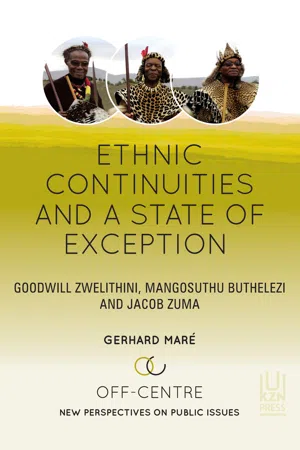
As we enter the third decade of the twenty-first century, South Africa continues to function under the oppressive burden – felt directly as such by all but the elite – of three continuities from apartheid: race thinking, capitalism and the politics of tradition. It is the last of this triad that is the focus of this book. Yet, as Gerhard Maré argues, continuities in the politics of tradition cannot be understood as separable from the other two, nor from the intimate metapolitics of patriarchy. Building on his previous research into how apartheid templates of ethnic separatism, and its popular mobilisations, played out in catastrophic violence in Natal and Zululand, Maré now takes the story into post-1994 South Africa. He sets as his focus three powerful men – Goodwill Zwelithini, Mangosuthu Buthelezi and Jacob Zuma – to illustrate how, from different social locations, each has relied on claims to Zulu tradition to occupy powerful and financially rewarding positions. This book alerts readers to the dangers of tradition as a formal, structured politics, which enriches a narrowly elite minority while overriding democratic rights, effecting a 'state of exception' for the governance of millions who are rendered as 'subjects'. At the same time, tradition in this form leaves intact another divide, at a time when health disasters, inequality and climate catastrophe can be addressed only through shared and collective human engagement.
eBook - PDF
Ethnic Continuities and a State of Exception
Goodwill Zwelithini, Mangosuthu Buthelezi and Jacob Zuma
- 121 pages
- English
- PDF
- Available on iOS & Android
eBook - PDF
Ethnic Continuities and a State of Exception
Goodwill Zwelithini, Mangosuthu Buthelezi and Jacob Zuma
About this book
Information
Print ISBN
9781869144562
Table of contents
Trusted by 375,005 students
Access to over 1.5 million titles for a fair monthly price.
Study more efficiently using our study tools.