How have university scholars across a variety of disciplines navigated the co-creative and collaborative relationships involving community partners? How has the addition of digital components changed the way information can be communicated to the intended audience? Through digital projects, traditional academic silos have given way to community-based partnerships which open research, storytelling, and curation to wide array of contributors from civic engagement professionals, librarians, archivists, technology personnel, local citizens, and academics. The collaborative process may push your comfort zone and make you grapple with your roll of storytelling but as the authors of the last chapter say, "You can't make ketchup without smashing a few tomatoes."
Digital projects can empower communities through collaboration and create new primary sources, collapse barriers, and spark new dialogue. Digital Community Engagement "lifts the hood" and presents nine examples of digital collaborations from constructing a public response to police violence, to creating digital stories of homelessness, to young activists united around local people in the Deep South to build a grassroots movement for social change.
Wingo, Heppler and Schadewald bring together cutting-edge campus-community partnerships with a focus on digital projects. The case studies, authored by academics and their community partners, explore models for digital community engagement that leverage new media through reciprocal partnerships. The contributions to this volume stand at the crossroads of digital humanities, public history, and community
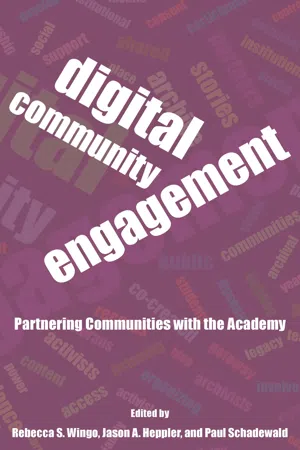
eBook - ePub
Digital Community Engagement
Partnering Communities with the Academy
- English
- ePUB (mobile friendly)
- Available on iOS & Android
eBook - ePub
Digital Community Engagement
Partnering Communities with the Academy
About this book
Information
1
Learn from the Past, Organize for the Future
Building the SNCC Digital Gateway
Geri Augusto, Molly Bragg, Bill Chafe, Charles Cobb, Courtland Cox, Emilye Crosby, Kaley Deal, Karlyn Forner, John Gartell, Wesley Hogan, Hasan Kwame Jeffries, Jennifer Lawson, Naomi Nelson, Judy Richardson, Will Sexton, and Timothy Tyson
DOI: 10.34314/wingodigital.00002
Introduction
Karlyn Forner
It’s one thing—I’m thinking from the university or institutional perspective—to consult with community people or movement veterans or activists. It’s another thing to have them actually participating in it in an equitable way on ownership and decision-making and content.
—Charlie Cobb, SNCC veteran
There were times when this project slowed down because [the SNCC veterans] did not respond quickly enough. Because [the university partners] would do nothing until we said what we had to say, commented on it, directed it, do whatever we had to do. When they said scholar activists, they mean that in the fullest sense of the word.
—Judy Richardson, SNCC veteran
What makes this unique is not just the relationships with each other but the telling the history from the inside out and bottom up. We all know that it is not the norm.
—Courtland Cox, SNCC veteran
While there exists a rich body of literature about public history and shared authority, this chapter does not cite it. Instead, the collaboration between SNCC veterans, scholars, and archivists grew out of lived experience, as well as a collective willingness to try something and see it through. As Naomi Nelson, director of Duke University’s Rubenstein Library, explained, “the ‘literature’ we consulted was not formal historiography, but the lived history of the Movement, the transfer of informational wealth from community organizers, and the hard-won insight of the movement veterans.” The experiences of the movement veterans, scholars of grassroots organizing, and archivists committed to accountability framed the collaboration and guided the project through the challenges and opportunities along the way.1
In 2013 the Student Nonviolent Coordinating Committee (SNCC) Legacy Project, the Center for Documentary Studies at Duke University (CDS), and Duke University Libraries (DUL) formed a partnership to chronicle SNCC’s historic struggles for voting rights and to develop ongoing programs that could contribute to a more civil and inclusive democracy in the 21st century.
During the 1960s, SNCC (pronounced “snick”) became the cutting edge of the direct-action Civil Rights Movement, focusing on both political freedom and equal economic opportunity. SNCC was the only national, Southern-based civil rights organization begun and led primarily by young people. Its full-time student workers, “field secretaries,” worked with local Black communities to help them organize and take control of their own lives. As SNCC activist and SNCC Legacy Project (SLP) member, Charlie Cobb, explained:
At a deeper level than the immediate political concern with voter registration, SNCC’s work was also about cultivating new local leadership and reinforcing existing local leadership. SNCC field secretaries did not see themselves as community leaders but as community organizers, a distinction that empowered local participants by reinforcing the idea at the heart of SNCC’s work in every project that “local people” could and should take control of their own lives.
Movement veterans formed the SNCC Legacy Project in 2010 to preserve the history of SNCC’s grassroots organizing work and to assist today’s educators, activists, and students in ongoing struggles for self-determination, justice, and democracy. Three years later, SLP formed a partnership with Duke University that brought together SNCC veterans, noted civil rights scholars, library professionals, and students in a multi-faceted, multi-year project that sought to change the normative story of the Civil Rights Movement. The people sitting at the table shared a common vision. They wanted to tell the story of SNCC’s organizing from the bottom up and inside out—exploring SNCC’s thinking and how their work at the grassroots affected how people organized to change history—and to make SNCC materials more widely accessible to students, teachers, activists, and citizens. “At the first meeting, we didn’t even know where it could lead and what it could be, but there was that willingness and that interest and the trust,” SNCC veteran Jennifer Lawson explained.

Figure 1.1: SNCC Digital Gateway Project Partners (from left to right); first row: Will Sexton (DUL), John Gartrell (DUL), Wesley Hogan (CDS), Karlyn Forner (DUL); second row: Jennifer Lawson (SLP), Geri Augusto (SLP), Charlie Cobb (SLP), Emilye Crosby (SUNY Geneseo), Judy Richardson (SLP), Hasan Kwame Jeffries (The Ohio State University); back row: Courtland Cox (SLP), Molly Bragg (DUL), Naomi Nelson (DUL), and William Chafe (CDS). Courtesy of the Center for Documentary Studies and the SNCC Digital Gateway Project.
The collaboration’s pilot website, One Person, One Vote: The Legacy of SNCC and the Fight for Voting Rights, launched in March 2015, and thanks to support from a three-year grant from the Andrew W. Mellon Foundation, the project partners were able to expand that work into the SNCC Digital Gateway website.
The SNCC Digital Gateway tells the story of how young activists in SNCC united with local people in the Deep South to build a grassroots movement for change. It unveils the inner workings and thinking of SNCC as an organization by examining how it coordinated sit-ins and Freedom Schools, voter registration and economic cooperatives, and anti-draft protests and international solidarity struggles. Profiles highlight individuals’ contributions to the Movement; a timeline traces the evolution of SNCC’s organizing; “Inside SNCC” pages delve into SNCC’s internal organization; and a map highlights important sites of organizing.

Figure 1.2: Contemporary and veteran activists in conversation at the “Arts and Culture in the Movement” breakout session at the closing events of the SNCC Digital Gateway project at North Carolina Central University in Durham, North Carolina, March 24, 2018. Photograph by Kim Johnson. Courtesy of the SNCC Digital Gateway Project.
During all phases of the project, SNCC partners have been central in shaping the telling of SNCC’s story. They have worked collaboratively with historians of the Movement, archivists, project staff, and students to weave together grassroots stories and primary source material and create new multimedia productions that illuminate this history for new generations. The perspectives of the activists are front and center throughout the website. In the “Our Voices” section, veteran activists explain important themes and ideas from SNCC’s history in their own voices. The “Today” section then ties this history to the present, featuring contemporary activists’ reflections on how SNCC’s organizing informs their struggles today.
Beyond telling history from the inside out and the bottom up, the SNCC Legacy Project and Duke also sought to create a replicable model for partnerships between activists and scholars. Collaborations between activists and universities have a long, fraught history. “For SNCC, it’s not unusual for people to misuse what we have done for purposes that go in another direction,” SNCC veteran and SLP president Courtland Cox explained. A pattern of exploitive relationships with elite white institutions and scholars had created deep distrust among SNCC veterans.
To make their efforts transparent and of potential use to others, partners from SLP and Duke set out to formally document what made their collaboration between activists and the academy work. What follows is a working paper collaboratively written by sixteen partners of the SNCC Digital Gateway project. It lays out what project partners found to be the essential components for a successful partnership, one that’s built on equitable relationships, mutual respect, trust, and a common vision. Copies of this working paper, as well as the longer unabridged version, can be found in the “Resources” section of the SNCC Digital Gateway website.

Figure 1.3: SNCC Digital Gateway logo. Courtesy of the SNCC Digital Gateway Project.
Building Partnerships Between Activists & the Academy
This working paper was collaboratively written by the partners of the SNCC Digital Gateway project, including: Geri Augusto (SLP), Molly Bragg (DUL), Bill Chafe (CDS), Charles Cobb (SLP), Courtland Cox (SLP), Emilye Crosby (SUNY Geneseo), Kaley Deal (project coordinator), Karlyn Forner (project manager), John Gartell (DUL), Wesley Hogan (CDS), Hasan Kwame Jeffries (The Ohio State University), Jennifer Lawson (SLP), Naomi Nelson (DUL), Judy Richardson (SLP), Will Sexton (DUL), and Timothy Tyson (CDS)
Project Partners
It’s possible, with the right people and the right place, to make things happen that otherwise cannot happen.
—Bill Chafe, founder of the Center for Documentary Studies at Duke University
Activist Partners
Are organized.
The SNCC Legacy Project was established in 2010, following the 50th anniversary conference celebrating SNCC’s founding. Within six months, the organization had a governing board, its own 501(c)(3) status, and the support of a significant number of SNCC veterans. Its mission was ...
Table of contents
- Front cover
- Halftitle page
- Title page
- Copyright
- Contents
- Acknowledgements
- A Letter to Future Community Partners
- Introduction
- 1 Learn from the Past, Organize for the Future
- 2 Archival Resistance to Structural Racism
- 3 Harvesting History, Remembering Rondo
- 4 “Send Out a Little Light”
- 5 Seen and Heard
- 6 Everyday Life in Middletown
- 7 Mobilizing Digital Stories
- 8 Hear, Here
- 9 You Can’t Make Ketchup Without Smashing a Few Tomatoes
- DiCE Biographies
- Index
Trusted by 375,005 students
Access to over 1.5 million titles for a fair monthly price.
Study more efficiently using our study tools.
Frequently asked questions
Yes, you can cancel anytime from the Subscription tab in your account settings on the Perlego website. Your subscription will stay active until the end of your current billing period. Learn how to cancel your subscription
No, books cannot be downloaded as external files, such as PDFs, for use outside of Perlego. However, you can download books within the Perlego app for offline reading on mobile or tablet. Learn how to download books offline
Perlego offers two plans: Essential and Complete
- Essential is ideal for learners and professionals who enjoy exploring a wide range of subjects. Access the Essential Library with 800,000+ trusted titles and best-sellers across business, personal growth, and the humanities. Includes unlimited reading time and Standard Read Aloud voice.
- Complete: Perfect for advanced learners and researchers needing full, unrestricted access. Unlock 1.5M+ books across hundreds of subjects, including academic and specialized titles. The Complete Plan also includes advanced features like Premium Read Aloud and Research Assistant.
We are an online textbook subscription service, where you can get access to an entire online library for less than the price of a single book per month. With over 1.5 million books across 990+ topics, we’ve got you covered! Learn about our mission
Look out for the read-aloud symbol on your next book to see if you can listen to it. The read-aloud tool reads text aloud for you, highlighting the text as it is being read. You can pause it, speed it up and slow it down. Learn more about Read Aloud
Yes! You can use the Perlego app on both iOS and Android devices to read anytime, anywhere — even offline. Perfect for commutes or when you’re on the go.
Please note we cannot support devices running on iOS 13 and Android 7 or earlier. Learn more about using the app
Please note we cannot support devices running on iOS 13 and Android 7 or earlier. Learn more about using the app
Yes, you can access Digital Community Engagement by Rebecca Wingo,Jason Heppler,Paul Schadewald in PDF and/or ePUB format, as well as other popular books in Languages & Linguistics & Library & Information Science. We have over 1.5 million books available in our catalogue for you to explore.