- 282 pages
- English
- ePUB (mobile friendly)
- Available on iOS & Android
eBook - ePub
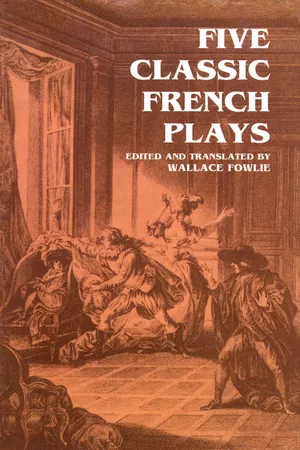
Five Classic French Plays
About this book
Dramas that both entertain and quicken the spirit, these classics are a blend of poetic beauty, intrigue, and rhetoric that have enthralled generations of theatergoers in France and around the world. Each of the authors is a playwright of international repute, whose works nevertheless embody a rigorously French style and tone.
From the pathos of Racine to the comic exuberance of Moliére, the landmark dramas span two centuries of French literary history and represent five different genres: the tragicomedy of Corneille's The Cid (1636)/ Racine's tragic Phaedra (1677); the high comedy of Moliére's The Intellectual Ladies (1672); Marivaux's romantic comedy, The Game of Love and Chance (1730); and the conspiratorial comedy of Beaumarchais' The Barber of Seville (1775).
Vivid translations by noted scholar Wallace Fowlie are remarkable for their faithfulness to the original text. In addition, Mr. Fowlie precedes each text with a brief historical-critical introduction that defines the importance of the play in the history of the French theater, the literary position of the playwright, and the general meaning of the play. Any student or lover of theater will welcome this treasury of masterpieces from the Golden Age of French drama, newly available in an attractive Dover edition at a reasonable price.
From the pathos of Racine to the comic exuberance of Moliére, the landmark dramas span two centuries of French literary history and represent five different genres: the tragicomedy of Corneille's The Cid (1636)/ Racine's tragic Phaedra (1677); the high comedy of Moliére's The Intellectual Ladies (1672); Marivaux's romantic comedy, The Game of Love and Chance (1730); and the conspiratorial comedy of Beaumarchais' The Barber of Seville (1775).
Vivid translations by noted scholar Wallace Fowlie are remarkable for their faithfulness to the original text. In addition, Mr. Fowlie precedes each text with a brief historical-critical introduction that defines the importance of the play in the history of the French theater, the literary position of the playwright, and the general meaning of the play. Any student or lover of theater will welcome this treasury of masterpieces from the Golden Age of French drama, newly available in an attractive Dover edition at a reasonable price.
Frequently asked questions
Yes, you can cancel anytime from the Subscription tab in your account settings on the Perlego website. Your subscription will stay active until the end of your current billing period. Learn how to cancel your subscription.
No, books cannot be downloaded as external files, such as PDFs, for use outside of Perlego. However, you can download books within the Perlego app for offline reading on mobile or tablet. Learn more here.
Perlego offers two plans: Essential and Complete
- Essential is ideal for learners and professionals who enjoy exploring a wide range of subjects. Access the Essential Library with 800,000+ trusted titles and best-sellers across business, personal growth, and the humanities. Includes unlimited reading time and Standard Read Aloud voice.
- Complete: Perfect for advanced learners and researchers needing full, unrestricted access. Unlock 1.4M+ books across hundreds of subjects, including academic and specialized titles. The Complete Plan also includes advanced features like Premium Read Aloud and Research Assistant.
We are an online textbook subscription service, where you can get access to an entire online library for less than the price of a single book per month. With over 1 million books across 1000+ topics, we’ve got you covered! Learn more here.
Look out for the read-aloud symbol on your next book to see if you can listen to it. The read-aloud tool reads text aloud for you, highlighting the text as it is being read. You can pause it, speed it up and slow it down. Learn more here.
Yes! You can use the Perlego app on both iOS or Android devices to read anytime, anywhere — even offline. Perfect for commutes or when you’re on the go.
Please note we cannot support devices running on iOS 13 and Android 7 or earlier. Learn more about using the app.
Yes, you can access Five Classic French Plays by Wallace Fowlie in PDF and/or ePUB format, as well as other popular books in Literature & Drama. We have over one million books available in our catalogue for you to explore.
Information
The Cid
(LE CID)
1636

A TRAGICOMEDY IN FIVE ACTS
BY
PIERRE CORNEILLE

translated by WALLACE FOWLIE
Pierre Corneille
(1606–1684)
In recent years there has been a renewed critical interest in the tragedies of Corneille, an appreciative re-evaluation of his dramatic art. And yet the general theatergoing public has never given his plays the support and the enthusiasm they have given to Racine and Molière. The strong moralizing accent of his work accounts to some degree for his position among the classical playwrights. His poetry is vigorous but tends toward the bombastic. His language seems today somewhat archaic and oratorical, but he was a master of the alexandrine verse. His poetic style has clarity and precision and a firm sense of rhythm. The poetry of his best tragedies, Le Cid, Horace, Cinna, Polyeucte, is a poetry of action, an intellectual language projecting the feelings and dilemmas of the characters.
Corneille’s biography is sober and uneventful. He was a Norman, born in Rouen, in 1606. There he was educated by the Jesuits, who gave him a solid training in Latin and the humanities and who introduced him to the theater in school productions. He was a sincerely pious man throughout his life and devoted to his large family. His last years were disturbed by disappointment at the public’s waning interest in his work, and by jealousy over the fame of his younger rival Racine.
The principle of the Cornelian form of tragedy is truth, resemblance to life, or, as it is sometimes called, verisimilitude. Although the three unities of Greek tragedy were not fully established in France when Corneille wrote Le Cid in 1636, he did subscribe to them. However, the unities of time, place, and action were not always easy for him to observe. Only in the work of Racine do they seem to be the natural laws of tragedy, observed in order to reach in the art a maximum verisimilitude.
The theater of Corneille ignores the trappings of melodrama which were used in the plays of his predecessors. He does have complications, but they are of a moral order. The moral problem in his play may be extraordinary, but it is always human and believable. He follows the precept of Aristotle in electing almost always an historical subject, and therefore one which, in large part, is true to fact. Le Cid, for example, had an immediate poetic source, but it had also a basis in history.
The type of human nature which Corneille depicts is highly intelligent and willful. Repeatedly he uses as protagonists clear-thinking, passionate individuals who are almost fanatical in their exaltation. His theory of love is close to that of Descartes. Love, to Corneille, is the desire for the good, and it is based upon knowledge of the good. One falls in love because of the perfection that is visible in the beloved. This formula applies to the love of Chimene and Rodrigue. Even in persecuting Rodrigue, Chimene believes she has the right and the duty to love him.
If esteem is the determining factor in love, as it seems to be in Corneille, then the lover acts, not because of love, but because of honor and duty, because of his gloire. The lovers are more worthy of love after making an effort of will which may threaten the very existence of love. Thus Rodrigue, in killing the father of Chimene, and Chimene, in demanding the death of Rodrigue, are examples of the supreme triumph of will. Cornelian heroism is always the exaltation of will which is looked upon as a free faculty of man. The very structure of the tragedy is based upon this freedom and power of will. The hero and the heroine, Rodrigue and Chimene, are equal in their strength of will. Their opposition to one another is evenly balanced, as if the play were a carefully calculated mathematical, as well as a moral, problem.
Every aspect of the play’s structure reiterates this psychology of will. It is in the form of the Cornelian dialogue, both the long eloquent speeches or tirades which are convincingly reasoned arguments, and the brief elliptical answers where arguments and ideas are reduced to maxims, and where the language ...
Table of contents
- Cover
- Contents
- The CID
- Phaedra
- The Intellectual Ladies
- The Game of Love and Chance
- The Barber of Seville
- Selected Bibliography