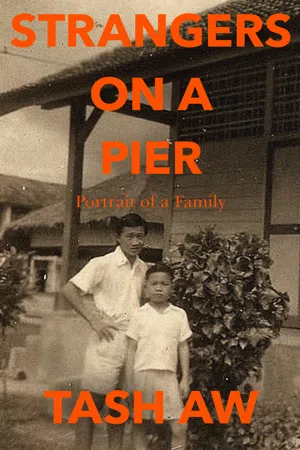
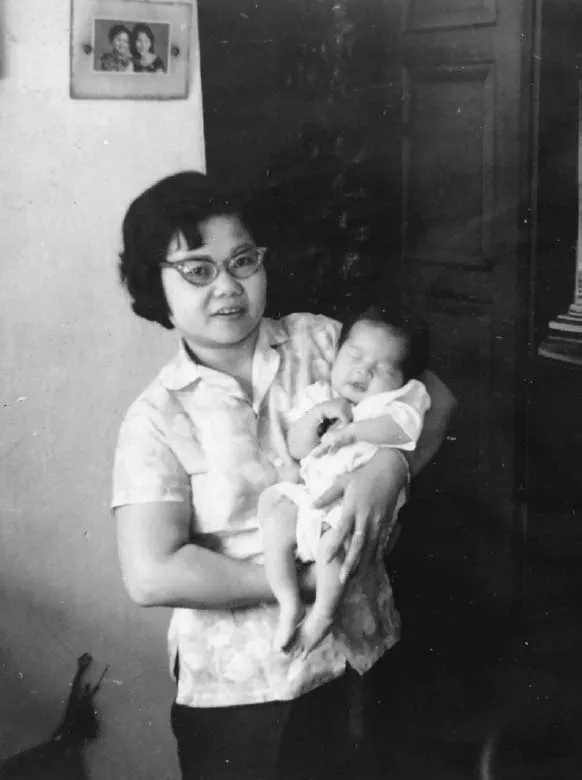
We thought we would find you dead, but instead you are sitting next to me, more alive than ever.
Two weeks prior to this, my parents and I had driven from Kuala Lumpur to see you, more than three hours through heavy traffic until we reached the small rural town where you have lived for nearly sixty years, and where I spent all my school holidays with you. You were very sick by then; the cancer had spread so extensively that no one was sure which part of your body was causing you the most pain. I spent half an hour with you, sitting by your bed while you slept. Your lips were cracked and you had lost so much weight that your cheeks had collapsed to the bone. You had never been a tall person but now, motionless in bed, you looked like a child. My mother spent only a few minutes with you. What’s the point, she said, your grandmother doesn’t even know we’re here. Much later, she would admit to me that she couldn’t bear the sight of you on the threshold of death. There was no air in the room; she found it hard to breathe.
Last night I was preparing to leave the country – a book tour and other work commitments that would keep me away for several months – when Uncle C rang, very late, to say you were slipping away. It wasn’t worth coming, he said; he just wanted to let us know. But we drove back anyway, to begin the funeral arrangements and spend a few days sorting through your affairs. There would be strange lightness in the mood of the house, the melancholy shot through with a sense of relief at your passing, just as we had experienced two decades earlier when Ah Gong had died, and you had said yourself, At least he’s not in pain anymore.
We pulled into the back lane that always smells of chicken shit, and I remembered the sensation of loneliness I always experienced as a child when I came to stay with you for the school holidays, away from my life in the city. I wish I could speak fondly of the nostalgia of returning to the family village, but it was never the case with me. Uncle C was waiting for us out in the lane, shielding his eyes against the midday sun. Something strange is happening, he said. We walked into the kitchen and saw you standing by the kettle, waiting for it to come to the boil. You had a towel around your neck, your hair, always curly and dyed black, was freshly washed and you’d put on a new blouse and a pair of dark trousers. You tried to lift the kettle but didn’t quite have the strength; the effort made your legs tremble. It was as if you hadn’t noticed that your body was failing you.
Uncle C whispered, It’s been weeks since she’s been able to stand up.
You looked up and saw us standing there. Come, come, you said, calling me by my childhood nickname, you must be thirsty, Granny make you some tea. You referred to yourself in the third person, just as you always had. It was as if we’d seen each other every week for the last three decades – as if there was no gulf between us.
You took me through to the sitting room and sat next to me on the plastic-covered sofa. Your eyes were bloodshot and tired but you were still eager for company. I could hear my parents talking in low, urgent tones with Uncle C in the next room, but I couldn’t make out what they were saying because I was concentrating on your voice.
It is this moment – both too short and somehow eternal – that comes back to me from time to time these days, when I am waiting for a bus or about to fall asleep. You are talking to me, your face beaming with the pleasure of being alive even though you know that you are dying. You are speaking with a freedom I have never seen in you, telling me things about my grandfather, about yourself, incidents which even my mother will not be familiar with. It’s because you’re so close to Granny, she will say later, but in fact it is the opposite. You’re telling me these things because we have grown apart, and sometimes it’s easier to be intimate with a stranger.
Alone with you, in what we both know will be our last conversation, it strikes me that the story of our relationship is the story of separation.
Our closeness is measured in the distance between us.
*
When I was at university in Britain, I found myself talking to a fellow student, a willowy blonde boy from an old, grand family, who was summarising his genealogy. Only one part of my family is aristocratic, he laughed, the other part is just nineteenth-century industrial money. I listened carefully as he patiently explained the hierarchy of dukes, marquesses, earls and so on. I was new to the country and fascinated by people’s interest in social backgrounds – fascinated, also, by the way the British were able to make this interest seem so casual that any curiosity about family circumstances felt almost incidental, ancillary to politeness.
It was lunchtime. Other students joined us, setting down their trays on the long refectory tables and slipping easily into the conversation about families and lineage while they ate a curious dish that I remember clearly, Chicken à la King (British eating habits, which seemed impossibly complex and exotic, were another of my early fascinations with the country: if dinner was sometimes tea, when was tea? Why was tea sometimes finger sandwiches, sometimes chips and egg? Was supper the same as dinner? It certainly wasn’t the same as the siew-ye we had back in Malaysia. I was also mystified by the question of education – why were private schools called public? – the terminology of toilets, plastic basins in kitchen sinks, and so on.)
I’m always really surprised, the blonde boy said, when people don’t know the maiden names of their four great-grandmothers. He was teased by the others for being ‘posh’, but they nonetheless rose to the challenge and managed to dredge up one or two of their great-grandmothers’ names, or at least a few salient facts of their lives – one the daughter of a Galician sailor caught in a storm and swept all the way to Wales; another a shepherdess in Cumbria; someone else a seamstress of lace, some pieces of which had been handed down all the way to her great-grandchildren. One great-grandmother had had an affair with a French count whose father had been the inspiration for a minor character in In Search of Lost Time.
I kept silent and laughed, as if it was all a joke, to hide the fact that I was thinking of you; to hide the awkwardness of having no knowledge of who your mother was. Her name had long since been scrubbed from our family’s collective memory – our country’s too. Of her face, nothing is remembered. The way she laughed, the things that made her happy or enraged, the people she loved, those who oppressed her: nothing has been retained.
It is the same story on the other side of our family, as it is with almost all the friends in Malaysia to whom I ask the question the blonde boy asked me. Who were your great-grandparents? Must have been labourers from Madras or Donno, farmers in Fujian province? is the most detailed answer I get.
Everything else is lost.
*
No one knows exactly what year you were born in, or where. All we know is that you were born in a remote village, a cluster of wooden houses, deep in the jungle. Some very ulu place is how my mother puts it. She deduces the inaccessibility and deprivation of your birthplace from the fact you once told her that when your father died – you were still a small child then – his body had to be transported to the nearest hospital by bullock cart. Dragged out of the jungle by a gu-chia.
My mother didn’t think to ask where this took place, and you didn’t elaborate. Already, you believed that your story was not important. To be born a girl in a poor family early in the twentieth century was to resign yourself to certain facts: you would not be sent to school, you would instead be put to work at the earliest age, you would wait to be married to the first suitable man who came for you, you would have children with him, your life would be less important than that of your family’s. Your past, and your present, would give way to their future.
How would you tell your story, anyway, even to those close to you? Once, my sister – still very small, in her early days of school – innocently asked you what your favourite subject was when you were at school. I was still a child too, but old enough to understand the embarrassment of the question. Without you ever having talked about your childhood, I knew that you had not been allowed to go to school; that your intelligence and humour disguised your complete lack of formal education; that the simple act of sitting in a classroom aged six or seven made us different from you.
I can’t ever recall you talking about yourself: whether you were happy or sad with a situation in the family or the village – all you discussed was the wellbeing of others. You asked about our homework, whether we were eating well, how our friends were. You wanted our young lives to take centre stage while yours was willingly relegated to the shadows.
One time I came into the shop that the family ran – a modest shop on half of the ground floor of this old shop-house that we’re sitting in now. It was one of those quiet times of the day, just after lunch when the afternoon heat was at its fiercest and there was no one in the street. I was going to take up my usual place near the front of the shop, where I looked after the counter selling soap and hairbrushes and shampoo, and the women who travelled in from the jungle villages would occasionally buy something cheap from me, a bar of Popinjay soap or a packet of hairpins, because they found it amusing to purchase something sold by a child from the city. That day you were alone in the shop, talking to a customer who wanted to buy some dishcloths. Her voice was raised. I couldn’t hear what she was saying, but her tone was aggressive, the rapidity of her speech suggesting the conversation was more than just about the price. The air was shot with the hissing of air valves from the tyre-repair shop next door. I heard the woman say the word Cina, the two syllables dragged long, a sudden, terrible slowing of the rhythm of the sentence, when that single word comes to mean more than just Chinese, and the very person you are becomes an insult.
You kept smiling, making calming noises, ya okay, okaaay, as you folded up the towels neatly and placed them back into the cabinet. I came and stood next to you and asked if you were alright. You smiled and said, I’m used to it, I learned to deal with lots of angry customers where I worked when I was young.
Where was that?
In a place in Ipoh.
I couldn’t think of a way to ask more questions about your work and what it had meant to you. The time didn’t seem right – has never felt right. The way you smiled made me feel more hurt than relief, and I couldn’t understand why.
*
By the end of my first year in Britain I felt I’d deciphered most of the basic codes of everyday life. I had learnt that when asked how I was, the correct response was not that I was homesick, or miserable because of the low skies and drizzle, and maybe battling depression, but that I was fine. That wasn’t difficult to work out, being the rough equivalent of the Asian way of greeting someone by asking them whether they had eaten lunch or dinner, the answer always being, yes, or just about to – an exchange that expressed concern without any real concern.
At university the students drank until last orders and explained to me how to consume entire pints of beer as pub closing time approached. Just open your gullet and pour it down. The next morning the men would be absent from lectures, emerging from their rooms only at lunchtime or even later in the afternoon with bloodshot eyes, but at the end of the year they would perform superbly in exams, announcing their results as casually as possible, as if they were at once accidental and inevitable. Um yeah, I got a first? What I discovered was that after leaving the pub, they dozed off the alcohol before working intensely in the quiet hours of the morning. I learned that the quality they prized was e...