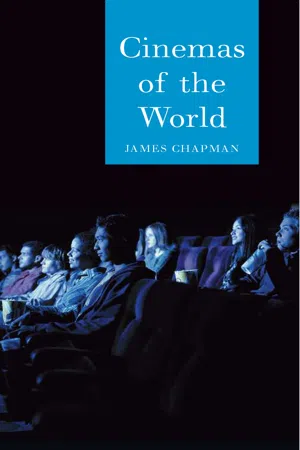
The cinema has been the pre-eminent popular art form of the twentieth century. In Cinemas of the World, James Chapman examines the relationship between film and society in the modern world: film as entertainment medium, film as a reflection of national cultures and preoccupations, film as an instrument of propaganda. He also explores two interrelated issues that have recurred throughout the history of cinema: the economic and cultural hegemony of Hollywood on the one hand, and, on the other, the attempts of film-makers elsewhere to establish indigenous national cinemas drawing on their own cultures and societies.
Chapman examines the rise to dominance of Hollywood cinema in the silent and early sound periods. He discusses the characteristic themes of American movies from the Depression to the end of the Cold War especially those found in the western and film noir – genres that are often used as vehicles for exploring issues central to us society and politics. He looks at national cinemas in various European countries in the period between the end of the First World War and the end of the Second, which all exhibit the formal and aesthetic properties of modernism. The emergence of the so-called ‘new cinemas’ of Europe and the wider world since 1960 are also explored.
- English
- ePUB (mobile friendly)
- Available on iOS & Android
eBook - ePub
About this book
Information
Subtopic
Film & VideoPART I: INTRODUCTION
ONE
Film History: Sources, Methods, Approaches
Film history is both like and unlike other types of history. It shares with political, social, economic, military and other forms of history the aim of exploring and, as far as is possible, explaining the past. The film historian is concerned with the historical development of the medium of film and the institution of cinema. To this end, the film historian employs empirically based research methods to establish what has happened, how and why it has happened, and what the consequences have been. Where the film historian differs from other historians is in the nature of the primary sources at his disposal. While the film historian still makes use of traditional types of primary source materials – including production records, scripts, trade journals, the diaries and memoirs of filmmakers, film reviews and surveys of cinema-going habits – his main sources are the films themselves. The film historian may be interested in films as records of the past (actuality and documentary films), films as cultural artefacts (the analysis of film style and aesthetics) or films as social documents (the idea that films reflect the values, attitudes and assumptions of the societies in which they were made). Their analysis, however, from whichever perspective, requires specialist methods and skills that are unique to film history.
A SHORT HISTORY OF FILM HISTORY
While the history of film dates back to the invention of the medium in the 1890s, the study of film history as an academic discipline is a much more recent development. The vast majority of scholarly books and articles that could be described as ‘film histories’ have been published during the last three decades. This is not to say there were no film histories or film historians before the 1970s. Several pioneering works of film history appeared during the 1920s, 1930s and 1940s. The early history of American cinema was the subject of Terry Ramsaye’s A Million and One Nights (1926), Benjamin Hampton’s History of the American Film Industry (1931) and Lewis Jacobs’s The Rise of the American Film (1939) – three books representing, respectively, the aesthetic, economic and social perspectives on film history that have now become standard approaches to the subject – while the best candidate for the first history of world cinema is the British filmmaker and critic Paul Rotha’s The Film Till Now (1930). Perhaps the most influential early work of film history, however, was the German sociologist Siegfried Kracauer’s From Caligari to Hitler (1947), in which he suggested that the cinema of Weimar Germany could be seen as a reflection of the social and psychological condition of the German people – a methodological approach that has been enormously influential on the work of later scholars. The existence of these pioneering works notwithstanding, however, the study of film history was not yet recognized within the academy and research into the history of the medium was the province mainly of cinephiles and film buffs such as Leslie Halliwell in Britain and William K. Everson in America.
It was during the 1960s that the study of film made its first inroads into the academy. In 1960 the British filmmaker Thorold Dickinson took up an appointment at the Slade School of Fine Art in London where he taught courses on film and in 1969 set up the Slade Film History Register as a central record of film material likely to be of interest to historians in the same way as the National Register of Archives had done for manuscript sources. In April 1968 a conference on ‘Film and the Historian’ was held at University College, London, under the auspices of the British Universities Film Council, providing a forum for historians such as A.J.P. Taylor, J.A.S. Grenville and Nicholas Pronay to discuss the value of filmic evidence to the historian. The outcome of the conference was the establishment of the University Historians’ Film Committee ‘with the aim of co-ordinating and promoting activities relating to the use of film (together with still photographs and sound recordings) for historical research and teaching’.1 A series of international conferences on similar themes in the late 1960s and early 1970s – at the universities of Göttingen, Koblenz, Utrecht, Delaware and the Imperial War Museum in London – along with the publication of Paul Smith’s edited volume The Historian and Film (1976) marked the emergence of the ‘film and history’ movement, culminating in the foundation of the International Association for Media and History in 1977.
The film and history movement was concerned initially with encouraging the use of archive film, especially newsreels and documentaries, for historical teaching and research. In Britain this cause was taken up in the 1970s by organizations such as the InterUniversity History Film Consortium and the Open University. At the same time, partly developing out of the film and history movement, but also gaining impetus from cultural history and sociology, scholars in Europe and North America were becoming interested in the study of the history of film in its own right. The development from ‘film and history’ to ‘film history’ can be traced through the publication of books such as Jeffrey Richards’s Visions of Yesterday (1973), Robert Sklar’s Movie-made America (1975), Richard Taylor’s Film Propaganda: Soviet Russia and Nazi Germany (1979), Pierre Sorlin’s The Film in History (1979), John O’Connor and Martin Jackson’s American History/American Film (1979) and K.R.M. Short’s Feature Films as History (1981), which collectively represented a shift of interest away from newsreel and documentary films towards feature films analysed as cultural artefacts and placed in their historical contexts. It was during the 1970s, too, that the first dedicated courses on ‘film history’ and ‘cinema and society’ appeared on the curricula of British and American universities. Initially there was much institutional resistance to this new development. ‘Only now is it being realized – and much more tardily in Britain than in the United States – that a study of cinema can reveal much about, for instance, popular attitudes and ideals,’ Jeffrey Richards complained in 1973. ‘Moribund, Oxbridge-oriented university panjandrums are still to be heard up and down the country chuntering that if Cinema Studies is adopted then the next step will be Football Studies (and why not?).’2
The resistance to film history arose largely from ingrained cultural attitudes towards the cinema which regarded a mere entertainment medium as not being a legitimate object of historical enquiry. It may also have been coloured by a misunderstanding of the difference between film history and film studies, which emerged in parallel with film history during the 1970s. While the two disciplines share common ground in terms of their subject matter, their approaches and methods are very different. Film studies grew principally out of English literature, and its agenda was dominated by similar concerns (questions of authorship, genre and narrative) and analytical methods (especially linguistic theories of semiotics and structuralism). Film studies has focused primarily on textual analysis and has been concerned with questions of aesthetics (form and style) and meaning (for which the application of psychoanalytical models derived from the theories of Freud and Lacan became especially voguish in the 1970s). Film history, in contrast, has been more concerned with contextual analysis, exploring the conditions and circumstances under which films have been made, considering their makers’ intentions, and, as far as possible, ascertaining how they have been received by both critics and cinema-goers. The institutionalization of the methodological and intellectual differences between the film studies school and the film history school is exemplified in the directions followed by the premier scholarly film journals. Since the early 1970s the pre-eminent film studies journal has been Screen, which has been at the vanguard of theoretical developments in the field (psychoanalysis in the 1970s, gender studies in the 1980s, reception theory in the 1990s), whereas the Historical Journal of Film, Radio and Television, founded in 1981, has been the leading forum for film historians seeking to place films within their social, political, industrial and cultural contexts.
It has taken several decades for film history to prove that, as a discipline, it has the same scholarly rigour and intellectual validity as other branches of history. Film history now, if still not universally accepted, is no longer regarded as the eccentric upstart that it once was, while the opprobrium of the Oxbridge panjandrums is reserved for more recent and trendy subjects like media and cultural studies.
THE NATURE AND EXTENT OF PRIMARY SOURCES
All history is determined, in the first instance, by the nature of the sources available to the historian. The crucial difference between film studies and film history is that whereas film studies opens up a wider range of possible interpretations (there are different ways of reading films that can elicit all sorts of meanings that may or may not have been intended by the makers and understood by contemporary audiences), film history is an empirical discipline that deals not in speculation but in research. The film historian sets out to assemble, assess and interpret the facts concerning the production and reception of films.
In common with all branches of history, the primary sources for film history are fragmentary and incomplete. For one thing, film is a highly perishable medium. Many films, especially from the early history of cinema, no longer exist. It has been estimated that barely a quarter of all films made during the silent period of cinema (up until the end of the 1920s) still survive. The historian of early cinema, indeed, might be compared to a medievalist in so far as he has to make generalizations based on the relatively small amount of source material that has survived, either by chance or by design, from the period. Little attention was given to film preservation until the 1930s when archives such as the National Film Library in London, the Cinémathèque Française in Paris and the Museum of Modern Art in New York began to collect prints of films for posterity. It was not only the perishability of the raw material that led to a large percentage of early films being lost, but also a failure to appreciate the necessity of film preservation. As Ernest Lindgren, curator of the National Film Library, observed in 1948: ‘The word “archive” rings with a deathly sound in the world of cinema, which is so young, vital and dynamic, eager for the future and impatient of the past.’3 Film companies, moreover, have generally regarded films as commodities first and foremost rather than as cultural artefacts and, until recently, have done little to ensure their preservation.
Even when films survive, furthermore, they are not always available to the researcher. Many films, especially those made in developing countries, do not circulate beyond their national boundaries. Films are sometimes withdrawn from public view by governments and regimes which disapprove of their political or social content. Even in liberal democracies such as Britain and the United States, foreign-language films are generally confined to a minority niche market and are often difficult to see. ‘Britain has one of the most restrictive exhibition systems in Europe’, the respected film critic Derek Malcolm complained recently, ‘and there’s little or no hope of seeing an enormous amount of world cinema, even on video or the internet.’4 Even where viewing prints and videos are available, furthermore, the historian constantly has to be alert to whether the film he sees today is the same film that audiences in the past would have seen, and how the interventions of censors and commercial distributors may have deleted scenes from the film. Sometimes, ‘lost’ scenes may be rediscovered. The much-vaunted restoration of Abel Gance’s epic Napoléon by archivist Kevin Brownlow, for example, calls into question the existence of a definitive version of the film.
Film history has also been determined, to a considerable extent, by the attitudes of contemporaries as to which films are deemed significant or important. ‘Out of two or three thousand full-length films produced in the world every year, there are perhaps only about fifteen whose titles are worth remembering, a half dozen that are worthy of mention in the future histories of cinema’, the influential French film critic André Bazin once remarked.5 While some films are celebrated and acclaimed, others disappear from view and become invisible to such an extent that they are virtually ‘written out’ of film history. It is astonishing how often the views of film critics have become received wisdoms that have permeated into film history. Canons exist in film history just as they do in English literature. One of the aims of what has been termed the ‘new film history’ since the 1980s has been to challenge critical orthodoxies and to reclaim films, genres and cycles, especially of popular cinema, that hitherto had been neglected or marginalized at the expense of more critically respectable art cinema.
The availability of the more traditional manuscript and printed source materials is also highly variable. One of the reasons why American cinema is the most heavily researched in the world is because it is also the best documented: the company papers of the major film studios have been deposited with university libraries, while the Academy of Motion Picture Arts and Sciences houses a large archive of filmmakers’ personal papers and collections from bodies such as the Production Code Administration. Other national cinemas have been less well documented – there is a paucity of sources for British cinema in comparison to Hollywood, for example – and in the developing world, especially, where the need for archiving has only recently been recognized and is in any event hampered by lack of proper resources, relatively little material is available. Some archives, notably in Eastern Europe, have only very recently been opened up to scholars; some still remain closed. The type of evidence available is also variable. While it is usually possible to piece together details of the production histories of films from working papers, scripts and trade journals, and while film reviews can provide insights into the critical reception of films, evidence regarding the popular reception of films and the social composition of cinema audiences is scarce.
THE DIFFERENT APPROACHES TO FILM HISTORY
As with other branches of history, film history is open to a variety of different approaches and interpretations. There is much more to film history than just the history of films. ‘The cinema’, writes David Robinson, ‘involves an aesthetic, a technology, an economy and an audience.’6 The history of cinema has been written from all those perspectives. In their didactic work Film History: Theory and Practice – one of the few serious attempts to engage with the historiography of film scholarship – Robert C. Allen and Douglas Gomery identify four approaches to film history, which they label aesthetic, technological, economic and social.7 Kristin Thompson and David Bordwell, in their Film History: An Introduction, add a fifth category – biographical – to those used by Allen and Gomery. ‘This sort of inventory’, they write, ‘helps us understand that there is not one history of film but several possible histories, each adopting a different perspective.’8
Biographical history is probably the most familiar to the general reader. Biographies of movie stars, film directors, producers and studio heads proliferate; the majority are either hagiographic, anecdotal accounts of their subject or scandalous exposés of a famous individual’s private life. Even in the more scholarly biographies, however, there is a tendency to reduce film history to the stories of ‘great men’. The ‘great man’ tradition in film history encompasses both inventors (such as Thomas Edison and the Lumière brothers) and filmmakers to whom important technological and artistic developments in the medium are attributed (the pre-eminent example being D.W. Griffith, often acclaimed as the ‘father of film’). The emphasis is very much on the role of individual agency, though it is of...
Table of contents
- Cover
- Title Page
- Dedication
- Copyright
- Contents
- Preface
- Part I - Introduction
- Part II - Silent Cinema
- Part III - Hollywood Cinema
- Part IV - European Cinemas
- Part V - World Cinemas
- Part VI - Conclusion
- References
- Select Bibliography
- List of Illustrations
- General Index
- Film Index
Trusted by 375,005 students
Access to over 1.5 million titles for a fair monthly price.
Study more efficiently using our study tools.
Frequently asked questions
Yes, you can cancel anytime from the Subscription tab in your account settings on the Perlego website. Your subscription will stay active until the end of your current billing period. Learn how to cancel your subscription
No, books cannot be downloaded as external files, such as PDFs, for use outside of Perlego. However, you can download books within the Perlego app for offline reading on mobile or tablet. Learn how to download books offline
Perlego offers two plans: Essential and Complete
- Essential is ideal for learners and professionals who enjoy exploring a wide range of subjects. Access the Essential Library with 800,000+ trusted titles and best-sellers across business, personal growth, and the humanities. Includes unlimited reading time and Standard Read Aloud voice.
- Complete: Perfect for advanced learners and researchers needing full, unrestricted access. Unlock 1.5M+ books across hundreds of subjects, including academic and specialized titles. The Complete Plan also includes advanced features like Premium Read Aloud and Research Assistant.
We are an online textbook subscription service, where you can get access to an entire online library for less than the price of a single book per month. With over 1.5 million books across 990+ topics, we’ve got you covered! Learn about our mission
Look out for the read-aloud symbol on your next book to see if you can listen to it. The read-aloud tool reads text aloud for you, highlighting the text as it is being read. You can pause it, speed it up and slow it down. Learn more about Read Aloud
Yes! You can use the Perlego app on both iOS and Android devices to read anytime, anywhere — even offline. Perfect for commutes or when you’re on the go.
Please note we cannot support devices running on iOS 13 and Android 7 or earlier. Learn more about using the app
Please note we cannot support devices running on iOS 13 and Android 7 or earlier. Learn more about using the app
Yes, you can access Cinemas of the World by James Chapman in PDF and/or ePUB format, as well as other popular books in Media & Performing Arts & Film & Video. We have over 1.5 million books available in our catalogue for you to explore.