Long before the devastating events of 11th September 2001 many countries had developed ways to deal with terrorists, but for the most part these groups were regarded as only domestic threats. The actions of the ‘Atta Group’ on 9/11, however, not only destroyed the World Trade Centre but also blew away forever these attitudes of complacency. The horror and enormity of the attacks on such iconic targets prompted an unprecedented response from across the globe.
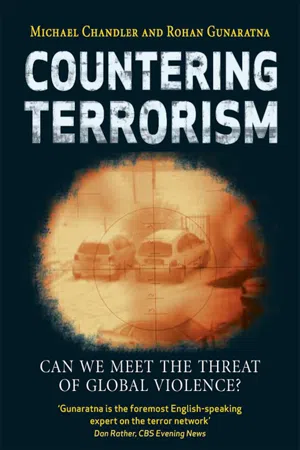
Countering Terrorism: Can We Meet the Treat of Global Violence? is a hard-hitting examination of responses to terrorism around the globe, looking not only at 9/11 but also the London and Madrid bombings, as well as terrorist activity in Iraq, Iran, Afghanistan, Pakistan, India, Palestine and elsewhere. The authors argue that despite the international community being presented with a prime opportunity to cooperate and collaborate against trans-national terrorism, the opportunity has been missed, long-term visionary policies have been held hostage to short-term political expediency, and what should have been a watershed has become a trickle in the sand.
The authors’ collective experience – dealing with a wide range of terrorist activity, security issues and conflict situations – spans over forty years, and includes first-hand exposure in the field. Together they bring their specialist knowledge to bear on one of the most critical issues of today, offering a clear-sighted way of understanding and dealing with global terrorism.
eBook - ePub
Countering Terrorism
Can We Meet the Threat of Global Violence?
- English
- ePUB (mobile friendly)
- Available on iOS & Android
eBook - ePub
About this book
Information
Subtopic
Política1
The Current and Future Terrorist Threat
Since 9/II there have been a number of very profound developments in the landscape of global terrorism. First, al-Qaida has transformed from a group into a movement. In addition to al-Qaida, some three dozen groups are willing and able to stage al-Qaida-style attacks. Western law enforcement and intelligence agencies are focusing on al-Qaida, but the threat has grown much larger. It is far more widespread. Second, the violent Islamists have declared Iraq the new ‘land of jihād’. The groups in Iraq have built robust support and operational cells in the Levant and beyond. Using Iraq as a launching pad, terrorist leaders have been planning and preparing attacks in countries outside and well beyond Iraq. Third, Muslims worldwide, including moderate Muslims, are angered by the US invasion of Iraq. They see no justification for it. Many Islamist groups are aggressively harnessing the resentment among the Muslims including those living in the migrant communities and diasporas of the West. These extremist groups are calling upon Muslims in North America, Europe and Australasia to provide recruits and other support. In particular, after the US invasion of Iraq, Islamist groups have found a significant amount of support to continue the fight against the USA, its allies and friends.
These three significant developments characterize the new threat environment in which we live. The emergence of Sunni Islamic extremism since the early 1980s has demonstrated a steady and sus-tained development. The actions of governments targeting the operational infrastructure of the Sunni extremist movement have not been very successful. The Sunni extremist movement gained a new impetus after 9/II. Its vanguard is al-Qaida, the child of the multinational campaign against the Soviet occupation of Afghanistan. But it also draws significant support, albeit of a somewhat covert nature, from the Muslim Brotherhood.
THE CONTEXT
Despite concerted action worldwide, al-Qaida, the most hunted group in history, has survived. Several years after 9/II the core leadership is still intact. Although many of the operational commanders have been apprehended or killed, many of the founders, the key ideological and spiritual leaders, are alive and at large. Furthermore, to survive the current and continuing threat to it from the international community, al-Qaida has evolved from a group into a movement. In order to remain relevant and to survive, the core group of al-Qaida led by Usama bin Laden, along with the associated groups and entities that comprise the movement or network, will further transform and mutate.
The threat of terrorism has grown far beyond the original al-Qaida. Nonetheless, close examination is necessary to understand the ideological and operational dimensions of the threat that has evolved. An examination of al-Qaida’s history reveals that the group has a remarkable ability to survive and evolve under pressure. This is the true strength of the adversary.
BACKGROUND
Historically, al-Qaida has undergone three distinct transformations:
Phase One: Following the Soviet withdrawal from Afghanistan in 1989, al-Qaida al-Sulbah (‘The Solid Base’) began as a group to support and assist local jihad movements and associated groups or to target directly opposing governments, mostly in Muslim countries. By providing finance, weapons and trainers the group played or attempted to play critical roles in what were then the lands of jihad: Algeria, Bosnia, Chechnya, Egypt, the disputed areas of Kashmir and Mindanao (southern Philippines), Tajikistan and Uzbekistan.
Phase Two: Al-Qaida developed its own capability to mount operations throughout the 1990s, due largely to close cooperation with Egyptian groups – Egyptian Islamic Jihad and the Islamic Group of Egypt-which culminated with the 11 September 2001 attacks against the USA. By recruiting Western-educated Islamists such as Khalid Sheikh Muhammad, al-Qaida was able to strike deep inside the West.
Phase Three: Due to security measures in Western countries taken immediately after the 2001 attacks, al-Qaida and its associated groups were no longer able to mount attacks, with the same ease, on Western soil. From September 2001 onwards al-Qaida, its associated groups and affiliated cells switched their attention to targets in countries where it was easier to operate. Attacks were staged in Indonesia, Kenya, Morocco, Pakistan, Tunisia and in Russia, including Caucasian states such as Chechnya and Ingushetia. Western facilities have been targeted in Saudi Arabia, Turkey and Iraq. In this latter phase, most of the attacks were not staged by al-Qaida per se but by entities associated with it. Since these associated groups lack the same level of expertise as the founding organization, the numbers of casualties and fatalities the entities have suffered have climbed – in some instances quite significantly. The loss of bases in which to train and rehearse in Afghanistan has forced al-Qaida to change from a hierarchical organization into a movement comprised of loosely affiliated groups and entities. In order to survive and continue the spread of its ideology and operational stance it has resorted to intensive networking.
THE CONTEMPORARY WAVE OF ISLAMISM
Against the backdrop of the global rise of Islamism and worldwide terrorism, 1 al-Qaida originated as a vicious by-product of the multinational, anti-Soviet campaign. Although it started out quite small, mostly as a group that supported the Arabs who went to fight the Soviets in Afghanistan, al-Qaida grew into prominence within a decade. The contemporary origins of the current Islamic movement date back to two landmark events, both of which occurred in 1979. First, the newly created Islamic Republic of Iran defied the USA, a superpower, by holding a group of Americans hostage for 444 days. Second, a number of Afghans, assisted by volunteers from across the Arab world, defeated the mighty Soviet army, which in 1979 had invaded a Muslim country. The successes of the Iranian revolution (1979) and the multinational campaign in Afghanistan from 1979 to 1989 against another superpower, the Union of Socialist Soviet Republics, instilled the belief among a significant segment of Muslim youth that they could take on the United States of America. They had defeated one superpower, so why not another?
A year before the Soviet army, the world’s largest army, withdrew in humiliation from Afghanistan, al-Qaida al-Sulbah was born. Its creator, Dr Abdullah Azzam, the principal ideologue of the anti-Soviet Afghan campaign, was a Jordanian-Palestinian religious cleric from Jenin in the West Bank. At its very formation in March 1988, al-Qaida was thought of as the vanguard of the Islamic movements. Azzam and his deputy and protégé, Usama bin Laden, wanted the group to play the lead role in conflict zones where Muslims were suffering.2
Al-Qaida arose out of the Afghan Service Bureau (Maktab-il-Khidamat), an organization established in 1984 by Azzam and bin Laden at the height of the campaign against the Soviet occupation of Afghanistan. From these roots, al-Qaida rank and file benefited directly from an earlier generation of organizational and operational expertise and experience. However, the true strength of al-Qaida is in an ideology of global jihad that appeals to a wide and disparate following in the Muslim world, including a number of Islamist parties and groups. To date, the ideology drawn from historical events, and tested under fire in Afghanistan, Bosnia, Chechnya and Iraq, continues to resonate in the Muslim world. These ‘battlegrounds’ continue as principal sources of inspiration to the Islamist rank and file directly engaged in the fight. These ‘battlegrounds’, and the Islamist rhetoric that promotes their existence, appeal to a wide support base that sustains their perceived global aspirations. In addition, the Iranian revolution, the anti-Soviet campaign, the subsequent rise of the Taliban and, more recently, events in Iraq have politicized and radicalized a few hundred thousand Muslims worldwide. The fallout from these campaigns continues to radicalize and mobilize Muslim territorial and migrant communities. Even today, after the total destruction of its training and operational infrastructure in Afghanistan, neither al-Qaida nor other Islamist groups has difficulty in recruitment or replenishment. They have no difficulty in replacing losses of personnel, due to death, injuries or arrests, or replenishing their logistic resources, whether weapons or finances. Al-Qaida and its associated entities have managed to build, in the utmost secrecy, a robust, diffuse and highly resilient organization. It has changed from that of a tightly knit organization with a hierarchical – even bureaucratic-management structure to a loose affiliation of like-minded groups. Bound together by the same ideology espoused by bin Laden and the éminence grise of al-Qaida, Dr Ayman al-Zawahiri, the world must now confront a network that is not constrained by national borders. The world is now faced with terrorisme sans frontières.
Some five years after 9/II, the ‘core al-Qaida’ (a group of 3–4, 000 members, as estimated in October 2001) is operationally weak. Western security and intelligence services believe that this core group, led by bin Laden, is no longer able to mount ‘9/II’ style attacks on Western soil. Nonetheless, several African, Middle Eastern and Central, South and Southeast Asian groups have adopted al-Qaida-style tactics and technologies. Although the strength of al-Qaida is now limited to a few hundred members, its ideology of global jihad is widespread, inspiring dozens of Islamist groups worldwide.
What has been al-Qaida’s single biggest contribution? Al-Qaida has been able to inspire and instigate Islamist groups worldwide to fight at two levels. First, groups have attacked the near or domestic enemy: their own governments. Second, the fight has been taken against the far or distant enemy: the US, its allies and its friends. While refusing to die, the most hunted terrorist group or movement in history continues to fuel a global uprising among extremist elements in the Muslim world. In the post-9/II strategic era, especially the period after the invasion of Iraq, many new groups have emerged. They are expanding the Islamist space and increasing the threat exponentially. Intent on reducing the terrorist threat, the international community forged and implemented a wide range of security and counter-terrorism measures after 9/II. They offer no permanent solution. Nonetheless, military action in Afghanistan dismantled the safe-haven and training infrastructure of the Islamist terrorists. Stepping up intelligence and law enforcement measures in target countries has reduced the immediate threat (1–2 years). The capabilities of the terrorists have suffered, but their overall intentions and commitment to their interpretation of jihad remain unchanged.
This was clearly demonstrated by the bombings of the morning commuter trains in Madrid on 11 March 2004 and eighteen months later the attacks in central London. After painstakingly identifying the post-9/l11 security architecture, the terrorists found gaps in its armour. They effectively exploited these loopholes and attacked iconic capitals in Western Europe. The terrorists mounted their attacks in countries that were fully supportive of, and participating in, the US-led coalition offensive in Iraq. However, it is important not to overlook the fact that Spain and the UK had both been active and effective supporters of the United Nations’ peacekeeping efforts in Bosnia in the early 1990s. Later, as key participants in the NATO-led implementation (I-FOR) and stabilization (S-FOR) forces, they had continued to provide significant troop contributions during Bosnia’s post-conflict stabilization period. Spain and the UK have also been major contributors to the process of reconstruction in ‘post-Taliban’ Afghanistan. Spain, in particular, has suffered significant casualties-seventeen Spanish soldiers dying as a result of a helicopter crash in August 2005 near Herat in north-western Afghanistan, and sixty-two killed two years earlier, when one of their trooping flights crashed in Turkey.
As a result of the intervention in Afghanistan by the US-led coalition, al-Qaida and its associates have been dispersed from their core base there and in Pakistan. They have spread into lawless zones around the world: Iraq, in particular its border areas with Iran and Syria; Somalia, a conflict of international neglect; Yemen, where only 35 per cent of the country is under government control; Kashmir, a conflict zone involving India; the Myanmar – Bangladesh border; the southern Philippines; and other areas in conflict. Al-Qaida is using bases in these areas to launch attacks against the US and/or its allies. The sustained efforts of those nations that take a more robust and pro-active stance on counter-terrorism has led to a substantial number of key al-Qaida ‘commanders’ being killed or captured. One of the most significant of these was Khalid Sheikh Muhammad (or KSM as he is often referred to ‘in the trade’), the head of the al-Qaida military committee, who was captured in Pakistan by the Inter-Services Intelligence on I March 2003. In his place, two leaders emerged. One of these, Faraj al-Libi (Libby), the coordinator of domestic operations, was arrested in Pakistan in May 2005. The other, Hamzah al-Rabiyyah, the coordinator for external operations, was killed in the Afghanistan/Pakistan border areas by Pakistan security forces in December 2005. Despite his death a new ‘operations chief’ will emerge. It is highly likely that he already existed, ready to take over, or has done so by now.
Over the years several commanders have emerged in South and Southeast Asia, the Arabian Gulf, North Africa, the Horn of Africa, the Levant, the Caucasus and other regions. Some of them have already been killed or captured. Others are alive and continue to organize or engage in attacks against their proclaimed enemies. For instance, Isamuddin Riduan, alias Hambali, was captured by the Thai Special Branch II in Central Thailand on II August 2003. Khalid Ali Abu Ali-Haj, alias Hazim al-Shɔir, a senior leader, was killed by Saudi security forces in Saudi Arabia on 15 March 2004. But Fazul Abdullah Muhammad, alias Haroon, the Chief of East Africa operations, remains at large. Just as infantry squares in the Napoleonic wars closed ranks, filling the gaps caused by shot, shell and musketry fire, so too does al-Qaida, rapidly replacing losses of its key commanders. Of greater importance was the emergence of Abu Musab al-Zarqawi as the de facto commander of operations of a network of groups in Iraq associated with the al-Qaida movement.
After 9/II, and more specifically the US-led invasion and subsequent occupation of Iraq, Ahmad Fadil Nazal al-Khalayleh, alias Abu Musab al-Zarqawi, a Jordanian from Zarka, imposed himself as a rising figure in the network. A particular milestone in his rise to international prominence was the gruesome beheading of Nick Berg. But he had the blood on his hands of many other hundreds of people in Iraq and beyond. In Iraq he appeared to take delight in the daily slaughter, not just of members of the coalition forces, but of Kurds, Shia and even Sunnis. Although his main base was in Iraq, the tentacles of the network he built extend deeply into the Middle East and well into Europe and North America. Given the extent of the networks he was able to assemble after 9/II, he was considered as the de facto operational chief for the al-Qaida movement until his death in Bakuba in June 2006. Despite his differences with Usama bin Laden over the targeting of Shia Muslims, al-Zarqawi managed to absorb numerous Islamist support networks or transform them into operational ones.
Al-Zarqawi, a veteran of the anti-Soviet multinational Afghan jihad, was unknown in the 1980s. He came to the attention, internationally, of intelligence and security services in the late 1990s after he started to work with al-Qaida. From 1992 to 1997, while in jail in Jordan, he was indoctrinated by Abu Muhammad Maqdisi. Although they did not meet, this process continued between al-Zarqawi and Abu Qatada, the religious leader of al-Tawhid, by communicating through Maqdisi. Between 1997 and 1999 al-Zarqawi planned to overthrow the regime in Jordan and conduct operations against Israel. Like some three dozen other Islamist groups, that of al-Zarqawi also received funds and support from al-Qaida to train Jordanians and Palestinians. Recruits from these two nationalities had not previously featured prominently in relation to al-Qaida.
Al-Zarqawi became an important operational leader within al-Tawhid, which had cells in a number of European countries, including Great Britain and Germany. Through these cells, links were established with Ansar al-Islam in Iraq and with several other groups in the region and beyond. For instance, a cell connected to al-Zarqawi, operating in the Pankisi valley in Georgia, provided training for both Chechens and North Africans with the intention of conducting chemical and biological attacks in Russia, France and the UK.3 As part of the preparation for attacks on targets in Europe and beyond, training and experiments in building chemical and biological weapons were also conducted in the Khurmal chemical plant and training camp. This was situated in the Halabja district of Suleimaniyeh province in Kurdish Iraq, an area controlled by Ansar al-Islam.4 In addition to Iraq, al-Zarqawi either absorbed or began to influence several other networks in Europe. As such, the Salafist jihad networks influenced and/or controlled by al-Zarqawi became one of the most serious terrorist...
Table of contents
- Cover
- Title Page
- Copyright
- Contents
- Introduction
- 1 - The Current and Future Terrorist Threat
- 2 - To Know and Understand One’s Enemy
- 3 - Iraq: A Strategic Defeat?
- 4 - Iran-The Open Flank
- 5 - Terrorism: An Enduring Threat
- 6 - The United Nations: Rising to the Challenge
- 7 - Afghanistan: The Taliban and the Threat Beyond
- 8 - Initial Reactions to 9/11
- 9 - Towards Tougher Sanctions
- 10 - Lifeblood of Terrorism
- 11 - Terrorism and Modern Communications
- 12 - The Reluctant Leadership
- 13 - Pathways Out of Violence
- References
- Acknowledgements
- Index
Trusted by 375,005 students
Access to over 1.5 million titles for a fair monthly price.
Study more efficiently using our study tools.
Frequently asked questions
Yes, you can cancel anytime from the Subscription tab in your account settings on the Perlego website. Your subscription will stay active until the end of your current billing period. Learn how to cancel your subscription
No, books cannot be downloaded as external files, such as PDFs, for use outside of Perlego. However, you can download books within the Perlego app for offline reading on mobile or tablet. Learn how to download books offline
Perlego offers two plans: Essential and Complete
- Essential is ideal for learners and professionals who enjoy exploring a wide range of subjects. Access the Essential Library with 800,000+ trusted titles and best-sellers across business, personal growth, and the humanities. Includes unlimited reading time and Standard Read Aloud voice.
- Complete: Perfect for advanced learners and researchers needing full, unrestricted access. Unlock 1.5M+ books across hundreds of subjects, including academic and specialized titles. The Complete Plan also includes advanced features like Premium Read Aloud and Research Assistant.
We are an online textbook subscription service, where you can get access to an entire online library for less than the price of a single book per month. With over 1.5 million books across 990+ topics, we’ve got you covered! Learn about our mission
Look out for the read-aloud symbol on your next book to see if you can listen to it. The read-aloud tool reads text aloud for you, highlighting the text as it is being read. You can pause it, speed it up and slow it down. Learn more about Read Aloud
Yes! You can use the Perlego app on both iOS and Android devices to read anytime, anywhere — even offline. Perfect for commutes or when you’re on the go.
Please note we cannot support devices running on iOS 13 and Android 7 or earlier. Learn more about using the app
Please note we cannot support devices running on iOS 13 and Android 7 or earlier. Learn more about using the app
Yes, you can access Countering Terrorism by Michael Chandler,Rohan Gunaratna in PDF and/or ePUB format, as well as other popular books in Política y relaciones internacionales & Política. We have over 1.5 million books available in our catalogue for you to explore.