- English
- ePUB (mobile friendly)
- Available on iOS & Android
eBook - ePub
About this book
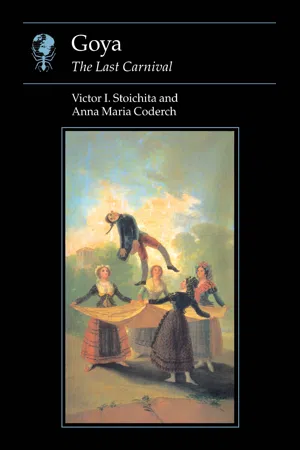
This intriguing book on Goya concentrates on the closing years of the eighteenth century as a neglected milestone in his life. Goya waited until 1799 to publish his celebrated series of drawings, the Caprichos, which offered a personal vision of the 'world turned upside down'. Victor I. Stoichita and Anna Maria Coderch consider how themes of Revolution and Carnival (both seen as inversions of the established order) were obsessions in Spanish culture in this period, and make provocative connections between the close of the 1700s and the approaching end of the Millennium. Particular emphasis is placed on the artist's links to the underground tradition of the grotesque, the ugly and the violent. Goya's drawings, considered as a personal and secret laboratory, are foregrounded in a study that also reinterprets his paintings and engravings in the cultural context of his time.
Information
Topic
ArtSubtopic
Art General1 The Turn of the Century as a Symbolic Form
A CARNIVAL THAT NEVER TOOK PLACE
‘A feeling of melancholy reigned deep within their souls as they entered the city of Rome.’1 So ends book VIII of Corinne ou l’Italie by Madame de Staël (1807). It is necessary to read the beginning of book IX in order to understand how a powerful antithesis is created, without any breaking off:
It was the day of the noisiest festival of the year, the end of the carnival, when, like a fever of joy, like a lusting after entertainment, it takes hold of the people of Rome in a manner that does not exist anywhere else. The whole city is in disguise, at the windows there is barely a spectator left without a mask to watch those who wear them, and this merriment begins on a particular day and at a given moment; and no public or private event in the year would normally prevent anyone from enjoying himself at this time. (. . .) During the carnival, class, manners and minds are all mixed up; and the crowd and the shouts, and the repartee and sugared almonds that indiscriminately flood the passing carriages, mix all mortal beings together, creating a jumbled-up nation, as though there were no longer any social order. Corinne and Lord Nelvil, both dreamers and thinkers, arrived in the middle of the hullabaloo. At first they were stunned by it, for there is nothing more strange than this bustle of noisy pleasures, when the soul completely withdraws into itself. They stopped off at the Piazza del Popolo, went up into the amphitheatre, next to the obelisk, from where they could see the horserace.2
The detailed description that ensues, and to which we shall return, is the most important outcome of the fundamental split described in Madame de Staël’s novel. There is on the one hand, those who observe (Corinne, Nelvil) and, on the other, the objects of their observations (the race, the festival). As a result, the Carnival, which should in principle have erased all boundaries between spectators and actors (‘at the windows there is barely a spectator left without a mask to watch those who have them’) has lost something of its all-encompassing power and therefore, implicitly, something of its innermost being. Hence the festival is turned into something it was not: a show. This fatal transformation signals the death of the Carnival and had been anticipated by Goethe in Das Römische Carneval (1788/9): ‘When one ventures to describe the Roman carnival, one must expect to be reproached and told that such a festival cannot in fact be described.’3 Despite this instinctive reproach, Goethe proceeded to write his famous and important description. Madame de Staël followed suit. By describing what cannot (or must not) be described but only experienced, the Carnival, through the observer’s perfect magnifying glass, reveals what is at stake and the poet becomes hermeneutic.
Despite their similarities, Goethe’s and Madame de Staël’s texts describe two different ways of approaching the Carnival at the time of its transformation. To Goethe (whose description of the 1788 Roman festival was published in the spring of 1789), the Carnival was a symbolic Revolution:
If we are to be allowed to continue to speak more seriously than the subject warrants, we would observe that (. . .) liberty and equality can only be sampled in the vertigo of madness, and that the greatest of pleasures can only seduce at the highest point when it courts danger and when it delights in its proximity to voluptuous sensations that are both disturbing and sweet.4
As for Madame de Staël, the situation was more complicated though no less significant. She wrote her novel (set in 1795) at the beginning of the nineteenth century, in 1805. By describing what her heroes would have seen from the top of the stands erected in the Piazza del Popolo, the writer consciously or unconsciously employed poetic licence: we know for sure that there was no Carnival in Rome in 1795. For reasons that Goethe had intuited so efficiently, the Roman Carnival had been banned immediately after the French Revolution.5 When (in 1805) permission was granted for it to resume, it was no longer the same, as the author of Corinne implied: ‘. . . a kind of universal petulance made it more like the bacchanals of the imagination, but only of the imagination.’6 While it could even be said that for Goethe, in 1788, the Carnival heralded the Revolution, for Madame de Staël, in 1805, it was no more than a memory or, at the very most, a dream of the Ancien Régime:
. . . night is falling; slowly the noise diminishes, it is followed by the most profound of silences; all that is left of the evening is confused mental images which, by turning the life of each into a dream, for a brief moment, let the people forget their work, the scholars their studies, great lords their idleness.
Multiple rites of passage7 take place in this imaginary projection of the festival. The first involves the very essence of the Carnival. This, by definition, is a festival that celebrates the periodic rebirth of time.8 It unleashes energies, reverses hierarchies, mixes individuals together to create a dynamic mass. It affects time, by turning itself into an intermediary time, a kind of between-the-two. The second rite of passage, implicit in Madame de Staël’s nostalgic description, is born of the event that had put the festival on hold, an actual historical inversion that recognized its symbolic (and imaginary) double in the carnivalesque festival: the Revolution. We can add a third rite of passage: that of the end of one century and the beginning of another. This one shifts the closing ceremonies to the apparently abstract plane of the calendar. It brings about and introduces a reflection on transitional time, time which reverses so that it can begin again in the dialectic that founded this same calendar (the Christian one) that hangs in the balance between the ‘first century’ (and first year) of a new era (first century and first year of the Incarnation) and, according to the same belief system, the fast-approaching horizon of Judgement Day. In short, the Revolution squeezed itself in between the last actual Carnival described by Goethe and the first imaginary Carnival described by Madame de Staël. The turn of the century squeezed itself in between the imaginary time of the story entitled Corinne (1795) and the actual time it was written (1805). The ramifications of this double overlap are such that her text can be considered to have the richness of an allegory. Let us therefore use it as the point of departure for a search that is likely to go much further. For, in effect, throughout the eighteenth century, carnivalesque rebirth, revolutionary inversion and a gap in the calendar would appear to have been the different ways of acting upon and reflecting on time, and where they meet up is where we can place the birth of the modern world.
A TIME FOR JOY/A TIME FOR FEAR
The easiest way to define the Carnival is to say that it is a period that begins with the Epiphany (6 January) and ends at the beginning of Lent (Ash Wednesday). This last day signals the renunciation of the flesh, or to be more precise, the consumption of flesh is forbidden (carne levare) during the 46 days that lead up to Easter.9 But it is when it reaches its climax that the Carnival becomes truly itself. This takes place in the final days of the cycle, between Quinquagesima Sunday and Shrove Tuesday, when, traditionally, all manner of excess is permitted in the name of the period of abstinence due to begin the following day. Carnival and Lent vie with one another during February, but the actual dates vary from year to year. These – like Easter – are calculated on the lunar cycle, Easter falling on the first Sunday after the first full moon of spring. At the other end of this period of fasting, Shrove Tuesday is therefore the day when the last moon of winter wanes, while the night that precedes Ash Wednesday is marked by the moon’s temporary absence.10
The archaic, indeed ancestral nature of this kind of calculation has been repeatedly emphasized by ethnologists. At times they have drawn attention to parallels with other similar festivals which, in the pagan world or in ‘primitive’ societies, also celebrated this pivotal time,11 at other times they have preferred to stress the event’s Christian characteristics, inasmuch as carnivalesque debauchery can only be properly understood in relation to the asceticism of Lent.12
It is neither our intention nor within our powers to review the details of this debate. However, we do feel that it is necessary to provide a brief résumé of how the Carnival functions within the framework of Western culture with a view to furthering an understanding of its final evolution and crisis.
To begin, we can summarize the main characteristics of the Carnival as licence, excess, inversion, dressing-up and joy. We are conscious as we pause to examine these terms that they are limited and arbitrary in nature. At this point, two criticisms could be levelled at us. The first is that we could have added other characteristics; the second stems from the fact that licence/excess/inversion/dressing-up/joy are notions which have a complementary relationship because they either cut across or partially overlap with each another.
To be more precise, only the last term stands out from the others, inasmuch as it is a consequence of them. The latter, through their reciprocal, complementary relationship and through their common relationship to the joy they bring, reveal the possibility of an all-encompassing term. The joy brought by licence, excess, inversion and dressing-up is a reaction to the mise-en-scène of otherness. Hence the Carnival could be defined as the festival of joyful otherness. It celebrates the period when the universe drifts as a result of order collapsing. Its opposite – disorder – triumphs, and the cosmos itself is vanquished by chaos. The Carnival is joy in the face of triumphant difference (joy in the face of disorder and chaos, seen as the reverse of order and the cosmos). A consideration of these issues brought us into contact with an anthropological discourse that, some several decades ago, through a study of ‘primitive’ cultures, drew attention to the existence of destructuring ceremonies and proposed that the carnival be considered in the light of the concept of ‘anti-structure’.13
The notion we are advancing, that of the festival of otherness, has, we believe, the advantage of leaving intact the paradoxical coherence of the Carnival founded on structuring opposites rather than destructuring ones. The terms that define Carnival (licence, excess, inversion, dressing-up) vindicate joy not as an attitude in the face of necessity, nothingness or the abyss (in the face of the abyss, not joy but only anguish is possible), but as a positive perception of otherness. Carnivalesque disorder is relative, not absolute, and it is no coincidence that it was in fact structuralist-based philosophy (mainly Bakhtin’s) that best defined it. A particularly crucial aspect should be emphasized, however; it was when the Carnival was in crisis that joy in the face of relative chaos came under threat and at times – as we shall see – even changed into anguish when faced with absolute chaos.14
Let us examine in greater depth the descriptive terms we have suggested, taking their intrinsic complementarity into account. The first of them, licence, gives carnivalesque time its characteristic of opposition to normal time. Permissiveness is a temporary ‘law’, however. The saying ‘Anything goes’ is only applicable to ‘meat days’ (Sunday, Monday, Tuesday before Ash Wednesday); hence the desire to take advantage of them as much as possible and the frenzy to be as licentious as possible to the bitter end. Excess (of food, sexual appetites, liberty, joy) is born of the latent fear of the imminent approach of the permissive period’s end.
Licence and excess are a direct response to the prohibitions during the Days of Abstinence (it is the imminent threat of Lent that automatically justifies the Carnival) and an indirect response to all the rules that govern normal time, ‘normal’ time being time structured and regulated in accordance with the rhythm and necessities of every...
Table of contents
- Front Cover
- Title Page
- Copyright
- Contents
- Preface and Acknowledgements
- 1 The Turn of the Century as a Symbolic Form
- 2 The Carnival Is Dead, Long Live the Carnival!
- 3 Vertigo
- 4 Clinic of Pure Reason
- 5 Goya’s Pharmacy
- 6 The Carnival of Language
- 7 Royal Games
- 8 Ha-ha, Ho-ho, Hu-hu, He-he!
- Appendix: Publicity Notice from the Diario de Madrid, 6 February 1799
- References
- List of Illustrations
Trusted by 375,005 students
Access to over 1.5 million titles for a fair monthly price.
Study more efficiently using our study tools.
Frequently asked questions
Yes, you can cancel anytime from the Subscription tab in your account settings on the Perlego website. Your subscription will stay active until the end of your current billing period. Learn how to cancel your subscription
No, books cannot be downloaded as external files, such as PDFs, for use outside of Perlego. However, you can download books within the Perlego app for offline reading on mobile or tablet. Learn how to download books offline
Perlego offers two plans: Essential and Complete
- Essential is ideal for learners and professionals who enjoy exploring a wide range of subjects. Access the Essential Library with 800,000+ trusted titles and best-sellers across business, personal growth, and the humanities. Includes unlimited reading time and Standard Read Aloud voice.
- Complete: Perfect for advanced learners and researchers needing full, unrestricted access. Unlock 1.5M+ books across hundreds of subjects, including academic and specialized titles. The Complete Plan also includes advanced features like Premium Read Aloud and Research Assistant.
We are an online textbook subscription service, where you can get access to an entire online library for less than the price of a single book per month. With over 1.5 million books across 990+ topics, we’ve got you covered! Learn about our mission
Look out for the read-aloud symbol on your next book to see if you can listen to it. The read-aloud tool reads text aloud for you, highlighting the text as it is being read. You can pause it, speed it up and slow it down. Learn more about Read Aloud
Yes! You can use the Perlego app on both iOS and Android devices to read anytime, anywhere — even offline. Perfect for commutes or when you’re on the go.
Please note we cannot support devices running on iOS 13 and Android 7 or earlier. Learn more about using the app
Please note we cannot support devices running on iOS 13 and Android 7 or earlier. Learn more about using the app
Yes, you can access Goya by Victor I. Stoichita,Stoichita, Victor I. in PDF and/or ePUB format, as well as other popular books in Art & Art General. We have over 1.5 million books available in our catalogue for you to explore.