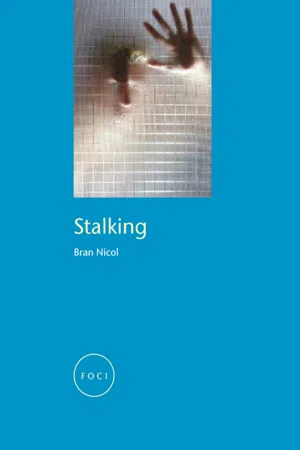
Stalking is very real and very pervasive. In recent years more and more people have been harassed by strangers or persecuted by ex-lovers. Almost any celebrity you care to mention has been stalked. Numerous films and novels revolve around the figure of the stalker. But, though seemingly everywhere, it is only since the 1990s that the term ‘stalking’ has begun to be widely used.
This unprecedented study reveals the cultural dimension of this obsessive behaviour and examines stalking in the context of contemporary media-saturated culture. Moving from novels of previous historical periods such as Richardson’s Clarissa and Dickens’s Our Mutual Friend, to classic Hollywood cinema such as Play Misty For Me and Taxi Driver, to more recent stalking films and novels, Fatal Attraction, One Hour Photo and Enduring Love, Nicol skilfully shows how stalking has pervaded human society for over two hundred years. He also considers famous cases of celebrity stalking such as Jodie Foster, John Lennon, Monica Seles and Jill Dando and related issues such as the internet and TV shows.
By examining the depiction of stalking in books, films and the news, and drawing on forensic psychology, psychoanalysis and cultural theory, this book reveals how fears and desires are expressed in contemporary culture. Stalking offers a unique analysis and history for anyone who wants to make sense of this contemporary phenomenon.
eBook - ePub
Stalking
About this book
Information
CHAPTER ONE
What is Stalking?
Stalker: [3.] b. A person who pursues another, esp. as part of an investigation or with criminal intent; spec. one who follows or harasses someone (often a public figure) with whom he or she has become obsessed. Oxford English Dictionary
Stalking, in the sense of systematic harassment, was formally defined only recently. The above entry appeared in the Oxford English Dictionary in 1997, following media interest in the phenomenon over the previous decade. Stalking is defined by forensic psychologists, those who have done most research into the phenomenon, as ‘a constellation of behaviours in which one individual inflicts on another repeated unwanted intrusions and communications’.1 More precise definitions are difficult to produce because stalking doesn’t come down to a single act. It involves a multitude of acts – not all of which are illegal in themselves (an obscene phone call is, sending an e-mail or standing outside a house is not). Nevertheless, as the authors of a recent study say, ‘As far as the general public is concerned, it may be that stalking is like great art: they cannot define it, but they know it when they see it’.2
For stalking is a term that has come to feature more and more in everyday use. It is a byword for acting ‘weird’, for showing an unhealthy fascination with someone or something, an alternative for ‘freaky’ or ‘creepy’. It is often used as an insult. We use it ironically if we keep bumping into someone: ‘I’m not stalking you!’ But it is also quite common now to find the word used in a more positive sense on the internet, in chat rooms or on ‘blogs’, in the context of being a fan – when someone discovers the work of a novelist or musician and decides to ‘stalk’ the rest of his work, for example. Common to all these definitions is a sense that to stalk is to act obsessively, in excess of what would be considered ‘proper’ or ‘normal’ behaviour.
Of course the term stalking is not a 1990s neologism. The roots of the term ‘to stalk’ come from the frequentative form of the Old English word ‘-stealcian’, as in bestealcian ‘to steal along’. Just as ‘to talk’ is ‘to tell frequently’, so to stalk is repeatedly to ‘steal along’. The way the term is used now to denote ‘harassment’ is therefore a metaphor: we imagine one person persecuting another in the way a hunter patiently but purposefully tracks an animal he is going to kill and use for food or clothing.
For centuries the term was applied almost exclusively to the stealthy tracking movement of animals, especially predatory ones such as big cats, or the hunting of them by other animals or humans. This sense still exists – as a glance at the other sections of the stalking definition in the OED will confirm. You can still go on ‘deer stalking’ holidays in Scotland, or buy from the ‘Stalker’ range of hunting-style clothing by the US company L. L. Bean. Interestingly, though, the term’s associations with hunting carried connotations of criminality or terror from the outset.
A stalker was defined in 1424 as ‘one who stalks game illegally, a poacher’ and in 1508 as ‘one who prowls about for purposes of theft’. Stalking was often a term applied to ghosts, as in Shakespeare’s Hamlet (Act 1, Scene 1) or the first line of Karl Marx’s The Communist Manifesto (‘A spectre is stalking Europe…’). Gradually, throughout the Nineteenth and Twentieth Centuries uses of the term ‘to stalk’ began to encompass the hunting of one human being by another. In William Thackeray’s 1855 novel The Newcomes: Memoirs of a Most Respectable Family, for example, there is the line ‘As he was pursuing the deer, she stalked his lordship’. Arthur Ransome’s 1947 ‘Swallows and Amazons’ adventure story for children, Great Northern?, contains the exchange: ‘“We must just go on, pretending we don’t know we’re being stalked …” “And then the stalker will get a bit careless and let himself be seen,” said Roger.’3
The old and new senses of the word – hunting animals and harassing other people – are not divorced, then. Hunting has always been associated with a particular image of masculinity. One of the chapters in Baden Powell’s famous manual for the Scouting Movement, Scouting for Boys, published in 1908, is on ‘Stalking’, teaching boys how to track animals. The instructions reflect an image of the hunter as lone killer, a disciplined and silent assassin. In fact, the stalkers we read about nowadays are malicious hunters, their victims prey, though they are far from the glorified image evoked in books like Scouting for Boys. The connotation is frequently invoked in the discourse surrounding serial killers. In Thomas Harris’s novel The Silence of the Lambs, for example, the serial killer at large has been given the name ‘Buffalo Bill’ by the tabloids because he skins his victims. He perceives of his grisly practice in hunting terms (e.g. ‘he didn’t want to field-dress her here’4).
But unlike hunting, stalking as we understand it now is not limited to one particular location or time-frame, nor one method of pursuit. Stalking involves repeated, persistent, unsolicited communications or physical approaches to the victim. It can involve letters, telephone calls, text messages, e-mails and other signs that the stalker has visited (like damage to a victim’s car). A stalker may literally follow the victim, or keep watch on his or her house. Stalking also encompasses more indirect forms of persecution such as ordering products or sending unsolicited mail on the victim’s behalf or instigating spurious legal actions. The result of such behaviour is to induce in the victim a state of alarm and distress or fear of physical violence. These fears are reasonable, for stalking very often results in violence to a person or their property.
It was in the 1970s that the term stalking began to shift more decisively from referring to the hunting of animals to the persecution of human beings. This decade sees the term used in American newspapers in relation to two forms of ‘hunting’: first, the pursuit of celebrities, initially by photographers and then by deranged men, and second, serial killing.
In the early 1960s a new kind of photo-journalist had been identified: the paparazzo (the name derived from a character in Federico Fellini’s 1960 portrayal of the emptiness of celebrity culture, La Dolce Vita) whose job is to pursue celebrities and get shots of them engaged in private and public business. The paparazzi were first defined in a Time magazine article of 14 April 1961, which described them as ‘a ravenous wolf pack of freelance photographers who stalk big names for a living and fire with flash guns at point-blank range’.5 The article portrays celebrity pursuit as an activity far removed from idolization. It depicts the photographers as menacing harassers who are openly hostile about their subjects, hell bent on catching them in ‘trouble’ or provoking them into causing it themselves. The language is the language of hunting: celebrities are the prey, divided into ‘big’ or ‘small’ game.
Tales of paparazzi excess are now legion in celebrity culture. The Time article gives the example of one ‘paparazzo’, Tazio Secchiaroli, who, having been ‘called a dirty name’ by the movie star Ava Gardner, ‘vengefully hid for hours in a cardboard box on a Cinecitta movie lot, [then] finally got what he came for: an unflattering shot of Ava in an old bath towel, hair wet and stringy as a mop’.6 Perhaps the most disturbing example of the paparazzo-as-stalker is Ted Leyson’s relentless pursuit of the famously reclusive Greta Garbo. The series of photographs Leyson took on her 84th birthday in 1989 are truly disturbing, for what is on display is not so much a trophy celebrity, but an act of violent intrusion into the life of an old woman who had withdrawn from the public eye 48 years before, fear in her eyes as she is cornered in her limousine. A week after they were taken Garbo died.
Photo-journalism naturally absorbs the traditional hunting connotations of the term stalking. The stalking capacity of the reporter is fuelled by the inherent intrusive potential of the camera. The camera ‘shoots’, it takes (i.e. steals) pictures. In an essay on photography which first appeared in The New York Review of Books in the mid 1970s, Susan Sontag describes the touring photographer as ‘an armed version of the solitary walker reconnoitering, stalking, cruising the urban inferno, the voyeuristic stroller who discovers the city as a landscape of voluptuous extremes’.7 By the late 1970s, the verb stalking was commonly used for such work. A Newsweek article of 12 September 1977 describes a photographer, Ron Galella, as having ‘made a career of stalking [Jackie Kennedy] with a camera until she went to court to keep him at a distance’.8
It would be a mistake to overstate the links between photography and serial murder, but there is a similar general logic at work in both, which revolves around the ‘capturing’ of a targeted individual (often for the image they represent) and involves a similar dynamic of power and control. Serial killers are not stalkers per se, as stalking involves someone known in some way to the stalker, while serial-killing was, significantly, previously known as ‘stranger-killing’. But serial killers typically stalk their victims in some way before attacking them. In his 6-point breakdown of the different stages of serial killing, Joel Norris terms number 3 ‘The Trolling Phase’, when the killer searches for a victim (‘trolling’ is a kind of sauntering or cruising).9
The media took to referring to the ‘Son of Sam’, the gunman who terrorized New York in the summer of 1977, as a ‘stalker’: he was described as having ‘stalked his prey’, having a ‘favorite stalking ground’, and indulging in ‘night-stalking’.10 Subseqently stalking was a label frequently used in newspaper reports of serial-killings and rapes, and also in reviews of slasher movies like Halloween (1978) or horror films like The Shining (1980). Another serial killer, Richard Ramirez, who murdered 12 people in a period from June 1984 to August 1985, was dubbed the ‘Night Stalker’ by Los Angeles media.
The use of the term stalking and its variants in these two spheres paved the way for the proper entry into the language of the term stalking in its contemporary sense in the late 1980s and early 1990s. At this time it was applied to a kind of composite version of the two modern hunters we have just been considering, the hostile paparazzo and the psychopathological serial murderer – specifically, a man person (usually a man) who becomes obsessed by a celebrity and ends up attacking him or her.
If we had to pinpoint one moment when modern ‘stalking culture’ began, it would be the murder of the TV actress Rebecca Schaeffer by one Robert John Bardo in 1989. Bardo was an intense, intelligent young man (though a teacher once described him as ‘a time bomb on the verge of exploding’). Schaeffer wrote back to him, saying his letter was ‘the most beautiful’ she had ever received. She finished with a sketch of a peace sign and a love heart, and signed it ‘with love from Rebecca’. On receiving it Bardo wrote in his diary: ‘When I think of her, I would like to become famous to impress her’. He had over 100 videotapes featuring the actress. He later explained that she ‘came into my life in the right moment. She was brilliant, pretty, outrageous, her innocence impressed me. She turned into a goddess for me, an idol. Since then, I turned an atheist, I only adored her.’11
In 1987 he twice attempted to enter Burbank studios, where she was filming the TV show My Sister Sam, the second time with a knife concealed in his jacket. After being refused entry he wrote in his diary: ‘I don’t lose. Period.’ Then he saw her film Class Struggle in Beverly Hills, in which Schaeffer’s character was shown in bed with an actor. Bardo was appalled. This proved, he thought, that Schaeffer had become ‘one more of the bitches of Hollywood’ and ought to be punished for her loose morals. He sketched a diagram of her body, marking the points where he planned to shoot her, and asked his brother to buy him a gun.
He then found Schaeffer’s address through the Division of Motor Vehicles, and travelled to LA with the gun and a copy of J. D. Salinger’s novel The Catcher in the Rye. On 17 July 1989, he knocked on her door and introduced himself as her biggest fan. She thanked him before politely dismissing him. He went to have breakfast. He returned an hour later and shot her, point blank, on the doorstep.
Bardo was by no means the first man to stalk and attack a celebrity. Schaeffer’s murder followed on from other high-profile stalking cases involving public figures: Mark Chapman’s murder of John Lennon in December 1980, John Hinckley’s attempt to assassinate President Reagan in March 1981 to impress Jodie Foster, the stabbing of actress Teresa Saldana by Arthur Jackson in 1982, and Margaret Ray’s non-violent harassment of TV talkshow host David Letterman in 1988–9. But what was different about the Bardo case was that it quickly led to a vast proliferation of material – in newspapers and other media, as well as academic and clinical literature – that sought to link these events and to define the perpetrators as symptomatic of a distinctive phenomenon. Newspapers cited as damning evidence, for example, the fact that Bardo possessed a copy of The Catcher in the Rye, because this book was central to the deluded motivation behind Chapman’s murder of Lennon. A newspaper article published on 17 February 1992 called ‘In The Mind of the Stalker’ described Bardo as ‘a symbol of a spreading national menace’ and ‘an archetypal stalker’.12
It is difficult to believe now, but contemporary accounts of previous attacks on celebrities do not describe them as ‘stalking’ stories. Analyses of the murder of John Lennon in widely circulated news magazines like Life or Newsweek, for example, never use the term, even though it has some of the key ingredients of what came to be seen as the ‘classic’ stalker case, featuring a loner with an identity crisis and an unhealthy obsession with a celebrity.13 But after Schaeffer’s murder, the term ‘stalker’ was here to stay. Not only was it the accepted term in the media, it also became inscribed in the law. In their response to her death, the Los Angeles Police Department established its Threat Management Unit, aimed at dealing with stalking cases in the light of increasing psychological research about the phenomenon. In 1990, the state of California passed the first anti-stalking law. Stalking had become an officially designated crime.
By 1992, 30 more states had joined California, and all US states had passed such laws by 1993. This was followed in 1996 by a federal, interstate anti-stalking law designed to cover stalkers who cross the boundaries between US states. In 1997 a similar law was introduced in Britain, ‘The Protection from Harassment Act’, designed to ‘to make provision for protecting persons from harassment and similar conduct’. By 2000 many other countries had followed suit: Australia, Canada, Japan, and most countries in Western Europe.
The reason for such an explosion of anti-stalking legislation was the recognition, as more media coverage was given to stalking and more academic research was undertaken, that stalking was not just a crime perpetrated on celebrities. Rather the pattern of obsession and persecution involved in celebrity stalking was also played out on a daily basis amongst ‘ordinary’ people. Everyday cases of stalking began to be a staple of newspaper articles in the late 1980s and early 1990s. The availability of anti-stalking laws meant that there was an inexhaustible supply of stalking cases dealt with in the courts, which could then be the focus of media reports.
What happened as a result of Bardo’s stalking...
Table of contents
- Cover
- Title Page
- Other Titles in This Series
- Dedication
- Copyright
- Contents
- Introduction
- 1 - What is Stalking?
- 2 - Stalking in Contemporary Culture
- 3 - Enter the Stalker
- 4 - Stalking and Love
- 5 - Stalking and Morality
- References
- Acknowledgements
- List of Illustrations
Trusted by 375,005 students
Access to over 1.5 million titles for a fair monthly price.
Study more efficiently using our study tools.
Frequently asked questions
Yes, you can cancel anytime from the Subscription tab in your account settings on the Perlego website. Your subscription will stay active until the end of your current billing period. Learn how to cancel your subscription
No, books cannot be downloaded as external files, such as PDFs, for use outside of Perlego. However, you can download books within the Perlego app for offline reading on mobile or tablet. Learn how to download books offline
Perlego offers two plans: Essential and Complete
- Essential is ideal for learners and professionals who enjoy exploring a wide range of subjects. Access the Essential Library with 800,000+ trusted titles and best-sellers across business, personal growth, and the humanities. Includes unlimited reading time and Standard Read Aloud voice.
- Complete: Perfect for advanced learners and researchers needing full, unrestricted access. Unlock 1.5M+ books across hundreds of subjects, including academic and specialized titles. The Complete Plan also includes advanced features like Premium Read Aloud and Research Assistant.
We are an online textbook subscription service, where you can get access to an entire online library for less than the price of a single book per month. With over 1.5 million books across 990+ topics, we’ve got you covered! Learn about our mission
Look out for the read-aloud symbol on your next book to see if you can listen to it. The read-aloud tool reads text aloud for you, highlighting the text as it is being read. You can pause it, speed it up and slow it down. Learn more about Read Aloud
Yes! You can use the Perlego app on both iOS and Android devices to read anytime, anywhere — even offline. Perfect for commutes or when you’re on the go.
Please note we cannot support devices running on iOS 13 and Android 7 or earlier. Learn more about using the app
Please note we cannot support devices running on iOS 13 and Android 7 or earlier. Learn more about using the app
Yes, you can access Stalking by Bran Nicol in PDF and/or ePUB format, as well as other popular books in Social Sciences & Popular Culture. We have over 1.5 million books available in our catalogue for you to explore.