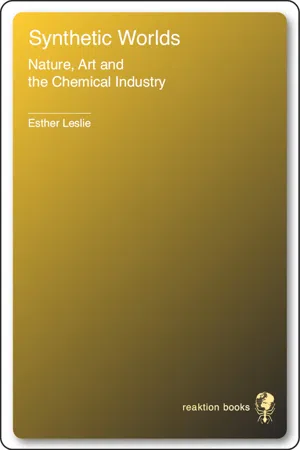
Synthetic Worlds considers the remarkable alliance between chemistry and art, taking us from the late eighteenth century to the period immediately following the Second World War. Esther Leslie offers fascinating new insights into the place of the material object and the significance of the natural, the organic, the inorganic and the synthesized in this poetics of science.
Through its dazzling innovations, which began in the nineteenth century, chemistry has granted new colours and surfaces, new substances, coatings and textures to the world. Often they are the result of accidents or the by-products of pollution. Chemistry has also invented simulants and surrogates for naturally occurring materials. Sometimes these developments confounded earlier alchemical and Romantic philosophies of science and nature, but, at other times, dynamic theories of chemical action combined with the emergent chemistry textbook orthodoxy. For example, the colour wheels of Goethe and Philipp Otto Runge, Hegelian theories of a spirit that inhabits dyes and 'drives' materials, and Romantic ideas of the weddings of substances influenced the experiments that boosted the successful German chemical industry after the 1840s. In turn, chemistry's discoveries seeped back into philosophy and art.
Esther Leslie’s Synthetic Worlds considers this and other startling affinities between chemistry, industry, aesthetics and art. Themes include the impact of artificial imitations and synthetics, the location of value, the mutability of substance, chemical fragility and artistic technique, the poetics of the inorganic and pollution, Bauhaus-influenced modulation and patina in art practice, and nationalist narratives of chemical breakthrough.
- English
- ePUB (mobile friendly)
- Available on iOS & Android
eBook - ePub
About this book
Information
References
introduction
1 Thomas Pynchon, Gravity’s Rainbow (1973;London, 1995), p. 48.
2 Ibid., p. 164.
3 Ibid., p. 166.
4 One crucial source for the chemical details was Williams Haynes’s chatty narrative in This Chemical Age: The Miracle of Man-Made Materials (New York, 1942). Another was Richard Sasuly, IG Farben (New York, 1947).
5 Pynchon, Gravity’s Rainbow, p. 166.
6 Ibid., p. 167.
7 Ibid.
8 Theodor W. Adorno and Max Horkheimer, Dialectic of Enlightenment (1944;London, 1995).
9 Karl Marx, The Eighteenth Brumaire of Louis Bonaparte (1852) (London, 1984), p. 36.
10 The essay can be found in English in Stephen Bronner and Douglas Kellner eds, Critical Theory and Society: A Reader (New York, 1989), pp. 77–94. This quotation is on p. 78.
11 See the quotation from Leon Battista Alberti in Michael Baxandall, Painting and Experience in Fifteenth Century Italy (Oxford, 1988), p. 16.
12 See Karl Marx, Capital, vol. I (New York, 1906), p. 84.
13 Ibid., p. 87.
14 See Pynchon, Gravity’s Rainbow, p. 167.
15 Negative Dialectics appeared in 1966, but Adorno noted that aspects of the book stemmed from the 1930s. See his editorial note on the German second edition.
16 See Adorno and Horkheimer, Dialectic of Enlightenment, p. 138. In German, Dialektik der Aufklärung, in Gesammelte Schriften, vol. III (Frankfurt am Main, 1986), p. 160.
17 Sasuly, IG Farben, pp. 4–5.
18 See Eric Schlosser, Fast Food Nation: What the All-American Meal is Doing to the World (Harmondsworth, 2001), p. 17. For more recent developments in relation to Chicken McNuggets, see p. 139.
19 Theodor W. Adorno, Aesthetic Theory (London, 1984), pp. 100–01; in German, Ästhetische Theorie, in Gesammelte Schriften, vol. VII (Frankfurt am Main, 1986), p. 107.
20 Walter Benjamin, Selected Writings, vol. IV: 1938–1940 (Cambridge, MA, 2003), p. 338.
21 See Theodor W. Adorno, Negative Dialectics (London, 1973), p. 403. In German, Negative Dialektik, in Gesammelte Schriften, vol. VI (Frankfurt am Main, 1986), p. 395.
22 Ibid., pp. 404–5 (translation modified); German edn, p. 396.
23 Ibid., p. 57 (translation modified); German edn, p. 66.
one
1 See Walter Benjamin, ‘Berliner Kindheit um 1900’(1938), in Gesammelte Schriften, vol. VII, pt 1 (Frankfurt am Main, 1991), pp. 398–400. Another version appears in Berliner Chronik (1932), in Gesammelte Schriften, vol. VI (Frankfurt am Main, 1991, p. 472. It is in English as ‘Berlin Childhood around 1900’, in Walter Benjamin, Selected Writings, vol. III: 1935–1938 (Cambridge, MA, 2002). A Berlin Chronicle of 1932 is in Benjamin, Selected Writings, vol. II: 1927–1934 (Cambridge, MA, 1999), pp. 600–1.
2 See Walter Benjamin, Selected Writings, vol. I: 1913–1926 (Cambridge, MA, 1996), p. 90.
3 Benjamin, ‘Berlin Childhood around 1900’, Selected Writings, vol. III, pp. 358–9. Biedermeier denotes the period from c. 1815–48, and denotes a cosy, domestic, middle-class existence.
4 Walter Benjamin, Notes for Berliner Chronik, in Gesammelte Schriften, vol. VI, p. 800.
5 In 1819 E.T.A. Hoffmann wrote a story about a miner’s death at Falun in 1670. Others were inspired by the same true story. Heinrich Heine wrote a ballad. Richard Wagner sketched the outline for an opera called Die Bergwerke von Falun. Later Georg Trakl and Franz Führmann used the theme.
6 Their first collection of folk-tales was initiated by Clemens Brentano, who sought out the Grimm brothers’ help in compiling a continuation of his folk songs Des Knaben Wunderhorn (1805).
7 This story – a version of the ‘Open Sesame’ story from the Arabian One Thousand and One Nights – is in the Grimms’ collection of fairy-tales of 1812–15.
8 F. J. Bertuch, Über die Mittel Naturgeschichte gemei...
Table of contents
- Front Cover
- Half Title
- Title Page
- Copyright
- Contents
- introduction: Glints, Facets and Essence
- one Substance and Philosophy, Coal and Poetry
- two Eyelike Blots and Synthetic Colour
- three Shimmer and Shine, Waste and Effort in the Exchange Economy
- four Twinkle and Extra-terrestriality: A Utopian Interlude
- five Class Struggle in Colour
- six Nazi Rainbows
- seven Abstraction and Extraction in the Third Reich
- eight After Germany: Pollutants, Aura and Colours That Glow
- conclusion: Nature’s Beautiful Corpse
- References
- Select Bibliography
- Acknowledgements
- Index
Trusted by 375,005 students
Access to over 1.5 million titles for a fair monthly price.
Study more efficiently using our study tools.
Frequently asked questions
Yes, you can cancel anytime from the Subscription tab in your account settings on the Perlego website. Your subscription will stay active until the end of your current billing period. Learn how to cancel your subscription
No, books cannot be downloaded as external files, such as PDFs, for use outside of Perlego. However, you can download books within the Perlego app for offline reading on mobile or tablet. Learn how to download books offline
Perlego offers two plans: Essential and Complete
- Essential is ideal for learners and professionals who enjoy exploring a wide range of subjects. Access the Essential Library with 800,000+ trusted titles and best-sellers across business, personal growth, and the humanities. Includes unlimited reading time and Standard Read Aloud voice.
- Complete: Perfect for advanced learners and researchers needing full, unrestricted access. Unlock 1.5M+ books across hundreds of subjects, including academic and specialized titles. The Complete Plan also includes advanced features like Premium Read Aloud and Research Assistant.
We are an online textbook subscription service, where you can get access to an entire online library for less than the price of a single book per month. With over 1.5 million books across 990+ topics, we’ve got you covered! Learn about our mission
Look out for the read-aloud symbol on your next book to see if you can listen to it. The read-aloud tool reads text aloud for you, highlighting the text as it is being read. You can pause it, speed it up and slow it down. Learn more about Read Aloud
Yes! You can use the Perlego app on both iOS and Android devices to read anytime, anywhere — even offline. Perfect for commutes or when you’re on the go.
Please note we cannot support devices running on iOS 13 and Android 7 or earlier. Learn more about using the app
Please note we cannot support devices running on iOS 13 and Android 7 or earlier. Learn more about using the app
Yes, you can access Synthetic Worlds by Esther Leslie in PDF and/or ePUB format, as well as other popular books in History & Art General. We have over 1.5 million books available in our catalogue for you to explore.