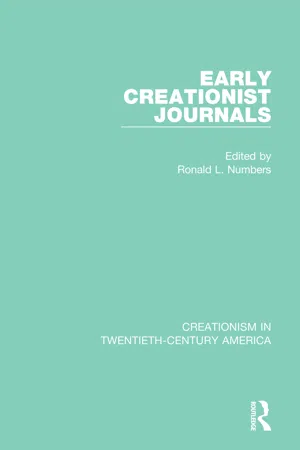
Originally published in 1995, Early Creationist Journals is the ninth volume in the Creationism in Twentieth-Century America series, reissued in 2021. The book is a concise primary source collection containing a selection of journal articles from the early twentieth century outlining discoveries in biology, geology, physiology and archaeology and their relation to Christianity. The aim of the journals was to provide a platform for creationists of the 1920s to voice their theories on new science and how more recent discoveries fit within creationist beliefs, including flood theory. These interesting and unique journals will be of interest to academics working in the field of religion and natural history and provide a unique snapshot into the debates between evolutionists and Christianity during a period of great scientific change.
- 644 pages
- English
- ePUB (mobile friendly)
- Available on iOS & Android
eBook - ePub
Early Creationist Journals
About this book
Information
THE
BULLETIN
OF
DELUGE GEOLOGY
AND RELATED SCIENCES
Volume 1 June, 1941 Number 1
CONTENTS
Foreword
Dinosaurs and the Deluge,
Professor George McCready Price
Deluge Ice Data from Ocean Depths,
Benjamin Franklin Allen
A Chemist’s View of Genesis,
O. L. Brauer, Ph. D.
FOREWORD
“... all the fountains of the great deep (were) broken up, and the windows of heaven were opened. . . . And the waters prevailed exceedingly upon the earth; and all the high hills . . . and the mountains . . . And all flesh died that moved upon the earth, ... and every man . . . and Noah only remained alive, and they that were with him in the ark. . . . And the waters returned from off the earth, going and returning (margin). Gen. 7:11, 19, 20, 21, 23; 8:3.
There are two current explanations for the geologic formations of the crust of the earth as they are found today. One accounts for these features as a result of natural processes which have been operating through countless ages of the past. The other holds that such formations are the result of a catastrophe of world magnitude. The theory of uniformitarianism (that nature has always proceeded as at present), as elaborated by modern geologists, is a little more than a century old. The belief in a universal Deluge is as old as written history.
Since there are no other admitted possibilities, and since the two accounts are mutually contradictory, one or the other of them must be wrong. Putting aside the authority of the Old Testament Scriptures for the moment, and viewing the situation purely on a scientific basis, which of the two accounts is in closest agreement with the facts of geology? The truth must lie in the testimony of the rocks, if this source of information can be correctly read and rightly interpreted. To this source of information, every scientist, every honest seeker after truth, must submit his thesis.
Even to the superficial student of Geology, certain fundamental facts seem to be self evident. It is agreed generally that the very uniform strata of the earth’s crust imply the action of water. The disruption of the earth’s crust which is evidently responsible for mountain formation indicates the action of some tremendous superimposed force, effecting its influence in great lines and extensive areas of the several continents. A study of the fossils, moreover, indicates a profound change sometime in the past in the types and distribution of the fauna and flora of the earth, a change which has evidently been accompanied by a climatic change of no small degree. Upon these data, which all geologists can accept as basic, a study of the two conceptions may be undertaken.
It is worth while to canvass the field in an effort to see whether, on the face of things, there is any good reason whatever to believe that a Deluge may have occurred. We believe there is. The sudden disappearance of families of gigantic reptiles and of many mammals, the formation of great coal fields, often hundreds of miles in extent, the formation of great deserts by recedence of great inland lakes, the abrupt change of climate at the poles from warm to cold as well as the unique universal lamination of the sedimentary layers of the earth’s crust can better be explained by a universal Flood than by any long-continued process known to man. This superficial evidence is sufficiently substantial to warrant a more critical investigation of the details.
On the other side, the facts which weigh heavily against the doctrine of uniformitarianism are the universal stratification of the earth’s crust without any locally complete record of the “geologic ages”; the reversal of these layers and other irregularities in a number of extensive areas; the occurrence of fossil “graveyards” which indicate sudden destruction of animals in large numbers (without historical counterpart); the testimony of fossil trees standing through many laminations of coal thus refuting the theory that coal has been ages in the making, the absence of even a solitary example of an imperfect transitional fossil form of the countless failures which must have lived and died if organic evolution were true, and finally a failure to account for the radical change in climate which evidently occurred at some time in the past.
With much evidence in favor of a universal deluge and a number of facts which militate against the acceptance of the long-age theory of the formation of the earth’s crust, it would seem as though any fair minded individual would be compelled to recognize the possibility, and to admit the likelihood, of a Deluge at least seriously enough for scientific consideration. The critical testing of any theory which has any merits is legitimate. It is now proposed that the Deluge “theory” be put to the crucial test, not only as to the general geologic phenomena, but as to the details of the various related sciences.
Many biological and botanical features of plants and animals in the part as compared to those of the present, together with the principles of geography, climatology, ecology, paleontology, oceanography, hydrology, geophysics, chemistry, mineralogy, archeology, ethnology, philology and certain phases of astronomy, as well as other sciences, are necessary in developing the history of the earth and its life. Research is going forward in all of these sciences to construct, if possible, a more reasonable and scientific history of the earth and its life than current theories afford. If the Bible statements are true, only by developing the facts underlying them can this be done.
This is the object of the Society for the Study of the Deluge Geology and Related Sciences, organized some three years ago under the encouragement and stimulation of Professor George McCready Price. The Society is non-denominational and has for its only essential thesis, the literal interpretation of the Book of Genesis and other Scriptures relating thereto. If the Deluge did occur, it is believed that the scientific facts now available, or easily discoverable, will abundently prove it.
This Bulletin is published by the Society to record for the use of resident and distant members and other interested individuals, worthwhile source material which has been presented before the organization. In this way it is hoped to accumulate material which will be useful to Christian workers and Bible Students. This publication must of necessity be small at first. It has no endowment and therefore its continued existence depends upon the support of those interested in its message. As the number of members and subscribers increases, the Bulletin will be correspondingly enlarged. The support of believers everywhere is therefore earnestly solicited.
The Editorial Staff
THE FATE OF THE DINOSAURS
“Fate cropped him short, for be it understoodHe would have lived much longer, if he could.”—W. D. Rhodes
“The great race [the dinosaurs] entrenched on earth for so many million years, widespread over the six continents, and consisting of forms which were certainly majestic for their time, silently passed away, leaving the reptilian field to a few relatively unimportant orders, but having no descendants, of its own. . . . Then, almost suddenly, at the end of the Cretaceous, and for no obvious cause, the candle flame of their life was extinguished; the wind of some unknown circumstance had blown over it and it was gone. So closed one of the most memorable chapters in the history of life on earth.”
“The main problem before us, then, is why towards the close of the Cretaceous period, there were numerous forms of dinosaurs alive and apparently comfortably settled in their respective habits and environments, yet, when the Tertiary era dawned, none was left and the mammals were assuming the dominant position among the land-living forms. Was the cause some world-wide cataclysm of a physical nature, or some widespread epidemic whose ravages have left no trace upon the bones?
“Now, the period of the extinction of the dinosaurs was coincident with the worldwide Lamaride revolution which must have brought profound changes in its train, and which must have supplied the basic geological cause of extinction.”
“... It is generally agreed, however, that considerable uplift-movements of the land, and a consequent diminution in the extent of the seas, followed, and there was very probably a decrease in the temperature, though this was not so marked as that accompanying other great revolutions.”
“The career of the dinosaurs was far from brief, and far from a futile or vain attempt to snatch a permanent hold on the chain of life. Their passing was comparable with, and no less dramatic than, that of a mighty empire of world-wide extent.” —Swinton, W. E.: The Dinosaurs. A Short History of a Great Group of Extinct Reptiles, London, 1934, pp. 176-187.
DINOSAURS AND THE DELUGE*
Prof. George McCready Price
“One of the most inexplicable of events,” declares Dr. Charles Schuchert, a well known geologist, speaking of dinosaurs, “is the dramatic extinction of this mighty race.”1
A “dramatic extinction,” as here used, means an extinction which came suddenly, and was universal over the entire globe; while the word “inexplicable” means that this extinction cannot be explained in the terms of the accepted theories of natural science.
The late Henry Fairfield Osborn also expressed surprise at the sudden and universal extinction of these animals, for he said: “The cutting off of this giant dinosaur dynasty was nearly, if not quite, simultaneous the world over.”2
The question naturally arises, What was it that killed them all off? We all know that reptiles are notoriously tough and hard to kill. This applies to all the various kinds of reptiles still living, whether snakes, alligators, lizards, or turtles, all of which are included in the class reptiles. They are not much subject to diseases, nor to external or internal parasites. And many of them today are among the longest lived animals now living, some turtles or tortoises being known to live for more than two hundred years. All these facts add to the mystery of the sudden and complete extinction of that mighty race, the ancient dinosaurs. What but a universal Flood could possibly have killed them all off, and “simultaneously the world over”? And this conclusion is rendered even more inevitable when we learn that their bones or skeletons are universally found where they must have been buried by vast currents of flowing water, often in regions like the high plateaus of Wyoming and other parts of Western America, or the dry tablelands of central Asia, where large volumes of water are now unknown.
Giant Living Tanks
The dinosaurs comprised some of the most gigantic animals which ever walked on dry land. Several fairly complete skeletons have been recovered which are 70 or more feet long, with a body that must have weighed 30 or 40 tons, or as much as ten full grown elephants. James D. Dana says that, if we did not have the positive evidence of the bones themselves, we might have thought that such masses of living flesh would be too gigantic for muscles to move on dry land. But any one who has visited any of the larger museums in this country or in Europe has seen the actual bones themselves, these bones being sometimes fairly fresh-looking, and not at all highly mineralized.
Of course, they were not all such monstrous brutes. Some were no bigger than an ordinary alligator, while others were even smaller. But they were among the most bizarre or odd-looking creatures imaginable.
For instance, the Stegosaurs were covered with a complete coat of mail, like a modern crocodile, the hide of which will resist a rifle bullet. But the Stegosaurs were as heavy as an ordinary elephant, with fairly long and sturdy legs, and a body flattened laterally, with two rows of large plates of horny material along the ridge of the back from the head to the tail, the latter being armed with massive spokes several inches in length. Some of the dorsal plates were nearly two feet in size. In the museum in Berlin, Germany, I was shown a specimen of one of these creatures from East Africa which had massive spikes instead of the flat plates along the back. These Stegosaurs had very small heads, and diminutive brains. They were probably vegetable feeders, and harmless enough; but their massive armor rendered them like living, traveling citadels, almost immune to attack.
Triceratops is the name of another kind of massive animal weighing several tons, with a strong horn over the nose, like a rhinoceros, but with an additional horn over each eye. The skull had a massive extension backward over the entire neck, making the skull sometimes six or seven feet long. They were evidently formidable fighters, as is evidenced by fractured and healed jaws and horns, with neck-crests and even skulls that have been pierced and healed again. Two of these old warriors charging at each other like infuriated rhinoceroses or wild bulls must have been a terrifying spectacle.
Extinction “Dramatic” and “Simultaneous”
There were also monstrous carnivorous dinosaurs, with sturdy hind legs and massive tail, like a kangaroo, but with diminutive front legs which must have been of little use except for assisting in eating. The body was stout and strong, weighing several tons; the head was massive with a large mouth and a formidable array of teeth; and the creature when standing erect on its tripod of tail and hind feet must have reached a height of twenty-five or thirty feet. Then if we may suppose it to have been as active accordingly as a modern “skidoo lizard,” it must have been able to travel with amazing speed, probably faster than any modern automobile. Altogether it must have been a very formidable animal. One of these carnivorous monsters has been named Tyrannosaurus rex, meaning king of the tyrant monsters, a name which seems very appropriate.
A very interesting kind of flying reptile was the Pterodactyl, which though having a long tail might be supposed to resemble somewhat a modern bat; for its long wings had a spread of fifteen or twenty feet,...
Table of contents
- Cover
- Half Title
- Title Page
- Copyright Page
- New Preface to the re-issue of 2021
- Original Title Page
- Original Copyright Page
- Table of Contents
- Series Introduction
- Volume Introduction
- The Creationist (1937–8)
- The Bulletin of Deluge Geology and Related Sciences (1941–2)
- The Bulletin Of Creation, the Deluge and Related Sciences (1943–5)
- The Forum for the Correlation of Science and the Bible
- Acknowledgments
Trusted by 375,005 students
Access to over 1.5 million titles for a fair monthly price.
Study more efficiently using our study tools.
Frequently asked questions
Yes, you can cancel anytime from the Subscription tab in your account settings on the Perlego website. Your subscription will stay active until the end of your current billing period. Learn how to cancel your subscription
No, books cannot be downloaded as external files, such as PDFs, for use outside of Perlego. However, you can download books within the Perlego app for offline reading on mobile or tablet. Learn how to download books offline
Perlego offers two plans: Essential and Complete
- Essential is ideal for learners and professionals who enjoy exploring a wide range of subjects. Access the Essential Library with 800,000+ trusted titles and best-sellers across business, personal growth, and the humanities. Includes unlimited reading time and Standard Read Aloud voice.
- Complete: Perfect for advanced learners and researchers needing full, unrestricted access. Unlock 1.5M+ books across hundreds of subjects, including academic and specialized titles. The Complete Plan also includes advanced features like Premium Read Aloud and Research Assistant.
We are an online textbook subscription service, where you can get access to an entire online library for less than the price of a single book per month. With over 1.5 million books across 990+ topics, we’ve got you covered! Learn about our mission
Look out for the read-aloud symbol on your next book to see if you can listen to it. The read-aloud tool reads text aloud for you, highlighting the text as it is being read. You can pause it, speed it up and slow it down. Learn more about Read Aloud
Yes! You can use the Perlego app on both iOS and Android devices to read anytime, anywhere — even offline. Perfect for commutes or when you’re on the go.
Please note we cannot support devices running on iOS 13 and Android 7 or earlier. Learn more about using the app
Please note we cannot support devices running on iOS 13 and Android 7 or earlier. Learn more about using the app
Yes, you can access Early Creationist Journals by Ronald L. Numbers in PDF and/or ePUB format, as well as other popular books in Theology & Religion & Religion. We have over 1.5 million books available in our catalogue for you to explore.