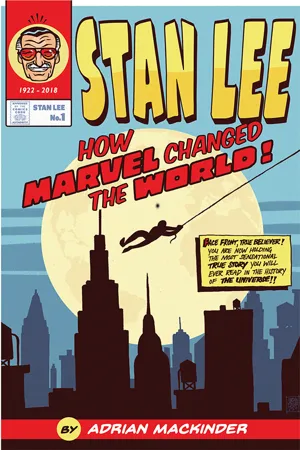
Discover the astonishing history of modern American entertainment, seen through the eyes of a pop-culture icon who lived for nearly 100 years.
Stan Lee: How Marvel Changed the World is not just another biography. It is a journey through twentieth century American history, seen through the life of a man who personified the American Dream. This book shows how Stan Lee's life reflects the evolution of American entertainment, society and popular culture throughout the 1900s and beyond. Along the way, bold questions will be asked. Was Stan Lee himself a superhuman creation, just a mask to protect his true, more complicated secret identity? Just like the vibrant panels of the comics he wrote, Lee's life, it seems, is never black and white. Sourced from Lee's own words, this book also includes brand new and exclusive interviews with Marvel comic book creators, for whom Lee's work proved an invaluable inspiration. Upbeat, accessible and fun, this book is told with a glint in the eye and a flair for the theatrical that would make Stan Lee proud. This is a bold celebration of the power of storytelling and a fitting tribute to Stan Lee's enduring legacy. Excelsior!
- 192 pages
- English
- ePUB (mobile friendly)
- Available on iOS & Android
eBook - ePub
About this book
Information
Chapter One
Once Upon a Time in Romania
To understand what makes a person tick, you need to wind back the clock. Our past informs our present, and what came before illuminates who we really are. Ask any storyteller. To relate to a character, you need to understand where they’ve been. There’s a reason we talk about life’s ‘defining moments’. There’s a reason we think the struggles and challenges we’ve endured in life ‘build character’. One of the reasons the recent Marvel Cinematic Universe franchise has proved so successful is because the filmmakers took their time introducing their central characters before they became who they were destined to be. From an arrogant billionaire arms dealer with a change of heart to a wartime science experiment put on ice, we spent time with Tony Stark and Steve Rogers before they became superheroes. We followed them to that fork in the road that transformed their lives, and so when they ultimately became Iron Man and Captain America, we cared about what happened next.
Outside the Marvel universe, Christopher Nolan’s excellent 2005 reboot Batman Begins revitalised the character by being arguably the first live-action adaptation to place Bruce Wayne at the heart of the story. Prior to this, all we’d had was Batman portrayed as a rather two-dimensional supporting player in his own story, second fiddle to whichever actor du jour was chewing up the scenery as one of Batman’s more flamboyant villains. Batman Begins works so well because Nolan and co-scriptwriter David S. Goyer extensively explored Bruce Wayne’s formative years, from traumatised and guilt-ridden orphan, to lost teen with a mind for revenge, to angry soul seeking guidance to conquer his fears and find his true purpose as the saviour of Gotham City. It’s an hour into the film before Wayne first dons the iconic cape and cowl, but by this point we truly cared about the man under the mask. Batman Begins is a hugely compelling and satisfying character study that at once deconstructs and reaffirms the enduring appeal of the Dark Knight. More than this, you cared about Batman because you’d seen what Bruce Wayne had been through.
An origin story not only grounds us in a sense of time and place, but also helps us invest in everything that happens to the character. It adds layers and depth. If we know a hero’s background, we obtain a fuller insight into what motivates them, the decisions they make, as well as how and why they interact with others. A hero’s origin enriches every stage of their journey and rewards us for tagging along for the ride.
So, we come to the hero of this particular adventure: Stan Lee. Now. We could jump straight in at the fun stuff. We could swing straight into the hip and happening 1960s when Marvel Comics created a wealth of iconic characters that not only redefined the comic book industry, but raised the bar for popular mainstream entertainment across the globe. Tall tales of clobberin’ crooks through bank walls, destroying swathes of foes with a mighty hammer or dazzling feats of astral projection through inter-dimensional portals. We could start there. But that would be short-changing all of us. Especially Stan. After all, he was almost 40 years old when that happened. A lot of water had flowed under the bridge before then. Not all of it clean. These groundbreaking characters were not created out of thin air. You can’t build worlds on a whim. To do justice to Stan’s remarkable life and many achievements, we need to see the whole picture. The fact you picked up this book in the first place suggests you’re interested in uncovering how he got there. What made Stan the man he became. So, settle in. We’re going on an adventure.
Stanley Martin Lieber was born in New York City on 28 December 1922. But that’s not where his story begins. Stan proudly considered himself a quintessential New Yorker, but we need to look beyond the gleaming monoliths and brownstone rooftops of the Big Apple. We must voyage across the sea to Romania at the end of the nineteenth century, where prejudice and violence forced much of its Jewish population to join the millions across Europe heading overseas to escape persecution. It was a tumultuous time for Romania’s Jews, even though the 1800s had begun favourably. During the early to mid part of the century, the country was a haven for Jewish immigrants. Those fleeing pogroms from neighbouring countries had found sanctuary in its relatively tolerant climate.1 Scores of new arrivals intermingled with Romania’s existing Jewish community to build a considerable social, economic and even political presence within the country. This changed in 1866, when Romania established a new constitution that barred non-Christians from becoming citizens. This naturally affected its now-burgeoning Jewish population. Twelve years later, the pendulum swung back in favour of a more tolerant climate when Romania won independence from Ottoman rule. Now a constitutional monarchy under the cold, detached gaze of King Carol I, its fledgling Romanian government revoked this discriminatory law, promising fair and equal rights for all its citizens. It didn’t last.
More laws were soon introduced that prohibited Jews from taking certain kinds of trades and professions. Many Jewish men were forced into unemployment. In 1893, Jewish children were barred from the Romanian public education system unless they paid additional fees, which, of course, many families couldn’t afford. This legislation was extended in 1898 to include senior schools and universities. Then the Romanian economy took a downturn, and that’s when things turned nasty. In times of economic hardship, people often seek out a scapegoat for their country’s ills. Those considered different or ‘alien’ are usually first against the wall. History has tragically shown that blame is often laid at the doors of the local synagogue. Sure enough, aggressive strains of anti-Semitism re-infected Romanian society, sometimes erupting into brazen acts of violence. With grim inevitability, many in Romania had mistakenly concluded that there was a ‘Jewish problem’.
With such bleak and dangerous prospects on the horizon, many Romanian Jews inevitably looked beyond their borders for a chance of a life free from threat. So began the Romanian Jewish exodus. Between 1899 and 1904, approximately a third of all Romanian Jewry emigrated. Most set sail for the United States of America. Many wound up on the East Coast, in that paradigm of multicultural freedom, New York City. Among those tired, poor, huddled masses landing on Ellis Island was a teenager named Hyman Lieber.2 Hyman docked in the shadow of Lady Liberty in 1905, along with his teenage relative Abraham. The two Lieber boys entered into the throng of immigrants starting a new life in Manhattan. They lived in cramped conditions and often on servile wages. In this melting pot, the Romanian Jewish immigrants understandably stuck together. A ghetto was formed in an area previously dominated by German and Irish immigrants: New York’s Lower East Side.3
While no concrete evidence exists that Hyman Lieber started his American life in the heart of the ghetto, it’s highly likely he would have been very familiar with the First Roumanian American Synagogue on Rivington Street and the bustling and vibrant Orchard Street with its many Yiddish storefront signs, kosher butchers and horse-drawn carts clattering across crowded cobbled streets. This was the centre of the universe for New York’s Jewish community during the early 1900s; a new home in the new world where they could be safe. Not that immigrant life in New York was a walk in Central Park. Most relocated without even a basic understanding of English, so had to learn the language as best they could as fast as they could, simply to expand employment options. The alternative route for Jewish immigrants was to remain in the trades and professions offered within the community, who spoke more German than Yiddish. Tensions between different ethnic communities in that area did, on occasion, spiral into violence, notably in 1902 when an almighty scuffle broke out on Grand Street between workers at R. Hoe & Company’s printing press factory and Jews marching past in a funeral procession for Chief Orthodox Rabbi Jacob Joseph. While only eleven Jews and four factory workers were arrested by police, the Jacob Joseph Funeral Riot gained notoriety for alleged Irish Catholic anti-Semitism as large numbers of police officers were said to side with the factory workers.4
Despite tensions and hardships, life for Hyman and Abraham Lieber progressed. Census details reveal that by 1910 both were boarding with a family called Moshkowitz on Avenue A5, where Manhattan borders the Lower East Side. By this time, Hyman had changed his name to Jacob, and had begun working in the garment industry. It was a trade that would no doubt serve him well for years. The records then jump forward a decade to reveal that, in 1920, Jacob was lodging with a fellow rag-trade worker in the heart of Manhattan on 114th Street, just north of Central Park. Within two years, Jacob had married Celia Solomon, a girl also of Romanian Jewish origin. Her large family had moved to the US at the turn of the century, but Celia had been born in New York.6 The newlyweds quickly moved into an Upper West Side apartment, on the corner of Manhattan’s West 98th Street and West End Avenue,7 between Broadway and the Hudson River. As 1922 drew to a close, Jacob and Celia welcomed a new addition to the Lieber family, a bouncing baby boy they named Stanley. The timing wasn’t great. In October 1929, two months before Stan’s seventh birthday, Wall Street crashed. Following a recent similar financial collapse in London, share prices at the New York Stock Exchange tumbled catastrophically. Billions of dollars were wiped out in a matter of days, ushering in a twelve-year stretch of economic darkness later branded The Great Depression.
During this time, mass employment affected just about everyone, not least those trying to earn an honest wage in New York, such as Jacob Lieber. Work dried up, even in garment manufacturing. People just weren’t buying new clothes. Stan’s earliest recollections of family life were not always the fondest. His abiding memories were of his parents frequently arguing as they struggled to make ends meet. Financial pressures on the family grew in 1931 with the arrival of Stan’s younger brother Larry, forcing the Liebers to move north from their West End apartment to a meagre one-bedroom apartment on Fort Washington Avenue in Washington Heights.
The highest point of Manhattan, Washington Heights was bordered to the south by Harlem, Inwood to the north, the Hudson River to the west, and to the east the Harlem River and Coogan’s Bluff. The area was a lively mix of ethnicities, largely Irish and Greek. Some financial pressure was alleviated, however, and although Stan had some nearby green space for play, things were still far from rosy.
Stan would later vividly recall his father’s seemingly endless job hunting. The young boy would watch the weight of the Depression slowly compress his father into a crumpled heap. A normal routine involved Jacob either returning home from a day trudging the streets for work or scouring the ‘want ads’ for any opportunity. Some glimmer of hope. This fruitless endeavour chipped away at both his father’s confidence and the family unit. Jacob and Celia rowed incessantly about money. By Stan’s account, and to their eternal credit, they never took it out on the children. This was their burden to bear and bear it alone they must – at all costs. As with many self-made immigrants, Jacob was a product of his time, a proud man who wanted to be the pater familias, chief breadwinner and main provider. This was just how things were done. To feel his dignity and inherent value seemingly being stripped from him would have cut deep. It didn’t help that Celia contributed by borrowing from her considerably wealthier family. While not unusual today, back then this would have further needled Jacob’s fragile male pride.
Those early years left a profound mark on Stan, who said: ‘I realized at an early age how the spectre of poverty, the never-ending worry about not having enough money to buy groceries or to pay the rent, can cast a cloud over a marriage.’8 If there is a silver lining, it was that observing his father’s increasing despondence sowed the seeds of a strong work ethic in Stan that informed him for the rest of his life. ‘Seeing the demoralizing effect that his unemployment had on his spirit, making him feel that he just wasn’t needed, gave me a feeling I’ve never been able to shake,’ he later said. ‘It’s a feeling that the most important thing for a man is to have work to do, to be busy, to be needed.’9 Stan would attribute this as the reason why he spent his entire life juggling multiple projects at once and, while this armchair psychology may be a tad simplistic, it certainly goes some way to explain his astonishingly prolific career. ‘I’ll always regret the fact,’ he would reminisce, ‘that by the time I was earning enough money to make things easier for them, it was too late.’
Stan was the favourite son, but he felt guilty about such preferential treatment. He always wished his parents had lavished as much praise on young Larry as they did on him, but his mother worshipped the ground he walked on. ‘I used to come home from school … and she’d grab me and fuss over me and say “you’re home already? I was sure today was the day a movie scout would discover you and take you away from me!”’10 Larry also idolised Stan, but the two boys initially shared no relationship with each other, largely due to the nine-year age difference. Stan subsequently regretted this distance, but made up for it later when he actively brought Larry into the comic book industry as artist and writer, an act which no doubt assuaged the guilt he felt about his mother’s blatant favouritism. Larry went on to establish himself as a major creative force in his own right, best known as co-creator of Iron Man and illustrator of the newspaper comic strip The Amazing Spider-Man for over thirty years.
At school, Stan was a bright boy who worked hard. Driven by the need to finish his education so he could go out into the real world and contribute to the family coffers, his diligence was rewarded by skipping grades. Being the youngest boy in class led Stan to see himself as an outsider. He did not form lasting friendships at school, and in the summer months the kids he did befriend were spirited away to summer camps or driven off for family adventures. Too young for camp and in a family that could not afford a car, Stan had to find other ways to amuse himself. His rear-facing apartment didn’t even have a street view. Every time Stan looked out from his tiny home, he was literally staring at a brick wall. It is no coincidence then, that Stan found comfort, joy and inspiration in activities that he could do by himself and that cost nothing. Because when there’s no one to interact with, kids inevitably rely on their imagination. And that’s exactly what Stan did. He lost himself inside worlds that would, in time, help him transform from lonely little Stanley Lieber into the mighty Stan Lee. And what worlds there were to discover.
Chapter Two
Worlds of Pure Imagination
For Stan’s twelfth birthday, Jacob and Celia scraped enough cash together to buy him a bicycle. Their son cherished this as if it was his best friend – because it was. There’s nothing quite like the thrill of freedom your first bike gives you, and the joy of racing around the neighbourhood fuelled his burgeoning imagination. Stan wasn’t just a boy on a bike. Oh no. That would be far too dull. He was a courageous astronaut, boldly going where no kid had gone before on ‘a two-wheeled spaceship’. He was a brave knight in armour, atop a mighty steed, riding into countless battles – from which he no doubt always emerged triumphant.
This escapism offered Stan respite from a home filled with argument, stress and worry. And it wasn’t getting any better. By the 1930s, the Lieber family had to move again. Heading out of Manhattan altogether, they relocated to a one-bedroom apartment in the Bronx, on 1720 University Avenue. Tucked between Brandt Place and West 176th Street, this once-rural area had, after the First World War, undergone major urban growth. Then a huge influx of immigrants, notably French, German, Poles and Jews, transformed the borough into an effervescent melting pot. In 1937, it was recorded that nearly 600,000 Jews lived in the Bronx, just under half the borough’s entire population.1
Even by their own modest standards, the Bronx was much less affluent than the Liebers were accustomed to. The area had started to suffer rapid economic decline as middle-class residents began relocating elsewhere. It would not see urban renewal and regeneration until the late 1980s. Despite this second money-saving move, living conditions were no less restrictive than before. ‘My brother and I slept in the bedroom,’ Stan recalled, ‘my parents on a foldout couch.’2 This third-floor apartment was also rear facing. Yet again, Stan was denied a view. So, when he found himself such stifling circumstances, he lost himself in books.
It’s no surprise that a future writer found sanctuary in reading. But what may raise an eyebrow is that Stan had no real interest in comic books. Back then they were more primitive, far from the sophisticated established formats we have today. What truly sparked young Stan’s imagination were the novels of Edgar Rice Burroughs, Mark Twain and Jules Verne.
It’s easy to see why such escapist fiction appealed to Stan. These novels would transport him to times and places...
Table of contents
- Cover
- Title
- Copyright
- Contents
- Acknowledgements
- Prologue Face Front, True Believer!
- Chapter One Once Upon a Time in Romania
- Chapter Two Worlds of Pure Imagination
- Chapter Three The Golden Years
- Chapter Four War and Piecemeal
- Chapter Five Back to the Front
- Chapter Six The Rot Sets In
- Chapter Seven The Heroes We Need
- Chapter Eight More Human than Human
- Chapter Nine Master of the Universe
- Chapter Ten A Brave New World
- Chapter Eleven Stan Lee Presents
- Chapter Twelve The Long Dark Road to Hollywood
- Chapter Thirteen Development Hell
- Chapter Fourteen Rack and Ruin
- Chapter Fifteen Marvel Rising
- Chapter Sixteen The Oldest Posterboy in Town
- Epilogue Heroes Never Die
- Notes
- Bibliography
Trusted by 375,005 students
Access to over 1.5 million titles for a fair monthly price.
Study more efficiently using our study tools.
Frequently asked questions
Yes, you can cancel anytime from the Subscription tab in your account settings on the Perlego website. Your subscription will stay active until the end of your current billing period. Learn how to cancel your subscription
No, books cannot be downloaded as external files, such as PDFs, for use outside of Perlego. However, you can download books within the Perlego app for offline reading on mobile or tablet. Learn how to download books offline
Perlego offers two plans: Essential and Complete
- Essential is ideal for learners and professionals who enjoy exploring a wide range of subjects. Access the Essential Library with 800,000+ trusted titles and best-sellers across business, personal growth, and the humanities. Includes unlimited reading time and Standard Read Aloud voice.
- Complete: Perfect for advanced learners and researchers needing full, unrestricted access. Unlock 1.5M+ books across hundreds of subjects, including academic and specialized titles. The Complete Plan also includes advanced features like Premium Read Aloud and Research Assistant.
We are an online textbook subscription service, where you can get access to an entire online library for less than the price of a single book per month. With over 1.5 million books across 990+ topics, we’ve got you covered! Learn about our mission
Look out for the read-aloud symbol on your next book to see if you can listen to it. The read-aloud tool reads text aloud for you, highlighting the text as it is being read. You can pause it, speed it up and slow it down. Learn more about Read Aloud
Yes! You can use the Perlego app on both iOS and Android devices to read anytime, anywhere — even offline. Perfect for commutes or when you’re on the go.
Please note we cannot support devices running on iOS 13 and Android 7 or earlier. Learn more about using the app
Please note we cannot support devices running on iOS 13 and Android 7 or earlier. Learn more about using the app
Yes, you can access Stan Lee by Adrian Mackinder in PDF and/or ePUB format, as well as other popular books in Literature & Literary Biographies. We have over 1.5 million books available in our catalogue for you to explore.