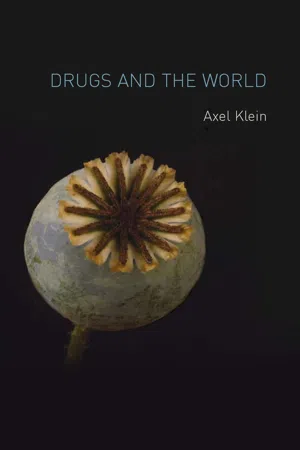
The use and misuse of psychoactive substances is one of the most widely discussed and yet least understood social processes. It is easy to condemn the use of illicit drugs, as well as alcohol and tobacco, as problems that require the services of professionals and the retribution of the state. Sight has been lost of the contributions that drugs have played in society and culture and the key role they play in ritual, religion and possibly human evolution. Drugs and the World restores the constructive aspect of drug use to the discussion, and reviews the policies and interventions that make up the contemporary web of drug controls.
Axel Klein traces the classification of substances to define ‘drugs’, and examines the links with both crime and addiction. He investigates the arguments made concerning the role of drugs, first in human evolution and then in history, to underscore their importance in the development of trade and nation states. Drawing on research from around the world, this book illustrates how global efforts to suppress drugs have had little impact on drug use, but have instead eroded institutions of the state, corrupted law enforcement and courts, and undermined the democratic process. Providing new material from the Caribbean, West Africa and the Caucasus to illustrate the bizarre consequences of an internationally devised drug-control programme, Drugs and the World moves to discussing the contribution of drugs to contemporary society, and ways of regulating their use and distribution.
Written by an expert author with more than fifteen years experience in the field of drug use, addiction prevention and drug policy, this book will appeal to a wide audience of readers wishing to know more about the use of illicit drugs in the world today.
eBook - ePub
Drugs and the World
About this book
Information
1 Taking Leave of Our Senses:
Drug Use and Drug-taking in the
21st Century
Drug control in a historical perspective
The faculty of reason is a fundamental principle behind our definition of what it is to be human. One of the great legacies of the Enlightenment has been the liberation of humanity from the shackles of ignorance and autocracy, to ring in an era of autonomy and self-determination based on a rational understanding of the world around us. Meanwhile the growing confidence of science helped to elevate the status of man versus his creator, by dislocating God from the centre of social and natural affairs, and to loosen the chains of superstition and custom. In this process the control that had been exerted over individual behaviour by church, the feudal lord and tradition subsided. Their place was taken by the individual will, seated in the faculty of reason, nurtured by education and training, and facilitated by transparent and accountable institutions of government. In the post-Enlightenment ideal, social stability and communal welfare have depended not on fear and brute force, but on individual self-control.
Notwithstanding occasional setbacks, such as the inexplicable emotive power unleashed by nineteenth-century nationalism, and the rearguard actions fought by religious fundamentalists, particularly of Christian and Islamic persuasion, the scheme has evolved into a principle of national and, importantly, global governance. From the opening, however, it was beset by an inexplicable difficulty in the form of ‘peculiar substances’. During the early modern period proponents of the Enlightenment lamented the corrosive effects of the ‘demon drink’. The increasingly articulate puritan critiques of alcohol-induced inebriation were delivered at a time when science as the study of nature was intertwined with the first phase of globalization, and busily engaged in the taxonomic ordering of the world. Scientific curiosity complemented and reinforced mercantile self-interest that procured for the European centres of commerce and study both the specimen for analysis and the cargo for commerce and consumption.
Patterns of consumption, which for most of Europe’s agrarian history had remained constant, began to change quite dramatically. New products such as coffee, tobacco, tea, sugar and cocoa arrived as luxurious curiosities that quickly caught on. The dual process of global trade and scientific experimentation delivered to the modern European consumer a whole range of substances with the potential to significantly alter mood and mind. Some of these were taken into the pharmacopoeia of medical practitioners, while others became first luxury goods, then staples. Yet these products contained dangers unrecognized in the first flurry of excitement. Plants discovered around the world by intrepid explorers continued to fire the imagination and ingenuity of European scientists intent on uncovering their secrets by isolating psychoactive alkaloids right up to the nineteenth century. The two scourges of contemporary drug control, morphine and cocaine, were first discovered by isolating and extracting the psychoactive alkaloids from poppy juice and coca leaves. The refined products were promoted as panaceas and marketed as ‘over the counter’ medicines, at the same time as the assault on alcohol was reaching a climax. Indeed, heroin synthesized from morphine was marketed by the pharmaceutical company Bayer as a morphine substitute in a cough syrup sold from 1898 to 1910 in a combination pack with aspirin and the diuretic Lycetol (Dimethyl-piperazidine tartrate). The cough syrup was finally withdrawn from the German market only in 1958.
In Britain, the US and much of northern Europe, the temperance movement had matured into a powerful political force by the late nineteenth century. Though often associated with other causes, such as female suffrage, it was in essence a single-issue campaign against the production, distribution and use of alcohol. Alcohol, in its many guises, was seen as the scourge of the urban poor in the rapidly industrializing towns, responsible for social deprivation and much of the ensuing misery. Campaigners such as William Booth, the founder of the Salvation Army, sought to realize social benefits by focusing on a single cause. This entirely reformist approach was, and is, much despised among revolutionaries, as it drew attention away from the structural conditions of exploitation, to home in on the patterns of consumption among the exploited. Moral crusaders, then as now, lay the blame for abject conditions at the door of the victim. Temperance reformers were not trying to redress exploitative relationships by raising wages or redistributing wealth or improving working conditions, but agitated instead to deprive the workers of one of the only sources of pleasure at their disposal.
It is not surprising, perhaps, that the temperance position was shared by paternalist industrialists, motivated either by genuine disgust over the appalling social conditions suffered by the urban poor and by a genuine philanthropic concern, or by shrewd calculation that simply ameliorating the worst deprivation would forestall more violent upheavals. Beneath this class-focused discussion of sectional interest and the distribution of wealth and power lies a cultural theme that took shape in the early modern period and remains with us today. It explains why the revulsion for habitual drunkenness that inspired so many political agitators in the nineteenth century was so easily adapted and transposed onto the growing number of addicts to opiates, cocaine and other substances in the twentieth century.
Alcohol addiction in the nineteenth century and problematic heroin or crack cocaine use today have both been seen as subverting the foundation of the social order that is vested in the rational autonomy of the self-determining individual. The actual intoxication itself is an offence to what in post-Enlightenment terms is the pinnacle of human achievement – the seat of reason – now occluded by a synthetically produced mimicking of pleasure. It may be said that switching off the endogenous apparatus for rational thought is a choice every individual should be free to make. But temperance campaigners in the past, and proponents of drug prohibition today, have argued on the other hand that drugs, through their psychotropic action and addictive properties, erode the very capacity of the will to make a free choice. Alcohol and drug users then forfeit their right to autonomy and self-determination, and thereby invite the intervention of the authorities as custodians of the rationality and enfeebled will of the individuals afflicted, guarding society from the intrusion of alcohol and drugs.
There are considerable variations in interpreting the respective rights and roles of individuals and the collective. In countries with welfarist traditions, such as Sweden, the assertion that the individual can be saved from him/herself by the intervention of a benign state is very persuasive. It is firmly rooted in the notion, stemming from Aristotle, of the ‘good society’ with responsibility for creating the conditions in which individuals can prosper. When it comes to dangerous substances, the state is called upon to intervene so as to curtail their availability, especially to younger and more vulnerable members of the community.
Whether individuals should be allowed to erase the very intellectual faculties that render them human in the first place echoes the discussion over the ethics of suicide. The sanctions against suicide were for centuries based on religious principles of the sanctity of life. With the elevation of reason itself, however, God was displaced as the reference point for moral reckoning. Direction for moral conduct has since then been provided by the declaration of ‘universal principles’, as well as the interests of society itself. With regard to general social interests, drugs are odious in that they foster selfish, egotistical behaviour and neglect of responsibility. Moreover, their effect on individual behaviour is to lower the threshold of inhibition. It is indeed this very facility that is appreciated in cohesive and integrated societies, where drugs are used to facilitate relaxation and social interaction. But in parts of the world, now or in the past, such as the industrial cities of Victorian England, or much of contemporary urban Africa, where the state’s presence is shadowy, where the bonds of tradition are weak, and customs are still in the making, the removal of internal control poses a threat to an already fragile community. Substances that lower the inhibitory thresholds and which may even spark off antisocial behaviour are potentially dangerous for the individuals and communities affected.
Individual autonomy and the function of social control are further undermined by one of the most obnoxious effects of drugs on the human psyche – addiction. The phenomenon is of relatively recent origin, dating back to the temperance campaigns in the US of the late eighteenth century and the early nineteenth, and its formulation owes much to the work of Benjamin Rush, the New England medical doctor who became one of the founders of the Temperance League. The propensity of individuals to overindulge in alcohol has of course been reported since antiquity, and drunkards, such as Falstaff or the Rabelaisian revellers, were stock characters in medieval and later literature. Periods of intense alcoholic binges on high days and holidays, at harvest festivals or during carnival, were woven into the calendar. Beer and wine were so integrated into the dietary patterns of most European countries prior to industrialization that we may well assume that many adults spent most waking hours under the influence. What changes in the modern period, however, is the assessment of the condition of chronic drunkenness, which is regarded alternately as a moral weakness in the individual or as a disease. In either case, the diagnosis opens the way for dramatic intervention, without challenging the underlying definition of humans as rational, self-determining individuals.
Indeed, this intervention by the state is based on the understanding that the addict has suffered such neurological damage as to be against his own will. The impetus to engage in the drugusing behaviour is so strong as to overcome all restraints and inhibitions and compel the addict to direct his/her behaviour towards the drug. Drug control, as first advocated by the antisaloon league, is simply a means of aiding the weak of will to resist temptation and retain their faculties. Over the past century, the proposition has been secularized and transformed into a political principle (albeit a paradoxical one): that the weak internal controls of individuals have to be supported at social level by the authority of the state to protect the freedom of the citizen from him or herself.
Ironically, the substance against which the crusade was waged in the first place, the demon drink, remains widely available in ever changing packages on supermarket shelves in most western countries. But the anxieties over individual degradation and social dislocation that prompted the first agitation remain with us, now transposed onto a new set of substances, most prominently cannabis, opiates, cocaine and a growing list of synthetics such as amphetamines and LSD. In clear contrast to the mid-nineteenth century, however, we do now have in place a complex regime of controls, invested with considerable powers over the liberty and property of individuals afflicted by ‘addiction’ or implicated in any other way with these now forbidden substances.
When setting out to rid the world of alcohol, the temperance movement had modelled itself on the campaign against the slave trade, a spectacularly successful moral crusade that had achieved the rescinding of commercial licences at home and the projection of naval power abroad. It was difficult at that time to anticipate how the extension of a formal control apparatus on as deeply entrenched a cultural practice would play out, at a time when both police forces and public health services were in their infancy. Most activists were driven by moral certitude and a sense of communal belonging. Yet they helped give rise to a process of state expansion that would lead to systems and forms of organization that are hard to reconcile with the lofty aspirations of the erstwhile campaigners. Far from promoting a charitable communitas, where a helping hand was held out to those who had temporarily fallen by the wayside, the control regime would become manifest in a criminal justice system of monstrous proportion. In the first decades of the twentieth century, when the instances of alcohol and drug control were created at national, and more critically, at international level, Christian charity was quickly replaced by the cold authority of the state. The international drug control institutions that had come into being in the early twentieth century very quickly rid themselves of the missionary zealots that had campaigned to bring them into being. Outside the public eye and accountable only to their governments, with little regard to popular opinion and no pretence of consultation, this small group of gentlemen created a complex set of international control organs.1 Established first under the auspices of the League of Nations and subsequently the United Nations, it was staffed by dispassionate technocrats concerned primarily with the smooth functioning of their agency and the extension of its power.
They had counterparts at national levels, responsible for translating international conventions into a regulatory framework. These new bureaucracies of drug control, which in many countries included alcohol, were equipped with sharp teeth. They were supported by legislation prohibiting a range of activities involving different substances, and soon supported by specialized enforcement agencies. Perversely, their failure in stemming the distribution and consumption of the prohibited substances only added to their prestige and the urgency of their mission.
Politicians and drug law enforcement officials began to conjure images of an overwhelming danger, which they were combating with lamentably inadequate powers and resources. Some of the emerging leaders of the movement, like the notorious Harry Anslinger, the Commissioner for the US Federal Bureau of Narcotics (1930–62), proved adept at aligning responsibility for drug-related offences with stigmatized minorities. This allowed attention to be shifted away from the operational failure of enforcement, aligning the fear of drugs with the fear of ethnic minorities and marginal groups. In the US this was accomplished by associating Mexicans in the southwest with marijuana, Chinese immigrants in California with opium, and African-Americans with cocaine in the south.
This ‘othering’ of drugs and drug use remains a constant theme in the drug war and continues to colour the way illicit drugs are depicted as something foreign and abnormal. Drug control agencies in most countries of the world describe their function in terms of protecting domestic populations from an external threat. This threat, the drug, is depicted as coming from outside, and is often carried by physically distinct minority ethnic groups. Far less attention and prestige is given to the control of domestic production, and the economic principle that domestic demand is responsible for the supply in the first place is elided altogether. Physical conditions associated with stigmatized behaviour, in the words of one AIDS researcher, ‘always begin in someone else’s country’.2
Attributing responsibility for drug use and its related problems to ethnic minorities or immigrants furnishes both a set of grievances to fuel racist sentiment and a justification for discriminatory operational measures, such as racial profiling and targeted ‘stop and search’ operations. These aggressive policing methods serve to rationalize the victimization of a minority, as often ‘repressive drug controls are a response to the drug user, not to drug use’.3 Minority groups, such as the Chinese in the US, West Indians in the UK or Somalis in Sweden, are then stigmatized by association with a particular drug, whether opium, marijuana or khat, condemned as dangerous by the authorities and despised by the mainstream. Members of the community now provide a legitimate target for surveillance and control. At the same time they provide a screen to protect the control agencies from a rigorous investigation into their inability to keep the drugs out. These ethnically bonded drug trafficking networks, so goes the argument, organize the drug flow and can only be contained through the control agencies appropriating ever greater funds and powers.
These control agencies, and the state that gives them licence, do have a powerful impact on the character and configuration of drug markets. Yet they have failed spectacularly in suppressing the use of opiates, cocaine and cannabis, in spite of the significant allocation of resources. For the early church-based campaigners, taking up the issue of alcohol and drugs demonstrated the power of the ‘social gospel’, taking the bible to the street to fight for a better life in this world. But the movement reached not only downwards, but also to the commanding heights of government. By 1919 the prohibitionists had sponsored enough Congressmen and Senators to pass the eighteenth amendment to the Constitution prohibiting ‘the manufacture, sale or transportation of liquors’ in the United States. Employing the power of the state to enforce what was essentially a moral issue was contested from the outset, but also took campaigners and government into new territory.
It is important to recall that the state in the nineteenth century was far smaller and far less involved in the management of human affairs than a century and a bit later. The dramatic expansion of government, either in its totalitarian or its welfarist form, was yet to occur, and with it a more incisive understanding of the role of bureaucracy and the deployment of power. What should perhaps have been clearer to devout Protestants, learned in ecclesiastical history and the breach with Rome, was the vulnerability of any organization to corruption.
Alcohol and drug control agencies have from the outset been tainted with allegations of corruption and direct involvement in underground markets, with numbers of office holders deliberately breaking the very laws that they had been recruited and sworn in to enforce. Corruption, a problem as old as authority itself, is so rampant in the drugs enforcement field today because most drug offences are victimless crimes. In the absence of victims pressing charges against drug offenders, the level of enforcement is largely at the discretion of the police officers themselves. Ironically, in some situations tolerance of drug offences, deliberate oversight or even complicity may bolster the popularity and even efficacy of local officers. As officers get involved in a regular relationship, however, their ability to uphold law and order is dissipated. During the 1920s Al Capone, archetype and role model for any aspiring drug-smuggling mobster, had large sections of the Chicago police force on his payroll, precipitating the collapse of law and order in that city. At a more quotidian level, police officers are involved at lower levels in the drugs market. The citation from a US General Accounting Office Report illustrates some of the principle mechanisms: ‘Since 1995...
Table of contents
- Cover
- Title Page
- Copyright
- Contents
- Introduction
- 1 - Taking Leave of Our Senses:: Drug Use and Drug-taking in the: 21st Century
- 2 - The Pathology of Drug Use
- 3 - Possible Benefits of Drug Use
- 4 - How Drugs Have Shaped History in the Modern Era
- 5 - Redefining the Issue: Symptom of Decadence or Development Problem?
- 6 - International Drug Control: System and Structure
- 7 - How Drugs Became a Development Issue
- 8 - Drugs and Development Along the Silk Route
- 9 - Positives and Negatives of the Drugs Economy
- 10 - The Khat Economy
- 11 - Drugs and the Management of Pleasure
- References
- Select Bibliography
- Index
Trusted by 375,005 students
Access to over 1.5 million titles for a fair monthly price.
Study more efficiently using our study tools.
Frequently asked questions
Yes, you can cancel anytime from the Subscription tab in your account settings on the Perlego website. Your subscription will stay active until the end of your current billing period. Learn how to cancel your subscription
No, books cannot be downloaded as external files, such as PDFs, for use outside of Perlego. However, you can download books within the Perlego app for offline reading on mobile or tablet. Learn how to download books offline
Perlego offers two plans: Essential and Complete
- Essential is ideal for learners and professionals who enjoy exploring a wide range of subjects. Access the Essential Library with 800,000+ trusted titles and best-sellers across business, personal growth, and the humanities. Includes unlimited reading time and Standard Read Aloud voice.
- Complete: Perfect for advanced learners and researchers needing full, unrestricted access. Unlock 1.5M+ books across hundreds of subjects, including academic and specialized titles. The Complete Plan also includes advanced features like Premium Read Aloud and Research Assistant.
We are an online textbook subscription service, where you can get access to an entire online library for less than the price of a single book per month. With over 1.5 million books across 990+ topics, we’ve got you covered! Learn about our mission
Look out for the read-aloud symbol on your next book to see if you can listen to it. The read-aloud tool reads text aloud for you, highlighting the text as it is being read. You can pause it, speed it up and slow it down. Learn more about Read Aloud
Yes! You can use the Perlego app on both iOS and Android devices to read anytime, anywhere — even offline. Perfect for commutes or when you’re on the go.
Please note we cannot support devices running on iOS 13 and Android 7 or earlier. Learn more about using the app
Please note we cannot support devices running on iOS 13 and Android 7 or earlier. Learn more about using the app
Yes, you can access Drugs and the World by Axel Klein in PDF and/or ePUB format, as well as other popular books in Social Sciences & World History. We have over 1.5 million books available in our catalogue for you to explore.