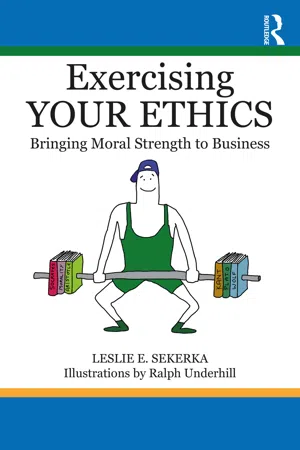
Through a witty and engaging style the author invites readers to consider their character authenticity at work. The book is for people who want to do the right thing, but may not be sure what that means, how to go about it, or how to withstand the forces that may push them away from wanting to be ethical. In a world that seems to reward winning, regardless of how it is achieved, we need a clearer reason for wanting to be and become our best selves. Poking fun at the ironies and hypocrisies of human behavior, Exercising Your Ethics prompts you to leverage techniques that will help you become more deliberate about choosing value-driven actions.
Exercising Your Ethics explains the messy business of workplace ethics in a way that is relatable and relevant. Readers will learn to build moral strength and encourage its development in others, while also recognizing moral vulnerability traps. It is an ideal resource for adult business education and training in academic or organizational settings. Educators, HR professionals, team leaders, coaches, and trainers will find the book a guide for competency development and as a way to prompt reflective discourse.
Illustrator Ralph Underhill produces cartoons for a diverse number of social and environmental movements. He has a particular interest in using artistic communications to motivate positive change.
This is not a question. It’s simply a statement of fact.
Business ethics is like having an unbiased opinion, taking a working vacation, earning negative income, or acting natural. It has become an oxymoron, i.e., a phrase in which seemingly contradictory terms appear in conjunction.
For years I argued against this claim.
But recently, I have seen enough evidence that has turned this wordplay into a reality. When I meet people, regardless of the setting (social gatherings, community activities, or while traveling), they usually ask me:
What do you do?
Rather than asking about family or personal interests, Americans, in particular, tend to dive intently toward work-related conversations. Jobs or career choices might suggest certain lifestyles. They are also likely to reveal implicit biases. For example, minutes into an initial dialogue, I’m invariably asked about the details of my profession.
The Conversation Goes Like This…
So, what do you do?
I’m a teacher.
Oh really, what grade?
I teach big kids, adults.
So, you’re a professor?
Yes.
What do you teach?
Business ethics.
As soon as I say, “business ethics,” now it gets interesting.
Check out the change in how people have reacted to that statement over the past two decades:
1990…Tell me more. What’s that about?
1995…Oh yeah, I’ve heard about that.
2000…Really, how interesting!
2005…That’s so important. We should do more.
2010…Isn’t that all over the news right now?
2015…You have a lot to keep you busy; great job security!
2020…Is there such a thing?
I fear the future reaction will be:
2025…Who cares?
If we’re going to reverse this trend, it comes down to the fact that ethics is a choice. Each of us must practice exercising the values we say we hold.
As a business ethicist, it pains me to openly admit that the overarching landscape of today’s global economy does not celebrate this topic.
Business ethics is often a figure of speech, rather than a corporate reality. The two words appear in sequence but frequently contradict one another. It’s almost as though they remain in separate galaxies, so far apart that it’s hard to imagine where they comingle, much less complement one another.
I’ve come to the realization that an accurate portrayal of ethics in business is much like the backdrop or stage setting for a theatrical play. It’s designed to look like something that may not be there.
Maybe it has always been this way.
Or, perhaps it is now more painfully obvious (in the twenty-first century) that the workplace has been shaped (either deliberately or as an unintended consequence) to ensure that other values (like money) supersede honesty, commitment, loyalty, fairness, transparency, and quality. In the race to disrupt, innovate, move faster, cut costs, connect globally, and be “smarter,” we have reduced the value of ethics as a praiseworthy norm. We like the sound of “being ethical.” But are we willing to do the work to make it genuine?
Certainly not enough!
Corporations may superficially claim to be ethical, backed by marketing, glossy brochures, and annual check-in-the-box training programs.
However, the backbone of many business operations lacks moral authenticity. Maybe an intention to be ethical was originally there. But when put to the test, how does the organization step up and embrace its stakeholders’ concerns?
Consider Apple. They say they care about sustainability for people and the planet. And yet, their business model is hypocritical. They subtly promote built-in obsolescence by encouraging ongoing device replacement. In the case dubbed “batterygate,” Apple agreed to pay $113 million to settle an investigation by nearly three dozen U.S. states. The firm’s past practices slowed customers older models down. Their throttling efforts drew nationwide scorn, shocking their customer base who, at the time, saw this manipulation as an attempt to nudge them into buying new and more expensive products.1 Encouraging replacement also increases environmental harms throughout the product’s supply chain. One iPhone is said to produce approximately 79 kilograms of CO2 emissions. In volume, 1 kilogram is about half a cubic meter, which equates to filling up two bathtubs.
Do the math and picture it.
That’s roughly 158 bathtub-size “clouds” of CO2 emissions created for every iPhone sold. In 2019, that number was 40.8 million (multiply that by 158).2
You get the idea.
Amplifying this concern is the fact that iPhones are fabricated with the use of conflict minerals. These are resources mined and sold in regions experiencing active conflict, where human rights violations and abuse occur in pursuit of valuable minerals.3 While an environmentally sound iPhone was introduced, its price point is totally unaffordable to the average consumer ($1,450). The Ethical Consumer consistently rates Apple poorly in areas of environment sustainability and human rights.4
In addition to questionable stakeholder practices, Apple has relished its ability to control and market dominate. Called to task by the European Union (EU), the Commission has charged the company with monopolistic behavior, inappropriately forcing apps to use its in-app payment system. Additionally, Apple is charged with antitrust violations for allegedly abusing its control over the distribution of music-streaming apps, amplifying the existing U.S. federal lawsuit regarding Epic Games.5
The tech giant Google once stated boldly in its corporate Code of Conduct that the company would “do no evil.”6 After adhering to this commitment for nearly two decades, it was retracted from their code one night without consulting with the employees. While a hint of this verbiage remains within the firm’s documentation, it’s interesting that the burden of the responsibility is now placed on organizational members, not the company itself. It reads:
And remember…don’t be evil, and if you see something that you think isn’t right – speak up!7
Over the past few years, Googlers have voiced their concerns about witnessing a shift in the company’s “greed and abuse of power” since it pivoted away from a focus on serving the greater good.8 Employee leaders who have since left the firm claim that the company now prioritizes profits over human rights.
Take heart
Don’t give up! There are companies out there who are truly committed to being ethical. They’re humble enough to realize they’re not perfect, and they continue to work at “doing well and doing good.” A clue on how to find them is to see how they go about achieving their goals. Instead of singing their praises, they’re busy actively pursuing stakeholder capitalism.
Ethical decisions made by corporations include Best Buy’s commitment to environmental sustainability, the move by CVS to stop selling tobacco products, a commitment to animal welfare by McDonald’s and Chipotle Mexican Grill, with initiatives to produce “ethically-raised” meat, and Sony’s focus on stakeholder safety.
The ethics of a company are only as sound as its last decisions and action, at the close of business that day.
Sometimes ethical business champions are found within smaller, privately held operations. Understanding how stated values are transferred into products and services can sometimes be easier to perceive in entrepreneurial startups. Their success may blossom and ultimately become a well-known brand. Companies like Patagonia, Ben & Jerry’s, Seventh Generation, Earthbound Farm, Eileen Fisher, Danone, and Natura are worth examining for best practices.
Now it’s your turn!
Take a moment to think about companies you like to do business with. Name three of them:
How do these organizations treat people and the planet?
If you’re interested in ethical excellence, companies that have a B Corp Certification provide a great starting point for role-modeling. Certifie...
Table of contents
Cover
Half Title
Title Page
Copyright Page
Table of Contents
Introduction: Let the good times roll
1 Business ethics is an oxymoron
2 It’s all about you
3 Use your power
4 Look around
5 R-E-S-P-E-C-T
6 Money before morality
7 Don’t lie to me
8 Trust us
9 Your challenge
10 Your workout routine
11 Get a posse
12 Building your strength
Gratitude: Life’s a team sport
Trusted by 375,005 students
Access to over 1.5 million titles for a fair monthly price.
Study more efficiently using our study tools.
Frequently asked questions
Yes, you can cancel anytime from the Subscription tab in your account settings on the Perlego website. Your subscription will stay active until the end of your current billing period. Learn how to cancel your subscription
No, books cannot be downloaded as external files, such as PDFs, for use outside of Perlego. However, you can download books within the Perlego app for offline reading on mobile or tablet. Learn how to download books offline
Perlego offers two plans: Essential and Complete
Essential is ideal for learners and professionals who enjoy exploring a wide range of subjects. Access the Essential Library with 800,000+ trusted titles and best-sellers across business, personal growth, and the humanities. Includes unlimited reading time and Standard Read Aloud voice.
Complete: Perfect for advanced learners and researchers needing full, unrestricted access. Unlock 1.5M+ books across hundreds of subjects, including academic and specialized titles. The Complete Plan also includes advanced features like Premium Read Aloud and Research Assistant.
Both plans are available with monthly, semester, or annual billing cycles.
We are an online textbook subscription service, where you can get access to an entire online library for less than the price of a single book per month. With over 1.5 million books across 990+ topics, we’ve got you covered! Learn about our mission
Look out for the read-aloud symbol on your next book to see if you can listen to it. The read-aloud tool reads text aloud for you, highlighting the text as it is being read. You can pause it, speed it up and slow it down. Learn more about Read Aloud
Yes! You can use the Perlego app on both iOS and Android devices to read anytime, anywhere — even offline. Perfect for commutes or when you’re on the go. Please note we cannot support devices running on iOS 13 and Android 7 or earlier. Learn more about using the app
Yes, you can access Exercising Your Ethics by Leslie E. Sekerka in PDF and/or ePUB format, as well as other popular books in Business & Business generale. We have over 1.5 million books available in our catalogue for you to explore.